
Utah
Is Disorderly Conduct a Misdemeanor in Utah? Penalties, Trespass
Independently fact-checked against primary sources (last audited October 18, 2026). · 45 primary sources cited on this page. How we verify our legal content
In Utah, a first disorderly conduct offense under Utah Code 76-9-102 is an infraction, punishable by a fine of up to $750 and no jail. It becomes a class C misdemeanor if the conduct continues after the person has been asked to stop, a class B misdemeanor if the person also has a prior disorderly conduct conviction within five years, and a class A misdemeanor with two or more such priors.
Criminal trespass under 76-6-206 is a class B misdemeanor (up to six months and $1,000), or a class A misdemeanor when committed in a dwelling. Trespass itself has no felony form, but trespass in a dwelling against a cohabitant becomes a third-degree felony when committed within 10 years after a prior domestic violence conviction (five years after a prior property damage offense) under 77-36-1.1, and Utah added a second-degree felony in 2025 for a trespasser who causes $1,500 or more in damage. Utah's criminal code, Title 76, was recodified effective May 7, 2025, so older section numbers you may see elsewhere have changed. For other states, see our guide to disorderly conduct and trespass laws by state.
Information last verified on 2026-10-18. This article has not been reviewed by a licensed lawyer.
Jurisdiction scope: This article covers Utah's state criminal statutes on disorderly conduct and related public-order offenses (Utah Code Title 76, chapter 9, as recodified in 2025 and amended in 2026, with threats against schools and false reports to police), criminal trespass (Title 76, chapter 6, part 2) and the trespass offenses in the education, wildlife and state-lands titles. It does not cover local noise ordinances and quiet hours (see Utah noise ordinance laws), the civil procedure for removing squatters (see Utah squatters' rights), use of force against an intruder (see Utah self-defense laws), city or county ordinances, civil trespass suits beyond the statutory damages noted below, or federal property rules.
What is disorderly conduct in Utah?
Utah Code 76-9-102 sets out two ways to commit disorderly conduct:
"(2) An actor commits disorderly conduct if: (a) the actor refuses to comply with the lawful order of a law enforcement officer to move from a public place or an official meeting, or knowingly creates a hazardous or physically offensive condition by any act that serves no legitimate purpose; or (b) intending to cause public inconvenience, annoyance, or alarm, or recklessly creating a risk of public inconvenience, annoyance, or alarm, the actor: (i) engages in fighting or in violent, tumultuous, or threatening behavior; (ii) makes unreasonable noises in a public place or an official meeting; (iii) makes unreasonable noises in a private place that can be heard in a public place or an official meeting; or (iv) obstructs vehicular or pedestrian traffic in a public place or an official meeting." (Utah Code 76-9-102(2))
In plain terms:
- Refusing a police order to move, from a public place or an official meeting, or knowingly creating a hazardous or physically offensive condition by an act with no legitimate purpose.
- Fighting or violent, tumultuous or threatening behavior, with the intent or reckless risk described below. Where a fight also involves an assault, see Utah assault laws.
- Unreasonable noise in a public place or official meeting, or in a private place where it can be heard in a public place or official meeting. Quiet hours and decibel limits are local matters; see our Utah noise ordinance laws page.
- Blocking vehicle or pedestrian traffic in a public place or official meeting.
The forms in subsection (2)(b) require that the person intend to cause public inconvenience, annoyance or alarm, or recklessly create a risk of it. The forms in (2)(a) do not carry that requirement. Section 76-9-102(4) provides that "the mere carrying or possession of a holstered or encased firearm, whether visible or concealed, without additional behavior or circumstances that would cause a reasonable person to believe the holstered or encased firearm was carried or possessed with criminal intent, does not constitute a violation of this section." For this section, "public place" means "a place to which the public or a substantial group of the public has access, including: (A) streets or highways; and (B) the common areas of schools, hospitals, apartment houses, office buildings, public buildings, public facilities, transport facilities, and shops." That definition applies only to 76-9-102.
Is disorderly conduct a misdemeanor in Utah?
Not on a first offense. Utah Code 76-9-102(3) sets a four-step ladder:
| Situation | Grade | Statutory penalty |
|---|---|---|
| First violation, no request to stop | Infraction | Fine up to $750; no jail |
| Violation after being asked to cease the conduct | Class C misdemeanor | Up to 90 days; fine up to $750 |
| After being asked to cease, and one prior conviction under 76-9-102 within five years | Class B misdemeanor | Up to 6 months; fine up to $1,000 |
| After being asked to cease, and two or more prior convictions under 76-9-102 within five years | Class A misdemeanor | Up to 364 days; fine up to $2,500 |
Under Utah Code 76-3-205(1), "A person convicted of an infraction may not be imprisoned." Jail terms for misdemeanors come from 76-3-204, and fines from 76-3-301(1). Both repeat-offender steps require the request to stop as well as the prior conviction.
Aggravated disorderly conduct on a street or highway (76-9-102.1)
Added in 2025, this offense covers a person who "intentionally, knowingly, or recklessly obstructs vehicular or pedestrian traffic on a street or highway with: (i) a speed limit of 40 miles per hour or more; or (ii) at least two lanes in the same direction of travel; and (b) refuses to comply with the lawful order of a law enforcement officer to move from the street or highway." It is a class B misdemeanor, and a class A misdemeanor if the person was convicted of the same offense within the previous year.
Related public-order offenses in Utah
Riot and failure to disperse (76-9-101, 76-9-104)
Riot under 76-9-101 covers engaging in violent conduct with two or more others that knowingly or recklessly creates a substantial risk of public alarm, assembling with two or more others to engage in violent conduct or offenses against persons or property, and refusing a lawful order to withdraw. It is a class B misdemeanor, but a third-degree felony if, in the course of the violation, "(i) the actor causes substantial or serious bodily injury; (ii) the actor causes substantial property damage or commits arson; or (iii) the actor was in possession of a dangerous weapon." A person arrested for riot "may not be released from custody before the actor appears before a magistrate or a judge."
Failure to disperse (76-9-104) is being at the scene of a riot, disorderly conduct or unlawful assembly and remaining "after having been ordered to disperse by a peace officer." It is a class C misdemeanor, and the section "does not apply to an actor who attempts to leave the scene ... but is unsuccessful in leaving the scene."
A separate gang-loitering offense (76-9-805) is also called failure to disperse: being in an area designated under Section 11-48-104 as one where gang loitering is prohibited, being ordered by an officer under Section 53-25-602 to disperse, and failing to do so or returning within eight hours. It is a class B misdemeanor. Part 1 of chapter 9 contains no general loitering or prowling offense. Utah's traffic code, as amended in 2018, separately bars impeding or blocking traffic on interstates, freeways, state highways and certain paved highways, including handing money or property to or from a vehicle occupant there, and bars soliciting money or goods "in an aggressive manner" within 10 feet of a bank entrance during business hours or of an ATM (41-6a-1009(4), (8)). A violation is an infraction; a third roadway violation within a year is a class C misdemeanor.
Public intoxication (76-9-110)
Utah makes public intoxication a crime. A person commits it if they are "(a) (i) ... in a public place; or (ii) in a private place where the actor could unreasonably disturb other individuals; (b) ... under the influence of alcohol, a controlled substance, or any substance having the property of releasing toxic vapors; and (c) ... under the influence to a degree that it may endanger the actor or another individual." It is a class C misdemeanor: up to 90 days and a fine of up to $750.
Public urination or defecation in a public place other than a public rest room, "under circumstances which the actor should know will likely cause affront or alarm to another individual," is an infraction (76-9-111).
False alarms, false 911 reports and threats
- Making a false alarm (76-9-105). Initiating or circulating a report or warning of a fire, impending bombing or other crime or catastrophe, knowing it is false or baseless and likely to cause an evacuation and public inconvenience or alarm. Class B misdemeanor; a third-degree felony if it alleges an ongoing act or imminent threat and causes or threatens bodily harm, serious bodily injury or death; a second-degree felony if it concerns a weapon of mass destruction.
- Emergency reporting abuse (76-9-105.5, amended by 2026 ch. 453). Reporting an emergency to a fire, police or medical response entity knowing it does not exist is a class B misdemeanor (second degree if it concerns a weapon of mass destruction). A false report to an emergency response service claiming an imminent or future threat of serious injury or death at a specified location is a second-degree felony. The section also covers repeat 911 calls about matters a dispatcher, officer or prosecutor has told the caller are not 911 matters (class B). A report becomes a class A misdemeanor on a third conviction, or when the caller was reckless and the response causes serious bodily injury or $5,000 or more in loss, and a third-degree felony when the caller was reckless and the response results in a death. A court must order reimbursement and at least four days in jail or 40 hours of community service.
- Party line or pay phone in an emergency (76-9-105.6). Refusing to yield a party line or public pay telephone needed to report an emergency, or asking for one on a false claim of emergency: class C misdemeanor.
- Threats against schools (76-5-107.1). Threatening, with real intent or as an intentional hoax, an offense involving bodily injury, death or substantial property damage while threatening use of a firearm, weapon or hoax weapon of mass destruction, or intending to disrupt the school or intimidate students or employees: third-degree felony. Intending to prevent or interrupt occupancy of the school is a class A misdemeanor, and a threat that causes an emergency agency to act is a class B misdemeanor.
- False information to police (76-8-506). Knowingly giving a peace officer or government agency false information to make them believe another person committed an offense, or reporting an offense knowing it did not occur: class B misdemeanor.
Funerals, residential picketing and meetings
- Disrupting a funeral or memorial service (76-9-108). The person must intend to disrupt a memorial service and, from 60 minutes before its scheduled start until 60 minutes after it ends, obstruct entry to or exit from the memorial site, block a funeral procession, make unreasonable noise, or "engage in a disruptive activity within 200 feet of the memorial service." Class B misdemeanor.
- Targeted residential picketing (76-9-109). Picketing "specifically directed or focused toward a residence, or one or more occupants of the residence," on the sidewalk or street in front of it, in front of an adjoining residence, on either side of it, or "within 100 feet of the property line of the targeted residence." The section also covers publishing or disclosing someone's home address or location with intent to cause others to picket that residence. Class B misdemeanor. The section does not apply to picketing at one's own residence, picketing a meeting place or assembly area commonly used to discuss subjects of general public interest, or "general picketing that proceeds through residential neighborhoods or that proceeds past residences."
- Disrupting a meeting or procession (76-9-103). Obstructing or interfering with a lawful meeting, procession or gathering "by physical action, verbal utterance, or any other means," intending to prevent or disrupt it. Class B misdemeanor.
- Disrupting a school (76-9-106). Being on public or private school property with the purpose of creating "an unreasonable and substantial disruption or risk of disruption" of a school function, and remaining "after being requested to leave by a school official." Class B misdemeanor. Unauthorized entry onto a school bus (76-9-107) is also a class B misdemeanor.
Masks and houses of worship (2026)
Two offenses enacted in the 2026 General Session took effect May 6, 2026:
- Intentional concealment of identity while committing an offense in public (76-9-115). Intentionally or knowingly wearing "a mask or other facial obscurant or disguise with the intent to conceal the actor's identity from law enforcement or other government officials," in a public place, while committing or attempting a local, state or federal criminal offense, or while congregating with others the person knows are doing so. Class A misdemeanor.
- Unlawful deprivation of religious rights (76-9-116). "In concert with two or more individuals, intentionally or knowingly" depriving another person of the right to enter or exit a house of worship, for the purpose of preventing that person from exercising religious liberty rights under the First Amendment or the Utah Constitution. Third-degree felony, with a civil action for damages. The section does not apply to the exercise of rights under the First Amendment or Utah Constitution, Article I, Section 15.
Commercial obstruction (76-9-113, 76-9-114)
Entering or remaining unlawfully on the premises or in a building of a retail business that deals in tangible personal property, intending "to interfere with the employees, customers, personnel, or operations of the business," is commercial obstruction, a class A misdemeanor. The section does not apply to action protected by the National Labor Relations Act or the Federal Railway Labor Act, or to the exercise of rights under the First Amendment or Utah Constitution, Article I, Section 15. Aggravated commercial obstruction, which adds intent to take control of merchandise or data, alter or remove records, damage property, assault someone, or commit another felony, is a second-degree felony.
Criminal trespass in Utah
Utah's general trespass statute, 76-6-206, has no numbered degrees. It is a class B misdemeanor, and a class A misdemeanor "if a violation of Subsection (2)(a) or (b) is committed in a dwelling." A dwelling is a building usually occupied by a person lodging there at night (76-6-201). Criminal trespass committed by one cohabitant against another is a domestic violence offense (77-36-1). The term cohabitant is broader than a live-in partner: under 78B-7-102 it includes a person 16 or older who is or was the other party's spouse or lived with them as a spouse, is their parent, grandparent or another relative within the second degree, has a child in common with them, lives or has lived in the same residence, or is or was in a consensual sexual relationship with them. Under 77-36-1.1 a domestic violence offense committed or convicted within 10 years after a prior domestic violence conviction (within five years after a prior property damage offense) moves up one level: a class B trespass becomes a class A misdemeanor, and a class A trespass in a dwelling becomes a third-degree felony.

What the statute prohibits
Both main forms apply "under circumstances not amounting to burglary" and require that the person "enter or remain unlawfully." Under 76-6-201(3), that means entering or remaining when "(a) at the time of the entry or remaining, the premises or any portion of the premises are not open to the public; and (b) the actor is not otherwise licensed or privileged to enter or remain on the premises."
- Trespass with a purpose (76-6-206(2)(a)). Entering or remaining unlawfully, or flying an unmanned aircraft unlawfully over property, while intending to cause annoyance or injury to a person or damage to property (including graffiti), intending to commit a crime other than theft or a felony, or being reckless as to whether one's presence will cause fear for another's safety.
- Trespass after notice (76-6-206(2)(b)). "Knowing the actor's or unmanned aircraft's entry or presence is unlawful, the actor enters or remains on or causes an unmanned aircraft to enter or remain unlawfully over property to which notice against entering is given by: (i) personal communication to the actor by the owner or someone with apparent authority to act for the owner; (ii) fencing or other enclosure obviously designed to exclude intruders; or (iii) posting of signs reasonably likely to come to the attention of intruders."
The statute also covers entering a sex-designated changing room in violation of Section 63G-31-302(3), a class B misdemeanor that rises to class A in circumstances the statute lists. Entering a condominium unit in violation of Section 57-8-7(8) is also criminal trespass, an infraction (76-6-206(2)(c), (3)(c)). For drone rules more broadly, see Utah drone laws.
When a store or owner tells you to leave
Notice by "personal communication to the actor by the owner or someone with apparent authority to act for the owner" is one of the three kinds of notice in 76-6-206(2)(b). Remaining after that communication, knowing one's presence is unlawful, falls under the notice form of trespass. Section 76-6-206(4) provides that it is a defense "that: (a) the property was at the time open to the public; and (b) the defendant complied with all lawful conditions imposed on access to or remaining on the property."
The statute also gives the property owner statutory damages of "three times the value of damages resulting from the violation of Subsection (2) or $500, whichever is greater," plus "reasonable attorney fees not to exceed $250, and court costs" (76-6-206(5)).
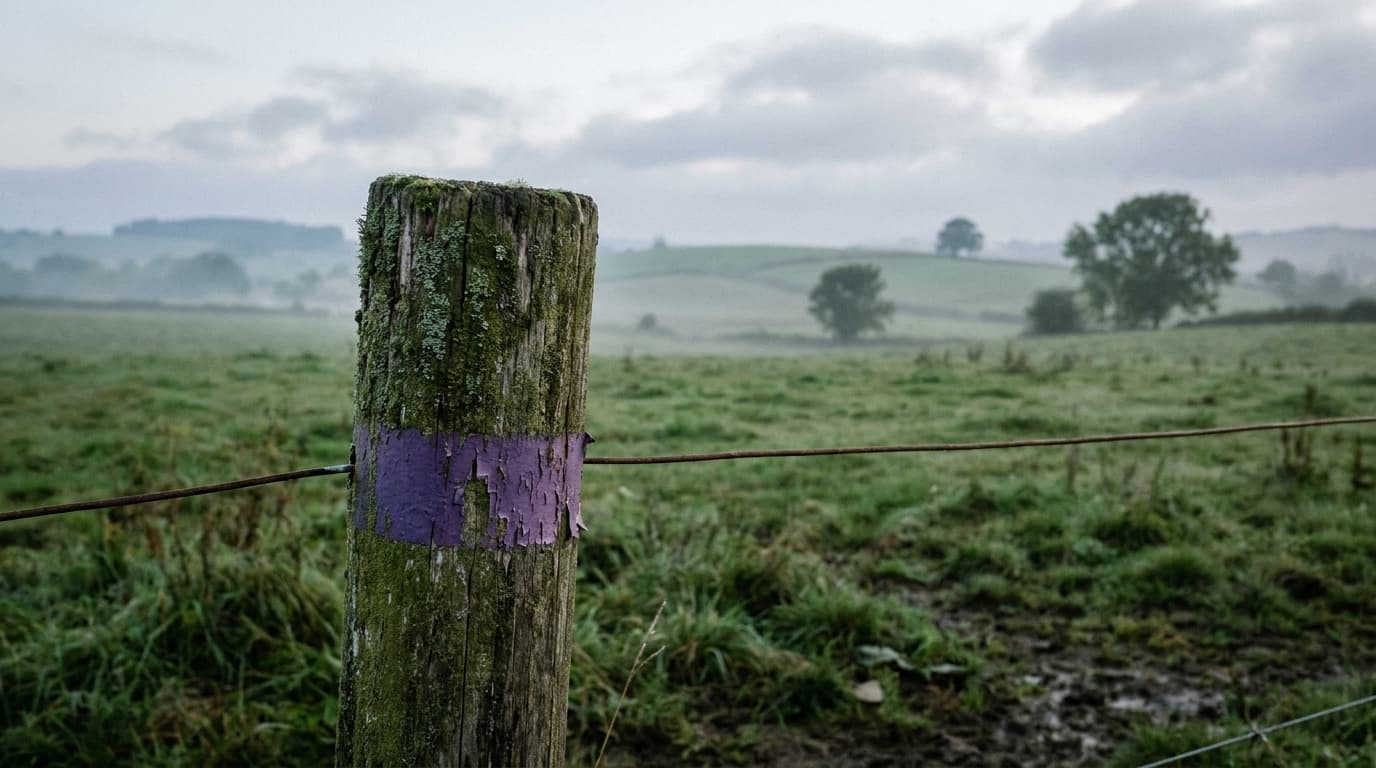
Is there a purple paint law in Utah?
No. The criminal trespass part (76-6-206 to 76-6-206.6), the school trespass statute (53G-8-603), the state-lands statute (65A-3-1) and the wildlife posting statute (23A-5-317) contain no purple paint provision. The only paint rule is in the hunting and fishing trespass statute:
"'Properly posted' means that signs prohibiting trespass or bright yellow, bright orange, or fluorescent paint are clearly displayed: (i) at the corners, fishing streams crossing property lines, roads, gates, and rights-of-way entering the land; or (ii) in a manner that would reasonably be expected to be seen by a person in the area." (Utah Code 23A-5-317(1)(c))
While taking wildlife or engaging in wildlife-related activities, a person may not enter cultivated or properly posted private land without permission (documented authorization signed by the owner or person in charge, naming the person, the dates and the property), enter or remain after being told not to by the owner, an employee or an apparent agent or on land fenced to exclude intruders, or obstruct an entrance or exit to private property; posting land one does not own or legally control is also prohibited. A violation is punished under 23A-5-301, which provides that "a violation of this title is a class B misdemeanor," along with civil damages. A hearing officer may also revoke the related license, tag or permit, and may treat a second conviction within five years as a flagrant violation and bar a new license or permit for up to five years (23A-5-317(4)).
Special trespass offenses
- Agricultural or range land (76-6-206.3). Entering or remaining without authorization on agricultural or range land where notice is given by personal communication from the owner, an employee or an apparent agent; by "fencing or other form of enclosure a reasonable person would recognize as intended to exclude intruders"; or by "posted signs or markers that would reasonably be expected to be seen by persons in the area of the borders of the land." Class B misdemeanor, plus civil damages. Cutting or disabling that fencing (76-6-206.5) is also a class B misdemeanor.
- School property (53G-8-603). Entering or remaining on school property with an unlawful intent, or without authorization after notice by a school official's personal communication, signs, fencing, or "a current order of suspension or expulsion." Class B misdemeanor.
- State park lands (76-6-206.2). Unauthorized building, extended occupancy, commercial use or grazing, or remaining "after being ordered to leave by a person with actual authority to act for the division, or by a law enforcement officer." Class B misdemeanor.
- State trust and sovereign lands (65A-3-1). Using, occupying or building on state lands without written authorization from the division, or occupying them more than 30 days after authorization ends. Class B misdemeanor.
- Abandoned or inactive mines (76-6-206.1). Entering and remaining unlawfully in underground workings is a class B misdemeanor; removing or tampering with warning signs, covers or fencing is a class A misdemeanor.
- Private stream beds and banks (76-6-206.6). Touching or remaining on restricted private property along public waters in violation of Section 73-29-201, with the listed intents or after notice. Class B misdemeanor, with defenses for property open to the public, an express easement, or access allowed by 73-29-202.
- Camping on state property (76-6-208). Added in 2025: "An actor commits unsanctioned camping if the actor is camping on state property unless the state expressly authorizes camping on the state property." Class C misdemeanor. State property for this purpose does not include property of political subdivisions.
Critical infrastructure
Part 2 of chapter 6 contains no critical-infrastructure trespass offense. Utah's critical infrastructure statute, 76-6-106.3, punishes causing widespread injury or damage by destroying or substantially damaging a facility, or substantially tampering with or impeding its operation. It is "a first degree felony if done intentionally or knowingly" and "a second degree felony if done recklessly."
Squatting and long-term guests
Three statutes reach squatting-type conduct:
- Criminal trespass of a residence by a long-term guest (76-6-206.4). A non-tenant guest allowed to stay longer than 48 hours without paying, who "in circumstances not amounting to burglary, remains in a residence after receiving notice to leave the residence from: (i) an owner; (ii) a tenant; or (iii) someone with apparent authority to act for an owner or a tenant." Class B misdemeanor.
- Property damage or destruction by a trespasser (76-6-106.2, 2025). Entering or remaining unlawfully on real property and causing "damage or pecuniary loss equal to or in excess of $1,500," under circumstances not amounting to burglary. Second-degree felony.
- Fraudulent advertisement, sale, lease or mortgaging of real property (76-6-526, 2025). Knowingly listing or advertising residential property for sale, or selling, leasing or mortgaging real property, without legal title or authority. Second-degree felony.
For the owner's civil removal procedure, see Utah squatters' rights. For the rules on force against an intruder, see Utah self-defense laws.
Trespass versus burglary
Entering or remaining unlawfully in a building or part of one with intent to commit a felony, theft, an assault or certain listed offenses is burglary under 76-6-202: a third-degree felony, or a second-degree felony if committed in a dwelling.
Penalties at a glance
| Offense | Statute | What it prohibits | Class | Statutory penalty |
|---|---|---|---|---|
| Disorderly conduct | 76-9-102 | Refusing an order to move, hazardous conditions, or (with intent or recklessness) fighting, unreasonable noise, blocking traffic | Infraction; class C after a request to stop; class B or A after a request plus one or two-plus priors in 5 years | Infraction: fine up to $750, no jail; misdemeanor ranges below |
| Aggravated disorderly conduct on a street or highway | 76-9-102.1 | Blocking traffic on a 40 mph or multi-lane road and refusing an order to move | Class B misdemeanor; class A with a prior within 1 year | Up to 6 months and $1,000; up to 364 days and $2,500 |
| Riot | 76-9-101 | Violent conduct with two or more others, or assembling for violence | Class B misdemeanor; third-degree felony with serious or substantial injury, substantial damage or arson, or a dangerous weapon | Up to 6 months and $1,000; felony up to 5 years |
| Failure to disperse | 76-9-104 | Remaining at a riot, disorderly conduct or unlawful assembly after a dispersal order | Class C misdemeanor | Up to 90 days; up to $750 |
| Gang-loitering failure to disperse | 76-9-805 | Failing to disperse, or returning within 8 hours, from a designated area | Class B misdemeanor | Up to 6 months; up to $1,000 |
| Disrupting a meeting or procession | 76-9-103 | Intentionally obstructing a lawful meeting, procession or gathering | Class B misdemeanor | Up to 6 months; up to $1,000 |
| Disrupting a school; unauthorized school bus entry | 76-9-106; 76-9-107 | Disrupting a school function and staying after being asked to leave; boarding a school bus without authorization | Class B misdemeanor | Up to 6 months; up to $1,000 |
| Disrupting a funeral or memorial service | 76-9-108 | Intentional disruption within 60 minutes before or after; disruptive activity within 200 feet | Class B misdemeanor | Up to 6 months; up to $1,000 |
| Targeted residential picketing | 76-9-109 | Picketing aimed at a residence, in front of it or within 100 feet of its property line; publishing an address to prompt such picketing | Class B misdemeanor | Up to 6 months; up to $1,000 |
| Roadway solicitation; aggressive solicitation near a bank or ATM | 41-6a-1009(4), (8) | Impeding traffic on listed highways, including exchanges with vehicle occupants; aggressive solicitation within 10 feet of a bank entrance or ATM | Infraction; class C misdemeanor for a third roadway violation in a year | Fine up to $750; class C up to 90 days and $750 |
| Public intoxication | 76-9-110 | Under the influence in public, or in private where others could be disturbed, to a degree that may endanger someone | Class C misdemeanor | Up to 90 days; up to $750 |
| Public urination | 76-9-111 | Urinating or defecating in public, other than a rest room, likely to cause affront or alarm | Infraction | Fine up to $750; no jail |
| Commercial obstruction | 76-9-113 | Unlawfully entering a retail business intending to interfere with its operations | Class A misdemeanor | Up to 364 days; up to $2,500 |
| Aggravated commercial obstruction | 76-9-114 | Commercial obstruction plus intent to take property or data, damage, assault or commit a felony | Second-degree felony | 1 to 15 years |
| Concealing identity with a mask while committing an offense (2026) | 76-9-115 | Wearing a mask or disguise in public to hide identity while committing or joining an offense | Class A misdemeanor | Up to 364 days; up to $2,500 |
| Unlawful deprivation of religious rights (2026) | 76-9-116 | With two or more others, blocking entry to or exit from a house of worship to prevent religious exercise | Third-degree felony | Up to 5 years |
| Making a false alarm | 76-9-105 | Knowingly false report or warning of a fire, bombing or other crime or catastrophe likely to cause evacuation and alarm | Class B misdemeanor; third-degree felony (ongoing or imminent threat causing or threatening harm); second-degree (weapon of mass destruction) | Up to 6 months and $1,000; felony up to 5 years or 1 to 15 years |
| Emergency reporting abuse | 76-9-105.5 | Knowingly false emergency report; false report of an imminent threat at a specified location (swatting) | Class B misdemeanor; second-degree felony for a false imminent-threat report; class A or third-degree felony when the caller was reckless and the response causes serious injury, $5,000 loss or death | Up to 6 months and $1,000; mandatory reimbursement and 4 days in jail or 40 hours of service |
| Misusing a party line or pay phone in an emergency | 76-9-105.6 | Refusing to yield the line for an emergency, or claiming a false emergency | Class C misdemeanor | Up to 90 days; up to $750 |
| Threats against schools | 76-5-107.1 | Real or hoax threats of injury, death or major damage aimed at a school | Third-degree felony; class A or class B misdemeanor in the forms the statute lists | Up to 5 years; misdemeanor ranges |
| False information to police | 76-8-506 | Knowingly false information that another person committed an offense, or reporting an offense that did not occur | Class B misdemeanor | Up to 6 months; up to $1,000 |
| Criminal trespass | 76-6-206 | Unlawful entry or remaining with a listed purpose, or after notice by communication, fencing or signs | Class B misdemeanor; class A in a dwelling | Up to 6 months and $1,000; up to 364 days and $2,500 |
| Criminal trespass of a residence by a long-term guest | 76-6-206.4 | A guest of over 48 hours remaining after notice to leave | Class B misdemeanor | Up to 6 months; up to $1,000 |
| Agricultural or range land; cutting fences | 76-6-206.3; 76-6-206.5 | Entering after notice on farm or range land; disabling its fencing | Class B misdemeanor | Up to 6 months; up to $1,000 |
| School property trespass | 53G-8-603 | Entering with unlawful intent, or after notice or a suspension or expulsion order | Class B misdemeanor | Up to 6 months; up to $1,000 |
| State park and state lands trespass | 76-6-206.2; 65A-3-1 | Unauthorized use or occupancy, or remaining after an order to leave | Class B misdemeanor | Up to 6 months; up to $1,000 |
| Abandoned or inactive mines | 76-6-206.1 | Entering underground workings; tampering with warning signs or covers | Class B misdemeanor; class A for tampering | Up to 6 months and $1,000; up to 364 days and $2,500 |
| Private stream beds and banks | 76-6-206.6 | Touching or staying on restricted private property along public waters | Class B misdemeanor | Up to 6 months; up to $1,000 |
| Unsanctioned camping on state property | 76-6-208 | Camping on state property without express authorization | Class C misdemeanor | Up to 90 days; up to $750 |
| Hunting or fishing trespass | 23A-5-317; 23A-5-301 | Entering cultivated or properly posted land while taking wildlife without permission, or after notice; obstructing an entrance | Class B misdemeanor | Up to 6 months; up to $1,000; license or permit revocation, up to a 5-year bar for a second conviction within 5 years |
| Property damage by a trespasser (2025) | 76-6-106.2 | Trespassing and causing $1,500 or more in damage or loss | Second-degree felony | 1 to 15 years |
| Fraudulent sale, lease or mortgage of real property (2025) | 76-6-526 | Listing, selling, leasing or mortgaging property without title or authority | Second-degree felony | 1 to 15 years |
| Critical infrastructure damage or tampering | 76-6-106.3 | Destroying, damaging or tampering with a facility, causing widespread injury or damage | First-degree felony (intentional or knowing); second-degree (reckless) | First degree: 5 years to life; second degree: 1 to 15 years |
Misdemeanor jail terms come from Utah Code 76-3-204: up to 6 months for class B and 90 days for class C, and up to 364 days for class A. Fines come from 76-3-301(1): up to $2,500 for a class A misdemeanor, $1,000 for class B, and $750 for class C or an infraction. Felony prison terms come from 76-3-203: 1 to 15 years for a second-degree felony and up to 5 years for a third-degree felony, "unless the statute provides otherwise." For the full table, including felony fines, see Utah felony degrees and misdemeanor classes.
Recent changes to these statutes
- Laws of Utah 2025, ch. 173 (H.B. 21, Criminal Code Recodification and Cross References), effective May 7, 2025, reorganized chapter 9 of Title 76 into a new format, split some embedded offenses (such as commercial obstruction) into stand-alone sections, and created aggravated commercial obstruction as its own section (76-9-114).
- Laws of Utah 2025, ch. 195 enacted aggravated disorderly conduct on a street or highway (76-9-102.1), effective May 7, 2025.
- Laws of Utah 2025, ch. 295 enacted property damage or destruction by a trespasser (76-6-106.2) and fraudulent advertisement, sale, lease or mortgaging of real property (76-6-526), and amended criminal trespass (76-6-206).
- Laws of Utah 2025, ch. 504 enacted unsanctioned camping on state property (76-6-208), effective May 7, 2025.
- Laws of Utah 2026, ch. 368 enacted intentional concealment of identity while committing an offense in public (76-9-115) and unlawful deprivation of religious rights (76-9-116), both effective May 6, 2026.
- Laws of Utah 2026, ch. 453 amended emergency reporting abuse (76-9-105.5) and the party-line emergency section (76-9-105.6), and 2026 ch. 324 amended burglary (76-6-202); the current versions took effect May 6, 2026.
- Laws of Utah 2024, ch. 223 amended criminal trespass of a residence by a long-term guest (76-6-206.4), effective May 1, 2024.
Related Utah and state-by-state guides
- Disorderly conduct and trespass laws by state
- Utah noise ordinance laws
- Utah felony degrees and misdemeanor classes
- Utah squatters' rights
- Utah self-defense laws
- Utah expungement laws
- Nevada disorderly conduct and trespass laws
- How to charge someone with trespassing
Federal law separately governs conduct on federal property and at the U.S. Capitol; our state-by-state hub covers that layer.
This article provides general legal information about Utah's disorderly conduct, public-order and criminal trespass statutes as of 2026-10-18. It is not legal advice. For advice about a specific situation, contact a lawyer licensed in Utah.
Last updated: 2026-10-18.
Frequently Asked Questions
What is disorderly conduct in Utah?
Under Utah Code 76-9-102, it is refusing a lawful police order to move from a public place or official meeting, knowingly creating a hazardous or physically offensive condition, or, with intent to cause or reckless risk of public inconvenience, annoyance or alarm, fighting, making unreasonable noise, or blocking traffic in a public place or official meeting.
Is disorderly conduct a misdemeanor in Utah?
A first offense is an infraction, with a fine of up to $750 and no jail. It is a class C misdemeanor if committed after being asked to stop, class B if also after one prior conviction within five years, and class A with two or more priors within five years (76-9-102(3)).
Can you get disorderly conduct for yelling in Utah?
Making unreasonable noises in a public place or official meeting, or in a private place where they can be heard in public, is disorderly conduct under 76-9-102(2)(b) when done with intent to cause, or reckless risk of, public inconvenience, annoyance or alarm. A first offense is an infraction.
Is public intoxication illegal in Utah?
Yes. Under 76-9-110, being under the influence of alcohol, a controlled substance or a toxic-vapor substance in a public place, or in a private place where one could unreasonably disturb others, to a degree that may endanger oneself or another person, is a class C misdemeanor: up to 90 days and a fine of up to $750.
Is trespassing a felony in Utah?
Criminal trespass under 76-6-206 is a class B misdemeanor, or class A in a dwelling. Related felonies include a trespasser causing $1,500 or more in damage or loss (76-6-106.2, second degree), aggravated commercial obstruction (second degree), and burglary (third degree, or second degree in a dwelling). Trespass in a dwelling against a cohabitant within 10 years after a prior domestic violence conviction (five years after a property damage offense) is a third-degree felony (77-36-1.1).
Does Utah have a purple paint law?
No. Utah's only paint rule is in the hunting trespass statute, 23A-5-317, which treats land as properly posted with signs or bright yellow, bright orange or fluorescent paint displayed at corners, streams, roads, gates and rights-of-way, or where a person in the area would reasonably be expected to see them.
What happens if a store tells you to leave in Utah?
Under 76-6-206(2)(b), notice by personal communication from the owner or someone with apparent authority, followed by entering or remaining while knowing it is unlawful, is criminal trespass, a class B misdemeanor. The statute provides a defense where the property was open to the public and the person complied with all lawful conditions of access.
Is squatting a crime in Utah?
A long-term guest who stays after notice to leave commits a class B misdemeanor (76-6-206.4). Since 2025, a trespasser who causes $1,500 or more in damage commits a second-degree felony (76-6-106.2), and so does a person who knowingly lists, sells, leases or mortgages property without title or authority (76-6-526).
What are Utah's funeral protest rules?
Under 76-9-108, intending to disrupt a memorial service and, from 60 minutes before it starts to 60 minutes after it ends, blocking entry, exit or the procession, making unreasonable noise, or engaging in disruptive activity within 200 feet is a class B misdemeanor.
Updates
Independently fact-checked against the cited primary sources
The Law Behind This Article
This article rests on the statutory provisions below, held in our own legal record and retrieved from the official source. Tap a section to read the operative text.
Utah Code, Title 76: Criminal Offenses
§ 76-9-102Disorderly conduct.In forcecited in 2 of our articles
(1) (a) As used in this section: (i) "Official meeting" means: (A) a meeting, as defined in Section 52-4-103; (B) a meeting of the Legislature, the Utah Senate, the Utah House of Representatives, a legislative caucus, or any committee, task force, working group, or other organization in the state legislative branch; or (C) a meeting of an entity created by the Utah Constitution, Utah Code, Utah administrative rule, legislative rule, or a written rule or policy of the Legislative Management Committee. (ii) "Public place" means a place to which the public or a substantial group of the public has access, including: (A) streets or highways; and (B) the common areas of schools, hospitals, apartment houses, office buildings, public buildings, public facilities, transport facilities, and shops. (b) Terms defined in Section 76-1-101.5 apply to this section.
Official text (excerpt) · last checked 2026-07-29 · Read the full text in our law library · Verify at le.utah.gov
Also relied on in: Utah Noise Ordinance Laws (2026): Quiet Hours, Fines, Nuisance
§ 76-6-206Criminal trespass.In forcecited in 4 of our articles
(1) (a) As used in this section: (i) "Enter" means intrusion of the entire body or the entire unmanned aircraft. (ii) "Graffiti" means the same as that term is defined in Section 76-6-101. (iii) "Remain unlawfully," as that term relates to an unmanned aircraft, means remaining on or over private property when: (A) the private property or any portion of the private property is not open to the public; and (B) the person operating the unmanned aircraft is not otherwise authorized to fly the unmanned aircraft over the private property or any portion of the private property. (b) Terms defined in Sections 76-1-101.5 and 76-6-201 apply to this section.
Official text (excerpt) · last checked 2026-07-29 · Read the full text in our law library · Verify at le.utah.gov
Cited in 21 court opinions in our collectionLatest citing opinion in our collection: 2024
Opinions citing this section in our collection:
- Salt Lake City v. Grotepas (Court of Appeals of Utah 1994, 238 Utah Adv. Rep. 13)“…raised the statutory defense to criminal trespass found at Utah Code Ann. § 76-6-206 (4) (1990) [2] nor introduced any evid…”
- State v. Hamilton (Utah Supreme Court 2003, 473 Utah Adv. Rep. 18)“…oyance or injury to any person or damage to any property." Utah Code Ann. § 76-6-206 (@2)(a) (1999). 10 Under t…”
- State v. Kitches (Court of Appeals of Utah 2021, 484 P.3d 415)“…presence [would] cause fear for the safety of another.” Utah Code Ann. § 76-6-206(2)(a); see also id. § 76-2-103(2) (“A p…”
Identified automatically from the court opinions citing this section — not a ranking of which case controls.
Also relied on in: Utah Dog Bite Laws: Liability and Victim Rights, Utah Squatters Rights and Adverse Possession Laws (2026), Utah Drone Laws (2026): Police Warrants, Prisons & Privacy
§ 76-9-101Riot.In forcecited in 2 of our articles
(1) Terms defined in Section 76-1-101.5 apply to this section. (2) An actor commits riot if the actor: (a) simultaneously with two or more other individuals engages in violent conduct, knowingly or recklessly creating a substantial risk of causing public alarm; (b) assembles with two or more other individuals with the purpose of engaging, soon thereafter, in violent conduct, knowing, that two or more other individuals in the assembly have the same purpose; (c) assembles with two or more other individuals with the purpose of committing an offense against a person, or the property of another person who the actor supposes to be guilty of a violation of law, believing that two or more other individuals in the assembly have the same purpose; or (d) refuses to comply with a lawful order to withdraw prior to, during, or immediately following a violation of Subsection (2)(a), (b), or (c). (3) (a) Except as provided in Subsection (3)(b), a violation of Subsection (2) is a class B misdemeanor.
Official text (excerpt) · last checked 2026-07-29 · Read the full text in our law library · Verify at le.utah.gov
Cited in 2 court opinions in our collectionLatest citing opinion in our collection: 2008
Opinions citing this section in our collection:
- Bradford v. Wiggins (Court of Appeals for the Tenth Circuit 2008, 516 F.3d 1189)“…fords with rioting, a third degree felony, in violation of Utah Code Ann. § 76-9-101. Following their arraignment, on Febru…”
- Auvaa v. City of Taylorsville (District Court, D. Utah 2007, 506 F. Supp. 2d 903)“…ith a Legal Arrest ( Utah Code Ann. § 76-8-305 ) and Riot ( Utah Code Ann. § 76-9-101 ). At the conclusion of a jury trial in…”
Identified automatically from the court opinions citing this section — not a ranking of which case controls.
Also relied on in: Utah Surveillance Camera Laws (2026 Guide)
§ 76-9-104Failure to disperse.In force
(1) Terms defined in Section 76-1-101.5 apply to this section. (2) An actor commits failure to disperse if the actor: (a) is at the scene of a riot, disorderly conduct, or an unlawful assembly; and (b) remains at the scene of the riot, disorderly conduct, or unlawful assembly after having been ordered to disperse by a peace officer. (3) A violation of Subsection (2) is a class C misdemeanor. (4) This section does not apply to an actor who attempts to leave the scene of a riot, disorderly conduct, or unlawful assembly but is unsuccessful in leaving the scene.
Official text (excerpt) · last checked 2026-07-29 · Read the full text in our law library · Verify at le.utah.gov
§ 76-9-110Public intoxication.In force
(1) (a) As used in this section, "minor" means an individual who is younger than 21 years old. (b) Terms defined in Section 76-1-101.5 apply to this section. (2) An actor commits public intoxication if the actor: (a) (i) is in a public place; or (ii) in a private place where the actor could unreasonably disturb other individuals; (b) is under the influence of alcohol, a controlled substance, or any substance having the property of releasing toxic vapors; and (c) is under the influence to a degree that it may endanger the actor or another individual. (3) A violation of Subsection (2) is a class C misdemeanor. (4) (a) A peace officer or a magistrate may release an actor from custody arrested under this section if the peace officer or magistrate believes incarceration is unnecessary for the protection of the actor or another individual. (b) A peace officer may take the actor to a detoxification center or other special facility as an alternative to incarceration or release from custody.
Official text (excerpt) · last checked 2026-07-29 · Read the full text in our law library · Verify at le.utah.gov
§ 76-6-106.2Property damage or destruction by a trespasser on real property.In force
(1) Terms defined in Sections 76-1-101.5 and 76-6-101 apply to this section. (2) An actor commits property damage or destruction by a trespasser on real property if, under circumstances not amounting to burglary as defined in Section 76-6-202 or 76-6-203, the actor: (a) enters or remains unlawfully on real property; and (b) causes damage or pecuniary loss equal to or in excess of $1,500. (3) A violation of Subsection (2) is a second degree felony.
Official text (excerpt) · last checked 2026-07-29 · Read the full text in our law library · Verify at le.utah.gov
§ 76-6-526Fraudulent advertisement, sale, lease, or mortgaging of real property.In force
(1) Terms defined in Section 76-1-101.5 apply to this section. (2) An actor commits fraudulent advertisement, sale, lease, or mortgaging of real property if the actor knowingly: (a) (i) lists or advertises residential real property for sale; or (ii) sells, leases, or mortgages real property; and (b) does not have legal title to the property or authority to advertise, sell, lease, or mortgage the real property. (3) A violation of Subsection (2) is a second degree felony.
Official text (excerpt) · last checked 2026-07-29 · Read the full text in our law library · Verify at le.utah.gov
§ 76-9-115Intentional concealment of identity while committing an offense in public.In force
(1) (a) As used in this section, "public place" means a place to which the public or a substantial group of the public has access, including: (i) a street or highway; and (ii) the common areas of a school, hospital, apartment house, office building, public building, public facility, transport facility, and a retail establishment. (b) Terms defined in Section 76-1-101.5 apply to this section. (2) An actor commits intentional concealment of identity while committing an offense in public if the actor intentionally or knowingly: (a) wears a mask or other facial obscurant or disguise with the intent to conceal the actor's identity from law enforcement or other government officials; (b) is in a public place; and (c) while wearing the mask or other facial obscurant or disguise, is: (i) committing, or attempting to commit, a local, state, or federal criminal offense; or (ii) congregating with other individuals who the actor knows are committing, or attempting to commit, a local, state, or federal criminal offense. (3) A violation of Subsection (2) is a class A misdemeanor.
Official text (excerpt) · last checked 2026-07-29 · Read the full text in our law library · Verify at le.utah.gov
§ 76-9-116Unlawful deprivation of religious rights.In force
(1) (a) As used in this section, "house of worship" means the same as that term is defined in Section 76-11-201. (b) Terms defined in Section 76-1-101.5 apply to this section. (2) An actor commits unlawful deprivation of religious rights if the actor: (a) in concert with two or more individuals, intentionally or knowingly deprives another individual of the right to enter or exit a house of worship; and (b) the act described in Subsection (2)(a) is done with the purpose of preventing the individual from exercising the individual's religious liberty rights protected under the First Amendment to the United States Constitution or under Utah Constitution, Article I, Sections 1 and 4. (3) A violation of Subsection (2) is a third degree felony. (4) (a) An individual, or the heirs of a deceased individual, who has been injured by a violation of Subsection (2) may bring an action against the actor who committed the violation.
Official text (excerpt) · last checked 2026-07-29 · Read the full text in our law library · Verify at le.utah.gov
§ 76-6-206.1Criminal trespass of abandoned or inactive mines.In force
(1) (a) For purposes of this section: (i) "Abandoned or inactive mine" means an underground mine which is no longer open for access or no longer under excavation and has been clearly marked as closed or protected from entry. (ii) "Burglary" means an offense described in Section 76-6-202, 76-6-203, or 76-6-204. (iii) "Enter" means intrusion of the entire body. (b) Terms defined in Sections 76-1-101.5 and 76-6-201 apply to this section. (2) An actor commits criminal trespass of an abandoned or inactive mine if, under circumstances not amounting to burglary, the actor: (a) intentionally enters and remains unlawfully in the underground workings of an abandoned or inactive mine; or (b) intentionally and without authority removes, destroys, or tampers with any warning sign, covering, fencing, or other method of protection from entry placed on, around, or over any mine shaft, mine portal, or other abandoned or inactive mining excavation property. (3) (a) A violation of Subsection (2)(a) is a class B misdemeanor. (b) A violation of Subsection (2)(b) is a class A misdemeanor.
Official text (excerpt) · last checked 2026-07-29 · Read the full text in our law library · Verify at le.utah.gov
§ 76-3-204Misdemeanor conviction -- Term of imprisonment.In forcecited in 6 of our articles
A person who has been convicted of a misdemeanor may be sentenced to imprisonment as follows: (1) (a) Except as provided in Subsection (1)(b), in the case of a class A misdemeanor, for a term not exceeding 364 days. (b) (i) Except as provided in Subsection (1)(b)(ii), in the case of a class A misdemeanor under Title 76, Chapter 5, Offenses Against the Individual, for a term not exceeding one year. (ii) For a class A misdemeanor for one of following offenses, for a term not exceeding 364 days: (A) Section 76-5-102.9, propelling a bodily substance or material as described in Section 76-5-102.9; (B) Section 76-5-107.5, prohibition of "hazing"; (C) Section 76-5-113, surreptitious administration of certain substances; or (D) Section 76-5-303, custodial interference. (2) In the case of a class B misdemeanor, for a term not exceeding six months. (3) In the case of a class C misdemeanor, for a term not exceeding 90 days.
Official text (excerpt) · last checked 2026-07-29 · Read the full text in our law library · Verify at le.utah.gov
Cited in 14 court opinions in our collectionLatest citing opinion in our collection: 2025
Opinions citing this section in our collection:
- State v. Sanchez (Court of Appeals of Utah 2015, 782 Utah Adv. Rep. 78)“…nder the Immigration and Nationality Act. See id.; see also Utah Code Ann. § 76-3-204(1) (LexisNexis 2012). 3. Sanchez cites…”
- State v. Patience (Court of Appeals of Utah 1997, 323 Utah Adv. Rep. 24)“…or "an indeterminate term not to exceed five years." Under Utah Code Ann. § 76-3-204 (1) (1995), a person who has been convi…”
- Richfield City v. Walker (Court of Appeals of Utah 1990, 131 Utah Adv. Rep. 37)“…n of the penalty for a class B misdemeanor as set forth in Utah Code Ann. § 76-3-204 (2) (1978), imprisonment “for a term no…”
Identified automatically from the court opinions citing this section — not a ranking of which case controls.
Also relied on in: Utah Recording Laws (2026): One-Party Consent Rules, Utah Fireworks Laws (2026): Dates, Hours, and Penalties, Utah Age of Consent Laws: Statutes, Penalties and Reporting
Utah Code, Title 53G: Public Education System -- Local Administration
§ 53G-8-603Criminal trespass upon school property -- Penalty.In force
(1) As used in this section: (a) "Enter" means intrusion of the entire body upon school property. (b) "Remain unlawfully" means that a person remains on property when the person is not licensed or privileged to remain on the property. (c) (i) "School property" means a school. (ii) "School property" does not mean LEA offices or any other property an LEA owns or controls that is not a school. (2) A person is guilty of criminal trespass upon school property if the person does the following: (a) enters or remains unlawfully upon school property, and: (i) intends to cause annoyance or injury to a person or damage to property on the school property; (ii) intends to commit a crime; or (iii) is reckless as to whether the person's presence will cause fear for the safety of another; or (b) enters or remains without authorization upon school property if notice against entry or remaining has been given by: (i) personal communication to the person by a school official or an individual with apparent authority to act for a school official; (ii) the posting of signs reasonably likely to come to the attention of trespassers; (iii) fencing or other enclosure obviously designed to…
Official text (excerpt) · last checked 2026-07-29 · Read the full text in our law library · Verify at le.utah.gov
Search our full record of US law — 2.1 million sections, every state + federal →
Sources and References
- Utah Code 76-9-102, disorderly conduct(le.utah.gov).gov
- Utah Code 76-6-206, criminal trespass(le.utah.gov).gov
- Utah Code 76-6-106.2, property damage or destruction by a trespasser on real property(le.utah.gov).gov
- H.B. 21 (2025), Criminal Code Recodification and Cross References(le.utah.gov).gov
- Utah Code 76-3-205, infractions(le.utah.gov).gov
- Utah Code 76-3-204, misdemeanor terms of imprisonment(le.utah.gov).gov
- Utah Code 76-3-301, fines(le.utah.gov).gov
- Utah Code 76-9-102.1, aggravated disorderly conduct on a street or highway(le.utah.gov).gov
- Utah Code 76-9-101, riot(le.utah.gov).gov
- Utah Code 76-9-104, failure to disperse(le.utah.gov).gov
- Utah Code 76-9-805, failure to disperse (gang loitering)(le.utah.gov).gov
- Utah Code 76-9-110, public intoxication(le.utah.gov).gov
- Utah Code 76-9-111, public urination(le.utah.gov).gov
- Utah Code 76-9-108, disrupting a funeral or memorial service(le.utah.gov).gov
- Utah Code 76-9-109, targeted residential picketing(le.utah.gov).gov
- Utah Code 76-9-103, disrupting a meeting or procession(le.utah.gov).gov
- Utah Code 76-9-106, disrupting the operation of a school(le.utah.gov).gov
- Utah Code 76-9-115, intentional concealment of identity while committing an offense in public(le.utah.gov).gov
- Utah Code 76-9-116, unlawful deprivation of religious rights(le.utah.gov).gov
- Utah Code 76-9-113, commercial obstruction(le.utah.gov).gov
- Utah Code 76-9-114, aggravated commercial obstruction(le.utah.gov).gov
- Utah Code 76-6-201, burglary and trespass definitions(le.utah.gov).gov
- Utah Code 23A-5-317, trespassing while taking wildlife; properly posted land(le.utah.gov).gov
- Utah Code 23A-5-301, wildlife violations; penalties(le.utah.gov).gov
- Utah Code 76-6-206.3, criminal trespass on agricultural or range land(le.utah.gov).gov
- Utah Code 53G-8-603, criminal trespass upon school property(le.utah.gov).gov
- Utah Code 76-6-206.2, criminal trespass on state park lands(le.utah.gov).gov
- Utah Code 65A-3-1, trespass on state lands(le.utah.gov).gov
- Utah Code 76-6-206.1, criminal trespass of abandoned or inactive mines(le.utah.gov).gov
- Utah Code 76-6-206.6, criminal trespass on private property along public waters(le.utah.gov).gov
- Utah Code 76-6-208, unsanctioned camping(le.utah.gov).gov
- Utah Code 76-6-106.3, critical infrastructure(le.utah.gov).gov
- Utah Code 76-6-206.4, criminal trespass of a residence by a long-term guest(le.utah.gov).gov
- Utah Code 76-6-526, fraudulent advertisement, sale, lease or mortgaging of real property(le.utah.gov).gov
- Utah Code 76-6-202, burglary(le.utah.gov).gov
- Utah Code 76-3-203, felony terms of imprisonment(le.utah.gov).gov
- Utah Code 76-9-105, making a false alarm(le.utah.gov).gov
- Utah Code 76-9-105.5, emergency reporting abuse(le.utah.gov).gov
- Utah Code 76-9-105.6, prohibited use of a party line or public pay telephone in an emergency(le.utah.gov).gov
- Utah Code 76-5-107.1, threats against schools(le.utah.gov).gov
- Utah Code 76-8-506, providing false information to a law enforcement officer(le.utah.gov).gov
- Utah Code 41-6a-1009, use of roadway by pedestrians; prohibited activities(le.utah.gov).gov
- Utah Code 77-36-1, Cohabitant Abuse Procedures Act definitions(le.utah.gov).gov
- Utah Code 77-36-1.1, enhancement of offense and penalty for subsequent domestic violence offenses(le.utah.gov).gov
- Utah Code 78B-7-102, definitions (cohabitant)(le.utah.gov).gov
Paid attorney referral. RecordingLaw may receive compensation when you use an attorney-help link. RecordingLaw is not a law firm. Submitting a request does not guarantee that an attorney will accept your case and does not create an attorney-client relationship.