
North Carolina
Are Brass Knuckles Legal in North Carolina? (2026 G.S. 14-269)
Independently fact-checked against primary sources (last audited October 8, 2026). · 14 primary sources cited on this page. How we verify our legal content
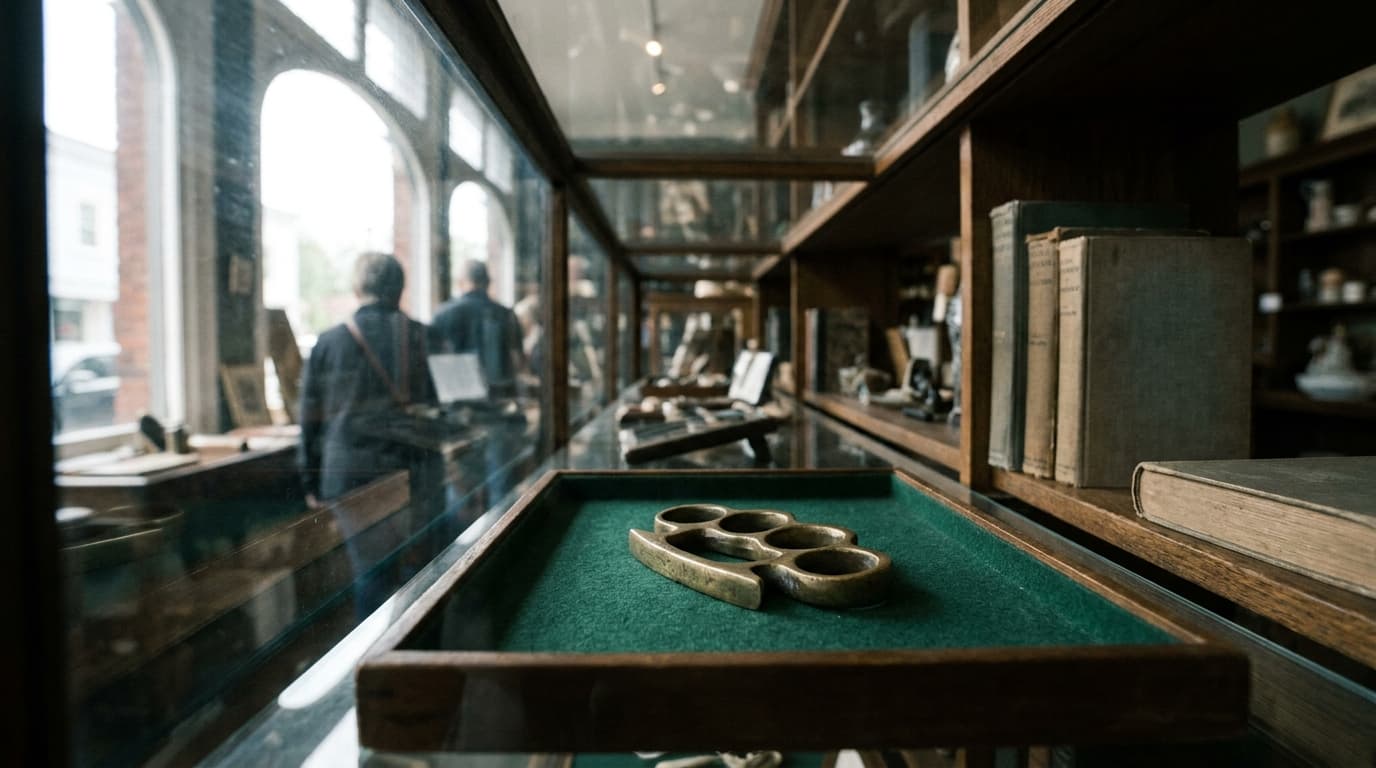
Owning brass knuckles is not a crime in North Carolina, but carrying them concealed is. Under G.S. 14-269(a), it is unlawful to willfully and intentionally carry "metallic knuckles" concealed about your person anywhere except your own premises, a Class 2 misdemeanor. Separate statutes make it a Class 1 misdemeanor to have knuckles on school property, openly or concealed (G.S. 14-269.2(d)), or to sell or give "brass knucks" to a minor (G.S. 14-315(a)). For how other states handle the same item, see our guide to brass knuckles laws by state.
Information last verified on 2026-10-08. This article has not been reviewed by a licensed lawyer.
Jurisdiction scope: This article covers North Carolina state law in Chapter 14 of the General Statutes: carrying concealed weapons (14-269), confiscation (14-269.1), weapons on educational property (14-269.2), the State Capitol, Executive Mansion and courthouses (14-269.4), deadly weapons and inmates (14-258.1 and 14-258.2), parades, picket lines and demonstrations (14-277.2), transfers to minors (14-315), local firearm preemption (14-409.40) and felon possession (14-415.1), plus the misdemeanor sentencing chart in G.S. 15A-1340.23, the deadly weapon felony enhancement in G.S. 15A-1340.16A and local state-of-emergency restrictions in G.S. 166A-19.31. It does not cover city or county ordinances, school board policies, private property rules, court case law, federal law or federal property, or the law of other states.
What North Carolina law says about brass knuckles
North Carolina regulates knuckles by how and where they are carried, not by banning them outright. The General Statutes name them in these sections:
- G.S. 14-269(a) makes it unlawful to carry "metallic knuckles" concealed about your person, except on your own premises.
- G.S. 14-269.2(d) makes it unlawful to possess or carry "metallic knuckles," openly or concealed, on educational property.
- G.S. 14-315(a) makes it unlawful to sell or transfer "brass knucks" to a minor.
None of those sections makes it a crime to buy knuckles as an adult, own them, or keep them at home. Other statutes reach knuckles without naming them, because they cover any "deadly weapon" or "dangerous weapon" in particular places. Those are covered below.
The wording varies from statute to statute. Sections 14-269 and 14-269.2 say "metallic knuckles," while 14-315 says "brass knucks." None of them defines the term.
Carrying brass knuckles concealed (G.S. 14-269)
The central rule is North Carolina's carrying-concealed-weapons statute:
"(a) It shall be unlawful for any person willfully and intentionally to carry concealed about his or her person any bowie knife, dirk, dagger, slung shot, loaded cane, metallic knuckles, razor, shuriken, stun gun, or other deadly weapon of like kind, except when the person is on the person's own premises." N.C. Gen. Stat. 14-269(a)
Four points come straight from that text:
- The offense is concealed carry. Subsection (a) does not mention open carry, ownership or sale.
- It requires intent. The carrying must be willful and intentional.
- Your own premises are excepted. Carrying knuckles concealed on your own premises is outside subsection (a).
- Vehicles are not mentioned. Subsection (a) speaks of carrying concealed "about his or her person." Whether knuckles kept in a glove box or console count as carried about the person is a question the statute text does not answer.
Plastic, wood and other non-metal knuckles
Section 14-269 does not define "metallic knuckles." Its list ends with "or other deadly weapon of like kind," and that phrase is not defined either. Whether knuckles made of plastic, polymer or wood fall under the named term or the catch-all phrase is not settled by the statute text.
Exceptions and the legitimate-use defense
Subsection (a) has one built-in exception, for a person on their own premises. Subsection (b) separately lists categories of persons, such as certain officers and military personnel in the circumstances it describes, to whom the section does not apply. The section's pocket knife carve-out in subsection (d) covers ordinary pocket knives only, not knuckles.
Subsection (b1) gives a defense that can apply to a non-firearm weapon such as knuckles, but all four conditions must be met and the defendant must prove them:
"(b1) It is a defense to a prosecution under this section that: (1) The weapon was not a firearm; (2) The defendant was engaged in, or on the way to or from, an activity in which the defendant legitimately used the weapon; (3) The defendant possessed the weapon for that legitimate use; and (4) The defendant did not use or attempt to use the weapon for an illegal purpose. The burden of proving this defense is on the defendant." N.C. Gen. Stat. 14-269(b1)
A handgun permit does not cover knuckles
North Carolina's concealed handgun permit exceptions in 14-269 attach to the handgun offense in subsection (a1) or to named official classes. They speak of handguns. Subsection (a), the provision that covers metallic knuckles, has only the own-premises exception, the persons listed in subsection (b) and the (b1) defense. A permit holder who carries knuckles concealed off their own premises is subject to subsection (a) like anyone else.
Penalty for carrying concealed
"(c) Any person violating the provisions of subsection (a) of this section shall be guilty of a Class 2 misdemeanor." N.C. Gen. Stat. 14-269(c)
North Carolina's misdemeanor sentencing chart, G.S. 15A-1340.23, sets the range by offense class and prior conviction level (Level I, II or III, which rises with the number of prior convictions). For a Class 2 misdemeanor, the sentence is 1 to 30 days at Level I, 1 to 45 days at Level II, and 1 to 60 days at Level III. The maximum fine is $1,000:
"Unless otherwise provided for a specific offense, the maximum fine that may be imposed is two hundred dollars ($200.00) for a Class 3 misdemeanor and one thousand dollars ($1,000) for a Class 2 misdemeanor. The amount of the fine for a Class 1 misdemeanor and a Class A1 misdemeanor is in the discretion of the court." N.C. Gen. Stat. 15A-1340.23
Brass knuckles at schools (G.S. 14-269.2)
Knuckles are named again in the statute on weapons on educational property. This one has no concealment element and no own-premises exception:
"(d) It shall be a Class 1 misdemeanor for any person to possess or carry, whether openly or concealed, any BB gun, stun gun, air rifle, air pistol, bowie knife, dirk, dagger, slungshot, leaded cane, switchblade knife, blackjack, metallic knuckles, razors and razor blades (except solely for personal shaving), firework, or any sharp-pointed or edged instrument except instructional supplies, unaltered nail files and clips and tools used solely for preparation of food, instruction, and maintenance, on educational property." N.C. Gen. Stat. 14-269.2(d)
The statute defines the places it covers:
"(1) Educational property. - Any school building or bus, school campus, grounds, recreational area, athletic field, or other property owned, used, or operated by any board of education or school board of trustees, or directors for the administration of any school." N.C. Gen. Stat. 14-269.2(a)(1)
Subsection (a)(1b) defines "school" as "A public or private school, community college, college, or university," so the ban covers community college, college and university property as well as K-12 schools.
Subsection (e) separately makes it a Class 1 misdemeanor for any person to cause, encourage, or aid a minor who is less than 18 years old to possess or carry metallic knuckles, openly or concealed, on educational property.
A Class 1 misdemeanor carries 1 to 45 days at Level I or II and 1 to 120 days at Level III under G.S. 15A-1340.23, and the fine is in the court's discretion. The Class I felony in the same section applies to firearms, not to knuckles.
School exceptions
Subsection (g) lists situations the section does not apply to. Two can reach knuckles:
"(g) This section shall not apply to any of the following: (1) A weapon used solely for educational or school-sanctioned ceremonial purposes, or used in a school-approved program conducted under the supervision of an adult whose supervision has been approved by the school authority. (1a) A person exempted by the provisions of G.S.14-269(b)." N.C. Gen. Stat. 14-269.2(g)
Subsection (h) protects a person who comes across a weapon and turns it in:
"(h) No person shall be guilty of a criminal violation of this section with regard to the possession or carrying of a weapon so long as both of the following apply: (1) The person comes into possession of a weapon by taking or receiving the weapon from another person or by finding the weapon. (2) The person delivers the weapon, directly or indirectly, as soon as practical to law enforcement authorities." N.C. Gen. Stat. 14-269.2(h)
The concealed handgun permit exception in subsection (k) and the nonpublic school provision in (g)(8) are limited to handguns, firearms or stun guns. Neither covers knuckles. A 2025 act (S.L. 2025-81) amended 14-269.2 but did not change subsection (d).
Selling or giving brass knuckles to minors (G.S. 14-315)
North Carolina's sale-to-minors statute uses the phrase "brass knucks":
"(a) Sale of Weapons Other Than Handguns. - If a person sells, offers for sale, gives, or in any way transfers to a minor any pistol cartridge, brass knucks, bowie knife, dirk, shurikin, leaded cane, or slungshot, the person is guilty of a Class 1 misdemeanor and, in addition, shall forfeit the proceeds of any sale made in violation of this section." N.C. Gen. Stat. 14-315(a)
Section 14-315 does not itself define "minor." It also contains defenses in subsection (b1), including one for a seller who reasonably believed, based on identification or other facts, that the buyer was not a minor. The statute does not make it a crime for a minor to own knuckles; it targets the person who transfers them. A minor who carries them concealed or brings them to school is covered by 14-269 and 14-269.2 like anyone else.
Courthouses, the State Capitol and the Governor's residences (G.S. 14-269.4)
Section 14-269.4 does not name knuckles. It covers any deadly weapon:
"It shall be unlawful for any person to possess, or carry, whether openly or concealed, any deadly weapon, not used solely for instructional or officially sanctioned ceremonial purposes in the State Capitol Building, the Executive Mansion, the Western Residence of the Governor, or on the grounds of any of these buildings, and in any building housing any court of the General Court of Justice. ... Any person violating the provisions of this section shall be guilty of a Class 1 misdemeanor." N.C. Gen. Stat. 14-269.4
The section does not define "deadly weapon," so whether a particular set of knuckles qualifies is a question for the courts. Its exceptions include persons exempt under 14-269(b) and a person in a court building who has the weapon for evidentiary purposes, to deliver it to a law enforcement agency, or for registration. If a court shares a building with nonpublic uses, the ban applies only to the part used for court purposes while the building is being used for court purposes. The handgun permit exceptions in 14-269.4 cover firearms only.
Parades, funerals, picket lines and demonstrations (G.S. 14-277.2)
Section 14-277.2 makes it a Class 1 misdemeanor for a participant, affiliate or spectator at a parade, funeral procession, picket line or demonstration on a private health care facility, or on a public place owned or controlled by the State or one of its political subdivisions, to willfully or intentionally possess or have immediate access to a dangerous weapon. Unlike 14-269.4, it pulls in the knuckles list by reference:
"(b) For the purposes of this section the term "dangerous weapon" shall include those weapons specified in G.S. 14-269, 14-269.2, 14-284.1, or 14-288.8 or any other object capable of inflicting serious bodily injury or death when used as a weapon." N.C. Gen. Stat. 14-277.2(b)
Because 14-269 and 14-269.2 both name metallic knuckles, knuckles are a dangerous weapon for this section whether carried openly or concealed. The section exempts persons listed in 14-269(b), persons authorized by State or federal law to carry dangerous weapons in their duties, and a person who obtains a permit from the sheriff or police chief of the locality where the event takes place.
Jails and prisons (G.S. 14-258.1 and 14-258.2)
Two corrections statutes reach knuckles through general language rather than by name:
- Giving or selling a deadly weapon to an inmate is punished as a Class H felony under G.S. 14-258.1(a).
- An inmate's own possession of a weapon is covered by G.S. 14-258.2(a):
"(a) Any person while in the custody of the Division of Prisons, or any person under the custody of any local confinement facility as defined in G.S.153A-217, who shall have in his possession without permission or authorization a weapon capable of inflicting serious bodily injuries or death, or who shall fabricate or create such a weapon from any source, shall be guilty of a Class H felony" N.C. Gen. Stat. 14-258.2(a)
Felons and brass knuckles (G.S. 14-415.1)
North Carolina's Felony Firearms Act is limited to firearms and weapons of mass death and destruction:
"(a) It is unlawful for any person who has been convicted of a felony to purchase, own, possess, or have in the person's custody, care, or control any firearm or any weapon of mass death and destruction as defined in G.S.14-288.8(c)." N.C. Gen. Stat. 14-415.1(a)
The section does not reach knuckles. A person with a felony record is still subject to the concealed-carry, school and place rules above.
Other offenses built on a deadly weapon
The sections that name knuckles do not set a sentence enhancement. Separately, G.S. 15A-1340.16A increases the minimum prison term by 12, 36 or 72 months, depending on the felony class, when a person commits a felony by using, displaying or threatening the use or display of a deadly weapon the person actually possessed about the person. It does not apply when that evidence is needed to prove an element of the felony or when no active prison term is imposed. Offenses defined by the use of a deadly or dangerous weapon, such as robbery under G.S. 14-87 or assault with a deadly weapon, are outside this page. Whether knuckles count as a deadly weapon in those offenses is a question for the courts.

Confiscation after a conviction (G.S. 14-269.1)
A conviction leads to loss of the knuckles:
"Upon conviction of any person for violation of G.S.14-269, G.S.14-269.7, or any other offense involving the use of a deadly weapon of a type referred to in G.S.14-269, the deadly weapon with reference to which the defendant shall have been convicted shall be ordered confiscated and disposed of by the presiding judge at the trial in one of the following ways in the discretion of the presiding judge." N.C. Gen. Stat. 14-269.1
The options include returning the weapon to a rightful owner who was not the defendant, on petition, or turning it over to state agencies such as the State Crime Laboratory.
City and county rules
North Carolina's local preemption statute, G.S. 14-409.40(b), bars counties and municipalities from regulating "firearms, firearms ammunition, components of firearms, dealers in firearms, or dealers in handgun components or parts." It does not mention knuckles or other non-firearm weapons, so it neither bars nor authorizes local rules on knuckles. Separately, G.S. 166A-19.31(b)(4) lets a city or county, by ordinance, restrict the possession and transportation of "dangerous weapons and substances" during a declared state of emergency. That term takes its meaning from G.S. 14-288.1, which includes any deadly weapon, and the subdivision does not authorize restrictions on lawfully possessed firearms or ammunition. Check your city or county code, and call your local police department's non-emergency line if a rule is unclear.
Penalties at a glance
| Conduct | Statute | Class |
|---|---|---|
| Carrying metallic knuckles concealed off your own premises | 14-269(a), (c) | Class 2 misdemeanor: 1 to 60 days depending on prior conviction level; fine up to $1,000 |
| Possessing or carrying metallic knuckles, openly or concealed, on educational property | 14-269.2(d) | Class 1 misdemeanor: 1 to 120 days depending on prior conviction level; fine in the court's discretion |
| Causing, encouraging or aiding a minor under 18 to possess or carry metallic knuckles on educational property | 14-269.2(e) | Class 1 misdemeanor |
| Selling, giving or transferring brass knucks to a minor | 14-315(a) | Class 1 misdemeanor, plus forfeiture of sale proceeds |
| Possessing any deadly weapon in the State Capitol, Executive Mansion, Western Residence or a courthouse | 14-269.4 | Class 1 misdemeanor |
| Possessing or having immediate access to a dangerous weapon at a parade, funeral procession, picket line or demonstration on a private health care facility or State or local public property | 14-277.2 | Class 1 misdemeanor |
| Giving or selling a deadly weapon to an inmate | 14-258.1(a) | Class H felony |
| Inmate possessing a weapon capable of inflicting serious bodily injuries or death | 14-258.2(a) | Class H felony |
Self-defense and other options in North Carolina
Section 14-269(a) lists stun guns alongside metallic knuckles, and 14-269.2(d) bans both on school property. The rules for sprays and stun devices are covered in our guide to North Carolina pepper spray and stun gun laws. For bowie knives, dirks, daggers and pocket knives, see North Carolina knife laws. When the law allows force at all is covered in North Carolina self-defense laws.
Related pages
- Brass knuckles laws by state
- North Carolina knife laws
- North Carolina pepper spray and stun gun laws
- North Carolina self-defense laws
- Virginia brass knuckles laws
- Tennessee brass knuckles laws
This article provides general legal information about North Carolina state law, not legal advice. Weapons laws change and local rules vary. For advice about a specific situation, contact a lawyer licensed in North Carolina or your local law enforcement agency.
Last updated: 2026-10-08.
Frequently Asked Questions
Are brass knuckles legal in North Carolina?
Owning them is not a crime under the General Statutes, but carrying metallic knuckles concealed off your own premises is a Class 2 misdemeanor under G.S. 14-269(a), possessing them on educational property is a Class 1 misdemeanor under 14-269.2(d), and transferring brass knucks to a minor is a Class 1 misdemeanor under 14-315(a).
Can I carry brass knuckles in my pocket in North Carolina?
Not concealed. G.S. 14-269(a) makes it unlawful to willfully and intentionally carry metallic knuckles concealed about your person except on your own premises, a Class 2 misdemeanor punishable by up to $1,000 and 1 to 60 days depending on prior conviction level.
Can I carry brass knuckles openly in North Carolina?
The concealed-carry offense in G.S. 14-269(a) does not reach open carry, but the bans on educational property (14-269.2), in courthouses and the State Capitol (14-269.4), and at parades and demonstrations (14-277.2) apply whether the weapon is open or concealed.
Does a concealed handgun permit let me carry brass knuckles in North Carolina?
No. The permit exceptions in G.S. 14-269 apply to handguns. Subsection (a), which covers metallic knuckles, excepts only a person on their own premises, the persons listed in subsection (b), and the legitimate-use defense in (b1).
Can I keep brass knuckles in my car in North Carolina?
G.S. 14-269(a) speaks of carrying concealed about the person and does not mention vehicles; whether knuckles in a glove box or console are carried about the person is a question the statute text does not answer.
Can I bring brass knuckles to a school in North Carolina?
No. G.S. 14-269.2(d) makes it a Class 1 misdemeanor to possess or carry metallic knuckles, openly or concealed, on educational property, which includes school buildings, buses, campuses, grounds, recreational areas and athletic fields, and covers community college, college and university property as well as K-12 schools. Causing, encouraging or aiding a minor under 18 to carry knuckles there is also a Class 1 misdemeanor under 14-269.2(e).
Can you sell brass knuckles to a minor in North Carolina?
No. Under G.S. 14-315(a), selling, offering for sale, giving or transferring brass knucks to a minor is a Class 1 misdemeanor, and the seller must forfeit the proceeds of the sale.
Are plastic knuckles illegal in North Carolina?
G.S. 14-269(a) names metallic knuckles and ends its list with any other deadly weapon of like kind, but it does not define either term, so whether plastic or wooden knuckles are covered is not answered by the statute text.
Can a felon own brass knuckles in North Carolina?
The felon-in-possession statute, G.S. 14-415.1, covers only firearms and weapons of mass death and destruction, so it does not reach knuckles. The concealed-carry, school and other place rules apply to everyone.
Updates
Independently fact-checked against the cited primary sources
The Law Behind This Article
This article rests on the statutory provisions below, held in our own legal record and retrieved from the official source. Tap a section to read the operative text.
North Carolina General Statutes, Chapter 14: Criminal Law.
§ 14-269Carrying concealed weaponsIn forcecited in 4 of our articles
(a) It shall be unlawful for any person willfully and intentionally to carry concealed about his or her person any bowie knife, dirk, dagger, slung shot, loaded cane, metallic knuckles, razor, shuriken, stun gun, or other deadly weapon of like kind, except when the person is on the person's own premises. (a1) It shall be unlawful for any person willfully and intentionally to carry concealed about his or her person any pistol or gun except in the following circumstances: (1) The person is on the person's own premises. (2) The deadly weapon is a handgun, the person has a concealed handgun permit issued in accordance with Article 54B of this Chapter or considered valid under G.S. 14-415.24, and the person is carrying the concealed handgun in accordance with the scope of the concealed handgun permit as set out in G.S. 14-415.11(c). (3) The deadly weapon is a handgun and the person is a military permittee as defined under G.S. 14-415.10(2a) who provides to the law enforcement officer proof of deployment as required under G.S. 14-415.11(a).
Official text (excerpt) · last checked 2026-07-29 · Read the full text in our law library · Verify at ncleg.gov
Cited in 60 court opinions in our collectionLatest citing opinion in our collection: 2026
Opinions citing this section in our collection:
- State v. McGirt (Court of Appeals of North Carolina 1996, 122 N.C. App. 237)“…4-415.1 , and carrying a concealed weapon, in violation of N.C. Gen. Stat. § 14-269 . It is undisputed that on 27 October…”
- State v. Mather (Court of Appeals of North Carolina 2012, 221 N.C. App. 593)“…icting him of carrying a concealed handgun in violation of N.C. Gen. Stat. § 14-269 (al) (2011). On appeal, Defendant argue…”
- State v. Mbacke (Court of Appeals of North Carolina 2011, 209 N.C. App. 35)“…to proving Defendant's intent to carry a concealed weapon, N.C. Gen.Stat. § 14-269(a1) provides that it is unlawful for "a…”
Identified automatically from the court opinions citing this section — not a ranking of which case controls.
Also relied on in: North Carolina Knife Laws (2026): Pocket Knife Rule and Schools, Knife Laws by State (2026): Carry Rules, Blade Limits, Penalties, North Carolina Pepper Spray and Stun Gun Laws (2026)
§ 14-269.2Weapons on campus or other educational propertyIn forcecited in 3 of our articles
(a) The following definitions apply to this section: (1) Educational property. - Any school building or bus, school campus, grounds, recreational area, athletic field, or other property owned, used, or operated by any board of education or school board of trustees, or directors for the administration of any school. (1a) Employee. - A person employed by a local board of education or school whether the person is an adult or a minor. (1b) School. - A public or private school, community college, college, or university. (1c) School administrative director. - Any individual authorized by the school board of trustees to act on behalf of the nonpublic school. (1d) School board of trustees. - The governing body of any nonpublic school. For purposes of parochial schools, the school board of trustees may be the board of deacons, the board of elders, or any other designated board which oversees the general affairs of the church, synagogue, temple, or other place of religious worship that is affiliated with the nonpublic school. (1e) School operating hours. - Any time when any of the following occur: a. The premises are being used for curricular or extracurricular activities. b.
Official text (excerpt) · last checked 2026-07-29 · Read the full text in our law library · Verify at ncleg.gov
Cited in 40 court opinions in our collectionLatest citing opinion in our collection: 2026
Opinions citing this section in our collection:
- State v. Jackson (Supreme Court of North Carolina 2001, 353 N.C. 495)“…on school property and was charged with a violation of N.C.G.S. § 14-269.2, which makes it a felony to carry a fir…”
- State v. Haskins (Court of Appeals of North Carolina 2003, 160 N.C. App. 349)“…ndant was not a state actor exempt from the prohibitions of G.S. § 14-269.2. After careful review, we find no error…”
- Matter of Cowley (Court of Appeals of North Carolina 1995, 120 N.C. App. 274)“…ing pin. Respondent was charged with a violation of N.C. Gen. Stat. § 14-269.2 (b) which makes it a felony to carry a…”
Identified automatically from the court opinions citing this section — not a ranking of which case controls.
§ 14-315Selling or giving weapons to minorsIn forcecited in 2 of our articles
(a) Sale of Weapons Other Than Handguns. - If a person sells, offers for sale, gives, or in any way transfers to a minor any pistol cartridge, brass knucks, bowie knife, dirk, shurikin, leaded cane, or slungshot, the person is guilty of a Class 1 misdemeanor and, in addition, shall forfeit the proceeds of any sale made in violation of this section. (a1) Sale of Handguns. - If a person sells, offers for sale, gives, or in any way transfers to a minor any handgun as defined in G.S. 14-269.7, the person is guilty of a Class H felony and, in addition, shall forfeit the proceeds of any sale made in violation of this section. This section does not apply in any of the following circumstances: (1) The handgun is lent to a minor for temporary use if the minor's possession of the handgun is lawful under G.S. 14-269.7 and G.S. 14-316 and is not otherwise unlawful. (2) The handgun is transferred to an adult custodian pursuant to Chapter 33A of the General Statutes, and the minor does not take possession of the handgun except that the adult custodian may allow the minor temporary possession of the handgun in circumstances in which the minor's possession of the handgun is lawful under G.S.
Official text (excerpt) · last checked 2026-07-29 · Read the full text in our law library · Verify at ncleg.gov
Cited in 2 court opinions in our collectionLatest citing opinion in our collection: 2024
Opinions citing this section in our collection:
- State v. Sherrod (Court of Appeals of North Carolina 2008, 191 N.C. App. 776)“…(2007) (bullets excluded from enumerated list of weapons); N.C. Gen. Stat. § 14-315 (a) (2007) (“pistol cartridge” listed a…”
- Rocky Mountain Gun Owners v. Polis (Court of Appeals for the Tenth Circuit 2024, 121 F.4th 96)“…Hampshire (N.H. Rev. Stat. Ann. § 159:12); North Carolina (N.C. Gen. Stat. § 14-315); North Dakota (N.D. Cent. Code §§ 62.1…”
Identified automatically from the court opinions citing this section — not a ranking of which case controls.
Search our full record of US law — 2.1 million sections, every state + federal →
Sources and References
- N.C. Gen. Stat. 14-269, Carrying concealed weapons(www.ncleg.gov).gov
- N.C. Gen. Stat. 14-269.2, Weapons on campus or other educational property(www.ncleg.gov).gov
- N.C. Gen. Stat. 14-315, Selling or giving weapons to minors(www.ncleg.gov).gov
- N.C. Gen. Stat. 15A-1340.23 (misdemeanor punishment chart and fines)(www.ncleg.gov).gov
- N.C. Gen. Stat. 14-269.4 (deadly weapons in the State Capitol, Executive Mansion, Western Residence and courthouses)(www.ncleg.gov).gov
- N.C. Gen. Stat. 14-277.2 (dangerous weapons at parades, funerals, picket lines and demonstrations)(www.ncleg.gov).gov
- N.C. Gen. Stat. 14-258.1 (giving or selling deadly weapons to inmates)(www.ncleg.gov).gov
- N.C. Gen. Stat. 14-258.2 (weapons possessed by persons in custody)(www.ncleg.gov).gov
- N.C. Gen. Stat. 14-415.1 (firearms possession by persons convicted of a felony)(www.ncleg.gov).gov
- N.C. Gen. Stat. 14-269.1 (confiscation and disposition of deadly weapons)(www.ncleg.gov).gov
- N.C. Gen. Stat. 14-409.40 (local regulation of firearms)(www.ncleg.gov).gov
- N.C. Gen. Stat. 15A-1340.16A (enhanced sentence for a felony committed with a firearm or deadly weapon)(www.ncleg.gov).gov
- N.C. Gen. Stat. 166A-19.31 (local ordinances during states of emergency)(www.ncleg.gov).gov
- N.C. Gen. Stat. 14-288.1 (definitions, including dangerous weapon or substance)(www.ncleg.gov).gov