
Washington
Washington Name Change Laws: How to Legally Change Your Name
Independently fact-checked against primary sources (last audited August 11, 2026). · Law checked current as of August 11, 2026. · 4 primary sources cited on this page. How we verify our legal content

Washington routes a general adult, child, or ward name-change petition to district court, not superior court, under RCW 4.24.130. That venue choice is easy to get wrong when comparing Washington to other states, since most of this cluster's states use their general trial court for the equivalent filing.
The other detail worth stating carefully is sealing. A Washington name-change file is not automatically sealed as a general rule. District court petitions become public Recorder's Office records unless the petitioner affirmatively asks the judge to seal the file at the hearing. Automatic sealing is real, but it is narrower than that: it applies only in superior court, for a specific list of protected-category petitioners.
Information last verified on 2026-08-11. This article has not yet been reviewed by a licensed lawyer.
How to Legally Change Your Name in Washington
A general adult, child, or ward name-change petition is filed in district court under RCW 4.24.130(1). This is worth stating plainly because it differs from most other states in this batch, where the general trial court (circuit, superior, or district-as-general-jurisdiction court) handles the filing directly. In Washington, the statute's plain text does not tie venue to the petitioner's county of residence; a petition can be filed in any judicial district.
The cost has two parts: a district court filing fee and a county recording fee. RCW 4.24.130(4) directs the district court to collect the filing and recording fees authorized by RCW 36.18.010 and to transmit the fee and the order to the county auditor, so the amount a petitioner actually pays is published by the individual court rather than as a single statewide price. King County District Court publishes a representative example: a $98 filing fee plus a $203.50 recording fee for an individual petition, with family petitions running $204.50 or more. Check the current fee schedule for the district court where you plan to file. A full fee waiver is available on a financial-hardship affidavit, unless victim compensation already covered the costs of the name change.
Changing a Minor's Name
A general child or ward petition also runs through district court under 4.24.130(1), the same track as an adult petition. Superior court has separate, concurrent jurisdiction for a narrower set of situations: an emancipated minor, a child already involved in a Title 13 or Title 74 juvenile proceeding, or a petition grounded in asylum or refugee status, special-immigrant-juvenile status, gender identity, or domestic-violence or stalking safety. This is also where automatic sealing applies, described below; it is a superior-court, protected-category feature, not a general rule that reaches every minor's petition.
Restoring Your Name After Divorce
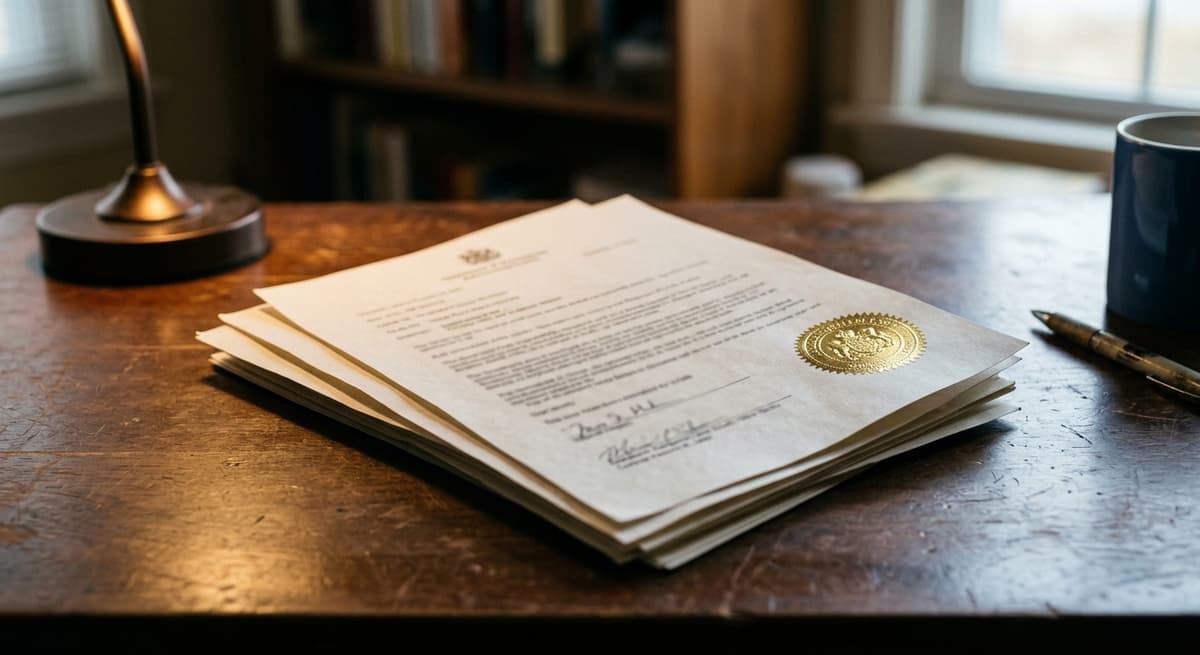
Divorce-based restoration is a standard part of the dissolution decree, not a separate filing. Under RCW 26.09.150(3), on request of a party whose marriage or domestic partnership is dissolved or declared invalid, the court shall order a former name restored, or the court may, in its discretion, order a change to a different name instead.
Publication and Sealing: Not a Blanket Default
Washington has no newspaper-publication requirement for the general public. The detail that needs care is sealing, and it is easy to overstate. District court petitions are NOT automatically sealed. King County District Court's own guidance states this directly: the court does not automatically seal name-change files, and a petitioner must ask the judge to do so at the hearing. Absent that request, the granted order becomes viewable as a public record through the county Recorder's Office.
Automatic sealing is real in Washington, but only in a narrower circumstance: superior court petitions grounded in the protected categories described above, gender identity, refugee or asylum status, domestic-violence or stalking safety, and emancipated minors, receive automatic sealing under RCW 4.24.130(5). That route is closed to two groups: RCW 4.24.130(5)(d) excludes anyone subject to the Department of Corrections rules in subsection (2) or the sex-offender registration rules in subsection (3), so neither the protected-category venue nor its automatic sealing is available to them. Even that automatic superior-court sealing does not automatically make a new name confidential with the Social Security Administration or the U.S. State Department; those agencies apply their own separate rules for what they will and will not disclose. Since most general adult petitioners use the default district court track, a reader should not assume their Washington name change will be confidential by default. If confidentiality matters to your situation, either request sealing explicitly in district court or determine whether your circumstances qualify for the superior court's protected-category track.
Restrictions: Corrections and Sex-Offender Rules
A person under Department of Corrections jurisdiction who is changing their name must notify DOC at least five days before the change is entered into court records. The change may be denied if it would interfere with legitimate penological interests, except when the change is for religious or cultural reasons or is related to a marriage or dissolution. Violating the DOC-notice requirement is itself a misdemeanor.

A sex offender required to register under RCW 9A.44.130 still applies through the general 4.24.130(1) district court process described above, and must additionally follow the procedures set out in RCW 9A.44.130(7). Those registry procedures are cumulative, not a substitute for the court petition.
Both groups are also shut out of the superior court track. RCW 4.24.130(5)(d) provides that subsection (5) does not apply to a person who is subject to the requirements of subsection (2) or (3) of that section. A person under Department of Corrections jurisdiction, or a person subject to sex-offender registration, therefore cannot use the protected-category superior court route described above and cannot receive its automatic sealing, even on gender-identity, domestic-violence, or stalking grounds.
Name Change After Marriage
Washington has no general marriage-based name-change statute. The reference to "recognition of marriage or dissolution of marriage" in 4.24.130(2) is only an exception carved out of the DOC-offender penological-interest restriction, not a standalone mechanism for changing a name at marriage. A spouse who wants a new name at marriage does so administratively, presenting the marriage certificate to the Social Security Administration and the DMV. For the federal-level steps involved, see name change after marriage.
Related Washington Records
For the marriage certificate or divorce decree that may support a filing, see Washington marriage and divorce records. For how the state's court system handles filings and case access generally, see Washington court records. For the broader dissolution process a name restoration is part of, see Washington divorce laws. For the full agency-by-agency update process once a change is granted, see the name change checklist and how to legally change your name.
Disclaimer
This article provides general information about Washington name-change law. It is not legal advice and does not create an attorney-client relationship. Fees, forms, and sealing procedures vary by county and change over time; verify current details with your district or superior court clerk or a licensed Washington attorney before relying on anything here for a specific situation.

Last updated: 2026-08-11. Fees and forms reflect their published status as of August 2026.
Frequently Asked Questions
What court handles a name change in Washington state?
District court, for the general adult, child, or ward petition under RCW 4.24.130(1). Superior court handles only a narrower set of protected-category cases.
Is a Washington name change automatically sealed?
No, not by default. District court files become public Recorder's Office records unless the petitioner asks the judge to seal the file at the hearing. Automatic sealing applies only to superior court filings involving specific protected categories.
How much does a Washington name change cost?
Fees are published by each district court rather than as a single statewide price. King County District Court's example is $98 for filing plus $203.50 for recording an individual petition. A fee waiver is available on a hardship affidavit.
Does Washington require newspaper publication for a name change?
No. Washington has no general publication requirement for the public.
Can I get my maiden name back after a Washington divorce without a separate name-change petition?
Yes. RCW 26.09.150(3) makes it a standard part of the dissolution decree: the court restores a former name on request, and may order a different name change at its discretion.
Updates
Corrected the statutory subsection for the marriage and dissolution exception, clarified that a registered sex offender must use the general district court petition in addition to the RCW 9A.44.130(7) registry procedures, and added the RCW 4.24.130(5)(d) rule that closes the sealed superior court track to people under Department of Corrections jurisdiction or subject to registration.
Independently fact-checked against the cited primary sources; governing law re-checked for recent changes
The Law Behind This Article
This article rests on the statutory provisions below, held in our own legal record and retrieved from the official source. Tap a section to read the operative text.
Revised Code of Washington
§ 4.24.130Action for change of name—Fees.In forcecited in 2 of our articles
(1) Any person desiring a change of the person's name or that of the person's child or of an individual subject to guardianship for whom the person has been appointed as guardian, may apply therefor to the district court of any judicial district in the state, by petition setting forth the desire for such change; thereupon such court in its discretion may order a change of the name and thenceforth the new name shall be in place of the former. (2) An offender under the jurisdiction of the department of corrections who applies to change the offender's name under subsection (1) of this section shall submit a copy of the application to the department of corrections not fewer than five days before the entry of an order granting the name change. No offender under the jurisdiction of the department of corrections at the time of application shall be granted an order changing the offender's name if the court finds that doing so will interfere with legitimate penological interests, except that no order shall be denied when the name change is requested for religious or legitimate cultural reasons or in recognition of marriage or dissolution of marriage.
Official text (excerpt) · last checked 2026-09-02 · Read the full text in our law library · Verify at app.leg.wa.gov
Cited in 9 court opinions in our collectionLatest citing opinion in our collection: 2024
In the courts (editorial summary, independently checked):Washington courts treat RCW 4.24.130 as the route for a child's name change. In Re the Marriage of Hurta vacated a name change entered on a dissolution modification, saying the application had to be made under 4.24.130. Daves v. Nastos held a name change may be obtained in a paternity action only by amending the pleadings under 4.24.130.
Opinions citing this section in our collection:
- Daves v. Nastos (Washington Supreme Court 1985, 105 Wash. 2d 24)✓A trial court changed a child's surname to her father's in a paternity action; the court held the parentage statute does not itself authorize a name change, that the relief must be pleaded under RCW 4.24.130, and vacated the order for lack of a best interests finding.
- Danny v. Laidlaw Transit Services, Inc. (Washington Supreme Court 2008, 165 Wash. 2d 200)“…se include RCW 40.24.030 (address confidentiality program); RCW 4.24.130(5) (name of domestic violence victim ca…”
- In Re the Marriage of Hurta (Court of Appeals of Washington 1979, 25 Wash. App. 95)✓After a dissolution decree, a father petitioned to modify it so his daughter would carry his surname; the court held the dissolution statutes contain no name change provision, that application had to be made under RCW 4.24.130, and vacated the name change order.
Identified automatically from the court opinions citing this section — not a ranking of which case controls.
Also relied on in: How to Legally Change Your Name
§ 26.09.150Decree of dissolution of marriage or domestic partnership, legal separation, or declaration of invalidity—Finality—Appeal—Conversion of decree of legal separation to decree of dissolution—Name of party.In force
(1) A decree of dissolution of marriage or domestic partnership, legal separation, or declaration of invalidity is final when entered, subject to the right of appeal. An appeal which does not challenge the finding that the marriage or domestic partnership is irretrievably broken or was invalid, does not delay the finality of the dissolution or declaration of invalidity and either party may remarry or enter into a domestic partnership pending such an appeal. (2)(a) No earlier than six months after entry of a decree of legal separation, on motion of either party, the court shall convert the decree of legal separation to a decree of dissolution of marriage or domestic partnership. The clerk of court shall complete the certificate on the form provided by the department of health. On or before the tenth day of each month, the clerk of the court shall forward to the state registrar of vital statistics the certificate of each decree of divorce, dissolution of marriage or domestic partnership, annulment, or separate maintenance granted during the preceding month.
Official text (excerpt) · last checked 2026-07-29 · Read the full text in our law library · Verify at app.leg.wa.gov
Cited in 18 court opinions in our collectionLatest citing opinion in our collection: 2024
Opinions citing this section in our collection:
- In re the Marriage of Moody (Washington Supreme Court 1999, 137 Wash. 2d 979)“…f legal separation into a decree of dissolution pursuant to RCW 26.09.150. In November 1995, Homer filed a “motio…”
- In Re Marriage of Moody (Washington Supreme Court 1999, 976 P.2d 1240)“…f legal separation into a decree of dissolution pursuant to RCW 26.09.150. In November 1995, Homer filed a "motio…”
- In re the Marriage of Mu Chai (Court of Appeals of Washington 2004, 122 Wash. App. 247)“…n is final when entered, subject to the right of appeal. 2 RCW 26.09.150 allows a decree of separation to be con…”
Identified automatically from the court opinions citing this section — not a ranking of which case controls.
§ 36.18.010Auditor's fees.In force
Except as otherwise ordered by the court pursuant to RCW 4.24.130, county auditors or recording officers shall collect the following fees for their official services: (1) For recording instruments, for the first page eight and one-half by 14 inches or less, $5; for each additional page eight and one-half by 14 inches or less, $1. The fee for recording multiple transactions contained in one instrument will be calculated for each transaction requiring separate indexing as required under RCW 65.04.050 as follows: The fee for each title or transaction is the same fee as the first page of any additional recorded document; the fee for additional pages is the same fee as for any additional pages for any recorded document; the fee for the additional pages may be collected only once and may not be collected for each title or transaction; (2) For preparing and certifying copies, for the first page eight and one-half by 14 inches or less, $3; for each additional page eight and one-half by 14 inches or less, $1; (3) For preparing noncertified copies, for each page eight and one-half by 14 inches or less, $1; (4) For administering an oath or taking an affidavit, with or without seal,…
Official text (excerpt) · last checked 2026-07-29 · Read the full text in our law library · Verify at app.leg.wa.gov
Cited in 1 court opinions in our collectionLatest citing opinion in our collection: 2018
Opinions citing this section in our collection:
- State Of Washington v. LA Investors, LLC (Court of Appeals of Washington 2018, 410 P.3d 1183)“…te for LRO’s mailers in Washington was “two to three 3 RCW 36.18.010(2) & (3) (for certified copies, $3.00 f…”
Identified automatically from the court opinions citing this section — not a ranking of which case controls.
Search our full record of US law — 2.1 million sections, every state + federal →
Sources and References
- Revised Code of Washington § 4.24.130, Change of Name(app.leg.wa.gov).gov
- Revised Code of Washington § 26.09.150, Decree, Contents(app.leg.wa.gov).gov
- King County District Court, Name Changes(kingcounty.gov).gov
- Washington Courts, Name Change Forms(courts.wa.gov).gov
- Revised Code of Washington 9A.44.130, Registration of Sex Offenders and Kidnapping Offenders(app.leg.wa.gov)
- Revised Code of Washington 36.18.010, County Auditor's Fees(app.leg.wa.gov)