
Arkansas
Arkansas Knife Laws (2026): Intent-Based Carry Rules
Independently fact-checked against primary sources (last audited September 18, 2026). How we verify our legal content

Arkansas built its main weapons-carry statute around intent, not bare possession. Ark. Code Ann. § 5-73-120 makes it a crime to carry a handgun, knife, or club "with a purpose to attempt to unlawfully employ" it as a weapon against a person. Simply having a knife on you, openly or concealed, is not the offense; carrying one with an unlawful purpose to use it against someone is. For this statute, "knife" means any bladed hand instrument three inches or longer capable of inflicting serious physical injury or death by cutting or stabbing, and the law names a dirk, a sword or spear cane, a razor, an ice pick, a throwing star, a switchblade, and a butterfly knife as examples.
Jurisdiction scope: This page covers Arkansas state law only, principally Ark. Code Ann. §§ 5-73-120 and 5-73-109. It does not cover Arkansas's concealed handgun licensing subchapter, which is specific to firearms, or general assault and battery statutes that can apply to a knife used as a weapon regardless of how it was carried.
Is it legal to carry a knife in Arkansas?
Yes, in general. Ark. Code Ann. § 5-73-120(a) states: "A person commits the offense of carrying a weapon if he or she possesses a handgun, knife, or club on or about his or her person, in a vehicle occupied by him or her, or otherwise readily available for use with a purpose to attempt to unlawfully employ the handgun, knife, or club as a weapon against a person." The offense turns on that unlawful purpose. Merely having a knife, open or concealed, is not itself illegal under this section.
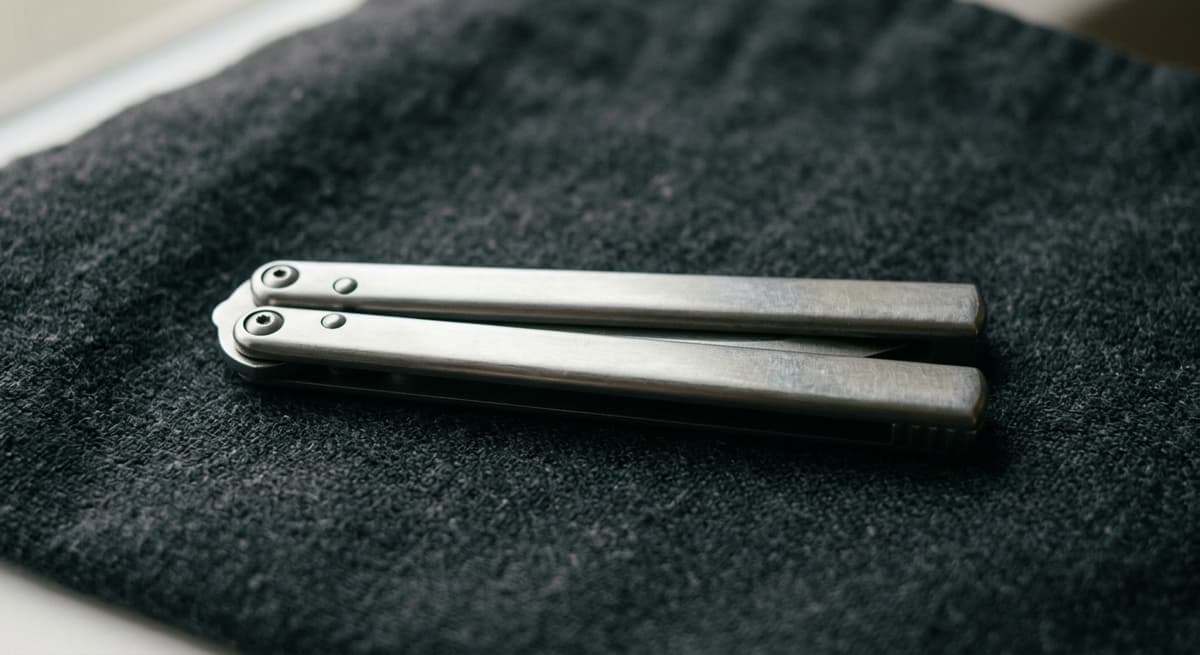
The statute defines "knife" for its own purposes as "any bladed hand instrument three inches (3") or longer that is capable of inflicting serious physical injury or death by cutting or stabbing," and it names a dirk, a sword or spear in a cane, a razor, an ice pick, a throwing star, a switchblade, and a butterfly knife as examples that fit the definition.
Subsection (c) separately lists ten circumstances in which carrying a weapon under this section is permissible, including being in your own dwelling, place of business, or on property you have an interest in; being a law enforcement officer, correctional officer, or member of the armed forces acting in that capacity; being on a journey outside the county where you live, other than through an airport security checkpoint; and holding a valid license to carry a concealed handgun while not in a place prohibited to license holders under § 5-73-306. A violation of § 5-73-120 is a Class A misdemeanor.
Furnishing a knife to a minor
Ark. Code Ann. § 5-73-109 makes it an offense to sell, barter, lease, give, rent, or otherwise furnish a firearm or other deadly weapon to a minor without the consent of a parent, guardian, or other person responsible for the minor's welfare. Arkansas's general definition of "deadly weapon," in Ark. Code Ann. § 5-1-102, reaches a firearm or "anything manifestly designed, made, or adapted for the purpose of inflicting death or serious physical injury," or "anything that in the manner of its use or intended use is capable of causing death or serious physical injury," a definition broad enough to cover a knife depending on the circumstances.

Furnishing a deadly weapon to a minor is a Class A misdemeanor by default. It becomes a Class B felony only if the item furnished is a handgun, an explosive or incendiary device, metal knuckles, a defaced firearm, or "another implement for the infliction of serious physical injury or death that serves no lawful purpose." An ordinary knife, which has ordinary lawful uses, would not fit that felony-tier language on its own.
Restricted places and local ordinances
Arkansas's weapons chapter does not contain a general list of places where knife carry is restricted. Ark. Code Ann. § 5-73-306 lists places, such as police stations, courtrooms, schools, and the state capitol, where a concealed handgun license does not authorize carry, but its text is scoped to licensed handgun carry and does not extend to knives. Separately, Ark. Code Ann. § 5-73-131 makes it a Class D felony for an incarcerated person to use, possess, make, repair, sell, or otherwise deal in a weapon that serves no common lawful purpose, which includes a knife, without the approval of the custodial authority.

Arkansas's general local-preemption statute, Ark. Code Ann. § 14-16-504, bars a city, town, or county from regulating "the ownership, transfer, transportation, carrying, or possession of firearms, ammunition for firearms, or components of firearms." That text reaches firearms, ammunition, and firearm components only; it does not mention knives, so it does not establish statewide knife preemption.
Federal law: what it does and does not reach
Federal law does not ban an individual from owning or carrying a switchblade. The Federal Switchblade Act, 15 U.S.C. §§ 1241 to 1245, instead regulates interstate commerce in switchblade knives, barring their manufacture, sale, transport, or introduction into interstate commerce, and, in 15 U.S.C. § 1245, makes it a federal offense to knowingly possess, manufacture, sell, or import a ballistic knife in or affecting interstate commerce or within federal territorial jurisdiction. Sections 1242 and 1243, the two federal offenses, do not apply to certain knives and people under 15 U.S.C. § 1244. A 2009 amendment, § 1244(5), exempts from those prohibitions any knife with a spring, detent, or other closure-bias mechanism that requires hand, wrist, or arm exertion on the blade itself to overcome the bias and assist opening, which is what keeps modern assisted-opening folding knives legal in interstate commerce. A separate exemption, § 1244(4), covers a person with only one arm possessing or carrying a switchblade with a blade three inches or less. None of this changes what Arkansas allows for ordinary carry; state law governs that question within Arkansas.
Disclaimer: This article provides general legal information about Arkansas's knife laws as of September 2026. It is not legal advice. Consult a lawyer licensed in Arkansas for advice about a specific situation. Because Arkansas's carrying statute turns on intent, the facts of a specific encounter, not just the knife carried, determine whether an offense occurred.
For a state-by-state comparison, see knife laws by state. Arkansas's self-defense statutes are covered separately on the Arkansas self-defense laws page.
Statutes cited reflect the Arkansas Code as codified. Arkansas's official code text is published through a licensed portal; check a current, official copy of the Arkansas Code for amendments enacted after this codification before relying on the exact wording quoted here. Last updated: 2026-09-18.
Frequently Asked Questions
Is it legal to carry a knife in Arkansas?
Yes, in general. Arkansas's carrying-a-weapon statute only makes it a crime to carry a knife, open or concealed, when it is carried with a purpose to attempt to unlawfully employ it as a weapon against a person. Simply having a knife on you is not itself the offense.
What counts as a 'knife' under Arkansas's carrying-a-weapon law?
Ark. Code Ann. 5-73-120 defines knife as any bladed hand instrument three inches or longer capable of inflicting serious physical injury or death by cutting or stabbing, and names a dirk, a cane sword or spear, a razor, an ice pick, a throwing star, a switchblade, and a butterfly knife as examples.
Is a switchblade legal to carry in Arkansas?
A switchblade is named in the statutory definition of knife, so it is covered by the same intent-based rule as any other qualifying knife: carrying one is only illegal if carried with a purpose to unlawfully employ it as a weapon against a person.
Does Arkansas have a statewide knife preemption law?
Arkansas's general local-preemption statute, Ark. Code Ann. 14-16-504, bars a city, town, or county from regulating the ownership, transfer, transportation, carrying, or possession of firearms, ammunition, or firearm components. That text reaches firearms only and does not mention knives, so it does not establish statewide knife preemption.
Updates
Independently fact-checked against the cited primary sources
Sources and References
- Ark. Code Ann. 5-73-120 - Carrying a weapon (intent element, knife definition, permissible-carry exceptions, Class A misdemeanor)(law.justia.com)
- Ark. Code Ann. 5-73-306 - Prohibited places (concealed handgun license holders only)(law.justia.com)
- Ark. Code Ann. 5-73-109 - Furnishing a deadly weapon to a minor(law.justia.com)
- Ark. Code Ann. 5-1-102 - Definitions (deadly weapon)(law.justia.com)
- Ark. Code Ann. 1-4-136 - State knife (Bowie knife official designation)(law.justia.com)
- Ark. Code Ann. 5-73-131 - Possession or use of weapons by incarcerated persons (Class D felony)(law.justia.com)
- Ark. Code Ann. 14-16-504 - Regulation by local unit of government (local preemption scoped to firearms, ammunition, and firearm components; no knife language)(law.justia.com)
- 15 U.S.C. 1241-1245 - Federal Switchblade Act, interstate commerce and importation scope(law.cornell.edu)
- 15 U.S.C. 1244 - exceptions, including the 2009 assisted-opening carve-out and the one-arm exception(law.cornell.edu)