
Utah
Is Jaywalking Illegal in Utah? Crossing Rules and Fines (2026)
Independently fact-checked against primary sources (last audited October 10, 2026). · 20 primary sources cited on this page. How we verify our legal content
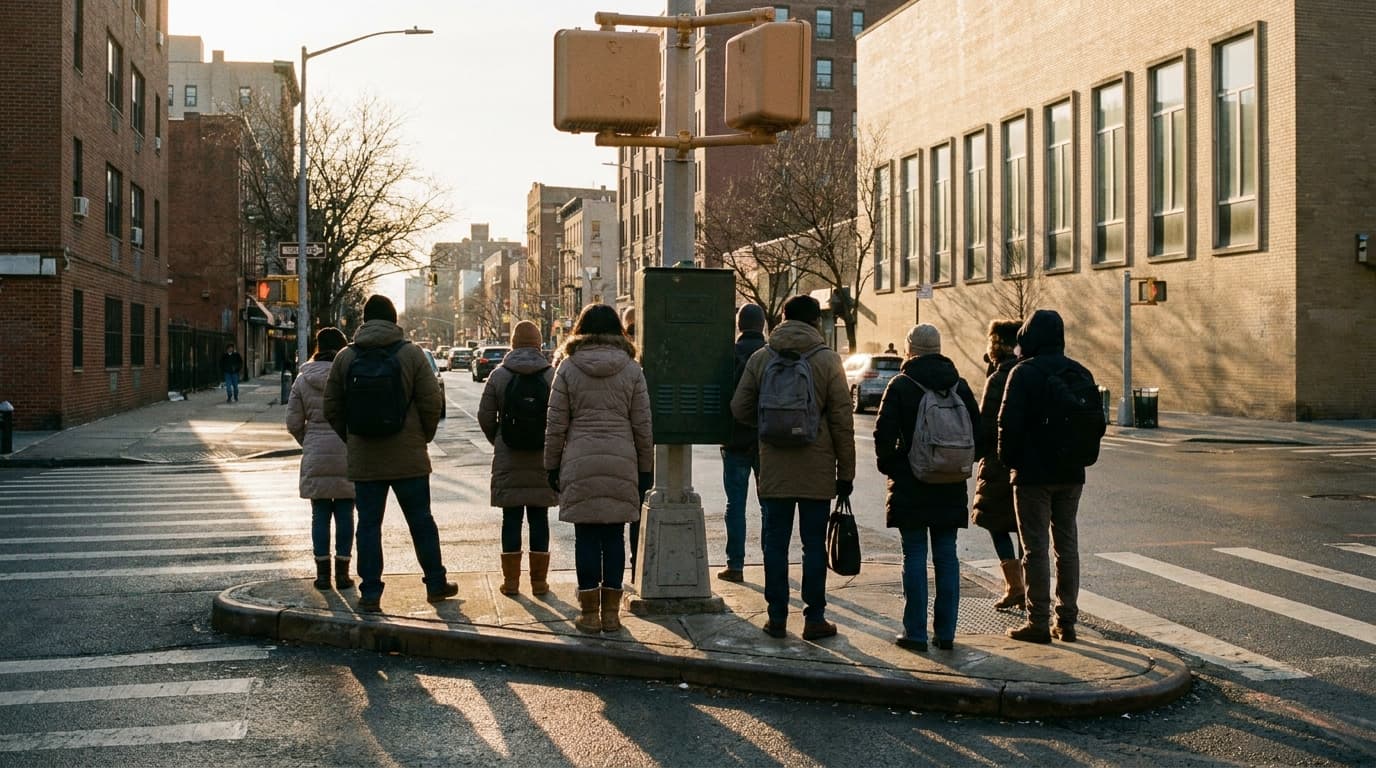
In Utah, the crossing rules people call jaywalking are in Utah Code 41-6a-1003. A pedestrian crossing outside a marked crosswalk or an unmarked crosswalk at an intersection must yield the right-of-way to all vehicles, may not cross between adjacent intersections with operating traffic-control signals except in a marked crosswalk, and may not cross an intersection diagonally unless a traffic-control device allows it. The statute itself says "A violation of this section is an infraction." The Utah courts' 2026 Uniform Fine Schedule lists a suggested fine of $130 for 41-6a-1003, while the law caps the fine for an infraction conviction at $750 (Utah Code 76-3-301). To compare other states, see our guide to jaywalking laws by state.
Information last verified on 2026-10-10. This article has not been reviewed by a licensed lawyer.
Jurisdiction scope: This article covers Utah state law: the pedestrian sections of Title 41, Chapter 6a, Part 10 (41-6a-1001, 1002, 1003, 1009 and 1010), the signal sections 41-6a-305 and 306, the crosswalk and pedestrian definitions in 41-6a-102, the other Part 10 sections (41-6a-1004 through 1008), local powers in 41-6a-208, the infraction fine ceiling in 76-3-301, the surcharge in 51-9-401, the conviction definition in 53-3-102, stops and identification under 77-7-15 and 76-8-301.5, and the Utah courts' 2026 Uniform Fine Schedule. It does not cover the text of any city or county ordinance, the exact total owed on a ticket, insurance effects, injury claims after a crash, or the law of other states.
Is jaywalking illegal in Utah?
It depends on where and how you cross. Most of Utah's crossing rules are a duty to yield: crossing away from a crosswalk is allowed under state law, but vehicles go first. Two are flat rules that apply even when the road is empty: no crossing between two adjacent signalized intersections except in a marked crosswalk, and no diagonal crossing unless a traffic-control device allows it. A posted sign can add a restriction, because pedestrians must obey traffic-control devices that apply to them (41-6a-1001). A city or county can also require crosswalk use in a business district or on a designated highway (41-6a-208(2)(p)).
| Situation | Utah rule |
|---|---|
| Crossing outside a marked crosswalk or an unmarked crosswalk at an intersection | Allowed if the pedestrian yields the right-of-way to all vehicles (41-6a-1003(1)), unless a local ordinance requires crosswalks in a business district or on a designated highway (41-6a-208(2)(p)) |
| Crossing where there is a pedestrian tunnel or overhead pedestrian crossing | The pedestrian must yield the right-of-way to all vehicles (41-6a-1003(2)) |
| Crossing between adjacent intersections with traffic-control signals in operation | Only in a marked crosswalk (41-6a-1003(3)) |
| Crossing an intersection diagonally | Barred unless authorized by a traffic-control device, and then only as the device directs (41-6a-1003(4)) |
| Crossing at an unmarked crosswalk a highway authority has restricted | Barred, or yield required, where traffic-control devices showing the restriction are in place (41-6a-1010) |
| Suddenly leaving a curb into the path of a vehicle so close as to be an immediate hazard | Barred (41-6a-1002(1)(c)) |
| Starting to cross on a flashing Don't Walk or Upraised Hand; entering on a steady one | Barred (41-6a-306(2) and (3)) |
| Starting to cross on steady yellow, or entering the roadway on a steady red alone, with no pedestrian signal directing otherwise | Barred (41-6a-305(3)(b) and (4)(b)) |
| Walking along a roadway where a sidewalk is provided and its use is practicable | Barred (41-6a-1009(1)) |
| Walking along or on a no-access freeway, except during an emergency | Barred (41-6a-1009(7)) |
| Impeding or blocking traffic on an interstate, freeway, state highway, state route, or a paved highway with a speed limit of 35 mph or higher | Barred; a third or subsequent violation in a one-year period is a class C misdemeanor (41-6a-1009(4) and (9)(b)) |
Crossing outside a crosswalk
The basic rule is Utah Code 41-6a-1003(1):
"(1) A pedestrian crossing a roadway at any point other than within a marked crosswalk or within an unmarked crosswalk at an intersection shall yield the right-of-way to all vehicles on the roadway."
This is a duty to yield, not a ban. A pedestrian who crosses mid-block, waits for a gap and lets traffic pass complies with subsection (1), subject to the signalized-block and diagonal rules below and to any posted restriction. Subsection (2) applies the same yield duty to "A pedestrian crossing a roadway at a point where there is a pedestrian tunnel or overhead pedestrian crossing." A broader rule in 41-6a-1009(6) backs this up: "Except as otherwise provided in this chapter, a pedestrian on a roadway shall yield the right-of-way to all vehicles on the roadway."
What counts as a crosswalk
An unmarked crosswalk at an intersection is treated the same as a painted one for the yield rule, and Utah's definition reaches intersections with a sidewalk on only one side. Utah Code 41-6a-102(16) provides:
"'Crosswalk' means: (a) that part of a roadway at an intersection included within the connections of the lateral lines of the sidewalks on opposite sides of the highway measured from: (i)(A) the curbs; or (B) in the absence of curbs, from the edges of the traversable roadway; and (ii) in the absence of a sidewalk on one side of the roadway, that part of a roadway included within the extension of the lateral lines of the existing sidewalk at right angles to the centerline; or (b) any portion of a roadway at an intersection or elsewhere distinctly indicated for pedestrian crossing by lines or other markings on the surface."
Part (a) is built from sidewalk lines, and its clause (ii) extends the crosswalk across the road from an existing sidewalk on one side. Part (b) covers marked crossings at an intersection "or elsewhere." The same section defines "pedestrian" as a person traveling "on foot" or "in a wheelchair" (41-6a-102(62)).
Mid-block between signals, and diagonal crossing
Subsections (3) and (4) of 41-6a-1003 are flat rules rather than yield rules:
"(3) Between adjacent intersections at which traffic-control signals are in operation, a pedestrian may not cross at any place except in a marked crosswalk. (4)(a) A pedestrian may not cross a roadway intersection diagonally unless authorized by a traffic-control device. (b) If a pedestrian is authorized to cross diagonally under Subsection (4)(a), the pedestrian shall cross only as directed by the appropriate traffic-control device."
Subsection (3) applies only on a stretch of road between two adjacent intersections where signals are operating. On that stretch, yielding is not enough: the crossing must be in a marked crosswalk. Subsection (5) states: "A violation of this section is an infraction."
A separate rule applies everywhere, including in crosswalks. Utah Code 41-6a-1002(1)(c) provides: "A pedestrian may not suddenly leave a curb or other place of safety and walk or run into the path of a vehicle which is so close as to constitute an immediate hazard."
Restricted crossings and posted signs
Utah lets a road authority close an unmarked crosswalk, but only with signs or other devices. Utah Code 41-6a-1010 provides:
"(1) A highway authority in its respective jurisdiction may, after an engineering and traffic investigation, designate unmarked crosswalk locations where: (a) pedestrian crossing is prohibited; or (b) pedestrians shall yield the right-of-way to vehicles. (2) The restrictions in Subsection (1) are effective only when traffic-control devices indicating the restrictions are in place."
More broadly, the Traffic Code does "not prevent a local highway authority for a highway under its jurisdiction and within the reasonable exercise of police power, from: ... (b) regulating traffic by means of a peace officer or a traffic-control device" (41-6a-208(2)(b)). And under 41-6a-1001(1), "A pedestrian shall obey the instructions of a traffic-control device specifically applicable to the pedestrian unless otherwise directed by a peace officer." A violation of 41-6a-1001 is an infraction (41-6a-1001(3)). Utah Code 41-6a-208(2)(p) also lets a local highway authority prohibit pedestrians "from crossing a highway in a business district or any designated highway except in a crosswalk." The sign requirement in 41-6a-208(4) lists other local powers but not (2)(p), so that subsection does not tie an ordinance of this kind to posted signs. Before crossing mid-block, watch for posted signs and check your city's or county's ordinances, especially downtown.
Walk signals and traffic lights
Under 41-6a-1001(2), "A pedestrian is subject to traffic and pedestrian-control signals under Sections 41-6a-305 and 41-6a-306."
Where pedestrian signals are installed, 41-6a-306 controls. A pedestrian facing a steady "Walk" or "Walking Person" signal "has the right-of-way and may proceed across the roadway in the direction of the signal" (41-6a-306(1)). The section continues:
"(2) A pedestrian facing a flashing 'Don't Walk' or 'Upraised Hand' of a pedestrian traffic-control signal may not start to cross the roadway in the direction of the signal, but a pedestrian who has partially completed crossing on the walk signal shall proceed to a sidewalk or safety island. (3) A pedestrian facing a steady 'Don't Walk' or 'Upraised Hand' of a pedestrian traffic-control signal may not enter the roadway in the direction of the signal. (4) A violation of this section is an infraction."
Utah's Don't Walk rules have no exception for an empty road. A pedestrian who started on the walk signal keeps going to a sidewalk or safety island.
Where there is no pedestrian signal, the ordinary traffic light governs pedestrians too. Utah Code 41-6a-305(1)(b) states that "Traffic-control signals apply to the operator of a vehicle and to a pedestrian as provided in this section," and the section then provides:
- On green: "Unless otherwise directed by a pedestrian traffic-control signal under Section 41-6a-306, a pedestrian facing any green signal other than a green turn arrow may proceed across the roadway within any marked or unmarked crosswalk" (41-6a-305(2)(c)).
- On steady yellow or a yellow arrow: "Unless otherwise directed by a pedestrian traffic-control signal under Section 41-6a-306, a pedestrian facing a steady circular yellow or yellow arrow signal is advised that there is insufficient time to cross the roadway before a red indication is shown, and a pedestrian may not start to cross the roadway" (41-6a-305(3)(b)).
- On steady red: "Unless otherwise directed by a pedestrian traffic-control signal under Section 41-6a-306, a pedestrian facing a steady red signal alone may not enter the roadway" (41-6a-305(4)(b)).
Walking along the road
Utah Code 41-6a-1009 covers walking along a road, not just crossing it:
"(1) Where there is a sidewalk provided and its use is practicable, a pedestrian may not walk along or on an adjacent roadway. (2) Where a sidewalk is not provided, a pedestrian walking along or on a highway shall walk only on the shoulder, as far as practicable from the edge of the roadway. (3) Where a sidewalk or a shoulder is not available, a pedestrian walking along or on a highway shall: (a) walk as near as practicable to the outside edge of the roadway; and (b) if on a two-way roadway, walk only on the left side of the roadway facing traffic."
Section 41-6a-1009 adds these rules:
- Freeways: "A pedestrian may not walk along or on a no-access freeway facility except during an emergency" (41-6a-1009(7)).
- Blocking traffic: "An individual may not impede or block traffic" on an interstate, a freeway, a state highway, a state route, or a highway that is paved with a speed limit of 35 miles per hour or higher, has a median, or has a fixed guideway, including shoulders, on-ramps, off-ramps and the area between the roadways of a divided highway (41-6a-1009(4)(a) and (b)). That conduct includes a pedestrian taking money or property from a person in a motor vehicle in those areas (41-6a-1009(4)(d)), and a county or municipality may adopt its own rule for those locations (41-6a-1009(4)(f)).
- Intoxication: "A pedestrian who is under the influence of alcohol or any drug to a degree which renders the pedestrian a hazard may not walk or be on a highway except on a sidewalk or sidewalk area" (41-6a-1009(5)).
Its penalty clause reads: "(9)(a) Except as provided in Subsection (9)(b), a violation of this section is an infraction. (b) A third or subsequent violation of Subsection (4) in a one-year period is a class C misdemeanor."
Other pedestrian rules
- Emergency vehicles: "A pedestrian shall yield the right-of-way to an authorized emergency vehicle upon the immediate approach of an authorized emergency vehicle using audible or visual signals" (41-6a-1004(1)). A violation is an infraction (41-6a-1004(3)).
- Railroad crossings: "A pedestrian may not pass through, around, over, or under or remain on a crossing gate or barrier at an active railroad grade crossing or bridge" (41-6a-1005(2)). A violation is an infraction (41-6a-1005(6)).
What drivers owe pedestrians
A pedestrian's duty to yield outside a crosswalk sits alongside duties Utah places on drivers in 41-6a-1002:
"(1)(a) Except as provided under Subsection (2), the operator of a vehicle shall yield the right-of-way by slowing down or stopping if necessary: (i) to a pedestrian crossing the roadway within a crosswalk when the pedestrian is on the half of the roadway upon which the vehicle is traveling; or (ii) when the pedestrian is approaching so closely from the opposite half of the roadway as to be in danger."
Section 41-6a-1002 adds two more driver duties, and other sections add more:
- School crosswalks: "The operator of a vehicle approaching a school crosswalk shall come to a complete stop at the school crosswalk if the crosswalk is occupied by a person" (41-6a-1002(2)).
- Passing a stopped car: "If a vehicle is stopped at a marked crosswalk or at any unmarked crosswalk at an intersection to permit a pedestrian to cross the roadway, the operator of any other vehicle approaching from the rear may not overtake and pass the stopped vehicle" (41-6a-1002(3)). The 2026 Uniform Fine Schedule lists a suggested fine of $350 for this violation.
- Turning on green: a driver facing a circular green signal, "including an operator turning right or left," must yield "to pedestrians lawfully within the intersection or an adjacent crosswalk" (41-6a-305(2)(a)(ii)), and a driver on a green arrow must yield "to pedestrians lawfully within an adjacent crosswalk" (41-6a-305(2)(b)(ii)).
- Turning on red: a driver turning after stopping at a red signal must yield to "a pedestrian lawfully within an adjacent crosswalk" (41-6a-305(4)(c)(ii)).
- Due care: a driver "shall: (a) exercise care to avoid colliding with a pedestrian; (b) give an audible signal when necessary; and (c) exercise appropriate precaution if the operator of the vehicle observes a child or an obviously confused, incapacitated, or intoxicated person." This section "supersedes any conflicting provision" of the chapter or a local ordinance (41-6a-1006).
- Blind pedestrians: a driver must yield to a blind or visually impaired pedestrian carrying a clearly visible white cane or accompanied by a guide dog in harness (41-6a-1007(1)(a)).
- Crossing a sidewalk: "The operator of a vehicle crossing a sidewalk shall yield the right-of-way to any pedestrian and all other traffic on the sidewalk" (41-6a-1008).
Jaywalking fine and penalty in Utah
Utah writes the penalty class into the pedestrian sections themselves. A violation of 41-6a-1003 (crossing rules), 41-6a-1001 (obeying devices) or 41-6a-306 (pedestrian signals) is an infraction, and so is a violation of 41-6a-1009 other than a third or subsequent violation of its subsection (4) within a year.
Two different figures matter, and they should not be confused:
- The statutory ceiling. Utah Code 76-3-301(1)(e) allows a fine "not exceeding ... $750 for a class C misdemeanor conviction or infraction conviction." That is the most a court may impose, not the usual ticket.
- The scheduled fine. The Utah courts' Uniform Fine Schedule (2026 edition, last updated July 1, 2026) gives courts a suggested fine for each offense. The schedule is a sentencing guide and is "not intended to supplant ... a court's authority to impose a just sentence," so the judge sets the final amount.
| Offense | Class | Suggested fine (2026 schedule) | Surcharge column |
|---|---|---|---|
| 41-6a-1003, pedestrians yielding right-of-way (crossing rules) | Infraction | $130 | 35% |
| 41-6a-305(4)(b), pedestrian entering roadway at steady red signal | Infraction | $60 | 0% |
| 41-6a-306, pedestrian disobeying pedestrian signal | Infraction | $50 | 0% |
| 41-6a-1002(3), driver passing a vehicle stopped at a marked or unmarked crosswalk | Infraction | $350 | 35% |
The schedule describes its Suggested Fine column as "The total Suggested Fine and Security Surcharge. This includes the $60 security surcharge for justice courts." Its surcharge column follows Utah Code 51-9-401, which sets a surcharge of 35% on conviction of offenses like these, imposed "in addition to the fine charged," and bars a surcharge "upon nonmoving traffic violations" (51-9-401(1)(b)(ii), (2)(a) and (4)). The schedule lists the two pedestrian signal entries as non-moving traffic, which is why their surcharge column reads 0%. The court handling the citation can give the exact total.
The schedule also lets the recommended amount rise if the ticket is ignored: it "may be increased by $50 if the defendant fails to appear or pay within fourteen days after receiving the citation," and by an additional $75 after forty days. For driver-license purposes, "Conviction" includes "the payment of a fine or court costs" (Utah Code 53-3-102(8)). The schedule marks the 41-6a-1003 entry "N" in its DLD Reportable column, the column for offenses reported to the Driver License Division.
Being stopped by police
Under Utah Code 77-7-15, "A peace officer may stop any individual in a public place when the officer has a reasonable suspicion to believe the individual has committed or is in the act of committing or is attempting to commit a public offense and may demand the individual's name, address, date of birth, and an explanation of the individual's actions." If an officer lawfully stops you for a crossing violation and demands your name or date of birth, refusing can be charged as failure to disclose identity, a class B misdemeanor, subject to the conditions in Utah Code 76-8-301.5(2) and (3). That is a heavier class than the infraction itself.
If a pedestrian is hit by a car
Whether a pedestrian was crossing lawfully under 41-6a-1003 can come up after a collision, alongside the driver duties in 41-6a-1002. For how fault and insurance work after a crash, see Utah car accident laws. Riders of electric scooters follow their own rules, covered in Utah e-scooter laws.
Related pages
- Jaywalking laws by state
- Utah car accident laws
- Utah e-scooter laws
- Idaho jaywalking laws
- Nevada jaywalking laws
This article provides general legal information about Utah law, not legal advice. For advice about a specific situation, contact a lawyer licensed in Utah or the court named on your citation.
Last updated: 2026-10-10.
Frequently Asked Questions
Is jaywalking illegal in Utah?
Crossing outside a marked crosswalk or an unmarked crosswalk at an intersection is allowed under state law if you yield the right-of-way to all vehicles (Utah Code 41-6a-1003(1)), unless a city or county ordinance requires crosswalks in a business district or on a designated highway (41-6a-208(2)(p)). Between adjacent signalized intersections you may cross only in a marked crosswalk, diagonal crossing is barred unless a device authorizes it, and posted restrictions apply (41-6a-1003, 41-6a-1010).
What is the fine for jaywalking in Utah?
The Utah courts' 2026 Uniform Fine Schedule lists a suggested fine of $130 for a 41-6a-1003 crossing violation, with a 35% entry in its surcharge column. The schedule is a guide; the most a court may impose for an infraction conviction is $750 (Utah Code 76-3-301).
Is jaywalking a crime in Utah?
A violation of the crossing section is an infraction (Utah Code 41-6a-1003(5)), the same class as violations of the pedestrian signal section (41-6a-306(4)). A third or subsequent violation within a year of 41-6a-1009(4), which bars impeding or blocking traffic on interstates, freeways, state highways and other major roads, is a class C misdemeanor (41-6a-1009(9)(b)).
Can a city ban crossing at a corner in Utah?
A highway authority may, after an engineering and traffic investigation, prohibit pedestrian crossing at an unmarked crosswalk, but the restriction is effective only when traffic-control devices showing it are in place (Utah Code 41-6a-1010).
Can I cross on Don't Walk in Utah?
No. On a flashing Don't Walk or Upraised Hand you may not start to cross, and on a steady one you may not enter the roadway (Utah Code 41-6a-306). The 2026 schedule lists a suggested fine of $50 for disobeying a pedestrian signal.
Which side of the road should I walk on in Utah?
Use the sidewalk where one is provided and its use is practicable (Utah Code 41-6a-1009(1)). With no sidewalk, walk on the shoulder; with neither, walk near the outside edge and, on a two-way roadway, only on the left side facing traffic (41-6a-1009(2) and (3)).
Do drivers have to stop for pedestrians in Utah?
A driver must yield to a pedestrian in a crosswalk by slowing down or stopping if necessary, must stop at a school crosswalk occupied by a person, and may not pass a vehicle stopped at a crosswalk for a pedestrian (Utah Code 41-6a-1002). Drivers turning on a green or red signal must yield to pedestrians lawfully in an adjacent crosswalk (41-6a-305), and every driver must exercise care to avoid colliding with a pedestrian (41-6a-1006).
Updates
Independently fact-checked against the cited primary sources
The Law Behind This Article
This article rests on the statutory provisions below, held in our own legal record and retrieved from the official source. Tap a section to read the operative text.
Utah Code, Title 41: Motor Vehicles
§ 41-6a-1003Pedestrians yielding right-of-way -- Limits on pedestrians.In force
(1) A pedestrian crossing a roadway at any point other than within a marked crosswalk or within an unmarked crosswalk at an intersection shall yield the right-of-way to all vehicles on the roadway. (2) A pedestrian crossing a roadway at a point where there is a pedestrian tunnel or overhead pedestrian crossing shall yield the right-of-way to all vehicles on the roadway. (3) Between adjacent intersections at which traffic-control signals are in operation, a pedestrian may not cross at any place except in a marked crosswalk. (4) (a) A pedestrian may not cross a roadway intersection diagonally unless authorized by a traffic-control device. (b) If a pedestrian is authorized to cross diagonally under Subsection (4)(a), the pedestrian shall cross only as directed by the appropriate traffic-control device. (5) A violation of this section is an infraction.
Official text (excerpt) · last checked 2026-07-29 · Read the full text in our law library · Verify at le.utah.gov
§ 41-6a-1002Pedestrians' right-of-way -- Duty of pedestrian.In force
(1) (a) Except as provided under Subsection (2), the operator of a vehicle shall yield the right-of-way by slowing down or stopping if necessary: (i) to a pedestrian crossing the roadway within a crosswalk when the pedestrian is on the half of the roadway upon which the vehicle is traveling; or (ii) when the pedestrian is approaching so closely from the opposite half of the roadway as to be in danger. (b) Subsection (1)(a) does not apply under conditions of Subsection 41-6a-1003(2). (c) A pedestrian may not suddenly leave a curb or other place of safety and walk or run into the path of a vehicle which is so close as to constitute an immediate hazard. (2) The operator of a vehicle approaching a school crosswalk shall come to a complete stop at the school crosswalk if the crosswalk is occupied by a person. (3) If a vehicle is stopped at a marked crosswalk or at any unmarked crosswalk at an intersection to permit a pedestrian to cross the roadway, the operator of any other vehicle approaching from the rear may not overtake and pass the stopped vehicle.
Official text (excerpt) · last checked 2026-07-29 · Read the full text in our law library · Verify at le.utah.gov
§ 41-6a-1010Unmarked crosswalk locations -- Restrictions on pedestrian.In force
(1) A highway authority in its respective jurisdiction may, after an engineering and traffic investigation, designate unmarked crosswalk locations where: (a) pedestrian crossing is prohibited; or (b) pedestrians shall yield the right-of-way to vehicles. (2) The restrictions in Subsection (1) are effective only when traffic-control devices indicating the restrictions are in place.
Official text (excerpt) · last checked 2026-07-29 · Read the full text in our law library · Verify at le.utah.gov
§ 41-6a-305Traffic-control signal -- At intersections -- At place other than intersection -- Color of light signal -- Inoperative traffic-control signals -- Affirmative defense.In force
(1) (a) Green, red, and yellow are the only colors that may be used in a traffic-control signal, except for a: (i) pedestrian traffic-control signal that may use white and orange; and (ii) rail vehicle that may use white. (b) Traffic-control signals apply to the operator of a vehicle and to a pedestrian as provided in this section. (2) (a) (i) Except as provided in Subsection (2)(a)(ii), the operator of a vehicle facing a circular green signal may: (A) proceed straight through the intersection; (B) turn right; or (C) turn left. (ii) The operator of a vehicle facing a circular green signal, including an operator turning right or left: (A) shall yield the right-of-way to other vehicles and to pedestrians lawfully within the intersection or an adjacent crosswalk at the time the signal is exhibited; and (B) may not turn right or left if a sign at the intersection prohibits the turn.
Official text (excerpt) · last checked 2026-07-29 · Read the full text in our law library · Verify at le.utah.gov
Search our full record of US law — 2.1 million sections, every state + federal →
Sources and References
- Utah Code 41-6a-1003, Pedestrians yielding right-of-way, Limits on pedestrians(le.utah.gov).gov
- Utah Courts, 2026 Uniform Fine Schedule(utcourts.gov).gov
- Utah Code 76-3-301, Fines of individuals(le.utah.gov).gov
- Utah Code 41-6a-1001, Pedestrians subject to traffic-control devices, Other controls(le.utah.gov).gov
- Utah Code 41-6a-1010, Unmarked crosswalk locations, Restrictions on pedestrian(le.utah.gov).gov
- Utah Code 41-6a-306, Pedestrian traffic-control signals, Rights and duties(le.utah.gov).gov
- Utah Code 41-6a-305, Traffic-control signal(le.utah.gov).gov
- Utah Code 41-6a-1002, Pedestrians' right-of-way, Duty of pedestrian(le.utah.gov).gov
- Utah Code 41-6a-1009, Use of roadway by pedestrians, Prohibited activities(le.utah.gov).gov
- Utah Code 41-6a-102, Definitions (crosswalk, pedestrian)(le.utah.gov).gov
- Utah Code 41-6a-208, Regulatory powers of local highway authorities(le.utah.gov).gov
- Utah Code 41-6a-1004, Emergency vehicle, Pedestrian to yield(le.utah.gov).gov
- Utah Code 41-6a-1005, Limitation on pedestrians related to railroad grade crossings or bridges(le.utah.gov).gov
- Utah Code 41-6a-1006, Vehicles to exercise due care to avoid pedestrians(le.utah.gov).gov
- Utah Code 41-6a-1007, Operators to yield right-of-way to blind pedestrian(le.utah.gov).gov
- Utah Code 41-6a-1008, Vehicle crossing sidewalk, Operator to yield(le.utah.gov).gov
- Utah Code 51-9-401, Surcharge, Application(le.utah.gov).gov
- Utah Code 53-3-102, Driver license definitions (conviction)(le.utah.gov).gov
- Utah Code 77-7-15, Authority of peace officer to stop and question suspect(le.utah.gov).gov
- Utah Code 76-8-301.5, Failure to disclose identity(le.utah.gov).gov