
Idaho
Is Jaywalking Illegal in Idaho? Crossing Rules and Fines (2026)
Independently fact-checked against primary sources (last audited October 10, 2026). · 27 primary sources cited on this page. How we verify our legal content
Idaho state law does not ban crossing outside a crosswalk outright, though Idaho Code 49-210 lets cities, counties and the Idaho Transportation Department prohibit crossing except in a crosswalk. Under Idaho Code 49-704(1), a pedestrian crossing at any point other than a marked crosswalk or an unmarked crosswalk at an intersection must yield the right-of-way to all vehicles; the same section flatly bars crossing between two adjacent signalized intersections except in a marked crosswalk, and bars diagonal crossing of an intersection unless traffic-control devices authorize it. A violation of these rules is an infraction, a civil public offense, and the Idaho Supreme Court's penalty schedule effective July 1, 2025 lists a $5.00 fixed penalty for pedestrian infractions, $61.50 once court costs and fees are added. For other states, see our guide to jaywalking laws by state.
Information last verified on 2026-10-10. This article has not been reviewed by a licensed lawyer.
Jurisdiction scope: This article covers Idaho state law: the pedestrian sections of Idaho Code Title 49, chapter 7 (49-701 to 49-710), the signal rules in 49-802 and 49-803, the pedestrian intoxication rule in 49-1426, the infraction rules in 49-110, 49-1501 to 49-1503 and 18-113A, the Idaho Supreme Court's infraction penalty schedule, and the Idaho Infraction Rules. It does not catalog city or county ordinances, injury claims after a crash, or the law of other states.
Is jaywalking illegal in Idaho?
It depends on where and how you cross. Idaho's code separates a duty to yield, which makes crossing outside a crosswalk lawful if you give way to traffic, from a few specific bans.
| Situation | Idaho rule |
|---|---|
| Crossing outside a marked crosswalk or an unmarked crosswalk at an intersection | Allowed, but the pedestrian must yield to all vehicles (49-704(1)), unless a local authority has prohibited crossing there except in a crosswalk (49-210) |
| Crossing where a pedestrian tunnel or overhead crossing is provided | Pedestrian must yield to all vehicles (49-704(2)) |
| Crossing between adjacent intersections with traffic-control signals in operation | Only in a marked crosswalk (49-704(3)) |
| Crossing an intersection diagonally | Barred unless traffic-control devices authorize it (49-704(4)) |
| Crossing at an angle where no crosswalk or device indicates otherwise | Must cross at right angles to the curb or by the shortest route (49-702(5)) |
| Starting to cross on a flashing or steady Don't Walk or Wait signal | Barred (49-803(2)) |
| Entering the traffic lanes facing a steady red light or red arrow | Barred unless a pedestrian signal directs otherwise (49-802(3)(d)) |
| Entering the highway facing a green turn arrow | Barred unless a pedestrian signal directs otherwise (49-802(1)(d)) |
| Suddenly leaving a curb into the path of a vehicle too close to stop | Barred (49-702(2)) |
| Walking on the roadway where a usable sidewalk is provided | Unlawful (49-708(1)) |
| Standing on a highway to solicit a ride | Barred (49-709(1)) |
| Approaching emergency or police vehicle using its signals | Pedestrian must yield the right-of-way (49-705(1)) |
| Passing a closed or moving railroad or bridge gate or barrier | Barred (49-710(2)) |
| Being on a highway, other than a sidewalk, while impaired to the point of being a hazard | Barred; a misdemeanor, not an infraction (49-1426, 49-236(1)) |
Crossing outside a crosswalk in Idaho
Idaho Code 49-704 holds the core rules in four subsections:

"(1) Every pedestrian crossing a highway at any point other than within a marked crosswalk or within an unmarked crosswalk at an intersection shall yield the right-of-way to all vehicles upon the highway. (2) Any pedestrian crossing a highway at a point where a pedestrian tunnel or overhead pedestrian crossing has been provided shall yield the right-of-way to all vehicles upon the highway. (3) Between adjacent intersections at which traffic-control signals are in operation, pedestrians shall not cross at any place except in a marked crosswalk. (4) No pedestrian shall cross a highway intersection diagonally unless authorized by traffic-control devices. When authorized to cross diagonally, pedestrians shall cross only in accordance with the traffic-control devices pertaining to crossing movements."
Subsections (1) and (2) are yield duties: a mid-block crossing on an ordinary street is lawful when the pedestrian lets traffic go first and crosses "at right angles to the curb or by the shortest route to the opposite curb" (49-702(5)), unless a local rule covers that street (see below). Subsection (3) is a prohibition that applies only on a block with working signals at both adjacent intersections, and subsection (4) bars a diagonal crossing of an intersection unless signs or signals allow it.
Section 49-704(1) also treats an "unmarked crosswalk at an intersection" the same way as a marked one. Idaho Code 49-104(16) defines a crosswalk as "(a) That part of a highway at an intersection included within the connections of the lateral lines of the sidewalks on opposite sides of the highway measured from the curbs or in the absence of curbs, from the edges of the traversable highway; and in the absence of a sidewalk on one side of the highway, that part of a highway included within the extension of the lateral lines of the existing sidewalk at right angles to the centerline" and "(b) Any portion of a highway at an intersection or elsewhere distinctly indicated for pedestrian crossing by lines or other markings on the surface."
City and county rules
Idaho Code 49-210 provides: "Local authorities by ordinance and the department by erecting appropriate traffic-control devices, are hereby empowered within their respective jurisdictions to prohibit pedestrians from crossing any highway except in a crosswalk." Section 49-208(1) also lets local authorities, "within the reasonable exercise of the police power," engage in "(n) Prohibiting pedestrians from crossing a highway in a business district or any designated highway except in a crosswalk; (o) Restricting pedestrian crossings at unmarked crosswalks."
A rule adopted under 49-208(1) has a notice condition. Under 49-208(2), "No ordinance or regulation enacted under paragraphs (d) through (p) of subsection (1) of this section shall be effective until traffic-control devices giving notice of local traffic regulations are erected upon or at the entrances to the highway or part affected as may be most appropriate."
Walk signals and traffic lights
Idaho Code 49-701 requires a pedestrian to "obey the instructions of any traffic-control devices specifically applicable to him, unless otherwise directed by a peace officer," and makes pedestrians "subject to traffic and pedestrian-control signals as provided in sections 49-802 and 49-803."
The pedestrian signal rule is in 49-803(2):
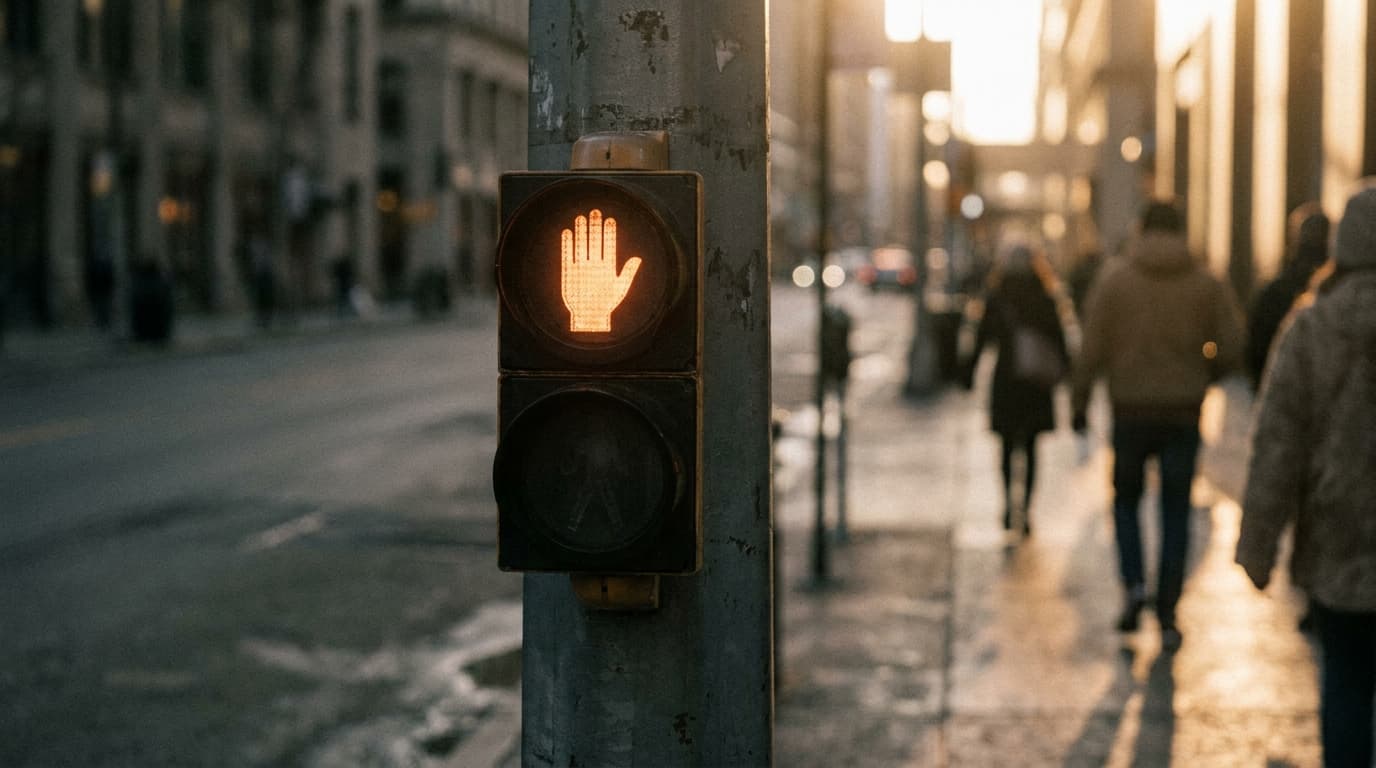
"Flashing or Steady "Don't Walk" or "Wait". No pedestrian shall start to cross the highway in the direction of the signal, but any pedestrian who has partially completed crossing shall proceed to a sidewalk or safety island while the "Don't Walk" or "Wait" signal is showing."
The rule is about starting. A pedestrian already partway across when the signal changes is told to keep going to the sidewalk or a safety island, not to turn back.
Where there is no Walk or Don't Walk signal, the ordinary traffic light binds pedestrians under 49-802:
- Circular green: a pedestrian, "unless prohibited by a sign or otherwise directed by a pedestrian-control signal, as provided in section 49-803, Idaho Code, may proceed across the highway within any marked or unmarked crosswalk, but shall yield the right-of-way to vehicles lawfully within the intersection at the time that signal is first shown" (49-802(1)(c)).
- Steady yellow: a pedestrian facing it, unless a pedestrian-control signal directs otherwise, "is being warned that there is insufficient time to cross the highway" (49-802(2)(b)).
- Steady red: "Unless otherwise directed by a pedestrian-control signal, a pedestrian facing a steady circular red or red arrow signal shall not enter the traffic lanes of a highway" (49-802(3)(d)).
For green arrows, 49-802(1)(d) provides that "A pedestrian facing a green arrow turn signal, unless otherwise directed by a pedestrian-control signal, as provided in section 49-803, Idaho Code, shall not enter the highway."
Walking along the road
Where there is no crossing involved, Idaho Code 49-708 sets the order of preference:
- Where a sidewalk is provided and its use is practicable, "it shall be unlawful for any pedestrian to walk along and upon an adjacent roadway" (49-708(1)).
- Where no sidewalk is available, a pedestrian "shall walk only on a shoulder, as far as practicable from the edge of the roadway" (49-708(2)).
- Where there is neither, a pedestrian "shall walk as near as practicable to an outside edge of the roadway, and, if on a two-way highway, shall walk only on the left side of the highway" (49-708(3)).
- "Except as otherwise provided in this title, any pedestrian upon a roadway shall yield the right-of-way to all vehicles upon the roadway" (49-708(4)).
Two other rules apply to people on foot. Section 49-709(1) provides that "No person shall stand on a highway for the purpose of soliciting a ride." Section 49-1426 provides that "A pedestrian who is under the influence of alcohol or any drug to a degree which renders him a hazard shall not walk or be upon a highway except on a sidewalk."
What drivers owe pedestrians in Idaho
A pedestrian's duty to yield outside a crosswalk sits alongside a driver's duty inside one. Idaho Code 49-702(1) provides: "When traffic-control signals are not in place or not in operation the driver of a vehicle shall yield the right-of-way, slowing down or stopping, if need be, to yield to a pedestrian crossing the highway within a crosswalk."
The same section puts a limit on pedestrians. Under 49-702(2), "No pedestrian shall suddenly leave a curb or other place of safety and walk or run into the path of a vehicle which is so close as to constitute an immediate hazard." And 49-702(3) provides that the driver's duty in subsection (1) does not apply under the conditions stated in 49-704(2), where a pedestrian tunnel or overhead crossing has been provided. Under 49-702(4), "Whenever any vehicle is stopped at a marked crosswalk or at an unmarked crosswalk at an intersection to permit a pedestrian to cross the highway, the driver of any other vehicle approaching from the rear shall not overtake and pass the stopped vehicle."
At working signals, drivers also owe pedestrians a duty. Under 49-802(1)(a), which governs a circular green signal, "Any driver, including one turning, shall yield the right-of-way to other traffic and to pedestrians lawfully within the intersection" or an adjacent crosswalk, and a driver turning on red must "yield the right-of-way to pedestrians lawfully within an adjacent crosswalk" (49-802(3)(b)).
Two more duties apply everywhere. Idaho Code 49-615 provides that "every driver of a motor vehicle shall exercise due care to avoid colliding with any pedestrian" and "shall exercise proper precaution upon observing any child or any obviously confused, incapacitated, or intoxicated person." Under 49-706, "The driver of a vehicle shall yield the right-of-way to any individual with a disability carrying a clearly visible white cane or accompanied by a service dog."
Jaywalking fine and penalty in Idaho
The chapter 7 pedestrian sections carry no penalty clause of their own. Their classification comes from Idaho Code 49-1501, which lets a peace officer issue an Idaho uniform citation "for any infraction violation of the provisions of chapters 3, 4 and 6 through 9 of this title." Idaho Code 49-236(2) provides: "It is an infraction for any person to violate any of the provisions of chapters 3, 4 and 6 through 9 of this title unless otherwise specifically provided." The pedestrian rules in chapter 7 and the signal rules in chapter 8 fall within that range.

The impaired-pedestrian rule in 49-1426 is in chapter 14, outside that list. Under 49-236(1), "It is a misdemeanor for any person to violate any of the provisions of this title except" the listed chapters, "unless otherwise specifically provided," and Idaho Code 18-113(1) makes a misdemeanor "punishable by imprisonment in a county jail not exceeding six (6) months, or by a fine not exceeding one thousand dollars ($1,000), or by both." The infraction rules below do not reach it.
Idaho defines an infraction in 49-110 as "a civil public offense, not constituting a crime, which is not punishable by incarceration and for which there is no right to a trial by jury or right to court-appointed counsel, and which is punishable by only a penalty not exceeding three hundred dollars ($300) and no imprisonment." Section 18-113A says the same of every infraction: it "is punishable only by a penalty not exceeding three hundred dollars ($300) as provided in this section and no imprisonment."
The amount actually charged comes from the Idaho Supreme Court's infraction penalty schedule. The schedule effective July 1, 2025 lists "Pedestrian or bicycle infractions" at a $5.00 fixed penalty. Court costs and fees bring the total to $61.50:
| Item on the schedule | Amount |
|---|---|
| Fixed penalty, pedestrian or bicycle infractions | $5.00 |
| Surcharge (I.C. 31-3201H(2)(c)) | $10.00 |
| Fee under I.C. 31-3201(3) | $5.00 |
| Infraction court fee (I.C. 31-3201A(3)) | $16.50 |
| P.O.S.T. fee (I.C. 31-3201B) | $15.00 |
| Fee under I.C. 31-3201(5) | $10.00 |
| Total | $61.50 |
The penalty is one "prescribed in the rules of the supreme court" (49-1502(2)), not a figure written into the statute, so the amount on your citation or from the court handling it controls.
Does paying the ticket create a record?
Under Idaho Code 49-1502(2), when a defendant "admits the offense, pays the penalty prescribed in the rules of the supreme court pursuant to section 49-1503(2), Idaho Code, or is found to have committed the infraction after trial before the court, a judgment shall be entered and reported to the department within ten (10) days of entry of the judgment." Paying the penalty therefore results in a judgment that the court reports to the department within ten days.
Paying by mail is itself an admission: "Payment of the total amount by mail shall constitute an admission of the charge" (Idaho Infraction Rule 6(a)). Under Rule 9(d), "No court shall have the power to withhold judgment nor to suspend any part of a judgment for a fixed penalty and costs prescribed under this rule."
That judgment is for a civil public offense, not a crime. For Title 49 purposes, though, 49-104 provides that "A conviction for purposes of this title shall also include an infraction judgment." And 49-1502(1) provides that "the burden of proof and the rules of evidence applied to an infraction proceeding shall be those provided in a criminal trial," so a pedestrian who contests the ticket gets the criminal standard of proof.
Can you be arrested for jaywalking in Idaho?
Not for an infraction. The Idaho Infraction Rules state: "An infraction violation has been declared by statute to be a civil public offense, not constituting a crime, so that a defendant charged with an infraction violation shall never be arrested for the infraction and shall never be required to post bail on such charge." That rule covers infractions only; a violation of the impaired-pedestrian rule in 49-1426 is a misdemeanor under 49-236(1).
Idaho Code 49-1503(1) also limits local ordinances: "No local authority may, by ordinance, regulation or otherwise make any act a misdemeanor which, but for that ordinance or regulation, would constitute an infraction under any provision of this chapter."
The pedestrian provisions in chapter 7 were added in 1988, and the official history lines for 49-701, 49-702, 49-704 and 49-708 show no later amendment. Chapter 7 contains no provision limiting police stops for pedestrian infractions. This article does not catalog city ordinances, so check your city's traffic code as well.
If a pedestrian is hit by a car
Whether a pedestrian yielded as 49-704 requires, or a driver yielded as 49-702 requires, can come up after a collision. For how fault, insurance and deadlines work in a crash claim, see Idaho car accident laws. People riding electric scooters follow different rules, covered in Idaho e-scooter laws.
Related pages
This article provides general legal information about Idaho law, not legal advice. For advice about a specific situation, contact a lawyer licensed in Idaho or the court that issued your citation.
Last updated: 2026-10-10.
Frequently Asked Questions
Is jaywalking illegal in Idaho?
Crossing outside a crosswalk is allowed if you yield the right-of-way to all vehicles (Idaho Code 49-704(1)), unless a city, county or the Idaho Transportation Department has prohibited crossing there except in a crosswalk (49-210). It is barred between adjacent signalized intersections except in a marked crosswalk (49-704(3)), and diagonal crossing of an intersection is barred unless traffic-control devices authorize it (49-704(4)).
What is the fine for jaywalking in Idaho?
The Idaho Supreme Court infraction penalty schedule effective July 1, 2025 lists a $5.00 fixed penalty for pedestrian or bicycle infractions, $61.50 in total once court costs and fees are added. By statute, an infraction cannot exceed $300 (Idaho Code 18-113A).
Is jaywalking a crime in Idaho?
Not for the crossing rules. Pedestrian violations in chapters 7 and 8 of Title 49 are infractions (Idaho Code 49-236(2), 49-1501), and Idaho Code 49-110 defines an infraction as a civil public offense, not constituting a crime, with no incarceration. Being on a highway other than a sidewalk while impaired to the point of being a hazard (49-1426) is a misdemeanor under 49-236(1).
Can I be arrested for jaywalking in Idaho?
The Idaho Infraction Rules state that a defendant charged with an infraction shall never be arrested for the infraction and shall never be required to post bail on such charge. That rule covers infractions, not the misdemeanor in 49-1426.
Can I cross in the middle of the block in Idaho?
Yes, if you yield to all vehicles (Idaho Code 49-704(1)) and cross at right angles or by the shortest route (49-702(5)), unless a city, county or the Idaho Transportation Department has prohibited crossing there except in a crosswalk (49-210; a business-district rule under 49-208(1)(n) takes effect only once signs giving notice are posted, 49-208(2)), or the block lies between two adjacent intersections with operating traffic-control signals, where you may cross only in a marked crosswalk (49-704(3)).
Can I start crossing on a flashing Don't Walk signal in Idaho?
No. Under Idaho Code 49-803(2), on a flashing or steady Don't Walk or Wait signal no pedestrian shall start to cross, but a pedestrian who has partially completed crossing shall proceed to a sidewalk or safety island.
Which side of the road should I walk on in Idaho?
Use the sidewalk where one is provided and practicable, otherwise the shoulder. Where there is neither, Idaho Code 49-708(3) says to walk as near as practicable to an outside edge and, on a two-way highway, only on the left side.
Do drivers have to stop for pedestrians in Idaho?
When traffic-control signals are not in place or not operating, a driver must yield, slowing down or stopping if need be, to a pedestrian crossing within a crosswalk (Idaho Code 49-702(1)). At signals, a driver on green, including one turning, and a driver turning on red must yield to pedestrians lawfully in the intersection or adjacent crosswalk (49-802), and every driver must exercise due care to avoid colliding with a pedestrian (49-615).
Updates
Independently fact-checked against the cited primary sources
The Law Behind This Article
This article rests on the statutory provisions below, held in our own legal record and retrieved from the official source. Tap a section to read the operative text.
Idaho Code
§ 49-704Crossing at other than crosswalksIn force
49-704. Crossing at other than crosswalks. (1) Every pedestrian crossing a highway at any point other than within a marked crosswalk or within an unmarked crosswalk at an intersection shall yield the right-of-way to all vehicles upon the highway.
Official text (excerpt) · last checked 2026-08-01 · Read the full text in our law library · Verify at legislature.idaho.gov
§ 49-702Pedestrians’ right-of-way in crosswalksIn force
49-702. Pedestrians’ right-of-way in crosswalks. (1) When traffic-control signals are not in place or not in operation the driver of a vehicle shall yield the right-of-way, slowing down or stopping, if need be, to yield to a pedestrian crossing the highway within a crosswalk.
Official text (excerpt) · last checked 2026-08-01 · Read the full text in our law library · Verify at legislature.idaho.gov
Search our full record of US law — 2.1 million sections, every state + federal →
Sources and References
- Idaho Code 49-704, Crossing at other than crosswalks(legislature.idaho.gov).gov
- Idaho Supreme Court Infraction Penalty Schedule (effective July 1, 2025)(api.isc.idaho.gov).gov
- Idaho Code Title 49, Chapter 7, Pedestrians(legislature.idaho.gov).gov
- Idaho Code 49-802 (traffic-control signals)(legislature.idaho.gov).gov
- Idaho Code 49-803 (pedestrian-control signals)(legislature.idaho.gov).gov
- Idaho Code 49-708 (pedestrians walking along highways)(legislature.idaho.gov).gov
- Idaho Code 49-709 (soliciting rides)(legislature.idaho.gov).gov
- Idaho Code 49-1426 (pedestrians under the influence)(legislature.idaho.gov).gov
- Idaho Code 49-702, Pedestrians' right-of-way in crosswalks(legislature.idaho.gov).gov
- Idaho Code 49-1501 (infraction citations)(legislature.idaho.gov).gov
- Idaho Code 49-110, Definitions (infraction)(legislature.idaho.gov).gov
- Idaho Code 18-113A (penalty for infractions)(legislature.idaho.gov).gov
- Idaho Code 49-1502 (infraction proceedings)(legislature.idaho.gov).gov
- Idaho Infraction Rules(isc.idaho.gov).gov
- Idaho Code 49-1503 (infraction penalties)(legislature.idaho.gov).gov
- Idaho Code 49-701 (pedestrians and traffic-control devices)(legislature.idaho.gov).gov
- Idaho Code 49-210 (authority to restrict pedestrian crossings)(legislature.idaho.gov).gov
- Idaho Code 49-208 (powers of local authorities)(legislature.idaho.gov).gov
- Idaho Code 49-236 (penalties)(legislature.idaho.gov).gov
- Idaho Code 18-113 (punishment for misdemeanor)(legislature.idaho.gov).gov
- Idaho Code 49-104 (definitions: conviction, crosswalk)(legislature.idaho.gov).gov
- Idaho Code 49-615 (drivers to exercise due care)(legislature.idaho.gov).gov
- Idaho Code 49-706 (pedestrian with a disability has right-of-way)(legislature.idaho.gov).gov
- Idaho Code 49-705 (pedestrians yield to emergency vehicles)(legislature.idaho.gov).gov
- Idaho Code 49-710 (bridge and railroad signals)(legislature.idaho.gov).gov
- Idaho Code 31-3201A (infraction court fee)(legislature.idaho.gov).gov
- Idaho Code 31-3201B (P.O.S.T. fee)(legislature.idaho.gov).gov