
Utah
Utah E-Scooter Laws: Sidewalk, Helmet & Age Rules (2026)
Independently fact-checked against primary sources (last audited July 23, 2026). · 5 primary sources cited on this page. How we verify our legal content

This article is general information about Utah e-scooter laws and is not legal advice. Because an enacted amendment changes the age rules on May 5, 2027, confirm the current date against the effective date before relying on either version, or consult a Utah attorney. Information last verified on 7 September 2026.
Are e-scooters legal in Utah?
Yes. Utah regulates standup e-scooters under the term "motor assisted scooter," defined and governed by Utah Code § 41-6a-1115. Subsection (1)(a) makes a motor assisted scooter "subject to the provisions under this chapter for a bicycle," so riders generally get bicycle rights and duties, with a short list of stated exceptions.
Subsection (1)(b) removes a motor assisted scooter from a few bicycle-specific rules that do not fit a scooter: the required seating-position rule, the required-lights-and-mirrors rule, the full-lane-use entitlement rule, and the driver's-licensing requirement. In practice, this means a Utah e-scooter rider does not need a driver's license to operate one.
What counts as an e-scooter in Utah
Utah Code § 41-6a-102 defines a motor assisted scooter as a self-propelled device with at least two wheels in contact with the ground, a braking system capable of stopping the unit under typical operating conditions, "an electric motor not exceeding 2,000 watts," handlebars with either a standing deck or a seat, a design that retains the ability to be propelled by human power alone, and "a maximum speed of 20 miles per hour on a paved level surface." An electric assisted bicycle is excluded from the definition and follows its own rules.
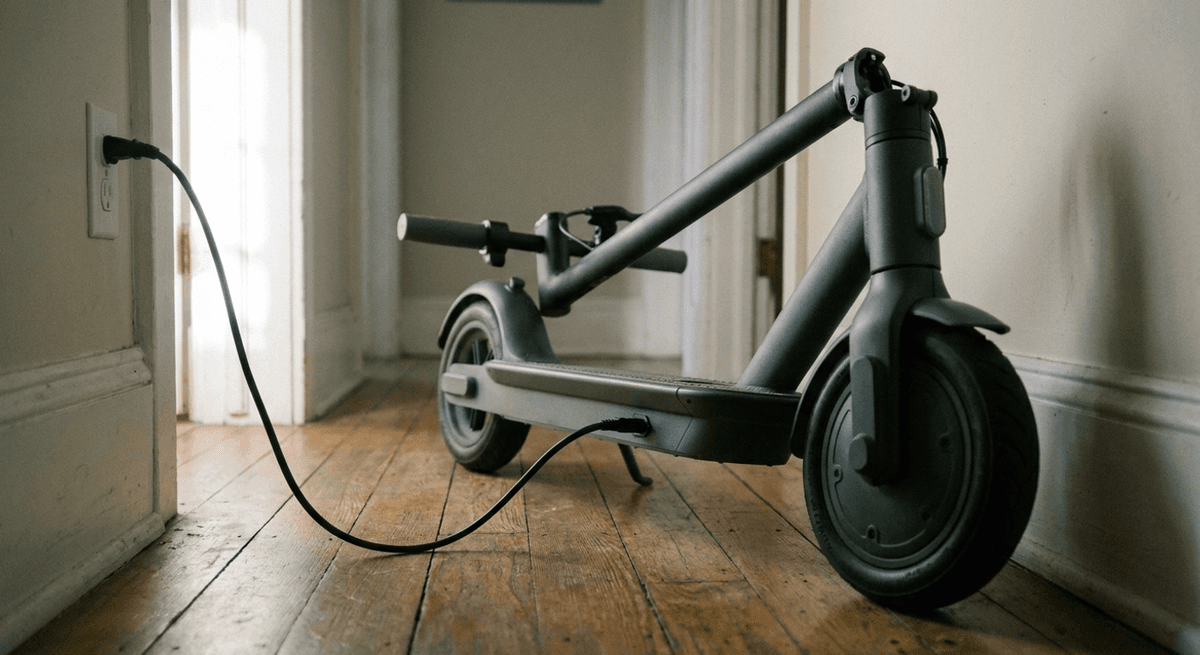
A motor assisted scooter is treated as a nonmotorized vehicle whenever it is being operated with the motor turned off, under § 1115(4), except anywhere it is locally posted or prohibited even in that state.
Where you can ride
Utah Code § 41-6a-1115.1 allows a city, county, or town to authorize and regulate sidewalk operation, including setting a sidewalk-specific speed limit, as long as any local rule stays "consistent with the regulation of bicycles" under the rest of the title. A local government may also regulate scooter operation generally and may designate locations where scooter-share operators may not stage shared scooters. That power has a floor built in for operators: under § 41-6a-1115.1(5)(g), at least one staging location must still be permitted on each side of each city block in commercial zones and business districts.
Prohibited locations under current law, § 1115(3), include public parking structures, public property posted as no-bicycles, and any device that has been structurally or mechanically altered outside of a rental company's own speed-lowering modification. Riders may cross a roadway in a crosswalk under § 1115(1)(c), but may not do so negligently, such as by colliding with a pedestrian or cyclist or by crossing at an unreasonable speed.
Rider rules
- Age, current law: § 1115(2) bars a person under 8 years old from operating a motor assisted scooter with the motor running on any public property, highway, path, or sidewalk. That is the only age floor in force as of this writing; there is no 16-and-up rule currently in effect for Utah e-scooters.
- Owner liability, current law: § 1115(5) makes it unlawful for an owner to "authorize or knowingly permit a person under the age of 18" to operate the scooter in violation of the section. This is a separate owner-liability rule sitting alongside the under-8 operator floor, not itself a second operator age minimum.
- Helmet: The helmet rule sits outside § 41-6a-1115, which is why it is easy to miss. Utah Code § 41-6a-1505 bars an individual under 21 from operating or riding a motor assisted scooter on a highway unless the individual is wearing protective headgear meeting the specifications adopted under that section, which for scooters and bicycles are the standards in 16 C.F.R. Part 1203. The section "does not apply to an individual operating a class 1 electric assisted bicycle or a motor assisted scooter rented from a business or corporate entity," so a rider on a rental or shared-fleet scooter is outside it. A court may not impose a fine over $25 for a headgear violation while operating a motor assisted scooter, and failure to wear headgear is not contributory or comparative negligence in a civil case. Riders 21 and older have no statewide helmet requirement.
- License, registration, insurance: None required under current law. Utah's Driver License Division separately confirms no license or endorsement is needed to operate a motor assisted scooter.
An already-enacted future change: effective May 5, 2027
Utah Code Chapter 334 of the 2026 General Session amends § 41-6a-1115, and this amendment is already enacted law, though it does not take effect until May 5, 2027. Under the amended text:
- Riders under 8 remain barred outright from operating on any highway.
- Riders aged 8 to 15 may operate on a highway only under direct adult supervision, or after obtaining a "personal electric vehicle safety certificate" under a new statutory section, § 41-6a-1512.
- Riders 16 and older may operate unsupervised, matching current practice.
- Operating on a freeway is added to the list of prohibited locations, which is not part of current law.
- The owner-liability age threshold in the amended version drops from under 18 to under 16, which is narrower than the current 18 threshold.
- The 15 mph operating speed cap does not change.
Penalties
A violation of § 41-6a-1115 is an infraction under current law, § 1115(6). The amendment effective May 5, 2027 does not change that classification. The headgear rule carries its own, lower ceiling: for a violation of § 41-6a-1505 committed while operating a motor assisted scooter, a court may not impose a fine exceeding $25. For any other infraction, check the current Utah Code fine schedule or your local court for the specific amount.
Enforcement in practice
Salt Lake City's own transportation page confirms an active downtown sidewalk restriction is enforced as city policy, though that page does not state speed or age enforcement figures for the city. Enforcement patterns do not change the underlying legal status; a rider should follow the statute and any posted local rule regardless of how actively it is enforced at a given time.
Salt Lake City e-scooter rules
Salt Lake City is Utah's largest city. The city's own transportation page states plainly that "riding on the sidewalk is not allowed downtown," and separately confirms parking restrictions: scooters may not be left within 50 feet of a GREENbike station, may not block UTA transit stops or vehicle spots, and may not obstruct ADA access. Speed limits and age requirements specific to Salt Lake City are not stated on that page, so check the city's shared mobility page or the Salt Lake City municipal code for any local rule that goes beyond the state statute. The statewide headgear rule for riders under 21 applies in Salt Lake City the same as everywhere else, subject to the same rental exception.
If a scooter-related incident happens on a Utah roadway, general Utah DUI and negligence rules can still apply; see RecordingLaw's Utah DUI Laws and Utah Car Accident Laws pages, and RecordingLaw's E-Scooter Laws by State hub to compare Utah's rules to other states.
Frequently Asked Questions
What is the minimum age to ride an e-scooter in Utah right now?
Current law only bars riders under 8 from operating with the motor running. There is no 16-year-old rule in force today; that structure does not take effect until May 5, 2027 under an already-enacted amendment.
Is Utah getting a new e-scooter age law?
Yes. An enacted amendment, effective May 5, 2027, replaces the under-8 rule with a tiered structure: under 8 barred, 8 to 15 need adult supervision or a safety certificate, and 16 and up may ride unsupervised. It is not in effect yet.
Do I need a helmet to ride an e-scooter in Utah?
If you are under 21, yes. Utah Code 41-6a-1505 requires protective headgear to operate or ride a motor assisted scooter on a highway if you are under 21, with an exception for a scooter rented from a business or corporate entity. The fine is capped at $25, and not wearing headgear is not treated as negligence in a civil case. Riders 21 and older have no statewide helmet requirement. The rule lives in section 41-6a-1505, not in the main motor-assisted-scooter section 41-6a-1115.
How fast can I legally ride an e-scooter in Utah?
The operating speed cap is 15 mph, even though the device itself may be built to reach up to 20 mph. This does not change under the 2027 amendment.
Do I need a license or registration to ride an e-scooter in Utah?
No. Utah exempts motor assisted scooters from the driver's-licensing requirement, and no registration or insurance is required for a privately owned scooter.
Can I ride an e-scooter on the sidewalk in Salt Lake City?
Not downtown. Salt Lake City's own transportation page states that sidewalk riding is not allowed downtown; other parts of the city were not specifically addressed on that page.
Updates
Corrected the helmet section: Utah Code § 41-6a-1505 does require protective headgear for riders under 21 on a highway (with a rental exception and a $25 fine cap); also fixed a reversed description of the local scooter-staging rule and removed leftover drafting notes from the published text.
Independently fact-checked against the cited primary sources
The Law Behind This Article
This article rests on the statutory provisions below, held in our own legal record and retrieved from the official source. Tap a section to read the operative text.
Utah Code, Title 41: Motor Vehicles
§ 41-6a-1115Motor assisted scooters -- Conflicting provisions -- Restrictions -- Penalties.In force
(1) (a) Except as otherwise provided in this section, a motor assisted scooter is subject to the provisions under this chapter for a bicycle. (b) For a person operating a motor assisted scooter, the following provisions do not apply: (i) seating positions under Section 41-6a-1501; (ii) required lights, horns, and mirrors under Section 41-6a-1506; (iii) entitlement to full use of a lane under Subsection 41-6a-1502(1); and (iv) driver licensing requirements under Section 53-3-202. (c) A person may operate a motor assisted scooter across a roadway in a crosswalk, except that the person may not operate the motor assisted scooter in a negligent manner in the crosswalk: (i) so as to collide with a: (A) pedestrian; or (B) person operating a bicycle or vehicle or device propelled by human power; or (ii) at a speed greater than is reasonable and prudent under the existing conditions, giving regard to the actual and potential hazards then existing. (2) A person under eight years of age may not operate a motor assisted scooter with the motor running on any public property, highway, path, or sidewalk.
Official text (excerpt) · last checked 2026-09-07 · Read the full text in our law library · Verify at le.utah.gov
§ 41-6a-1115.1Scooter-share programs -- Local ordinances regulating motor assisted scooters.In force
(1) For the purposes of this section: (a) "Local authority" means a county, city, or town. (b) "Scooter-share operator" means a person offering a shared scooter for hire. (c) "Scooter-share program" means the offering of a shared scooter for hire. (d) "Shared scooter" means a motor assisted scooter offered for hire. (2) A local authority may regulate the operation of a motor assisted scooter within its jurisdiction. (3) A local authority may authorize the operation of a motor assisted scooter on sidewalks and regulate the operation, including the maximum speed on the sidewalks. (4) A regulation adopted by a local authority pursuant to this section regarding the operation of a motor assisted scooter shall be consistent with the regulation of bicycles and this title. (5) (a) A local authority may regulate the operation of a scooter-share program within its jurisdiction. Regulation of scooter-share programs shall be consistent with this Subsection (5).
Official text (excerpt) · last checked 2026-07-29 · Read the full text in our law library · Verify at le.utah.gov
§ 41-6a-102Definitions.In forcecited in 2 of our articles
As used in this chapter: (1) "Alley" means a street or highway intended to provide access to the rear or side of lots or buildings in urban districts and not intended for through vehicular traffic. (2) "All-terrain type I vehicle" means the same as that term is defined in Section 41-22-2. (3) "All-terrain type II vehicle" means the same as that term is defined in Section 41-22-2. (4) "All-terrain type III vehicle" means the same as that term is defined in Section 41-22-2. (5) "Authorized emergency vehicle" includes: (a) a fire department vehicle; (b) a police vehicle; (c) an ambulance; and (d) other publicly or privately owned vehicles as designated by the commissioner of the Department of Public Safety. (6) "Autocycle" means the same as that term is defined in Section 53-3-102. (7) (a) "Bicycle" means a wheeled vehicle: (i) propelled by human power by feet or hands acting upon pedals or cranks; (ii) with a seat or saddle designed for the use of the operator; (iii) designed to be operated on the ground; and (iv) whose wheels are not less than 14 inches in diameter. (b) "Bicycle" includes an electric assisted bicycle.
Official text (excerpt) · last checked 2026-07-29 · Read the full text in our law library · Verify at le.utah.gov
Cited in 1 court opinions in our collectionLatest citing opinion in our collection: 2023
Opinions citing this section in our collection:
- Dutta v. AMICA Mutual Insurance (District Court, D. Utah 2023)“…d Facts ¶ 9. 127 Utah Code Ann. § 41-6a-102(28)(“‘Highway’ means the entire width b…”
Identified automatically from the court opinions citing this section — not a ranking of which case controls.
Also relied on in: Is Lane Splitting Legal in Utah? Filtering Rules (2026)
§ 41-6a-1512Safety program -- Personal electric vehicles.In force
(1) As used in this section: (a) "Personal electric vehicle" means an electric assisted bicycle, high power electric device, or motor assisted scooter. (b) "Personal electric vehicle safety certificate" means the personal electric vehicle safety certificate issued under Subsection (2)(c). (c) "Program" means the personal electric vehicle safety education and training program described in Subsection (2)(a). (2) The department shall: (a) design and administer a personal electric vehicle safety education and training program to develop and instill the knowledge, attitudes, habits, and skills necessary for the safe and ethical operation of a personal electric vehicle on a highway; (b) in accordance with Title 63G, Chapter 3, Utah Administrative Rulemaking Act, make rules that establish curriculum standards for the program; (c) issue a personal electric vehicle safety certificate to an individual who successfully completes the program; and (d) ensure that an individual may complete the program online. (3) The department may: (a) contract with another person to implement the program; and (b) collect a fee of $10 or less from each applicant for administration of the program.
Official text (excerpt) · last checked 2026-07-29 · Read the full text in our law library · Verify at le.utah.gov
§ 41-6a-1505Motorcycle-- Protective headgear -- Closed cab excepted -- Electric assisted bicycles, motor assisted scooters, electric personal assistive mobility devices.In forcecited in 2 of our articles
(1) An individual under 21 years old may not operate or ride the following on a highway unless the individual is wearing protective headgear that complies with specifications adopted under Subsection (4): (a) a motorcycle; (b) an electric assisted bicycle; (c) a motor assisted scooter; (d) a high power electric device; or (e) an autocycle that is not fully enclosed. (2) This section does not apply to an individual riding within an enclosed cab. (3) This section does not apply to an individual operating a class 1 electric assisted bicycle or a motor assisted scooter rented from a business or corporate entity. (4) The following standards and specifications for protective headgear are adopted: (a) 49 C.F.R. Sec. 571.218 related to protective headgear for motorcycles; and (b) 16 C.F.R. Part 1203 related to protective headgear for bicycles, motor assisted scooters, and electric personal assistive mobility devices.
Official text (excerpt) · last checked 2026-07-29 · Read the full text in our law library · Verify at le.utah.gov
Also relied on in: Utah Motorcycle Accident Laws (2026): Deadlines & Helmets
Search our full record of US law — 2.1 million sections, every state + federal →
Sources and References
- Utah Code § 41-6a-1115, current version, effective 5/14/2019 (Motor assisted scooters)(le.utah.gov).gov
- Utah Code § 41-6a-1115, future version, effective 5/5/2027 (Chapter 334, 2026 General Session)(le.utah.gov).gov
- Utah Code § 41-6a-1115.1, effective 5/1/2024 (Scooter-share programs; local ordinances)(le.utah.gov).gov
- Utah Driver License Division, motor assisted scooter licensing page(dld.utah.gov).gov
- Salt Lake City, shared mobility / e-scooter rules page(slc.gov).gov
- RecordingLaw.com, Utah DUI Laws(recordinglaw.com)
- RecordingLaw.com, Utah Car Accident Laws(recordinglaw.com)
- Utah Code § 41-6a-1505, current version (Protective headgear; electric assisted bicycles, motor assisted scooters)(le.utah.gov)
- Utah Code § 41-6a-102, current version (Definitions; motor assisted scooter)(le.utah.gov)
Paid attorney referral. RecordingLaw may receive compensation when you use an attorney-help link. RecordingLaw is not a law firm. Submitting a request does not guarantee that an attorney will accept your case and does not create an attorney-client relationship.