
Missouri
Is Jaywalking Illegal in Missouri? State Law vs. City Rules (2026)
Independently fact-checked against primary sources (last audited October 10, 2026). · 25 primary sources cited on this page. How we verify our legal content
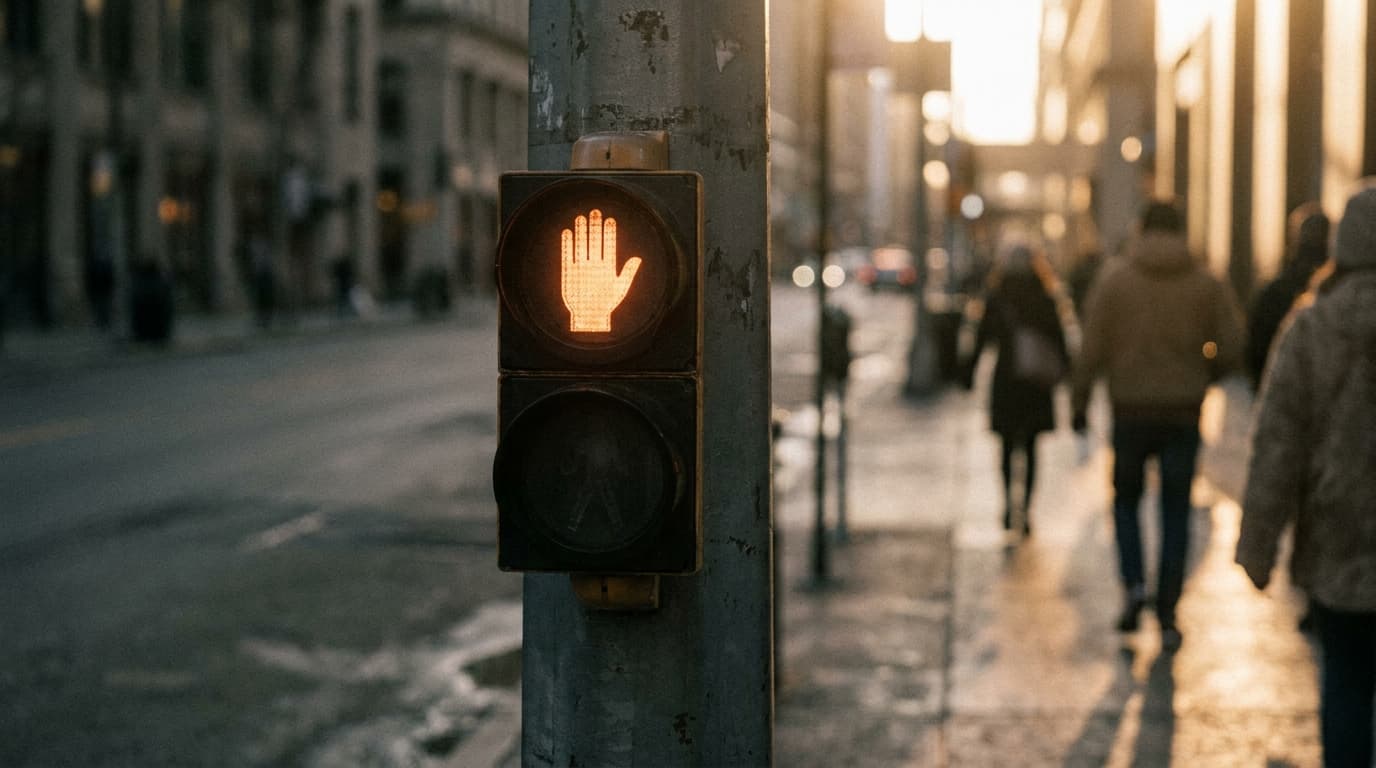
In Missouri, whether crossing outside a crosswalk is illegal depends on the city. The statewide traffic code in RSMo chapter 304 contains two pedestrian signal rules. Under the traffic-light rules in RSMo 304.281, unless a pedestrian signal directs otherwise, a pedestrian may not start to cross on a steady yellow or enter the roadway against a steady red; a violation is a class C misdemeanor. Under the WALK / DON'T WALK rule in RSMo 304.291, a violation is a misdemeanor carrying a fine of $5 to $500, up to one year in the county jail, or both (RSMo 304.361). The rules people usually mean by jaywalking (yield outside a crosswalk, no mid-block crossing between signalized intersections, crosswalk-only crossing in business districts) are in RSMo chapter 300, a model traffic ordinance that takes effect in a city only if the city adopts it (RSMo 300.600). To compare other states, see our guide to jaywalking laws by state.
Information last verified on 2026-10-10. This article has not been reviewed by a licensed lawyer.
Jurisdiction scope: This article covers Missouri state statutes: the pedestrian signal rules and related sections of RSMo chapter 304 (304.012, 304.024, 304.080, 304.110, 304.120, 304.281, 304.291, 304.361, 304.570), the model traffic ordinance in RSMo chapter 300 (300.010, 300.155, 300.160, 300.370 to 300.410, 300.600), the municipal court limits in RSMo 479.350 and 479.353, and the fine and jail limits in RSMo 558.002 and 558.011. It does not cover the text of any particular city's or county's ordinances, whether a given city has adopted chapter 300, local court fine schedules, driver license consequences, injury claims after a crash, or the law of other states.
Is jaywalking illegal in Missouri?
Missouri splits pedestrian law into two layers, and the answer depends on which one applies where you are.
The first layer is state law in chapter 304, which applies everywhere in Missouri. Its pedestrian provisions include the traffic-light rules in RSMo 304.281, which apply to pedestrians as well as drivers, the WALK / DON'T WALK signal rule in RSMo 304.291, and the driver's duty toward a pedestrian with a white cane or assistance dog in RSMo 304.080. The familiar mid-block and crosswalk-only crossing rules do not appear in chapter 304.
The second layer is chapter 300, the model traffic ordinance. It contains the full set of crossing rules, but it is ordinance text, not statewide law. RSMo 300.600 provides:
"This ordinance or any designated part thereof shall become effective in any city of the state upon the adoption thereof by the legislative body of the city by an ordinance appropriately describing this ordinance or the part thereof adopted."
So a rule in sections 300.370 to 300.410 binds you only in a city that has adopted that part of chapter 300, or that has its own ordinance on the subject. Separately, RSMo 304.120.2(1) lets municipalities, by ordinance, "Make additional rules of the road or traffic regulations to meet their needs and traffic conditions," but "No ordinance shall be valid which contains provisions contrary to or in conflict with this chapter, except as herein provided" (304.120.3). Check your city's code of ordinances to see which applies.
| Situation | Statewide (chapter 304) | In a city that adopted chapter 300 |
|---|---|---|
| Starting to cross against a DON'T WALK signal | Barred (304.291(2)) | Also barred (300.160(2)) |
| Starting to cross on a steady yellow light, unless a pedestrian signal directs otherwise | Barred (304.281.1(2)(b)) | Also barred (300.155) |
| Entering the roadway against a steady red light alone, unless a pedestrian signal directs otherwise | Barred (304.281.1(3)(c)) | Also barred (300.155) |
| Crossing outside a marked crosswalk or an unmarked crosswalk at an intersection | No chapter 304 rule | Allowed, but the pedestrian must yield the right-of-way to all vehicles (300.390(1)) |
| Crossing between adjacent intersections with traffic control signals in operation | No chapter 304 rule | Only in a crosswalk (300.395(1)) |
| Crossing outside a crosswalk in any business district | No chapter 304 rule | Barred (300.395(2)) |
| Crossing outside a crosswalk on a street designated by ordinance | No chapter 304 rule | Barred (300.395(3)) |
| Crossing an intersection diagonally | No chapter 304 rule | Barred unless authorized by official traffic control devices (300.395(4)) |
| Walking along a roadway | No chapter 304 rule | Use the sidewalk where provided; otherwise, when practicable, the left side facing traffic (300.405) |
The statewide rules: traffic lights and WALK / DON'T WALK signals
Two chapter 304 sections apply across Missouri, whether or not a city has adopted chapter 300. RSMo 304.281 provides that ordinary traffic lights "shall indicate and apply to drivers of vehicles and pedestrians." Each pedestrian rule applies unless a pedestrian control signal under 304.291 directs otherwise:

- Facing any green signal, except when the sole green signal is a turn arrow, pedestrians "may proceed across the roadway within any marked or unmarked crosswalk" (304.281.1(1)(c)).
- Facing a steady yellow, pedestrians are advised "that there is insufficient time to cross the roadway before a red indication is shown and no pedestrian shall then start to cross the roadway" (304.281.1(2)(b)).
- Facing a steady red signal alone, pedestrians "shall not enter the roadway" (304.281.1(3)(c)).
RSMo 304.281.2 adds: "Notwithstanding the provisions of section 304.361, violation of this section is a class C misdemeanor."
RSMo 304.291 sets the rule for WALK / DON'T WALK signals:
"(1) Walk. Pedestrians facing such signal may proceed across the roadway in the direction of the signal and shall be given the right-of-way by the drivers of all vehicles. (2) Don't Walk. No pedestrian shall start to cross the roadway in the direction of such signal, but any pedestrian who has partially completed his crossing on the "walk" signal shall proceed to a sidewalk or safety island while the "don't walk" signal is showing."
The violation is starting to cross on DON'T WALK. A pedestrian already in the street when the signal changes is told to keep going to a sidewalk or safety island, not to turn back.
The model ordinance: crossing outside a crosswalk
In a city that has adopted it, chapter 300 sets a yield rule and a list of places where crossing outside a crosswalk is barred outright. The yield rule is RSMo 300.390:
"1. Every pedestrian crossing a roadway at any point other than within a marked crosswalk or within an unmarked crosswalk at an intersection shall yield the right-of-way to all vehicles upon the roadway. 2. Any pedestrian crossing a roadway at a point where a pedestrian tunnel or overhead pedestrian crossing has been provided shall yield the right-of-way to all vehicles upon the roadway. 3. The foregoing rules in this section have no application under the conditions stated in section 300.395 when pedestrians are prohibited from crossing at certain designated places."
Under subsection 1, mid-block crossing is a duty to yield, not a ban. Subsection 3 points to the places where it is a ban. RSMo 300.395 provides:
"1. Between adjacent intersections at which traffic control signals are in operation, pedestrians shall not cross at any place except in a crosswalk. 2. No pedestrian shall cross a roadway other than in a crosswalk in any business district. 3. No pedestrian shall cross a roadway other than in a crosswalk upon any street designated by ordinance. 4. No pedestrian shall cross a roadway intersection diagonally unless authorized by official traffic control devices; and, when authorized to cross diagonally, pedestrians shall cross only in accordance with the official traffic control devices pertaining to such crossing movements."
Subsection 2 matters most in practice: in a city that has adopted 300.395, crossing outside a crosswalk anywhere in a business district is barred even if no car is coming. Subsection 3 lets a city name further streets by ordinance.
Three more model-ordinance rules shape how you cross:
- "No pedestrian shall cross a roadway at any place other than by a route at right angles to the curb or by the shortest route to the opposite curb except in a crosswalk" (300.385).
- "No pedestrian shall suddenly leave a curb or other place of safety and walk or run into the path of a vehicle which is so close that it is impossible for the driver to yield" (300.375(2)).
- "Pedestrians shall move, whenever practicable, upon the right half of crosswalks" (300.380).
The model ordinance's definition of "crosswalk," which governs chapter 300, is in RSMo 300.010(8):
"'Crosswalk', (a) That part of a roadway at an intersection included within the connections of the lateral lines of the sidewalks on opposite sides of the highway measured from the curbs, or in the absence of curbs from the edges of the traversable roadway; (b) Any portion of a roadway at an intersection or elsewhere distinctly indicated for pedestrian crossing by lines or other markings on the surface;"
Part (a) ties the unmarked crosswalk to the lines of the sidewalks on opposite sides of the highway at an intersection; part (b) covers a marked crossing at an intersection or elsewhere.
The model ordinance: the same light rules and walking along the road
Where a city has adopted it, RSMo 300.370 makes pedestrians "subject to traffic control signals as heretofore declared in sections 300.155 and 300.160 of this ordinance." For ordinary traffic lights, RSMo 300.155 tracks the statewide rules in 304.281, providing, each time "Unless otherwise directed by a pedestrian control signal as provided in section 300.160":
- Facing any green signal, except when the sole green signal is a turn arrow, pedestrians "may proceed across the roadway within any marked or unmarked crosswalk."
- Facing a steady yellow, pedestrians are advised "that there is insufficient time to cross the roadway before a red indication is shown and no pedestrian shall then start to cross the roadway."
- Facing a steady red signal alone, pedestrians "shall not enter the roadway."
RSMo 300.160 repeats the WALK and DON'T WALK rule for adopting cities, using "Wait" or "Don't Walk" for the stop phase.
Walking along a road is covered by RSMo 300.405: "1. Where sidewalks are provided it shall be unlawful for any pedestrian to walk along and upon an adjacent roadway. 2. Where sidewalks are not provided any pedestrian walking along and upon a highway shall when practicable walk only on the left side of the roadway or its shoulder facing traffic which may approach from the opposite direction." Like the rest of chapter 300, this binds only where a city has adopted it.
What drivers owe pedestrians
Some driver duties apply statewide and others only under the model ordinance.
Statewide:
- A pedestrian facing a WALK signal "shall be given the right-of-way by the drivers of all vehicles" (304.291(1)).
- Every person operating a motor vehicle "shall drive the vehicle in a careful and prudent manner and at a rate of speed so as not to endanger the property of another or the life or limb of any person and shall exercise the highest degree of care." A violation is a class B misdemeanor, or a class A misdemeanor if an accident is involved (304.012). The maximum fines for those classes are $1,000 and $2,000 (558.002).
- A driver approaching a person with a visual, aural or physical disability "who is carrying a cane predominantly white or metallic in color, with or without a red tip, or using a guide dog, hearing dog or service dog shall yield to such pedestrian," and a driver who fails to take such precautions is liable in damages for any injury caused (304.080). A violation of sections 304.080 to 304.110 is a misdemeanor with a fine "not exceeding twenty-five dollars and costs of prosecution" (304.110).
- Drivers proceeding on a green signal, "including vehicles turning right or left, shall yield the right-of-way to other vehicles and to pedestrians lawfully within the intersection or an adjacent crosswalk"; drivers on a green arrow yield to pedestrians lawfully within an adjacent crosswalk; and a driver turning right on red "shall yield the right-of-way to pedestrians and other traffic proceeding as directed by the signal" (304.281.1(1)(a), (1)(b), (3)(b)).
- The state highways and transportation commission may place signs establishing crossovers or crosswalks on highways under its jurisdiction (304.024.1). The infraction in that section applies to stopping, standing or parking a vehicle in violation of posted restrictions (304.024.2).
In a city that has adopted chapter 300:
- "When traffic control signals are not in place or not in operation the driver of a vehicle shall yield the right-of-way, slowing down or stopping if need be to so yield, to a pedestrian crossing the roadway within a crosswalk when the pedestrian is upon the half of the roadway upon which the vehicle is traveling, or when the pedestrian is approaching so closely from the opposite half of the roadway as to be in danger" (300.375(1)).
- A driver approaching from the rear may not overtake and pass a vehicle stopped at a marked crosswalk or an unmarked crosswalk at an intersection to let a pedestrian cross (300.375(4)).
- "Notwithstanding the foregoing provisions of sections 300.155 to 300.410, every driver of a vehicle shall exercise the highest degree of care to avoid colliding with any pedestrian upon any roadway and shall give warning by sounding the horn when necessary and shall exercise proper precaution upon observing any child or any confused or incapacitated person upon a roadway" (300.410).
Jaywalking fine and penalty in Missouri
The penalty depends on whether the ticket is for a state rule or a city ordinance.
State law. A violation of RSMo 304.291 falls under RSMo 304.361, which covers sections 304.271 to 304.351:
"Any person who violates any of the provisions of sections 304.271 to 304.351 is guilty of a misdemeanor and shall be punished by a fine of not less than five dollars nor more than five hundred dollars or by imprisonment in the county jail not exceeding one year or by both such fine and imprisonment."
The traffic-light rule is classed differently: "Notwithstanding the provisions of section 304.361, violation of this section is a class C misdemeanor" (304.281.2). A class C misdemeanor carries a fine of up to $750 (558.002) and a jail term "not to exceed fifteen days" (558.011).
Chapter 304 also has a catch-all, RSMo 304.570, for violations "for which no specific punishment is provided," with the same range: a fine of $5 to $500, up to one year in the county jail, or both.
City ordinance. A ticket under a city's adopted chapter 300 rules or its own pedestrian ordinance carries the penalty the city sets, subject to state limits on municipal courts. For a "minor traffic violation," RSMo 479.353 provides that "The court shall not assess a fine, if combined with the amount of court costs, totaling in excess of: (a) Two hundred twenty-five dollars for minor traffic violations," and that the court "shall not sentence a person to confinement," except for violations involving alcohol or controlled substances, violations endangering the health or welfare of others, or eluding or giving false information to a law enforcement officer.
RSMo 479.350(3) defines a minor traffic violation as a municipal or county traffic ordinance violation that does not involve an accident or injury and for which the Department of Revenue assesses no points or is authorized to assess one to four points, among other conditions. How that definition applies to a particular pedestrian ticket is a question for the municipal court handling it.
| Ticket | Penalty | Source |
|---|---|---|
| Starting to cross against DON'T WALK, state charge | Misdemeanor: fine of $5 to $500, up to one year in the county jail, or both | RSMo 304.291, 304.361 |
| Starting to cross on a steady yellow or entering against a steady red light, state charge | Class C misdemeanor: fine of up to $750, up to 15 days in jail | RSMo 304.281.2, 558.002, 558.011 |
| City ordinance pedestrian violation that is a minor traffic violation | Fine plus court costs may not exceed $225; no confinement except in the listed categories | RSMo 479.350(3), 479.353 |
| City ordinance pedestrian violation that is not a minor traffic violation | Set by the city ordinance | RSMo 300.600; city code |
The state figures are statutory ranges, not a typical ticket amount; the citation or the court shows the amount due.
Checking your city's rules
Because chapter 300 binds only adopting cities, the most useful step is to look up your city's code of ordinances and search its traffic title for pedestrian or crosswalk rules, or to ask the municipal court named on a citation. A city may adopt chapter 300 in whole or in part (300.600), and RSMo 300.395(3) contemplates cities designating streets by ordinance where crossing outside a crosswalk is barred. Posted signs at a crossing also matter.
If a pedestrian is hit by a car
Whether a pedestrian was crossing lawfully can come up after a collision, alongside the drivers' statewide duty of the highest degree of care (304.012). For how fault and insurance work after a crash, see Missouri car accident laws. Electric scooter riders follow a separate set of rules, covered in Missouri e-scooter laws.
Related pages
- Jaywalking laws by state
- Missouri car accident laws
- Missouri e-scooter laws
- Kansas jaywalking laws
- Illinois jaywalking laws
This article provides general legal information about Missouri law, not legal advice. For advice about a specific situation, contact a lawyer licensed in Missouri.
Last updated: 2026-10-10.
Frequently Asked Questions
Is jaywalking illegal in Missouri?
Missouri state law has no general rule against crossing outside a crosswalk; its statewide pedestrian rules are the signal rules: unless a pedestrian signal directs otherwise, no starting to cross on a steady yellow light and no entering the roadway against a steady red light (RSMo 304.281), and no starting to cross against a DON'T WALK signal (RSMo 304.291). The familiar jaywalking rules are in RSMo chapter 300, a model ordinance that applies in a city only if the city adopts it (RSMo 300.600), so the answer depends on where you cross.
What is the fine for jaywalking in Missouri?
Starting to cross against a DON'T WALK signal violates state law (RSMo 304.291) and carries a fine of $5 to $500, up to one year in the county jail, or both (RSMo 304.361). Starting to cross on a steady yellow or entering against a steady red light violates RSMo 304.281, a class C misdemeanor with a fine of up to $750 and up to 15 days in jail (RSMo 558.002, 558.011). A city ticket carries the penalty its ordinance sets; where it is a minor traffic violation, the fine plus court costs may not exceed $225 (RSMo 479.353).
Can I cross in the middle of the block in Missouri?
State law does not address it outside the signal rules. In a city that has adopted the model ordinance, a pedestrian crossing outside a crosswalk must yield to all vehicles (RSMo 300.390), and crossing outside a crosswalk is barred between adjacent signalized intersections, in any business district, and on streets designated by ordinance (RSMo 300.395).
Can I start crossing on a DON'T WALK signal in Missouri?
No. Under RSMo 304.291, which applies statewide, no pedestrian shall start to cross the roadway in the direction of a DON'T WALK signal; a pedestrian who has partly crossed on WALK must proceed to a sidewalk or safety island.
Does Missouri's model traffic ordinance apply in my city?
Only if your city adopted it. RSMo 300.600 provides that the ordinance, or any designated part of it, becomes effective in a city upon adoption by the city's legislative body by an ordinance describing what is adopted. Check your city's code of ordinances.
Do drivers have to stop for pedestrians in Missouri?
Statewide, a pedestrian facing a WALK signal must be given the right-of-way by the drivers of all vehicles (RSMo 304.291), drivers proceeding or turning on a green signal and drivers turning right on red must yield to pedestrians as RSMo 304.281 directs, and drivers must exercise the highest degree of care (RSMo 304.012). In cities that adopted the model ordinance, drivers must also yield to a pedestrian in a crosswalk when signals are not operating, slowing down or stopping if need be (RSMo 300.375).
Which side of the road should I walk on in Missouri?
The rule is in the model ordinance, so it applies where a city has adopted it: where sidewalks are provided, a pedestrian may not walk along an adjacent roadway, and where they are not, a pedestrian should walk when practicable only on the left side of the roadway or its shoulder, facing traffic (RSMo 300.405).
Updates
Independently fact-checked against the cited primary sources
The Law Behind This Article
This article rests on the statutory provisions below, held in our own legal record and retrieved from the official source. Tap a section to read the operative text.
Revised Statutes of Missouri, Title XIX (MOTOR VEHICLES, WATERCRAFT AND AVIATION), Chapter 304
§ 304.291Rules for pedestrians controlled by special signs.In force
Whenever special pedestrian-control signals exhibiting the words "Walk" or "Don't Walk" are in place such signals shall indicate as follows: (1) Walk. Pedestrians facing such signal may proceed across the roadway in the direction of the signal and shall be given the right-of-way by the drivers of all vehicles. (2) Don't Walk. No pedestrian shall start to cross the roadway in the direction of such signal, but any pedestrian who has partially completed his crossing on the "walk" signal shall proceed to a sidewalk or safety island while the "don't walk" signal is showing.
Official text (excerpt) · last checked 2026-07-31 · Read the full text in our law library · Verify at revisor.mo.gov
§ 304.281Rules for traffic where controlled by light signals — right turn on red light, when — violations, penalty.In force
1. Whenever traffic is controlled by traffic control signals exhibiting different colored lights, or colored lighted arrows, successively one at a time or in combination, only the colors green, red and yellow shall be used, except for special pedestrian signals carrying a word legend, and said lights shall indicate and apply to drivers of vehicles and pedestrians as follows: (1) Green indication (a) Vehicular traffic facing a circular green signal may proceed straight through or turn right or left unless a sign at such place prohibits either such turn. But vehicular traffic, including vehicles turning right or left, shall yield the right-of-way to other vehicles and to pedestrians lawfully within the intersection or an adjacent crosswalk at the time such signal is exhibited; (b) Vehicular traffic facing a green arrow signal, shown alone or in combination with another indication, may cautiously enter the intersection only to make the movement indicated by such arrow, or such other movement as is permitted by other indications shown at the same time. Such vehicular traffic shall yield the right-of-way to pedestrians lawfully within an adjacent crosswalk and to other traffic…
Official text (excerpt) · last checked 2026-07-31 · Read the full text in our law library · Verify at revisor.mo.gov
Revised Statutes of Missouri, Title XIX (MOTOR VEHICLES, WATERCRAFT AND AVIATION), Chapter 300
§ 300.390When pedestrian shall yield.In force
1. Every pedestrian crossing a roadway at any point other than within a marked crosswalk or within an unmarked crosswalk at an intersection shall yield the right-of-way to all vehicles upon the roadway. 2. Any pedestrian crossing a roadway at a point where a pedestrian tunnel or overhead pedestrian crossing has been provided shall yield the right-of-way to all vehicles upon the roadway. 3. The foregoing rules in this section have no application under the conditions stated in section 300.395 when pedestrians are prohibited from crossing at certain designated places.
Official text (excerpt) · last checked 2026-07-31 · Read the full text in our law library · Verify at revisor.mo.gov
§ 300.160Pedestrian control signals.In force
Whenever special pedestrian control signals exhibiting the words "Walk" or "Don't Walk", or appropriate symbols, are in place, such signals shall indicate as follows: (1) "Walk", pedestrians facing such signal may proceed across the roadway in the direction of the signal and shall be given the right-of-way by the drivers of all vehicles; (2) "Wait" or "Don't Walk", no pedestrian shall start to cross the roadway in the direction of such signal, but any pedestrian who has partially completed his crossing on the walk signal shall proceed to a sidewalk or safety zone while the wait signal is showing.
Official text (excerpt) · last checked 2026-07-31 · Read the full text in our law library · Verify at revisor.mo.gov
§ 300.375Pedestrians' right-of-way in crosswalks.In force
1. When traffic control signals are not in place or not in operation the driver of a vehicle shall yield the right-of-way, slowing down or stopping if need be to so yield, to a pedestrian crossing the roadway within a crosswalk when the pedestrian is upon the half of the roadway upon which the vehicle is traveling, or when the pedestrian is approaching so closely from the opposite half of the roadway as to be in danger. 2. No pedestrian shall suddenly leave a curb or other place of safety and walk or run into the path of a vehicle which is so close that it is impossible for the driver to yield. 3. Subsection 1 shall not apply under the conditions stated in subsection 2 of section 300.390. 4. Whenever any vehicle is stopped at a marked crosswalk or at any unmarked crosswalk at an intersection to permit a pedestrian to cross the roadway, the driver of any other vehicle approaching from the rear shall not overtake and pass such stopped vehicle.
Official text (excerpt) · last checked 2026-07-31 · Read the full text in our law library · Verify at revisor.mo.gov
§ 300.010Definitions.In forcecited in 2 of our articles
The following words and phrases when used in this ordinance mean: (1) "Alley" or "alleyway", any street with a roadway of less than twenty feet in width; (2) "All-terrain vehicle", any motorized vehicle manufactured and used exclusively for off-highway use, with an unladen dry weight of one thousand five hundred pounds or less, traveling on three, four or more nonhighway tires, with either: (a) A seat designed to be straddled by the operator, and handlebars for steering control, but excluding an electric bicycle; or (b) A width of fifty inches or less, measured from outside of tire rim to outside of tire rim, regardless of seating or steering arrangement; (3) "Authorized emergency vehicle", a vehicle publicly owned and operated as an ambulance, or a vehicle publicly owned and operated by the state highway patrol, police or fire department, sheriff or constable or deputy sheriff, traffic officer or any privately owned vehicle operated as an ambulance when responding to emergency calls; (4) "Business district", the territory contiguous to and including a highway when within any six hundred feet along the highway there are buildings in use for business or industrial…
Official text (excerpt) · last checked 2026-07-31 · Read the full text in our law library · Verify at revisor.mo.gov
Cited in 2 court opinions in our collectionLatest citing opinion in our collection: 2020
Opinions citing this section in our collection:
- In Re Buchberger (United States Bankruptcy Court, D. Arizona 2004, 311 B.R. 794)“…ated exclusively upon tracks.” Id. (citing Mo.Rev.Stat. §§ 300.010(15) & 301.010(31)). The co…”
- T.K. v. Cleveland (District Court, W.D. Missouri 2020)“…riding several feet away from the road in the grass. See Mo. Rev. Stat. § 300.010(36) (defining “street” or “highway” as…”
Identified automatically from the court opinions citing this section — not a ranking of which case controls.
Also relied on in: Missouri Lemon Law (2026): How to Qualify & Get a Refund
Search our full record of US law — 2.1 million sections, every state + federal →
Sources and References
- RSMo 304.291, Rules for pedestrians controlled by special signs(revisor.mo.gov).gov
- RSMo 304.281, Rules for traffic controlled by light signals(revisor.mo.gov).gov
- RSMo 304.361, Penalty for violating sections 304.271 to 304.351(revisor.mo.gov).gov
- RSMo 300.600, Effective date of model traffic ordinance upon adoption by a city(revisor.mo.gov).gov
- RSMo 479.353, Limits on fines and confinement in municipal and county courts(revisor.mo.gov).gov
- RSMo 304.080, Drivers to yield to pedestrians with white canes or assistance dogs(revisor.mo.gov).gov
- RSMo 304.012, Careful and prudent driving; highest degree of care(revisor.mo.gov).gov
- RSMo 300.160, Pedestrian control signals (model ordinance)(revisor.mo.gov).gov
- RSMo 300.390, When pedestrian shall yield (model ordinance)(revisor.mo.gov).gov
- RSMo 300.395, Prohibited crossing (model ordinance)(revisor.mo.gov).gov
- RSMo 300.405, Pedestrians walking along roadways (model ordinance)(revisor.mo.gov).gov
- RSMo 300.385, Crossing at right angles (model ordinance)(revisor.mo.gov).gov
- RSMo 300.375, Pedestrians right-of-way in crosswalks (model ordinance)(revisor.mo.gov).gov
- RSMo 300.380, Pedestrians to use right half of crosswalks (model ordinance)(revisor.mo.gov).gov
- RSMo 300.010, Definitions (crosswalk) (model ordinance)(revisor.mo.gov).gov
- RSMo 300.370, Pedestrians subject to traffic regulations (model ordinance)(revisor.mo.gov).gov
- RSMo 300.155, Traffic control signal legend (model ordinance)(revisor.mo.gov).gov
- RSMo 558.002, Fines for misdemeanors and infractions(revisor.mo.gov).gov
- RSMo 304.110, Penalty for violating sections 304.080 to 304.110(revisor.mo.gov).gov
- RSMo 304.024, Crossovers and crosswalks on state highways(revisor.mo.gov).gov
- RSMo 300.410, Drivers to exercise highest degree of care (model ordinance)(revisor.mo.gov).gov
- RSMo 304.570, General penalty for chapter 304 violations(revisor.mo.gov).gov
- RSMo 479.350, Definitions (minor traffic violation)(revisor.mo.gov).gov
- RSMo 304.120, Municipal regulations(revisor.mo.gov).gov
- RSMo 558.011, Sentence of imprisonment, terms(revisor.mo.gov).gov