
Arkansas
Arkansas Easements, Landlocked Property and Eminent Domain (2026)
Independently fact-checked against primary sources (last audited October 21, 2026). · 7 primary sources cited on this page. How we verify our legal content

In Arkansas, a prescriptive easement generally takes seven years of use that is adverse to the owner and under a claim of right, a period the Arkansas Supreme Court borrows from the seven-year adverse possession rule (Carson v. County of Drew, 2003; Ark. Code § 18-61-101). On eminent domain, the Property Owner's Bill of Rights in Ark. Code § 18-15-103 states that private property may only be taken for public use, requires a written good-faith offer before a condemnation suit, and has a 12-person jury set just compensation. Since Act 945 of 2021, Ark. Code § 18-15-104 has defined public use for the general eminent-domain chapter and excluded takings for the economic benefit of the general public, such as raising the tax base, tax revenues or employment.
This page covers both halves of Arkansas law: easements between private landowners first, then the power to take private property. For other states, see our guide to easement laws by state.
Information last verified on 2026-10-20. This article has not been reviewed by a licensed lawyer.
Jurisdiction scope: This article covers Arkansas law on private easements (Arkansas Supreme Court decisions on prescription and necessity; the county-court road statute in Ark. Code §§ 27-66-401 to 27-66-405; the public-road rule in § 18-61-101(e); conservation easements in Title 15, chapter 20) and on the condemnation of private property (article 2, section 22 of the Arkansas Constitution; Ark. Code Title 18, chapter 15; pipeline condemnation in § 23-15-101; relocation payments in §§ 22-9-701 and 22-9-702; Act 576 of 2025). It also covers state-highway condemnation and surplus buyback (Ark. Code §§ 27-67-311 to 27-67-322), the 2021 public-use and challenge sections (Acts 945 and 1044 of 2021) and easement relocation (Act 505 of 2023). Check the current official code before relying on exact statutory text. The page does not cover adverse possession of title (see Arkansas squatters' rights and adverse possession), HOA covenants, zoning or regulatory takings, urban renewal and blight statutes, federal condemnation (see eminent domain laws by state), or city and county ordinances.
How Long Does a Prescriptive Easement Take in Arkansas?
A prescriptive easement is a right to keep using a path, driveway or other part of someone else's land, earned through long use rather than a written grant. The elements come from decisions of the Arkansas Supreme Court. In Carson v. County of Drew (2003), the court stated:
"In Arkansas, it is generally required that one asserting an easement by prescription show by a preponderance of the evidence that one's use has been adverse to the true owner and under a claim of right for the statutory period."
On the length of that period, the court said: "This court has said that the statutory period of seven years for adverse possession applies to prescriptive easements." The seven years come from Ark. Code § 18-61-101(a), which limits suits to recover land:
"All suits, either in law or equity, for the recovery of any lands, tenements, or hereditaments shall be had and sued within seven (7) years next after the title or cause of action accrued and no time after the seven (7) years shall have passed."
The statute speaks of land; applying its seven years to easements is the Supreme Court's rule, not the statute's words. For how limitation periods work in other kinds of Arkansas cases, see our guide to the Arkansas statute of limitations.
When permissive use becomes adverse
The Carson court explained what turns permitted use into adverse use:
"Some circumstance or act in addition to, or in connection with, the use which indicates that the use was not merely permissive is required to establish a right by prescription."
Quoting its 1954 decision in Fullenwider v. Kitchens, the court in Carson explained what happens when use of a passageway, "whether it began by permission or otherwise," goes on long enough: if the use "continues openly for seven years after the landowner has actual knowledge that the usage is adverse to his interest or where the usage continues for seven years after the facts and circumstances of the prior usage are such that the landowner would be presumed to know the usage was adverse, then such usage ripens into an absolute right."
Undeveloped land gets a presumption in the owner's favor. The court stated that "the use of wild, unenclosed, and unimproved land is presumed to be permissive, until the persons using the land for passage, by their open and notorious conduct, demonstrate to the owner that they are claiming a right of passage."
Prescriptive easements and adverse possession of title
A prescriptive easement gives a right of use; adverse possession transfers ownership. Both draw on the seven-year period in § 18-61-101. For title, Ark. Code § 18-11-106 adds requirements: the claimant must have actual or constructive possession and meet one of the alternatives the section lists, the first being that the claimant "held color of title to the real property for a period of at least seven (7) years and during that time paid ad valorem taxes on the real property," and subsection (c) states that "the requirements of this section are in addition to all other requirements for establishing adverse possession." The Carson opinion cites § 18-11-106 with a "see also" after § 18-61-101 but does not apply its color-of-title and tax requirements to the easement claim; whether they reach easements is a question for a lawyer. For the title rules, see Arkansas squatters' rights and adverse possession.
How Can an Owner Prevent a Prescriptive Easement in Arkansas?
The statutes discussed on this page do not set out a sign or recorded-notice procedure for interrupting prescription. What the case law supplies is the permission rule above: under Carson, use the owner permits is not adverse unless some act or circumstance shows it is no longer merely permissive, or the use continues openly for seven years after the owner knows, or is presumed to know, that it is adverse.

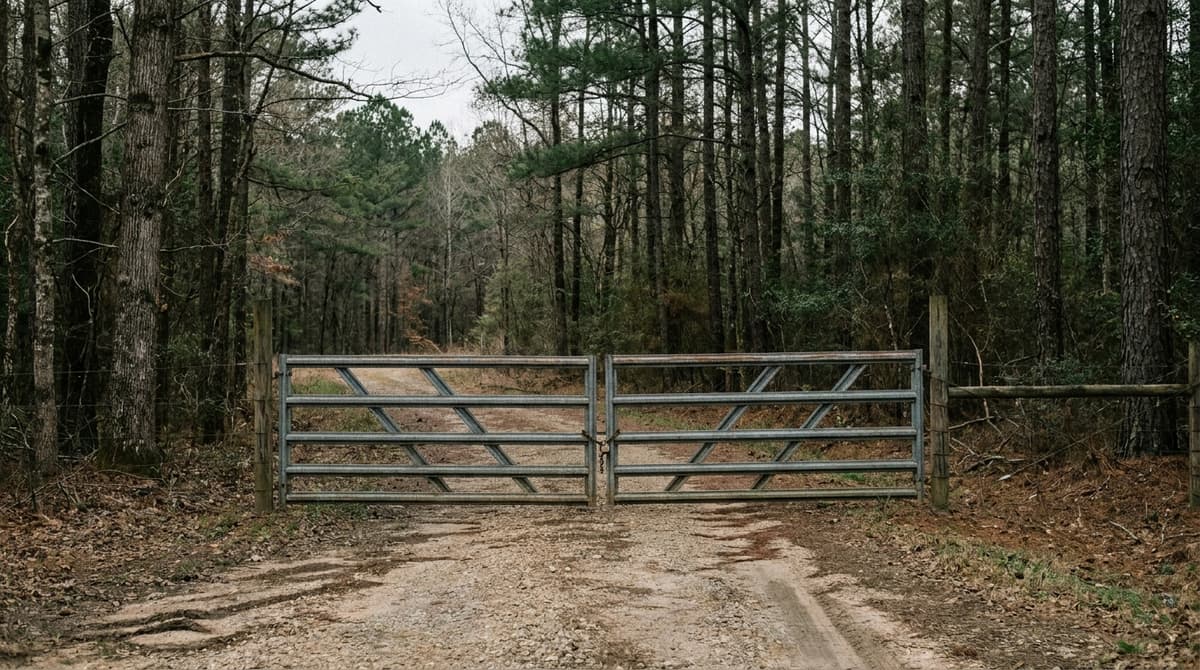
For roads used by the public, Ark. Code § 18-61-101(e)(2) provides that "the public's right to use an unpaved road established by an easement is abandoned if" access is denied by a gate across the road and "the gate is closed and locked continuously, other than briefly to allow access by the owner or others with the owner's express permission, for one (1) year." After that, an action to assert the public's right is barred (§ 18-61-101(e)(3)).
The rule has firm limits. Under § 18-61-101(e)(4), it does not apply to:
- A road or highway maintained by the State of Arkansas
- A road maintained or accepted for perpetual maintenance by a county
- A road maintained by an improvement district
- A road within the limits of a city of the first or second class
- The claim of any person, or that person's heirs, successors, assigns or tenants, who uses the unpaved road as a means of ingress and egress to land that person owns or leases
So a locked gate can end the general public's right over a qualifying unpaved road, but not the right of someone who uses the road to reach their own land.
Landlocked Property: The County Court Road Petition
Arkansas gives a landlocked owner a statutory route through the county court. Ark. Code § 27-66-401(a)(1) provides:
"When the lands, dwelling house, or plantation of any owner is so situated as to render it necessary to have a road from such lands, dwelling house, or plantation to any public road or navigable watercourse over the lands of any other person and the other person refuses to allow that owner the road, the owner may petition the county court to appoint viewers to lay off the road, provided the owner gives written notice to the person twenty (20) days before application to the court and attaches the written notice to the petition."
The written notice must include the amount of payment the owner offers for the road (§ 27-66-401(a)(2)). The petition must allege with particularity facts showing that the notice was given 20 days before the application, that the respondent refused to convey the requested access easement, and that the petitioner lacked the legal right of ingress and egress across the respondent's land or otherwise to a public road (§ 27-66-401(b)). The county court then sets a preliminary hearing, which may not be held earlier than 60 days after the petition is filed (§ 27-66-401(d)).
What the court can order
If the notices and petition are in order, the court appoints viewers. It gives each party at least 10 business days to submit up to three potential viewers and then selects one from each party plus one or more of its own choosing, for a total of three (§ 27-66-401(f)(2)(A)). It also orders the petitioner to deposit into the court registry an estimated sum for the viewers' fees and expenses, the survey, the neighbor's damages and any notice costs; if the deposit is not made, the court may dismiss the case without prejudice (§§ 27-66-401(f)(2)(B), 27-66-403(a)(1)). The evidentiary hearing may be held only after at least 60 days have passed since the petition was filed and the deposit has been made (§ 27-66-403(a)(3)(A)). A county court may not grant such a road across a railroad right-of-way (§ 27-66-405).
If the court finds the road necessary, the order establishes a road "not to exceed fifty feet (50') in width" and determines "the damages sustained by each owner of lands through which the access easement passes" (§ 27-66-403). The measure of damages is "the difference in the fair market value of the lands immediately before the access easement is ordered and the fair market value of the lands after the access easement is ordered" (§ 27-66-402(d)(2)).
The order must state that the respondent keeps title to the land the road crosses, and that "the road is for an access easement only and is not an easement for any other purpose, including a public utility." The statute also provides that "the petitioner shall be solely responsible for the maintenance of the road established under this subchapter." Obstructing a road established under Arkansas law, by felling trees across it or placing an obstruction on it, is a Class C misdemeanor, and the person also forfeits $100 for every day the obstruction remains after being notified to remove it (Ark. Code § 27-66-404).
Fees and appeal
The final order directs the petitioner to make any further deposits needed "for the payment of all costs and expenses, including reasonable attorney's fees and costs, accruing and remaining unpaid on account of the petition for the road," including the view, the survey and the damages owed to each owner the road crosses (§ 27-66-403(a)(3)(B)(ii)(b)(1)). Separately, the statute provides: "If the respondent substantially prevails on the disputed issues in the case, the court shall award reasonable attorney's fees and costs to the respondent." In deciding that, the court considers the respondent's success on the necessity, route and width of the road and the damages (§ 27-66-403(a)(3)(B)(ii)(b)(2)).
Either party may appeal the county court's final order to the circuit court "within thirty (30) days from the entry of the order and not thereafter," and the circuit court's review is de novo (§ 27-66-403(b)). Missing that 30-day window ends the right to appeal.
Easement by Necessity Under Arkansas Common Law
Separate from the county-court statute, Arkansas recognizes a common-law way of necessity. In Riffle v. Worthen (1997), the Arkansas Supreme Court stated that the person who asserts an easement has the burden of proving it exists, and repeated as well settled the rule from its 1932 decision in Boullioun v. Constantine:
"A way of necessity can only be raised out of land granted or reserved by the grantor, but not out of land of a stranger, for, if one owns land to which he has no access except over the lands of a stranger, he has not thereby any right to go across these for the purpose of reaching his own."
The court then set out what the owner claiming the easement must prove: that the same person or entity once held title to both tracts, that a conveyance of one tract severed that unity of title, and that the easement is necessary for the owner of the landlocked tract to use the land, "with the necessity existing both at the time of the severance of title and at the time the easement is exercised." The court added that "the degree of necessity must be more than mere convenience," and that "when a parcel of land is accessible by a navigable body of water but not by road and motor vehicle, the accessibility via the water does not defeat a showing of necessity." Where an owner's only access would cross land of a stranger, this common-law rule gives no way of necessity; the county-court petition is a separate, statutory route.
Conservation Easements and Ending an Easement
Arkansas's Conservation Easement Act (Ark. Code § 15-20-401 et seq.) treats a conservation easement much like any other easement. Under § 15-20-404, "except as otherwise provided in this subchapter, a conservation easement may be created, conveyed, recorded, assigned, released, modified, terminated, or otherwise altered or affected in the same manner as other easements." To look up what is recorded against a parcel, see Arkansas property records for how to search county land records.
For public unpaved roads, the locked-gate rule in § 18-61-101(e), described above, ends the public's right. A private easement can be lost by abandonment. In Bank of Fayetteville, N.A. v. Matilda's, Inc. (1991), the Arkansas Supreme Court stated that the person asserting abandonment "has the burden of proving it by clear evidence" and that an easement "may not be lost by merely showing nonuse," but that "abandonment of an easement will be presumed where the owner of the right does or permits to be done any act inconsistent with its future enjoyment." The court affirmed a finding of abandonment where a stairway had not been used, and its entry had been sealed and bricked, for at least 29 years.
Relocating an easement
Arkansas adopted the Uniform Easement Relocation Act in Act 505 of 2023. It lets the owner of land burdened by an easement, whether created by express grant or reservation or by prescription, implication, necessity or estoppel, ask a court to move it, and that owner "must commence a civil action" to do so. The court may approve the move only if it does not materially lessen the easement's usefulness, increase the burden on the easement holder, impair the purpose of the easement or anyone's safety, disrupt its use during the move without substantial mitigation, or impair the dominant land, a secured lender's collateral or other recorded interests. The act cannot be used to relocate public-utility, telecommunications, conservation or negative easements, State Highway Commission highway easements, or easements held by a public entity, and it does not apply to a relocation the parties agree to.
Eminent Domain in Arkansas
Eminent domain is the power to take private property for public use with compensation. This section covers Arkansas law; for federal condemnation and other states, see our guide to eminent domain laws by state.
Article 2, section 22 of the Arkansas Constitution provides: "The right of property is before and higher than any constitutional sanction; and private property shall not be taken, appropriated or damaged for public use, without just compensation therefor." The words "or damaged" reach beyond outright takings to property that is damaged for public use, though not every injury qualifies: in St. Francis Drainage District v. Austin (1956), which reproduced this text in a jury instruction, the Arkansas Supreme Court held that crops harmed when weed poison sprayed on a drainage-ditch right-of-way drifted onto them "were not damaged for public use."
Can Arkansas take property for a private developer?
In Kelo v. City of New London (2005), the U.S. Supreme Court held that a city's economic development plan "unquestionably serves a public purpose," so its takings satisfied the Fifth Amendment's public use requirement, and emphasized that "nothing in our opinion precludes any State from placing further restrictions on its exercise of the takings power."
Arkansas's Property Owner's Bill of Rights, Ark. Code § 18-15-103(b), states that "private property may only be taken for public use" and "may only be taken by a governmental entity or a private entity authorized by law to exercise the power of eminent domain." Act 945 of 2021 then added Ark. Code § 18-15-104, which defines public use for the general eminent-domain chapter (Title 18, chapter 15) as a taking by an authorized entity for the purpose of:
- Possessing, developing, occupying and owning property for the enjoyment of the general public or a public agency
- Possessing, occupying and owning property for the necessary operations of a utility or common carrier that the general public has a right to use
- Remediating and reselling blighted property
- Possessing and reselling abandoned property
The section provides that "'public use' does not include the taking of private property for the economic benefit of the general public, including without limitation for the purpose of an increase in the tax base, tax revenues, or employment." A taking for one of the listed public uses "is not prohibited because the public use also provides ancillary economic benefits." Blighted and abandoned property are defined narrowly. Blighted property is a building cited as unfit for human use or habitation because it is dilapidated, unsanitary or unsafe, is a fire hazard, or has had its electricity, heating or plumbing destroyed or removed. Abandoned property must have gone unoccupied and unused for at least one year, carry a housing, building or fire code citation left unremedied for 180 days, and have at least two years of delinquent property taxes. Urban renewal statutes in other titles of the code are outside this page.
Challenging a taking by a state agency
Act 945 also created a challenge procedure for condemnations by state agencies. Under Ark. Code § 18-15-1802, the owner may raise a defense or bring an action in circuit court to determine whether the property is lawfully being taken for a public use, as blighted property, as abandoned property, or as necessary to achieve a public use. The state agency "has the burden of proof to show by a preponderance of the evidence" that the taking is lawful. On necessity, the agency must also show that the property is required for a public use, that it has plans with a reasonable schedule to complete the use, that it has access to funding, and that the use cannot be accomplished with other property acquired with the owner's consent without an unreasonable increase in cost or delay.
The deadline is strict: the action "shall not be exercised more than one hundred eighty (180) days after the date the owner of the property received reasonable notice of a condemnation under this chapter." Act 1044 of 2021 excluded the Arkansas Department of Transportation and the State Highway Commission from "state agency" in § 18-15-104, so these state-agency rules do not apply to them. Highway condemnations have their own procedure, described below.
Who can use eminent domain in Arkansas: pipelines and companies
Ark. Code § 23-15-101(a) provides: "All pipeline companies operating in this state are given the right of eminent domain and are declared to be common carriers, except pipelines operated for conveying natural gas for public utility service." Under § 23-15-101(b), pipeline companies follow the same condemnation procedure as railroad, telegraph and telephone companies in § 18-15-1201 et seq.
Recent changes (2021-2025)
Changes since 2021 discussed on this page include the public-use definition and state-agency challenge (Acts 945 and 1044 of 2021), easement relocation (Act 505 of 2023) and the two-appraiser rule for highway surplus remnants (Act 210 of 2025).
Act 576 of the 2025 Regular Session provides that an industrial development authority "may acquire property by gift, by purchase, by negotiation, or by condemnation" for property "necessary or desirable for the carrying out of the powers of an industrial development authority and for the accomplishment of the purposes of this chapter." If an authority decides to exercise eminent domain, it may do so under the railroad condemnation procedure in §§ 18-15-1202 through 18-15-1207, under §§ 18-15-301 through 18-15-307, or under any other statute providing for the exercise of eminent domain by the state or its subdivisions. The act was approved April 14, 2025, and, having no emergency clause or stated effective date, took effect August 5, 2025, the general effective date for acts of that session (Ark. Att'y Gen. Op. No. 2025-032). It adds a new chapter 189 to Title 14 (the condemnation power is § 14-189-110), and the chapter does not authorize an authority to condemn a utility plant or distribution system owned or operated by a regulated public utility (§ 14-189-111).
What must happen before a condemnation suit
Ark. Code § 18-15-103 applies to an owner of property "subject to a proceeding to condemn private property under the right of eminent domain." Among the rights it lists:
- The owner "shall receive from the government or private entity an assessment of the just compensation the entity estimates for the property owner's private property before or contemporaneously with a good faith offer of just compensation" (§ 18-15-103(b)(5)(A)).
- The entity "shall make a written good faith offer to buy the property owner's private property before initiating a condemnation proceeding" (§ 18-15-103(b)(6)).
- The owner "has the right to hire an appraiser or other independent professional to determine the value of the private property" (§ 18-15-103(b)(7)).
Who decides compensation, and the procedure for companies
In a condemnation proceeding, "the circuit court shall impanel a jury of twelve (12) persons as in civil cases to determine the just compensation," and any party has the right to appeal the circuit court's decision on it (§ 18-15-103(b)(9)-(10)).
For railroad, telegraph and telephone companies, and pipeline companies through § 23-15-101(b), the code adds specific steps:
- The company petitions to have the damages for the right-of-way assessed, "giving the owner of the property at least ten (10) days' notice in writing by certified mail, return receipt requested, of the time and place where the petition will be heard" (§ 18-15-1202(a)(2)).
- Damages are "determined and assessed irrespective of any benefit the owner may receive from any improvement proposed by the company" (§ 18-15-1204(b)).
- If the company does not "pay or deposit the amount of damages assessed within thirty (30) days after the assessment," it forfeits "all rights in the premises" (§ 18-15-1207).
- If the dispute is likely to delay the company's work, the court sets a deposit; once it is made, the company may "enter upon the lands and proceed with the company's work" before damages are assessed and paid (§ 18-15-1206).
State highway condemnations (quick-take)
When the State condemns land for highway purposes, it may file a declaration of taking that states the amount it estimates as just compensation (Ark. Code § 27-67-312). On the filing and the deposit of that estimate with the circuit clerk, the State has the right of entry, the people in possession must surrender it on terms the court fixes, and title vests (§§ 27-67-314, 27-67-315). An owner who wants to challenge the validity of the taking must file a motion to strike the declaration of taking and dismiss the suit "on or before the return day mentioned in the summons or notice of publication, or within twenty (20) days after the filing of the declaration of taking, whichever is later." The statute adds: "Failure to file such motion within the time herein provided shall constitute a waiver of the right of any defendant to challenge the validity of the taking" (§ 27-67-313).
A 12-person jury sets compensation, and any court or jury "shall deduct from the value of any land taken for a right-of-way the benefits of the state highway to the remaining lands of the owner" (§ 27-67-316). The judgment includes 6% annual interest on the award from the surrender of possession to payment, except on amounts paid into court (§ 27-67-316(e)). The court may order the deposit paid out to the owner before trial, but if the final award is less than the amount paid out, the court enters judgment against the owner for the excess (§ 27-67-317(a), (c)). If the final award exceeds the deposit by 20% or more, the court awards the owner costs, expenses and reasonable attorney's fees, including appraisal and expert fees (§ 27-67-317(b)).
Just compensation and attorney fees
The constitution and § 18-15-103 require just compensation. The compensation sections covered on this page (§ 18-15-103, §§ 18-15-1202 to 18-15-1207, §§ 27-67-311 to 27-67-317, and the road-damages rule in § 27-66-402) do not add a percentage above value for homes or other property, apart from the 6% interest in highway cases described above.
The owner's fee rule is in § 18-15-103(b)(11)(A): "in a condemnation brought under the laws of this state, a property owner shall be entitled to an award of the property owner's costs, expenses, and reasonable attorney's fees incurred in preparing and conducting the final hearing and adjudication, including without limitation the cost of appraisals and fees for experts if the compensation ultimately awarded exceeds the condemning entity's written good faith offer required under subdivision (b)(6) of this section by twenty percent (20%) or more."
Two limits matter. Under § 18-15-103(b)(11)(A), the 20% comparison is against the written good-faith offer made before suit, while in state-highway quick-take cases § 27-67-317(b) compares the award with the amount deposited. And under § 18-15-103(b)(11)(B), "an award of costs, expenses, and attorney's fees in a condemnation action brought by a county or municipality is governed by the laws that authorize the condemnation action."
Inverse condemnation
When a corporation authorized by law to appropriate private property has entered upon and appropriated property, Ark. Code § 18-15-102(a) lets the owner sue that corporation in the circuit court of the county where the property is located "for damages for the appropriation at any time before an action at law or in equity for the recovery of the property so taken, or compensation therefor, would be barred by the statute of limitations." The measure of recovery is the same as in a condemnation by a corporation (§ 18-15-102(b)). The section ties the deadline to the statute of limitations without stating a period itself. The Arkansas Court of Appeals has explained that the Arkansas Supreme Court "has consistently upheld the seven-year statute of limitations for inverse condemnation actions, holding that a landowner has a right to bring suit for compensation of land within the period of seven years after the land was taken" (Daniel v. City of Ashdown, 2006), and it held the owners' claim in that case barred. A parallel rule applies to cities: when a municipality enters property it could have condemned without starting condemnation proceedings, the owner may start them against the municipality before the limitation period runs, and recovery is the fair market value of the property when the city entered (Ark. Code § 18-15-410).
Relocation payments
Ark. Code § 22-9-702 provides that relocation payments made under § 22-9-701 compensate or reimburse displaced persons "in accordance with the requirements of the Uniform Relocation Assistance and Real Property Acquisition Policies Act of 1970," and "shall not, for any purpose, be deemed or considered compensation for real property acquired or as compensation for damages to remaining real property." Section 22-9-701 ties these payments to the federal Uniform Relocation Act "as it existed on January 1, 2021" (Act 808 of 2021). Federal relocation amounts are covered in the national eminent domain guide.
Buying back condemned land
When the State Highway Commission declares land surplus, the owner it was acquired from, or that owner's heirs, successors or assigns, must be notified in writing or by publication, and "within sixty (60) days after written notice or publication" has the option to purchase it (Ark. Code § 27-67-322(b)). An entire right-of-way parcel may be reacquired by refunding the price the Commission paid; a remnant or portion is reacquired at its market value when declared surplus, as determined by two certified or licensed appraisers (§ 27-67-322(c), as amended by Act 210 of 2025). The option does not apply to capital assets, meaning land the Commission improved with offices, shops, storage yards or similar facilities, or property bought as an uneconomic remnant (§ 27-67-322(d)).
Separately, when a public school closes, the former owner of land the district took by eminent domain, or a successor, may repurchase the part with no capital improvements on it. The price is what the district paid if it acquired the land within the last 15 years, or fair market value if earlier, and the option must be exercised "within one (1) year after the school is closed, and not thereafter" (Ark. Code § 6-13-103(c)).
Arkansas Deadlines and Traps for Landowners
| Deadline or trap | Rule | Source |
|---|---|---|
| Challenge to a state agency's taking | Action on public use, blight, abandonment or necessity may not be brought more than 180 days after the owner received reasonable notice of the condemnation; ArDOT and the State Highway Commission are excluded | Ark. Code § 18-15-1802; Act 1044 of 2021 |
| Highway quick-take challenge | Motion to strike the declaration of taking by the later of the summons return day or 20 days after it is filed, or the challenge to validity is waived | Ark. Code § 27-67-313 |
| Highway deposit withdrawn before trial | If the final award is less than the deposit paid out, the court enters judgment against the owner for the excess | Ark. Code § 27-67-317(c) |
| Inverse condemnation | Generally within seven years after the land was taken (case law) | Daniel v. City of Ashdown (2006); Ark. Code §§ 18-15-102, 18-15-410 |
| County-court road order | Appeal to circuit court within 30 days of the order's entry "and not thereafter" | Ark. Code § 27-66-403(b) |
| Highway surplus buyback | Option to purchase within 60 days after written notice or publication | Ark. Code § 27-67-322(b) |
| School-closure buyback | Option exercised within one year after the school closes | Ark. Code § 6-13-103(c) |
Arkansas Easement and Eminent Domain Rules at a Glance
| Question | Arkansas rule | Source |
|---|---|---|
| Prescriptive easement period | Generally 7 years of adverse use under a claim of right, shown by a preponderance of the evidence (case law) | Carson v. County of Drew (2003); Ark. Code § 18-61-101(a) |
| Permissive use | Not adverse without an act or circumstance showing it is no longer merely permissive; wild, unenclosed land presumed permissive | Carson v. County of Drew (2003) |
| Landlocked land, statute | County-court petition after a refused written offer given 20 days ahead; road up to 50 feet, access only; petitioner maintains; appeal within 30 days | Ark. Code §§ 27-66-401 to 27-66-405 |
| Landlocked land, common law | Former common ownership of both tracts, severed by a conveyance, and necessity (more than mere convenience) both at severance and when used; never out of land of a stranger | Riffle v. Worthen (1997) |
| Ending a private easement | Abandonment, proved by clear evidence; an easement may not be lost by merely showing nonuse | Bank of Fayetteville v. Matilda's (1991) |
| Relocating an easement | Court order in a civil action if the move does not materially harm the holder; not for utility, conservation, highway or public-entity easements | Act 505 of 2023 |
| Public unpaved road behind a locked gate | Public right abandoned after one year locked, with exceptions for state, county, improvement-district and first- or second-class city roads and people reaching land they own or lease | Ark. Code § 18-61-101(e) |
| Economic-development takings | Not a public use under the general eminent-domain chapter: § 18-15-104 excludes takings for the economic benefit of the general public (tax base, tax revenues, employment); blight remediation and abandoned-property resale are listed public uses | Ark. Code § 18-15-104 (Act 945 of 2021) |
| Challenging a state agency's taking | Agency bears the burden; action within 180 days after reasonable notice; not ArDOT or the Highway Commission | Ark. Code § 18-15-1802; Act 1044 of 2021 |
| State-highway quick-take | Entry and title on deposit; motion to strike within the later of the return day or 20 days, or the challenge is waived | Ark. Code §§ 27-67-312 to 27-67-317 |
| Pre-suit duties | Assessment of just compensation and a written good-faith offer | Ark. Code § 18-15-103(b)(5)-(6) |
| Who sets compensation | 12-person jury in circuit court | Ark. Code § 18-15-103(b)(9) |
| Owner's attorney fees | Costs, expenses and fees if the award beats the written offer by 20% or more; county and municipal cases follow their own statutes; highway quick-take compares the award with the deposit | Ark. Code §§ 18-15-103(b)(11), 27-67-317(b) |
| Inverse condemnation | Generally within seven years after the land was taken (case law) | Ark. Code §§ 18-15-102, 18-15-410; Daniel v. City of Ashdown (2006) |
| Buying back condemned land | Highway surplus: 60-day option; closed schools: one-year option | Ark. Code §§ 27-67-322, 6-13-103(c) |
Related Arkansas Property Guides
- Easement laws by state
- Eminent domain laws by state
- Arkansas squatters' rights and adverse possession
- Arkansas property records
- Arkansas statute of limitations
Disclaimer: This article provides general legal information about Arkansas easement and eminent domain law. It is not legal advice. For a specific situation, contact a lawyer licensed in Arkansas or the public agency involved.
Last updated: 2026-10-20.
Frequently Asked Questions
How long does it take to get a prescriptive easement in Arkansas?
Generally seven years. The Arkansas Supreme Court requires use that is adverse to the owner and under a claim of right for the seven-year adverse possession period, shown by a preponderance of the evidence (Carson v. County of Drew, 2003; Ark. Code § 18-61-101). Use that began with permission needs some act or circumstance showing it is no longer merely permissive.
What can I do if my land is landlocked in Arkansas?
Ark. Code § 27-66-401 lets an owner who needs a road across another's land to a public road or navigable watercourse petition the county court to appoint viewers, after giving 20 days' written notice that includes an offered payment and being refused. The court may order an access-only road of no more than 50 feet (§ 27-66-403). A common-law easement by necessity requires former common ownership of both tracts, severed by a conveyance, and necessity both at the severance and when the easement is used (Riffle v. Worthen, 1997).
Who maintains a court-ordered access road in Arkansas?
Under the county-court road statute, the petitioner is solely responsible for maintaining the road. The court's order also determines the damages sustained by each owner whose land the road crosses, measured by the drop in fair market value (Ark. Code §§ 27-66-402(d)(2), 27-66-403).
Can a locked gate end a road easement in Arkansas?
For the public's right over an unpaved road established by an easement, yes: it is abandoned if a gate keeps it closed and locked continuously for one year, apart from brief access by the owner or people with permission (Ark. Code § 18-61-101(e)). The rule does not apply to state roads, county-maintained or county-accepted roads, improvement-district roads or roads within first- or second-class cities, or to people who use the road to reach land they own or lease.
Can Arkansas take private property for a private developer?
Ark. Code § 18-15-103(b) states that private property may only be taken for public use, and since Act 945 of 2021, § 18-15-104 excludes from public use, under the general eminent-domain chapter, the taking of private property for the economic benefit of the general public, such as increasing the tax base, tax revenues or employment. Remediating and reselling blighted property and reselling abandoned property, as the section defines them, are listed public uses, and a taking for a listed use is not barred because it also brings ancillary economic benefits.
Can a pipeline company use eminent domain in Arkansas?
Ark. Code § 23-15-101 gives all pipeline companies operating in Arkansas the right of eminent domain and declares them common carriers, except pipelines operated for conveying natural gas for public utility service. They follow the railroad condemnation procedure in § 18-15-1201 et seq.
Does Arkansas pay attorney fees in eminent domain cases?
Under Ark. Code § 18-15-103(b)(11), an owner is entitled to costs, expenses and reasonable attorney's fees, including appraisal and expert fees, if the final award exceeds the condemning entity's written good-faith offer by 20% or more. In condemnations brought by a county or municipality, fees are governed by the laws that authorize the action. In state-highway quick-take cases, the comparison is with the amount the State deposited (§ 27-67-317(b)).
How long does an owner have to challenge an eminent domain taking in Arkansas?
It depends on who is taking the property. Against a state agency, an action over whether the taking is for a lawful public use, as blighted or abandoned property, or as necessary may not be brought more than 180 days after the owner received reasonable notice of the condemnation (Ark. Code § 18-15-1802); the Arkansas Department of Transportation and the State Highway Commission are excluded. In a state-highway quick-take, a motion to strike the declaration of taking is due by the later of the summons return day or 20 days after the declaration is filed, or the challenge is waived (§ 27-67-313). An inverse-condemnation claim for land already taken is generally brought within seven years after the taking (Daniel v. City of Ashdown, 2006).
What must the condemning entity do before suing in Arkansas?
Ark. Code § 18-15-103(b) requires an assessment of the just compensation the entity estimates, given before or with a good-faith offer, and a written good-faith offer to buy before a condemnation proceeding begins. A 12-person circuit-court jury then determines just compensation if the case goes forward.
Updates
Independently fact-checked against the cited primary sources
The Law Behind This Article
This article rests on the statutory provisions below, held in our own legal record and retrieved from the official source. Tap a section to read the operative text.
Arkansas Code of 1987 Annotated
§ 18-15-103Bill of rights — Property owner.In force
(a) The principles expressed in subsection (b) of this section shall serve as standards to be followed in any proceeding that involves an entity authorized by law to exercise the power of eminent domain. (b) An owner of property subject to a proceeding to condemn private property under the right…
Official text (excerpt) · last checked 2020-11-06 · Read the full text in our law library
§ 27-66-401Establishment.In force
(a)(1) When the lands, dwelling house, or plantation of any owner is so situated as to render it necessary to have a road from such lands, dwelling house, or plantation to any public road or navigable watercourse over the lands of any other person and the other person refuses to allow that owner…
Official text (excerpt) · last checked 2020-11-06 · Read the full text in our law library
§ 27-66-402Duty of viewers.In force
(a) Viewers shall take the same oath and shall be governed in all respects as viewers appointed to public roads are governed under this act. (b) They shall examine the route proposed for the road and any other route which they may deem proper. (c) If a majority of the viewers state under oath…
Official text (excerpt) · last checked 2020-11-06 · Read the full text in our law library
§ 27-66-403Court order.In force
(a)(1) If the petitioner has not complied with the court's order under § 27-66-401 and paid into the registry of the county court the estimated sum, the court may dismiss the case without prejudice and provide that the matter may be refiled within one (1) year from dismissal in accordance with the…
Official text (excerpt) · last checked 2020-11-06 · Read the full text in our law library
§ 18-61-101Actions to recover land, tenements, or hereditaments.In forcecited in 2 of our articles
(a)(1) No person or his or her heirs shall have, sue, or maintain any action or suit, either in law or equity, for any lands, tenements, or hereditaments after seven (7) years once his or her right to commence, have, or maintain the suit shall have come, fallen, or accrued. (2) All suits, either…
Official text (excerpt) · last checked 2020-11-06 · Read the full text in our law library
Cited in 28 court opinions in our collectionLatest citing opinion in our collection: 2025
Opinions citing this section in our collection:
- Bonds v. Carter (Supreme Court of Arkansas 2002, 348 Ark. 591)“…of limitations for bringing actions to recover lands. See Ark.Code Ann. § 18-61-101 (1987). She also avers that the Uniform…”
- Carson v. County of Drew (Supreme Court of Arkansas 2003, 354 Ark. 621)“…That statutory period for adverse possession is set out in Ark. Code Ann. § 18-61-101 (1987). See also Ark. Code Ann. § 18-…”
- Myers v. Yingling (Supreme Court of Arkansas 2008, 372 Ark. 523)“…n, 228 Ark. 617 , 309 S.W.2d 318 (1958); see also Ark.Code Ann. § 18-61-101 (Repl. 2003). Here, there was no proo…”
Identified automatically from the court opinions citing this section — not a ranking of which case controls.
Also relied on in: Arkansas Squatters Rights and Adverse Possession Laws (2026)
§ 23-15-101Common carriers — Eminent domain.In force
(a) All pipeline companies operating in this state are given the right of eminent domain and are declared to be common carriers, except pipelines operated for conveying natural gas for public utility service. (b) The procedure to be followed in the exercise of the right shall be the same as…
Official text (excerpt) · last checked 2020-11-06 · Read the full text in our law library
§ 18-15-1202Petition for condemnation.In force
(a)(1) Any railroad, telegraph, or telephone company, organized under the laws of this state, after having surveyed and located its lines of railroad, telegraph, or telephone, in all cases in which the companies fail to obtain the right-of-way over the property by agreement with the owner of the…
Official text (excerpt) · last checked 2020-11-06 · Read the full text in our law library
§ 18-15-102Actions against corporations appropriating private property.In force
(a) Whenever any corporation authorized by law to appropriate private property for its use shall have entered upon and appropriated any real or personal property, the owner of the property shall have the right to bring an action against the corporation in the circuit court of the county in which…
Official text (excerpt) · last checked 2020-11-06 · Read the full text in our law library
§ 18-11-106Adverse possession.In forcecited in 3 of our articles
(a) To establish adverse possession of real property, the person and those under whom the person claims must have actual or constructive possession of the real property being claimed and have either: (1)(A) Held color of title to the real property for a period of at least seven (7) years and…
Official text (excerpt) · last checked 2020-11-06 · Read the full text in our law library
Cited in 42 court opinions in our collectionLatest citing opinion in our collection: 2025
In the courts (editorial summary, independently checked):Schrader held § 18-11-106's 1995 color-of-title and tax requirements did not apply after possession had vested under prior law. Roberts construed contiguous property to mean the claimant's titled land must touch the land claimed, and remanded because the trial court misapplied that rule.
Opinions citing this section in our collection:
- Boyette v. Vogelpohl (Court of Appeals of Arkansas 2005, 92 Ark. App. 436)✓The Boyettes and their predecessors used land to an old fence since the 1960s. The court held their claim vested before the 1995 color-of-title and tax amendment, so § 18-11-106 did not defeat it, and ordered title quieted to them.
- Schrader v. Schrader (Court of Appeals of Arkansas 2003, 81 Ark. App. 343)✓The Schraders began possessing the fenced strip in 1976 and their rights vested seven years later. The court held § 18-11-106's 1995 tax and color-of-title additions did not apply retroactively and affirmed their title.
- Roberts v. Boyd (Court of Appeals of Arkansas 2006, 94 Ark. App. 345)✓A survey left a gap between the deed descriptions. Under § 18-11-106(a)(2), the claimant’s titled parcel must touch the land claimed, which included the gap. The court remanded for findings on ownership and adverse use.
Identified automatically from the court opinions citing this section — not a ranking of which case controls.
Also relied on in: Arkansas Statute of Limitations: Filing Deadlines by Case Type
Search our full record of US law — 2.1 million sections, every state + federal →
Sources and References
- Carson v. County of Drew, 354 Ark. 621 (2003)(courtlistener.com)
- Ark. Code § 18-61-101, Actions to recover land, tenements, or hereditaments(advance.lexis.com)
- Ark. Code § 18-15-103, Bill of rights, property owner(advance.lexis.com)
- Ark. Code § 27-66-401, Private roads: establishment(advance.lexis.com)
- Ark. Code § 27-66-402, Private roads: duty of viewers(advance.lexis.com)
- Ark. Code §§ 27-66-403 to 27-66-405, Private roads: court order, obstruction, railroad limit(advance.lexis.com)
- Ark. Code § 18-11-106, Adverse possession requirements(advance.lexis.com)
- Riffle v. Worthen, 327 Ark. 470 (1997)(courtlistener.com)
- Ark. Code § 15-20-404, Conservation easements: creation and alteration(advance.lexis.com)
- St. Francis Drainage District v. Austin, 227 Ark. 167 (1956)(courtlistener.com)
- Kelo v. City of New London, 545 U.S. 469 (2005)(tile.loc.gov).gov
- Ark. Code § 23-15-101, Common carriers: eminent domain (pipeline companies)(advance.lexis.com)
- Act 576 of the 2025 Regular Session, Arkansas General Assembly (industrial development authorities)(arkleg.state.ar.us).gov
- Ark. Code §§ 18-15-1202 to 18-15-1207, Condemnation by railroad, telegraph and telephone companies (incl. § 18-15-1206 deposit)(advance.lexis.com)
- Ark. Code § 18-15-102, Action for damages against a corporation appropriating property(advance.lexis.com)
- Ark. Code § 22-9-702, Relocation payments not compensation for real property(advance.lexis.com)
- Act 945 of 2021 (SB 334), Ark. Code §§ 18-15-104, 18-15-1801, 18-15-1802(arkleg.state.ar.us).gov
- Act 1044 of 2021 (SB 706), amending Ark. Code §§ 18-15-104(4), 18-15-1802(arkleg.state.ar.us).gov
- Act 505 of 2023 (HB 1408), Uniform Easement Relocation Act(arkleg.state.ar.us).gov
- Act 210 of 2025 (HB 1486), amending Ark. Code § 27-67-322(c)(arkleg.state.ar.us).gov
- Act 808 of 2021 (SB 415), amending Ark. Code § 22-9-701(arkleg.state.ar.us).gov
- Arkansas Attorney General Opinion No. 2025-032 (effective date of 2025 acts)(ag-opinions.s3.amazonaws.com)
- Ark. Code §§ 27-67-311 to 27-67-317, Highway condemnation: declaration of taking(advance.lexis.com)
- Ark. Code § 27-67-322, Reacquisition of surplus property by former owner(advance.lexis.com)
- Ark. Code § 6-13-103, School districts: eminent domain and repurchase by former owner(advance.lexis.com)
- Ark. Code § 18-15-410, Rights of property owner upon entry by municipality(advance.lexis.com)
- Daniel v. City of Ashdown, 94 Ark. App. 446 (2006)(courtlistener.com)
- Bank of Fayetteville, N.A. v. Matilda's, Inc., 304 Ark. 518 (1991)(courtlistener.com)