
Kansas
Kansas Disorderly Conduct Laws: Penalties, Trespass and Purple Paint
Independently fact-checked against primary sources (last audited October 18, 2026). · 29 primary sources cited on this page. How we verify our legal content
Kansas makes disorderly conduct a class C misdemeanor under K.S.A. 21-6203, punishable by up to one month in the county jail and a fine of up to $500. The statute covers three acts, brawling or fighting, disturbing a lawful assembly, and using fighting words or noisy conduct, when the person knows or should know the act will alarm, anger or disturb others or provoke an assault or other breach of the peace.
Criminal trespass under K.S.A. 21-5808 is a class B nonperson misdemeanor (up to six months and $1,000), and it has no degrees. Trespass reaches felony level only in narrower statutes: criminal trespass on a nuclear generating facility (K.S.A. 66-2303, severity level 6), trespass on railroad property that causes more than $1,500 in loss or damage, and aggravated trespass on a critical infrastructure facility with intent to damage or impede it. For other states, see our guide to disorderly conduct and trespass laws by state.
Information last verified on 2026-10-18. This article has not been reviewed by a licensed lawyer.
Jurisdiction scope: This article covers Kansas's state criminal statutes on disorderly conduct (K.S.A. 21-6203), related public-order offenses in Articles 58, 59, 61 and 62 of Chapter 21 (with criminal threat, K.S.A. 21-5415, and the emergency curfew offense in K.S.A. 48-939), the 2026 session laws that changed them, and criminal trespass (K.S.A. 21-5808 to 21-5810, 21-5818 and 66-2303, with the wildlife posting rule in K.S.A. 32-1013). It does not cover local noise ordinances and quiet hours (see Kansas noise laws), the procedure for removing squatters (see Kansas squatters' rights), use of force against an intruder (see Kansas self-defense laws), civil trespass suits, city or county ordinances, or federal property rules.
What is disorderly conduct in Kansas?
Kansas has a single disorderly conduct statute, K.S.A. 21-6203, in Article 62 of the criminal code (crimes against the public peace). There is no separate offense named breach of the peace or disturbing the peace. The statute reads:
"Disorderly conduct is one or more of the following acts that the person knows or should know will alarm, anger or disturb others or provoke an assault or other breach of the peace: (1) Brawling or fighting; (2) disturbing an assembly, meeting or procession, not unlawful in its character; or (3) using fighting words or engaging in noisy conduct tending reasonably to arouse alarm, anger or resentment in others." (K.S.A. 21-6203(a))
In plain terms, the three forms are:
- Brawling or fighting. Where a fight also involves an assault or battery, see Kansas assault and battery laws.
- Disturbing a lawful assembly, meeting or procession. The gathering itself must be "not unlawful in its character."
- Fighting words or noisy conduct that tends reasonably to arouse alarm, anger or resentment in others. Loud-neighbor problems, quiet hours and decibel limits are mostly a matter for local rules; see our Kansas noise laws page.
The mental state is "knows or should know": the person knows, or should know, that the act will alarm, anger or disturb others, or provoke an assault or other breach of the peace. The statute contains no public-place element.
Fighting words, swearing and yelling
Kansas writes its fighting-words limit into the statute. Subsection (c) provides that "fighting words" means "words that by their very utterance inflict injury or tend to incite the listener to an immediate breach of the peace." Speech falls under subsection (a)(3) only if it meets that definition, or if it is "noisy conduct tending reasonably to arouse alarm, anger or resentment in others," and in either case only when the person knows or should know it will alarm, anger or disturb others or provoke an assault or breach of the peace.
The penalty
K.S.A. 21-6203(b) makes disorderly conduct a class C misdemeanor. A class C misdemeanor carries a definite jail term fixed by the court that "shall not exceed one month" (K.S.A. 21-6602(a)(3)) and a fine of up to $500 (K.S.A. 21-6611(b)). The statute has no repeat-offender ladder and no felony form; its only history entry is L. 2010, ch. 136, effective July 1, 2011.
Related public-order offenses in Kansas
Riot and incitement to riot (K.S.A. 21-6201)
Riot is "five or more persons acting together and without lawful authority" using force or violence that produces a breach of the public peace, or threatening such force or violence against any person or property "if accompanied by power or apparent power of immediate execution." Riot is a class A person misdemeanor (up to one year and $2,500), but a severity level 8 person felony if it occurs in a correctional facility, which the statute defines to include a jail.
Incitement to riot is knowingly urging others to riot, by words or conduct, "under circumstances which produce a clear and present danger of injury to persons or property or a breach of the public peace." It is a severity level 8 person felony, or severity level 6 if it occurs in a correctional facility.
Unlawful assembly and refusing to leave one (K.S.A. 21-6202)
Unlawful assembly is the meeting of not less than five persons with the intent to engage in disorderly conduct or riot, or a lawful assembly of five or more that agrees to engage in that conduct. It is a class B nonperson misdemeanor. Remaining at an unlawful assembly, "intentionally failing to depart from the place of an unlawful assembly after being directed to leave by a law enforcement officer," is a class A nonperson misdemeanor.
Public intoxication
Article 62 contains no public intoxication, drunk-and-disorderly or loitering offense. K.S.A. 65-4059 goes further for local law: "No county or city shall adopt any local law, ordinance, resolution or regulation having the force of law rendering public intoxication by alcohol in and of itself or being a common drunkard or being found in enumerated places in an intoxicated condition, an offense, a violation, or the subject of criminal penalties." The same section keeps drunken-driving and similar offenses involving motor vehicles, machinery or other hazardous equipment in force.
Funerals (K.S.A. 21-6106)
The Kansas funeral privacy act makes it a class B person misdemeanor to engage in a public demonstration at any public location within 150 feet of any entrance to a cemetery, church, mortuary or other funeral location, from one hour before a funeral begins until two hours after it ends; to knowingly obstruct a person's entry to or exit from a funeral; or to knowingly impede vehicles in a funeral procession. "Public demonstration" means picketing or similar conduct, or any oration, speech or use of sound amplification that is not part of the funeral. Each day of violation is a separate offense.
Cemeteries and desecration (K.S.A. 21-6205)
Recklessly damaging, defacing or destroying a public monument or structure or property in a cemetery (other than by fire or explosive) is criminal desecration under K.S.A. 21-6205: a class A nonperson misdemeanor under $1,000, a severity level 9 nonperson felony from $1,000 to under $25,000, and severity level 7 at $25,000 or more. Knowingly obtaining unauthorized control of a dead body or remains is a class A nonperson misdemeanor. 2026 Session Laws ch. 69 (House Bill 2331) added aggravated criminal desecration, that same conduct committed "with the intent to conceal the death of a human being or the commission of a crime," a severity level 7 nonperson felony. Before 2026, 21-6205 also covered damage to a place of worship. Ch. 149 removed that clause and covered the same conduct, with the same value grades, in its new religious-assembly offense (K.S.A. 21-6208). The ch. 69 version, which the Revisor lists as K.S.A. 21-6205a, still includes it, and the Revisor notes that the two versions were not reconciled during the 2026 session.
Places of worship (2026 Session Laws ch. 149)
House Bill 2018 (2026 Session Laws ch. 149, allowed to become law without the governor's signature) created the crime of interference with the conduct of a religious assembly, which the Revisor's 2026 list of new statutes places at K.S.A. 21-6208:
- Intentionally injuring, intimidating or interfering with a person lawfully exercising or seeking to exercise religious freedom at a place of religious worship, by force, threat of force or physical obstruction: severity level 10 person felony, severity level 6 for a second or subsequent conviction.
- Recklessly damaging, defacing or destroying the property of a place of worship (other than by fire or explosive): class A nonperson misdemeanor under $1,000; severity level 9 felony from $1,000 to under $25,000; severity level 7 felony at $25,000 or more.
- The aggravated form, the force, threat or obstruction offense committed while in possession of a firearm or weapon covered by K.S.A. 21-6301 or 21-6302: severity level 4 person felony.
"Physical obstruction" means making entry to or exit from the place of worship impassable, or unreasonably difficult or hazardous. The act took effect on its publication in the statute book. It also creates a civil cause of action for people injured by the conduct.
Public buildings (K.S.A. 21-5922)
Interference with the conduct of public business in public buildings is a class A nonperson misdemeanor. It covers knowingly denying officials, employees or invitees their lawful right to enter, use or leave a public building; impeding officials by restraint, coercion, intimidation or force; knowingly refusing to leave a public building when asked by the officer in charge of keeping order there, if the person is committing, threatening or inciting acts that would disrupt its lawful functions; and disrupting meetings of judicial, legislative or executive bodies. The aggravated form, committed while in possession of a firearm or weapon covered by 21-6301 or 21-6302, is a severity level 6 person felony.
House Bill 2372 (2026 Session Laws ch. 142, enacted over the governor's veto) extended the offense to public buildings "owned, operated or controlled by the United States" and added subsection (d): "Nothing in this section shall grant law enforcement authority to a federal law enforcement officer as defined in 5 U.S.C. § 8401 or 6 U.S.C. § 271." The same act created the crime of unlawful approach of a first responder (listed by the Revisor as K.S.A. 21-6334), a class B person misdemeanor: knowingly approaching or remaining within 25 feet of a first responder who is performing their duties, after a first responder signals not to because separation is reasonably believed necessary for safety, in a way that distracts the responder or increases their concern of harm to a person or property.
Public nuisance (K.S.A. 21-6204)
Knowingly causing or permitting a condition "which injures or endangers the public health, safety or welfare," or knowingly letting property under one's control be used for one, is a class C misdemeanor.
False 911 calls, false reports and threats
K.S.A. 21-6207 makes it a crime to transmit or communicate "false or misleading information in any manner to request emergency service assistance," knowing at the time "there is no reasonable ground for believing such assistance is needed." It is a class A nonperson misdemeanor; a severity level 10 nonperson felony when the person uses an electronic device or software to disguise the source of the request or the caller's identity; severity level 7 when the request includes false information that violent criminal activity or an immediate threat to life or public safety has taken or is taking place; and severity level 6, 4 or 1 person felony when bodily harm, great bodily harm or death results from the emergency response.
Falsely reporting to a law enforcement officer or agency that a particular person has committed a crime, knowing the information is false and intending that the officer or agency act on it, is interference with law enforcement under K.S.A. 21-5904(a)(1). That form is a class A nonperson misdemeanor, or a severity level 8 nonperson felony "in the case of a felony"; a knowingly false report intended to impede an officer's duty is class A or severity level 9, and a false report about the death or disappearance of a child under 13 is a severity level 8 nonperson felony.
A threat to commit violence communicated with intent to place another in fear, or to cause the evacuation, lock down or disruption of regular activities of any building, place of assembly or facility of transportation, is criminal threat under K.S.A. 21-5415, a severity level 9 person felony. It is aggravated criminal threat, a severity level 5 person felony, when a public, commercial or industrial building, place of assembly or facility of transportation is actually evacuated, locked down or disrupted as a result.
Using a phone or other telecommunications device to make obscene communications, or calls or messages with intent to abuse, threaten or harass, is harassment by telecommunication device under K.S.A. 21-6206, a class A nonperson misdemeanor.
Emergency curfews (K.S.A. 48-939)
During a declared state of disaster emergency, a knowing violation of a governor's executive order under K.S.A. 48-925 "that mandates a curfew or prohibits public entry into an area affected by a disaster is a class A nonperson misdemeanor." Other intentional violations of emergency orders carry a civil penalty of up to $2,500 per violation.
Criminal trespass in Kansas
Kansas has one general criminal trespass statute, K.S.A. 21-5808, with no degrees. It is a class B nonperson misdemeanor, punishable by up to six months in the county jail and a fine of up to $1,000.
What the statute requires
Trespass under 21-5808(a)(1) has two parts. First, the person enters or remains on or in any "land, nonnavigable body of water, structure, vehicle, aircraft or watercraft" knowing that they are "not authorized or privileged to do so." Second, one of three conditions applies:
- An order to leave or not to enter. The person enters or remains "in defiance of an order not to enter or to leave such premises or property personally communicated to such person by the owner thereof or other authorized person."
- Posting or enclosure. The premises are "posted as provided in K.S.A. 32-1013, and amendments thereto, or in any other manner reasonably likely to come to the attention of intruders, or are locked or fenced or otherwise enclosed, or shut or secured against passage or entry."
- A restraining order. The person enters or remains in defiance of a restraining order issued under one of the listed civil, family or juvenile statutes, and the order "has been personally served upon the person so restrained." A conviction under this branch carries a minimum of 48 consecutive hours of imprisonment, served before or as a condition of any probation, suspension, reduction of sentence or parole.
Subsection (a)(2) separately covers entering or remaining on land or in a structure in a way that interferes with access to or from a health care facility, after the facility owner or another authorized person personally communicates an order not to enter or to leave.
When a store or owner tells you to leave
The first branch of 21-5808 is the one that applies after a warning: once the owner or another authorized person personally communicates an order not to enter or to leave, entering or remaining afterward, knowing one is not authorized, is criminal trespass.
The burglary statute has a carve-out for banned shoppers. K.S.A. 21-5807(e) provides that the burglary section "shall not apply to any person entering into or remaining in a retail or commercial premises at any time that it is open to the public after having received a personal communication from the owner or manager of such premises not to enter such premises pursuant to K.S.A. 21-5808, and amendments thereto, except when such person is entering into or remaining in such premises with the intent to commit a person felony or sexually motivated crime therein."
Is there a purple paint law in Kansas?
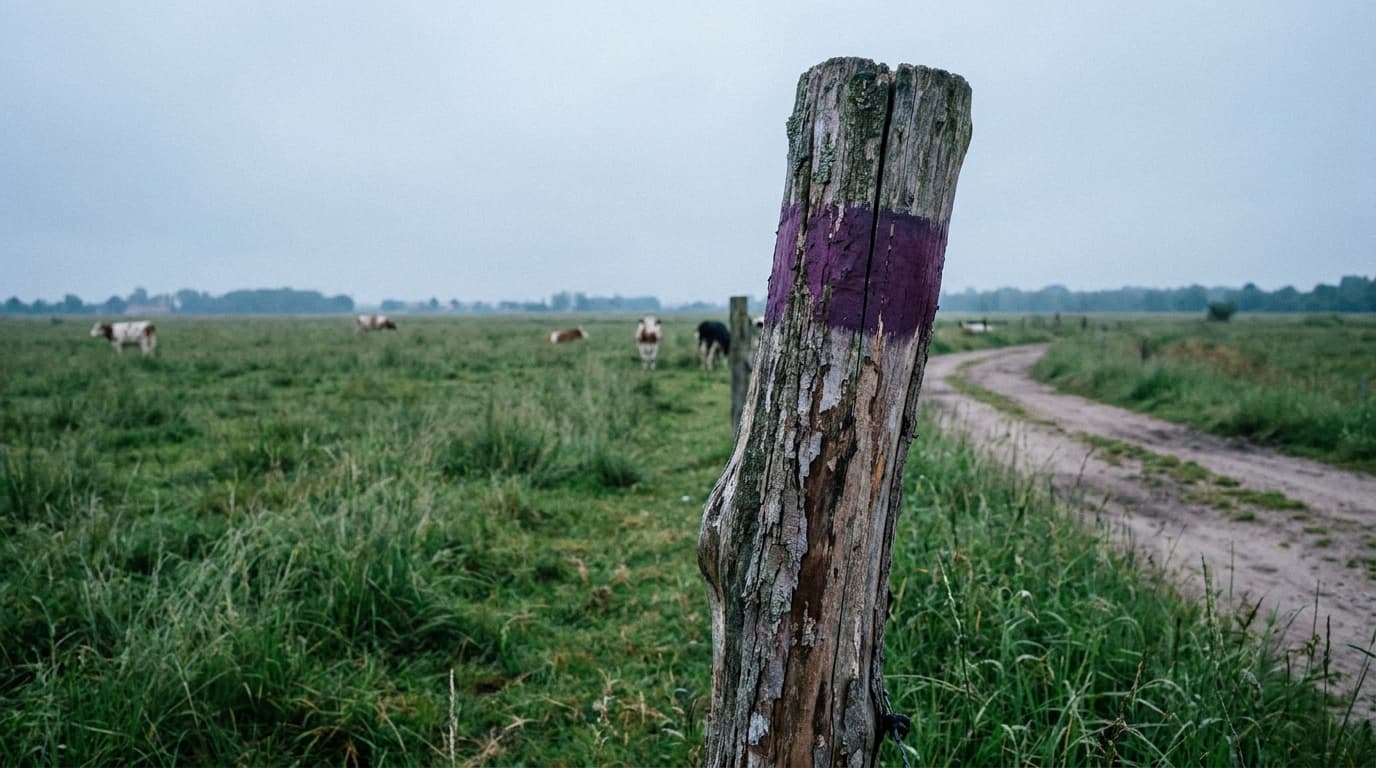
Yes, in the wildlife title. K.S.A. 32-1013(a) lets a landowner post land with signs stating that hunting, trapping or fishing is "by written permission only." Subsection (b) adds a purple paint alternative:
"Instead of posting land as provided in subsection (a), any landowner or person in lawful possession of any land may post such land by placing identifying purple paint marks on trees or posts around the area to be posted. Each paint mark shall be a vertical line of at least eight inches in length and the bottom of the mark shall be no less than three feet nor more than five feet high. Such paint marks shall be readily visible to any person approaching the land." (K.S.A. 32-1013(b))
Subsection (b) sets the length and height of each mark but no distance between marks. Land posted with paint "shall be considered to be posted by written permission only." The criminal trespass statute adopts this posting by reference: 21-5808(a)(1)(B) covers premises "posted as provided in K.S.A. 32-1013," and the criminal hunting statute, 21-5810(a)(3)(B), does the same for hunting and fishing. Taking wildlife on posted land without written permission in one's possession is itself a violation of 32-1013, a class C nonperson misdemeanor under K.S.A. 32-1031(a), with minimum fines of $250 on a second conviction, $300 on a third, and $400 plus at least 7 days in the county jail on a fourth or later conviction. For big game or wild turkey, K.S.A. 32-1032 applies instead: a fine of $500 to $1,000 or up to six months in jail, or both, on a first or second conviction; a class B misdemeanor with at least $1,000 and 30 days on a third; a class A misdemeanor with at least $1,000 and 60 days on a fourth and 90 days on a fifth or later; and forfeiture of hunting privileges for one year (first conviction, at the court's discretion), three years (second) and five years (third or later).
Who the trespass statute does not cover
Section 21-5808(d) provides that it does not apply to a licensed land surveyor and the surveyor's agents and employees entering land to make a survey, or to railroad property or a nuclear generating facility, which have their own statutes (K.S.A. 21-5809 and 66-2303).
Railroad property (K.S.A. 21-5809)
Entering or remaining on railroad property without the consent of the owner or its agent, "knowing that it is railroad property," or recklessly causing a derailment, is a class A nonperson misdemeanor. It becomes a severity level 8 nonperson felony if the trespassing "results in a demonstrable monetary loss, damage or destruction of railroad property valued at more than $1,500." Railroad property is defined broadly to include trains, tracks, bridges, signals, rights-of-way and other property a railroad company owns, leases, operates or possesses. The statute does not interfere with the lawful use of a public or private crossing.
Nuclear generating facilities (K.S.A. 66-2303)
Criminal trespass on a nuclear generating facility is "(1) Knowingly entering or remaining unlawfully in or on a nuclear generating facility; or (2) knowingly entering or remaining unlawfully within a structure or fenced yard of a nuclear generating facility." Subsection (b) makes it "a severity level 6, person felony."
Critical infrastructure facilities (K.S.A. 21-5818)
Knowingly entering or remaining without the owner's consent in a critical infrastructure facility, or in property containing one that is completely enclosed by a fence or barrier "obviously designed to exclude intruders" or clearly marked with signs forbidding entry without site authorization, is a class A nonperson misdemeanor. The aggravated form, the same entry "with the intent to damage, destroy or tamper with a critical infrastructure facility or impede or inhibit operations of the facility," is a severity level 7 nonperson felony. Damaging or tampering with a facility is a separate severity level 6 felony, and doing so with intent to impede its operations is severity level 5.
The definition covers 16 kinds of facilities, including refineries, power and water plants, pipelines, telecommunications infrastructure, rail yards and dams.
Hunting and fishing on another's land (K.S.A. 21-5810)
Criminal hunting is knowingly hunting, shooting, fur harvesting, pursuing any bird or animal, or fishing on another's land or nonnavigable water without the owner's permission, or from a public road or right-of-way next to occupied or improved premises without permission. Those forms are class C nonperson misdemeanors, and a court may order forfeiture of the hunting or fishing license on a first conviction and must on a second.
Continuing to hunt or fish after an order to leave, or on land posted consistent with 32-1013, is a class B nonperson misdemeanor with mandatory license forfeiture of six months on a first conviction or diversion, one year on a second, and five years on a third or later. A licensed hunter following a wounded animal is not in violation while in that pursuit, but must leave if instructed by the owner.
Squatting
Kansas's 2026 Removal of Squatters Act (House Bill 2378, 2026 Session Laws ch. 56, in effect since its publication in the statute book) is a removal procedure, not a new trespass crime. An owner or agent submits a notarized affidavit to the county law enforcement agency; after verification and at least 24 hours, an officer serves a notice to vacate immediately. The only crime the act creates is for the affiant: one "who knowingly provides a false affidavit to a law enforcement agency under this section may be charged with a class A nonperson misdemeanor." For the procedure, see Kansas squatters' rights.
Trespass versus burglary
Entering or remaining in a dwelling, building or vehicle without authority and with intent to commit a felony, theft, domestic battery, violation of a protection order or sexually motivated crime inside is burglary under K.S.A. 21-5807, a separate offense from trespass.
Penalties at a glance
| Offense | Statute | What it prohibits | Class | Statutory penalty |
|---|---|---|---|---|
| Disorderly conduct | 21-6203 | Brawling or fighting, disturbing a lawful assembly, fighting words or noisy conduct, knowing it will alarm or disturb others | Class C misdemeanor | Up to 1 month; up to $500 |
| Riot | 21-6201(a), (c)(1) | Five or more people using force or violence, or threatening it with apparent power to carry it out | Class A person misdemeanor; severity level 8 felony in a jail or correctional facility | Up to 1 year and $2,500 (misdemeanor); felony fine up to $100,000 |
| Incitement to riot | 21-6201(b), (c)(2) | Knowingly urging others to riot, creating a clear and present danger | Severity level 8 person felony; level 6 in a correctional facility | Fine up to $100,000; prison term from the sentencing grid |
| Unlawful assembly | 21-6202(a) | Five or more meeting with intent to commit disorderly conduct or riot | Class B nonperson misdemeanor | Up to 6 months; up to $1,000 |
| Remaining at an unlawful assembly | 21-6202(b) | Intentionally failing to leave after an officer's order | Class A nonperson misdemeanor | Up to 1 year; up to $2,500 |
| Maintaining or permitting a public nuisance | 21-6204 | Knowingly causing or permitting a condition that endangers public health, safety or welfare | Class C misdemeanor | Up to 1 month; up to $500 |
| Unlawful public demonstration at a funeral | 21-6106 | Picketing or speech within 150 feet, 1 hour before to 2 hours after; obstructing entry; impeding a procession | Class B person misdemeanor (each day separate) | Up to 6 months; up to $1,000 |
| Interference with a religious assembly (2026) | 2026 ch. 149 (K.S.A. 21-6208) | Force, threat or obstruction against worshippers; reckless damage to worship property | Severity level 10 person felony (level 6 repeat); property: class A misdemeanor to level 7 felony by value; armed: level 4 | Felony fines up to $100,000 (levels 6 to 10) or $300,000 (level 4) |
| Interference with public business in public buildings | 21-5922 | Blocking, impeding, refusing to leave when disrupting, or disrupting proceedings in a public building | Class A nonperson misdemeanor; armed: severity level 6 person felony | Up to 1 year; up to $2,500 (misdemeanor) |
| Unlawful approach of a first responder (2026) | 2026 ch. 142 (K.S.A. 21-6334) | Knowingly approaching or staying within 25 feet of an on-duty first responder after a safety signal not to, distracting the responder or raising concern of harm | Class B person misdemeanor | Up to 6 months; up to $1,000 |
| Unlawful request for emergency service assistance | 21-6207 | Knowingly false or misleading request for police, fire, medical or other emergency help | Class A nonperson misdemeanor; severity level 10 (disguised source), 7 (false report of violence or threat), 6, 4 or 1 (bodily harm, great bodily harm or death) | Up to 1 year and $2,500 (misdemeanor); felony fines up to $100,000 (levels 6 to 10) or $300,000 (levels 1 to 5) |
| False report to law enforcement | 21-5904(a)(1) | Knowingly false report that a person committed a crime, or other false information to impede officers | Class A nonperson misdemeanor; severity level 8 or 9 felony in the case of a felony; level 8 for a false report about a child under 13 | Up to 1 year and $2,500 (misdemeanor); felony fine up to $100,000 |
| Criminal threat | 21-5415 | Threat of violence to place another in fear or cause evacuation, lock down or disruption of a building, assembly or transportation facility | Severity level 9 person felony; aggravated (evacuation, lock down or disruption results): level 5 | Fine up to $100,000 (level 9) or $300,000 (level 5); prison term from the sentencing grid |
| Harassment by telecommunication device | 21-6206 | Obscene, abusive, threatening or harassing calls or messages | Class A nonperson misdemeanor | Up to 1 year; up to $2,500 |
| Criminal desecration | 21-6205; 21-6205a | Reckless damage to a public monument or cemetery property (and a place of worship in the 21-6205a version); unauthorized control of remains | Class A nonperson misdemeanor; severity level 9 felony from $1,000; level 7 from $25,000 | Up to 1 year and $2,500 (misdemeanor); felony fine up to $100,000 |
| Aggravated criminal desecration (2026) | 2026 ch. 69 (K.S.A. 21-6205a) | Control of remains with intent to conceal a death or a crime | Severity level 7 nonperson felony | Fine up to $100,000; prison term from the sentencing grid |
| Violating a disaster curfew or area-entry order | 48-939(a)(2) | Knowing violation of a governor's disaster curfew or entry ban | Class A nonperson misdemeanor | Up to 1 year; up to $2,500 |
| Criminal trespass | 21-5808 | Entering or remaining without authority after an order, posting, fencing or locking, or a served restraining order; blocking health care facility access after an order | Class B nonperson misdemeanor | Up to 6 months; up to $1,000; at least 48 hours for the restraining-order branch |
| Criminal hunting (no permission, or from an adjoining road) | 21-5810(a)(1)-(2) | Hunting or fishing on another's land without permission | Class C nonperson misdemeanor | Up to 1 month; up to $500; license forfeiture discretionary, then mandatory |
| Criminal hunting (after an order to leave, or on posted land) | 21-5810(a)(3) | Continuing to hunt or fish after an order, or on land posted under 32-1013 | Class B nonperson misdemeanor | Up to 6 months; up to $1,000; license forfeiture 6 months, 1 year, then 5 years |
| Taking wildlife on land posted by written permission only | 32-1013; 32-1031(a); 32-1032 | Taking wildlife on sign- or purple-paint-posted land without written permission | Class C nonperson misdemeanor; big game or wild turkey: K.S.A. 32-1032 ladder (see above) | Up to 1 month and $500; minimum fines from $250 on a second conviction, plus 7 days in jail from the fourth |
| Trespassing on railroad property | 21-5809 | Entering or remaining on railroad property without consent | Class A nonperson misdemeanor; severity level 8 felony over $1,500 loss or damage | Up to 1 year and $2,500 (misdemeanor); felony fine up to $100,000 |
| Criminal trespass on a nuclear generating facility | 66-2303 | Knowingly entering or remaining unlawfully in or on the facility or within its structure or fenced yard | Severity level 6 person felony | Fine up to $100,000; prison term from the sentencing grid |
| Trespassing on a critical infrastructure facility | 21-5818(a) | Knowing entry into a facility or a fenced or posted property containing one | Class A nonperson misdemeanor | Up to 1 year; up to $2,500 |
| Aggravated trespassing on a critical infrastructure facility | 21-5818(b) | The same entry with intent to damage, tamper or impede operations | Severity level 7 nonperson felony | Fine up to $100,000; prison term from the sentencing grid |
| False affidavit to remove a squatter (2026) | 2026 ch. 56, sec. 2(b) | Knowingly giving law enforcement a false removal affidavit | Class A nonperson misdemeanor | Up to 1 year; up to $2,500 |
Misdemeanor jail terms come from K.S.A. 21-6602(a): up to one year for class A, six months for class B and one month for class C. Misdemeanor fines come from K.S.A. 21-6611(b): up to $2,500, $1,000 and $500. Felony fines under K.S.A. 21-6611(a) are up to $300,000 for severity levels 1 to 5 and $100,000 for levels 6 to 10; felony prison terms come from the sentencing grid in K.S.A. 21-6804, which depends on the severity level and criminal history. For the full grid, see Kansas felony levels and misdemeanor classes.

Recent changes to these statutes
- 2026 Session Laws ch. 149 (House Bill 2018) created interference with the conduct of a religious assembly and its aggravated form (listed as K.S.A. 21-6208), with a civil cause of action. It became law without the governor's signature and took effect on publication in the statute book.
- 2026 Session Laws ch. 142 (House Bill 2372), enacted over the governor's veto, amended K.S.A. 21-5922 to reach buildings owned, operated or controlled by the United States, added the subsection on federal officers, and created unlawful approach of a first responder. It also amended the false-reporting statute, K.S.A. 21-5904. The act took effect on publication in the statute book; the Revisor's 2026 list of amended statutes gives July 1, 2026 for 21-5904 and 21-5922.
- 2026 Session Laws ch. 56 (House Bill 2378), approved April 6, 2026, created the squatter-removal affidavit procedure and the false-affidavit misdemeanor, which took effect on publication in the statute book.
- 2026 Session Laws ch. 69 (House Bill 2331) created aggravated criminal desecration and restructured the grading subsection of K.S.A. 21-6205; ch. 149 also amended 21-6205 to remove the place-of-worship clause, which its new religious-assembly section covers, and the Revisor lists the two unreconciled versions as 21-6205 and 21-6205a.
- 2025 Session Laws ch. 46 (House Bill 2061) amended K.S.A. 21-5818 so the telecommunications and video facilities it protects include aboveground and belowground lines, cables and wires and related structures and equipment.
- K.S.A. 21-6203 (disorderly conduct) and 21-5808 (criminal trespass) do not appear on the Revisor's 2025 or 2026 lists of amended statutes.
Related Kansas and state-by-state guides
- Disorderly conduct and trespass laws by state
- Kansas noise laws
- Kansas felony levels and misdemeanor classes
- Kansas squatters' rights
- Kansas self-defense laws
- Kansas expungement laws
- Missouri disorderly conduct and trespass laws
- How to charge someone with trespassing
Federal law separately governs conduct on federal property and at the U.S. Capitol; our state-by-state hub covers that layer.
This article provides general legal information about Kansas's disorderly conduct, public-order and criminal trespass statutes as of 2026-10-18. It is not legal advice. For advice about a specific situation, contact a lawyer licensed in Kansas.
Last updated: 2026-10-18.
Frequently Asked Questions
What is disorderly conduct in Kansas?
Under K.S.A. 21-6203, disorderly conduct is brawling or fighting, disturbing a lawful assembly, meeting or procession, or using fighting words or noisy conduct that tends to arouse alarm, anger or resentment, when the person knows or should know it will alarm, anger or disturb others or provoke a breach of the peace.
Is disorderly conduct a misdemeanor in Kansas?
Yes. It is a class C misdemeanor in every form, punishable by up to one month in the county jail (K.S.A. 21-6602(a)(3)) and a fine of up to $500 (K.S.A. 21-6611(b)).
Can you get disorderly conduct for swearing in Kansas?
Words fall under 21-6203 only if they are fighting words, which the statute defines as words that by their very utterance inflict injury or tend to incite the listener to an immediate breach of the peace, or noisy conduct tending reasonably to arouse alarm, anger or resentment, and only when the person knows or should know they will alarm, anger or disturb others or provoke a breach of the peace.
Is public intoxication illegal in Kansas?
Article 62 of the Kansas criminal code has no public intoxication offense, and K.S.A. 65-4059 bars cities and counties from making public intoxication by alcohol, in and of itself, an offense. The same section leaves drunk-driving and similar offenses in force.
Is trespassing a felony in Kansas?
Ordinary criminal trespass under K.S.A. 21-5808 is a class B nonperson misdemeanor. Trespass is a felony when it is on a nuclear generating facility (severity level 6, K.S.A. 66-2303), when it is on railroad property and causes more than $1,500 in loss or damage (severity level 8, K.S.A. 21-5809) or when it is aggravated trespass on a critical infrastructure facility, with intent to damage, tamper with or impede it (severity level 7, K.S.A. 21-5818).
Does Kansas have a purple paint law?
Yes. K.S.A. 32-1013(b) allows land to be posted with purple paint marks on trees or posts: vertical lines at least 8 inches long, bottom 3 to 5 feet above the ground, readily visible to anyone approaching. The criminal trespass statute, 21-5808(a)(1)(B), covers land posted as provided in 32-1013.
What happens if a store tells you to leave in Kansas?
Under K.S.A. 21-5808(a)(1)(A), entering or remaining after the owner or another authorized person personally communicates an order not to enter or to leave is criminal trespass, a class B nonperson misdemeanor. K.S.A. 21-5807(e) keeps a banned shopper who enters an open store out of the burglary statute unless the person intends a person felony or sexually motivated crime.
Is squatting a crime in Kansas?
The 2026 Removal of Squatters Act (2026 Session Laws ch. 56) is a procedure for law enforcement to serve a notice to vacate on an owner's affidavit; it does not create a new crime for the occupant. Knowingly filing a false affidavit is a class A nonperson misdemeanor. Unauthorized entry can still be criminal trespass under 21-5808 when its conditions are met.
Updates
Independently fact-checked against the cited primary sources
The Law Behind This Article
This article rests on the statutory provisions below, held in our own legal record and retrieved from the official source. Tap a section to read the operative text.
Kansas Statutes Annotated, Chapter 21: CRIMES AND PUNISHMENTS
§ 21-6203Disorderly conduct.In forcecited in 2 of our articles
(a) Disorderly conduct is one or more of the following acts that the person knows or should know will alarm, anger or disturb others or provoke an assault or other breach of the peace: (1) Brawling or fighting; (2) disturbing an assembly, meeting or procession, not unlawful in its character; or (3) using fighting words or engaging in noisy conduct tending reasonably to arouse alarm, anger or resentment in others. (b) Disorderly conduct is a class C misdemeanor. (c) As used in this section, "fighting words" means words that by their very utterance inflict injury or tend to incite the listener to an immediate breach of the peace.
Official text (excerpt) · last checked 2026-07-29 · Read the full text in our law library · Verify at ksrevisor.gov
Also relied on in: Kansas Noise Laws (2026): Quiet Hours, Disorderly Conduct, Fines
§ 21-5808Criminal trespass.In forcecited in 5 of our articles
(a) Criminal trespass is entering or remaining upon or in any: (1) Land, nonnavigable body of water, structure, vehicle, aircraft or watercraft by a person who knows such person is not authorized or privileged to do so, and: (A) Such person enters or remains therein in defiance of an order not to enter or to leave such premises or property personally communicated to such person by the owner thereof or other authorized person; (B) such premises or property are posted as provided in K.S.A. 32-1013, and amendments thereto, or in any other manner reasonably likely to come to the attention of intruders, or are locked or fenced or otherwise enclosed, or shut or secured against passage or entry; or (C) such person enters or remains therein in defiance of a restraining order issued pursuant to K.S.A. 60-3105, 60-3106, 60-3107, 60-31a05 or 60-31a06 or K.S.A.
Official text (excerpt) · last checked 2026-07-29 · Read the full text in our law library · Verify at ksrevisor.gov
Cited in 6 court opinions in our collectionLatest citing opinion in our collection: 2026
Opinions citing this section in our collection:
- State v. Lyon (Court of Appeals of Kansas 2020, 58 Kan. App. 2d 474)“…ger of such premises not to enter such premises pursuant to K.S.A. 21-5808, and amendments thereto, except…”
- State v. Vano – Per Curiam – Affirmed – Johnson (Court of Appeals of Kansas 2023)“…raining order must have prevented him from being there. See K.S.A. 21-5808 (defining criminal trespassing). Yet no…”
- State v. Swopes (Court of Appeals of Kansas 2017)“…801(a)(1) and (b)(3); (4) criminal trespass in violation of K.S.A. 21-5808(a)(1)(B); and (5) theft—less than $1,00…”
Identified automatically from the court opinions citing this section — not a ranking of which case controls.
Also relied on in: Kansas Laws on Recording in Public, Kansas Security Camera Laws, Kansas Video Recording Laws
§ 21-6201Riot; incitement to riot.In force
(a) Riot is five or more persons acting together and without lawful authority engaging in any: (1) Use of force or violence which produces a breach of the public peace; or (2) threat to use such force or violence against any person or property if accompanied by power or apparent power of immediate execution. (b) Incitement to riot is by words or conduct knowingly urging others to engage in riot as defined in subsection (a) under circumstances which produce a clear and present danger of injury to persons or property or a breach of the public peace. (c) (1) Riot is a: (A) Class A person misdemeanor, except as provided in subsection (c)(1)(B); and (B) severity level 8, person felony if the riot occurs in a correctional facility. (2) Incitement to riot is a: (A) Severity level 8, person felony, except as provided in subsection (c)(2)(B); and (B) severity level 6, person felony if the incitement to riot occurs in a correctional facility. (d) As used in this section, "correctional facility" means a "correctional institution" as defined in K.S.A. 75-5202, and amendments thereto, or a jail.
Official text (excerpt) · last checked 2026-07-29 · Read the full text in our law library · Verify at ksrevisor.gov
§ 21-6202Unlawful assembly; remaining at an unlawful assembly.In force
(a) Unlawful assembly is: (1) The meeting or coming together of not less than five persons with the intent to engage in conduct constituting: (A) Disorderly conduct, as defined by K.S.A. 21-6203, and amendments thereto; or (B) riot, as defined by K.S.A. 21-6201, and amendments thereto; or (2) when a lawful assembly of not less than five persons, agreeing to engage in conduct constituting disorderly conduct or riot. (b) Remaining at an unlawful assembly is intentionally failing to depart from the place of an unlawful assembly after being directed to leave by a law enforcement officer. (c) (1) Unlawful assembly is a class B nonperson misdemeanor. (2) Remaining at an unlawful assembly is a class A nonperson misdemeanor.
Official text (excerpt) · last checked 2026-07-29 · Read the full text in our law library · Verify at ksrevisor.gov
§ 21-6106Unlawful public demonstration at a funeral.In force
(a) Unlawful public demonstration at a funeral is: (1) Engaging in a public demonstration at any public location within 150 feet of any entrance to any cemetery, church, mortuary or other location where a funeral is held or conducted, within one hour prior to the scheduled commencement of a funeral, during a funeral or within two hours following the completion of a funeral; (2) knowingly obstructing, hindering, impeding or blocking another person's entry to or exit from a funeral; or (3) knowingly impeding vehicles which are part of a funeral procession. (b) Unlawful public demonstration at a funeral is a class B person misdemeanor. Each day on which a violation occurs shall constitute a separate offense. (c) As used in this section: (1) "Funeral" means the ceremonies, processions and memorial services held in connection with the burial or cremation of a person; and (2) "public demonstration" means: (A) Any picketing or similar conduct; or (B) any oration, speech, use of sound amplification equipment or device, or similar conduct that is not part of a funeral. (d) This section may be cited as the Kansas funeral privacy act.
Official text (excerpt) · last checked 2026-07-29 · Read the full text in our law library · Verify at ksrevisor.gov
§ 21-5809Trespassing on railroad property.In force
(a) Trespassing on railroad property is: (1) Entering or remaining on railroad property, without consent of the owner or the owner's agent, knowing that it is railroad property; or (2) recklessly causing in any manner the derailment of a train, railroad car or rail-mounted work equipment. (b) Trespassing on railroad property is a: (1) Class A nonperson misdemeanor, except as provided in subsection (b)(2); (2) severity level 8, nonperson felony if such trespassing results in a demonstrable monetary loss, damage or destruction of railroad property valued at more than $1,500. (c) Subsection (a) shall not be construed to interfere with the lawful use of a public or private crossing. (d) Nothing in this section shall be construed as limiting a representative or member of a labor organization which represents or is seeking to represent the employees of the railroad, from conducting such business as provided under the railway labor act (45 U.S.C. § 151 et seq.) and other federal labor laws.
Official text (excerpt) · last checked 2026-07-29 · Read the full text in our law library · Verify at ksrevisor.gov
§ 21-5810Criminal hunting.In force
(a) Criminal hunting is knowingly hunting, shooting, fur harvesting, pursuing any bird or animal, or fishing: (1) Upon any land or nonnavigable body of water of another, without having first obtained permission of the owner or person in possession of such premises; (2) upon or from any public road, public road right-of-way or railroad right-of-way that adjoins occupied or improved premises, without having first obtained permission of the owner or person in possession of such premises; or (3) upon any land or nonnavigable body of water of another by a person who knows such person is not authorized or privileged to do so, and: (A) Such person remains therein and continues to hunt, shoot, fur harvest, pursue any bird or animal or fish in defiance of an order not to enter or to leave such premises or property personally communicated to such person by the owner thereof or other authorized person; or (B) such premises or property are posted in a manner consistent with K.S.A. 32-1013, and amendments thereto. (b) Criminal hunting as defined in: (1) Subsection (a)(1) or (a)(2) is a class C nonperson misdemeanor.
Official text (excerpt) · last checked 2026-07-29 · Read the full text in our law library · Verify at ksrevisor.gov
§ 21-5818Trespassing on a critical infrastructure facility; aggravated trespassing on a critical infrastructure facility; criminal damage to a critical infrastructure facility; aggravated criminal damage to a critical infrastructure facility.In force
(a) Trespassing on a critical infrastructure facility is, without consent of the owner or the owner's agent, knowingly entering or remaining in: (1) A critical infrastructure facility; or (2) any property containing a critical infrastructure facility, if such property is completely enclosed by a fence or other physical barrier that is obviously designed to exclude intruders or is clearly marked with a sign or signs that are posted on the property that are reasonably likely to come to the attention of intruders and indicate that entry is forbidden without site authorization.
Official text (excerpt) · last checked 2026-07-29 · Read the full text in our law library · Verify at ksrevisor.gov
§ 21-6602Classification of misdemeanors and terms of confinement; possible disposition.In forcecited in 5 of our articles
(a) For the purpose of sentencing, the following classes of misdemeanors and the punishment and the terms of confinement authorized for each class are established: (1) Class A, the sentence for which shall be a definite term of confinement in the county jail which shall be fixed by the court and shall not exceed one year; (2) class B, the sentence for which shall be a definite term of confinement in the county jail which shall be fixed by the court and shall not exceed six months; (3) class C, the sentence for which shall be a definite term of confinement in the county jail which shall be fixed by the court and shall not exceed one month; and (4) unclassified misdemeanors, which shall include all crimes declared to be misdemeanors without specification as to class, the sentence for which shall be in accordance with the sentence specified in the statute that defines the crime; if no penalty is provided in such law, the sentence shall be the same penalty as provided herein for a class C misdemeanor. (b) Upon conviction of a misdemeanor, a person may be punished by a fine, as provided in K.S.A.
Official text (excerpt) · last checked 2026-07-29 · Read the full text in our law library · Verify at ksrevisor.gov
Cited in 13 court opinions in our collectionLatest citing opinion in our collection: 2026
Opinions citing this section in our collection:
- State v. Stover (Court of Appeals of Kansas 2026)“…endant to serve up to one year in jail for each conviction. K.S.A. 21-6602(a)(1). Additionally, the district court…”
- State v. Vallette (Court of Appeals of Kansas 2026)“…s, all of Vallette's convictions were class B misdemeanors. K.S.A. 21-6602(a)(2) provides that a jail sentence for…”
- State v. Sobek (Court of Appeals of Kansas 2025)“…ion of K.S.A. 8-1567(a)(2)-(3), K.S.A. 8-1567(b)(1)(B), and K.S.A. 21-6602(a)(1). In addition, the State charged S…”
Identified automatically from the court opinions citing this section — not a ranking of which case controls.
Also relied on in: Kansas Surveillance Camera Laws (2026 Guide), Kansas Smart Glasses Recording Laws (K.S.A. 21-6101), Kansas Recording Laws (2026): One-Party Consent Rules
§ 21-6611Fines; crimes committed on or after July 1, 1993.In forcecited in 8 of our articles
(a) A person who has been convicted of a felony may, in addition to the sentence authorized by law, be ordered to pay a fine which shall be fixed by the court as follows: (1) For any off-grid felony crime, or any felony ranked in severity level 1 of the drug grid committed prior to July 1, 2012, or in severity levels 1 or 2 of the drug grid committed on or after July 1, 2012, as provided in K.S.A. 21-6805, and amendments thereto, a sum not exceeding $500,000; (2) for any felony ranked in severity levels 1 through 5 of the nondrug grid as provided in K.S.A. 21-6804, and amendments thereto, or in severity levels 2 or 3 of the drug grid committed prior to July 1, 2012, or in severity levels 3 or 4 of the drug grid committed on or after July 1, 2012, as provided in K.S.A. 21-6805, and amendments thereto, a sum not exceeding $300,000; and (3) for any felony ranked in severity levels 6 through 10 of the nondrug grid as provided in K.S.A. 21-6804, and amendments thereto, or in severity level 4 of the drug grid committed prior to July 1, 2012, or in severity level 5 of the drug grid committed on or after July 1, 2012, as provided in K.S.A.
Official text (excerpt) · last checked 2026-07-29 · Read the full text in our law library · Verify at ksrevisor.gov
Cited in 6 court opinions in our collectionLatest citing opinion in our collection: 2026
Opinions citing this section in our collection:
- Heinzman v. State (Court of Appeals of Kansas 2026)“…olation when, in fact, the maximum amount was $300,000. See K.S.A. 21-6611(a)(2). She also…”
- State v. Abell (Court of Appeals of Kansas 2026)“…hose two cases for the appropriate fines in compliance with K.S.A. 21-6611(a)(3), and for the district court to de…”
- State v. Washington (Court of Appeals of Kansas 2025)“…nclude fines, in addition to or instead of jail time, under K.S.A. 21-6611. Washington's argument misappl…”
Identified automatically from the court opinions citing this section — not a ranking of which case controls.
Also relied on in: Kansas Audio Recording Laws, Kansas Ring Doorbell Laws: What You Need to Know in 2026, Kansas Theft Laws: $1,500 Felony Line, Shoplifting and Penalties
Kansas Statutes Annotated, Chapter 32: WILDLIFE, PARKS AND RECREATION
§ 32-1013Taking wildlife without permission on land posted "by written permission only"; penalties.In force
(a) Any landowner or person in lawful possession of any land may post such land with signs stating that hunting, trapping or fishing on such land shall be by written permission only. It is unlawful for any person to take wildlife on land which is posted as provided in this subsection, without having in the person's possession the written permission of the owner or person in lawful possession thereof. (b) Instead of posting land as provided in subsection (a), any landowner or person in lawful possession of any land may post such land by placing identifying purple paint marks on trees or posts around the area to be posted. Each paint mark shall be a vertical line of at least eight inches in length and the bottom of the mark shall be no less than three feet nor more than five feet high. Such paint marks shall be readily visible to any person approaching the land. Land posted as provided in this subsection shall be considered to be posted by written permission only as provided in subsection (a).
Official text (excerpt) · last checked 2026-07-29 · Read the full text in our law library · Verify at ksrevisor.gov
Search our full record of US law — 2.1 million sections, every state + federal →
Sources and References
- K.S.A. 21-6203, disorderly conduct(www.ksrevisor.gov).gov
- K.S.A. 21-6602, classification of misdemeanors and terms of confinement(www.ksrevisor.gov).gov
- K.S.A. 21-6611, fines(www.ksrevisor.gov).gov
- K.S.A. 21-6201, riot; incitement to riot(www.ksrevisor.gov).gov
- K.S.A. 21-6202, unlawful assembly; remaining at an unlawful assembly(www.ksrevisor.gov).gov
- K.S.A. 65-4059, local enactments on intoxicated persons prohibited(www.ksrevisor.gov).gov
- K.S.A. 21-6106, unlawful public demonstration at a funeral(www.ksrevisor.gov).gov
- 2026 Kansas Session Laws ch. 149 (House Bill 2018), interference with the conduct of a religious assembly(sos.ks.gov).gov
- 2026 Kansas Session Laws ch. 142 (House Bill 2372), amending K.S.A. 21-5922(sos.ks.gov).gov
- K.S.A. 21-6204, maintaining or permitting a public nuisance(www.ksrevisor.gov).gov
- K.S.A. 21-5808, criminal trespass(www.ksrevisor.gov).gov
- K.S.A. 21-5807, burglary; aggravated burglary(www.ksrevisor.gov).gov
- K.S.A. 32-1013, taking wildlife on land posted by written permission only(www.ksrevisor.gov).gov
- K.S.A. 32-1031, wildlife and parks violations; criminal penalties(www.ksrevisor.gov).gov
- K.S.A. 21-5809, trespassing on railroad property(www.ksrevisor.gov).gov
- K.S.A. 21-5818, trespassing on a critical infrastructure facility(www.ksrevisor.gov).gov
- K.S.A. 21-5810, criminal hunting(www.ksrevisor.gov).gov
- 2026 Kansas Session Laws ch. 56 (House Bill 2378), Removal of Squatters Act(sos.ks.gov).gov
- 2026 Composite List of New, Amended and Repealed Statutes (Kansas Revisor of Statutes)(www.ksrevisor.gov).gov
- 2025 Kansas Session Laws ch. 46 (House Bill 2061), amending K.S.A. 21-5818(sos.ks.gov).gov
- K.S.A. 66-2303, criminal trespass on a nuclear generating facility(www.ksrevisor.gov).gov
- K.S.A. 21-6207, unlawful request for emergency service assistance(www.ksrevisor.gov).gov
- K.S.A. 21-5904, interference with law enforcement(www.ksrevisor.gov).gov
- K.S.A. 21-5415, criminal threat; aggravated criminal threat(www.ksrevisor.gov).gov
- K.S.A. 21-6206, harassment by telecommunication device(www.ksrevisor.gov).gov
- K.S.A. 21-6205, criminal desecration(www.ksrevisor.gov).gov
- 2026 Kansas Session Laws ch. 69 (House Bill 2331), aggravated criminal desecration(sos.ks.gov).gov
- K.S.A. 32-1032, big game and wild turkey violations; criminal penalties(www.ksrevisor.gov).gov
- K.S.A. 48-939, emergency order violations; criminal penalty for curfew and area-entry orders(www.ksrevisor.gov).gov
Paid attorney referral. RecordingLaw may receive compensation when you use an attorney-help link. RecordingLaw is not a law firm. Submitting a request does not guarantee that an attorney will accept your case and does not create an attorney-client relationship.