LLC Operating Agreement: What It Is and Which States Require One
Independently fact-checked against primary sources (last audited September 28, 2026). · 24 primary sources cited on this page. How we verify our legal content
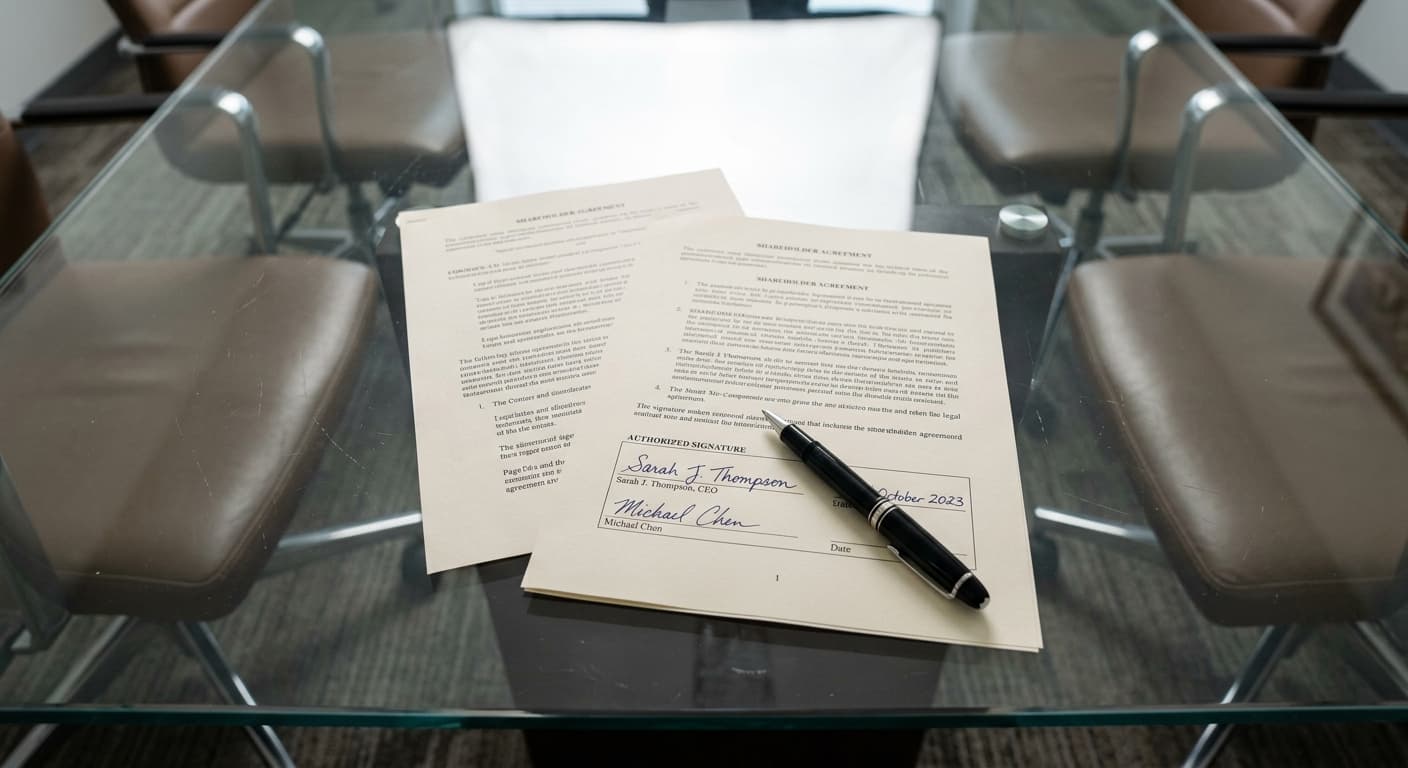
An LLC operating agreement is the agreement among a limited liability company's members about how the company is run: who manages it, how votes work, how profits and distributions are split, and what happens when a member leaves. Most state LLC statutes define the term broadly enough to cover an oral or implied agreement, and they fill any gap the members leave with default rules.
Of the twelve state codes reviewed for this page, only New York requires a written operating agreement. Missouri and Delaware use mandatory wording too, but their definitions accept an oral agreement, so a written document is not what they demand.
Scope: This page covers what an LLC operating agreement is and what state law says about it, based on the LLC statutes of twelve states opened for this review (California, Texas, Florida, New York, Pennsylvania, Illinois, Ohio, Georgia, North Carolina, Michigan, Delaware and Missouri) plus the IRS's LLC classification rules. It is not a 50-state survey.
If your LLC is organized in another state, read that state's LLC act before relying on any rule here. Our LLC operating agreement generator drafts a starting document for single-member and multi-member LLCs. For other legal topics by state, see our US laws index.
What an operating agreement is
Most of the statutes reviewed define an operating agreement by what it covers, not by what form it takes. California's definition is typical of the states that follow the Revised Uniform Limited Liability Company Act:
"'Operating agreement' means the agreement, whether or not referred to as an operating agreement and whether oral, in a record, implied, or in any combination thereof, of all the members of a limited liability company" (Cal. Corp. Code § 17701.02(s))
Pennsylvania (15 Pa.C.S. § 8812), Illinois (805 ILCS 180/1-5) and Florida (Fla. Stat. § 605.0102(45)) use the same "oral, implied, in a record" structure.
Texas calls the document a "company agreement" and defines it as "any agreement, written, implied, or oral, of the members concerning the affairs or the conduct of the business" (Tex. Bus. Orgs. Code § 101.001(1)). Delaware calls it a limited liability company agreement and counts any agreement "written, oral or implied, of the member or members as to the affairs of a limited liability company and the conduct of its business" (6 Del. C. § 18-101(9)).
Michigan is the exception among the states reviewed. Its definition is limited to "a written agreement by the member of a limited liability company that has 1 member, or between all of the members of a limited liability company that has more than 1 member" (MCL 450.4102(2)(r)).
What the agreement governs is set out in the statutes too. California lists relations among the members and between the members and the company, the rights and duties of a manager, the company's activities, and "the means and conditions for amending the operating agreement" (Cal. Corp. Code § 17701.10(a)). New York's § 417(a) describes provisions relating to "(i) the business of the limited liability company, (ii) the conduct of its affairs and (iii) the rights, powers, preferences, limitations or responsibilities of its members, managers, employees or agents."

Which states require an operating agreement
Three of the twelve codes reviewed use mandatory language, and only one of them requires a written agreement.
New York. "Subject to the provisions of this chapter, the members of a limited liability company shall adopt a written operating agreement that contains any provisions not inconsistent with law or its articles of organization" (N.Y. LLC Law § 417(a)). The timing rule is in subsection (c): "An operating agreement may be entered into before, at the time of or within ninety days after the filing of the articles of organization."
Missouri. "The member or members of a limited liability company shall adopt an operating agreement containing such provisions as such member or members may deem appropriate, subject only to the provisions of sections 347.010 to 347.187 and other law" (Mo. Rev. Stat. § 347.081.1). Missouri's definition, in § 347.015, describes "any valid agreement or agreements, written or oral, among all members, or written declaration by the sole member," so § 347.081 does not by its own terms demand a written document.
Delaware. Delaware's § 18-201(d) says an LLC agreement "shall be entered into or otherwise existing either before, after or at the time of the filing of a certificate of formation." Like Missouri's rule, that is mandatory wording. Because the definition in § 18-101(9) counts oral and implied agreements, it does not require a written document.
California. California's LLC act defines the operating agreement and says which provisions can be varied only in a written operating agreement, but the sections opened for this review (§§ 17701.02 and 17701.10) contain no sentence requiring members to adopt one.
For Texas, Florida, Pennsylvania, Illinois, Ohio, Georgia, North Carolina and Michigan, the definitions and gap-filling sections opened for this review contain no "shall adopt" requirement. That is a finding about those sections, not a guarantee that no other statute, lender, bank or investor will ask to see an agreement.

Single-member LLCs
A one-owner LLC can still have an operating agreement, and several states say so expressly:
- Texas: "A company agreement of a limited liability company having only one member is not unenforceable because only one person is a party to the company agreement" (Tex. Bus. Orgs. Code § 101.001(1)).
- Florida, Pennsylvania and Illinois include "a sole member" in their definitions (Fla. Stat. § 605.0102(45); 15 Pa.C.S. § 8812; 805 ILCS 180/1-5).
- Ohio includes "any written declaration of the sole member" (Ohio Rev. Code § 1706.01).
- Georgia: "In the case of a limited liability company with only one member, a writing signed by that member stating that it is intended to be a written operating agreement shall constitute a written operating agreement" (O.C.G.A. § 14-11-101(18)).
- North Carolina: where the LLC has only one interest owner and no agreement with another person, "any document or record intended by the interest owner to serve as the operating agreement will be the operating agreement" (N.C.G.S. § 57D-1-03(23)).
- Michigan and Missouri define the agreement to include a written agreement or declaration by a sole member (MCL 450.4102(2)(r); Mo. Rev. Stat. § 347.015).
Federal tax treatment turns on the number of members, not on whether an agreement exists. The IRS says "a domestic LLC with at least two members is classified as a partnership for federal income tax purposes unless it files Form 8832 and affirmatively elects to be treated as a corporation," and "an LLC with only one member is treated as an entity disregarded as separate from its owner, unless it files Form 8832 and elects to be treated as a corporation." The IRS adds that for employment tax and certain excise taxes, a one-member LLC "is still considered a separate entity."
What happens without an agreement: state default rules
Every statute reviewed fills the gaps an agreement leaves. California's version: "To the extent the operating agreement does not otherwise provide for a matter described in subdivision (a), this title governs the matter" (Cal. Corp. Code § 17701.10(b)). Texas (§ 101.052(b)), Florida (§ 605.0105), Pennsylvania (§ 8815(b)) and Ohio (§ 1706.08(A)(2)) contain parallel sentences.
The defaults are not the same everywhere, which is the practical reason to write the members' actual deal down. Three examples:
| Default rule | California | New York | Delaware |
|---|---|---|---|
| Who manages | Members, unless the articles state the LLC is manager-managed (Corp. Code § 17704.07(a)) | Members, unless the articles provide for managers (LLC Law § 401(a)) | Members, unless the LLC agreement provides for a manager (6 Del. C. § 18-402) |
| How members vote | "each member has equal rights in the management and conduct" of the LLC, "including equal voting rights" (§ 17704.07(b)(2)) | Each member votes "in proportion to such member's share of the current profits" (§ 402(a)) | Management vested in members in proportion to their interest in profits, with members owning more than 50 percent controlling (§ 18-402) |
| Profits and distributions | Distributions on the basis of the value of contributions stated in the required records (§ 17704.04(a)) | Profits, losses and distributions on the basis of the value of each member's contributions (§§ 503, 504) | Profits, losses and distributions on the basis of the agreed value of contributions (§§ 18-503, 18-504) |
| Amending the agreement | In a member-managed LLC, "only with the consent of all members" (§ 17704.07(b)(5)) | By a majority in interest of the members, subject to exceptions (§ 402(c)(3)) | With the approval of all members, for LLCs whose certificate of formation was filed on or after Jan. 1, 2012 (§ 18-302(f)) |
Consider two members of a California LLC who put in $90,000 and $10,000. Under the default rules each has an equal vote on ordinary business, while distributions track the value of what each contributed. In New York, the same two members would vote in proportion to their share of profits. An operating agreement lets the members choose, rather than inherit whichever state's pattern applies.
California also sets the default decision rules in a member-managed LLC: a difference "as to a matter in the ordinary course" of the company's activities "shall be decided by a majority of the members," while an act outside the ordinary course "may be undertaken only with the consent of all members" (§ 17704.07(b)(3)-(4)).
What an operating agreement cannot change
The freedom to contract has limits written into the statutes. California's § 17701.10(c) lists matters an operating agreement "shall not" do, including:
- vary the company's capacity "to sue and be sued in its own name";
- "eliminate the duty of loyalty, the duty of care, or any other fiduciary duty," subject to limited adjustments the statute allows;
- eliminate "the contractual obligation of good faith and fair dealing," although the agreement may set standards for measuring it that are "not manifestly unreasonable";
- vary the power of a court to order dissolution in the circumstances the statute specifies.
New York lets an operating agreement eliminate or limit a manager's personal liability for damages for breach of duty, but not where a judgment establishes that the manager's "acts or omissions were in bad faith or involved intentional misconduct or a knowing violation of law" or that the manager "personally gained in fact a financial profit or other advantage to which he or she was not legally entitled." The same subsection also excludes certain improper distributions (acts "not performed in accordance with section four hundred nine" for a distribution under § 508(a)) and "any act or omission prior to the adoption of a provision" limiting liability (N.Y. LLC Law § 417(a)).
What to put in an operating agreement
The default rules above double as a checklist. An operating agreement can settle each of these points instead of leaving them to the statute:
- Members and contributions: who the members are, what each contributed, and whether anyone must contribute more later.
- Ownership percentages: fixed by agreement, or tied to contributions.
- Management: member-managed or manager-managed, and who can sign for the company.
- Voting: what counts as an ordinary decision, what needs a supermajority or unanimous vote.
- Allocations and distributions: how profits, losses and cash are split, which the default rules otherwise tie to contributions.
- Transfers and new members: whether a member can sell an interest and how new members are admitted.
- Withdrawal, death or incapacity of a member.
- Dissolution and winding up.
- Amendments: how the agreement itself can be changed.
Our operating agreement generator covers each of these topics in its fourteen sections, along with formation, records, and liability and indemnification provisions. It flags New York's and Missouri's "shall adopt" rules when you pick those states. A generated document is a starting point; members with unequal contributions, outside investors or special tax allocations have more to decide than a template covers.
The agreement stays with the company. The California Secretary of State's FAQ states that "bylaws and operating agreements (and any amendments thereto) are maintained by the business entity and are not filed with the Secretary of State," and that operating agreements "are not filed" when a California LLC is formed.
Disclaimer: This page provides general legal information about LLC operating agreements under the statutes of twelve states and federal tax rules as of September 2026. It is not legal or tax advice and is not a 50-state survey. LLC statutes are amended regularly. Consult a lawyer licensed in the state where your LLC is organized, and a tax professional for classification elections, before relying on any rule described here.
Frequently Asked Questions
Is an LLC operating agreement legally required?
In New York, yes: members "shall adopt a written operating agreement" within 90 days after filing the articles (N.Y. LLC Law § 417(a), (c)). Missouri (§ 347.081.1) and Delaware (§ 18-201(d)) use mandatory wording, but both accept oral agreements, so neither requires a written document. The other nine state codes reviewed for this page contain no comparable mandatory sentence in the sections opened.
Does California require an LLC operating agreement?
The California sections reviewed (Corp. Code §§ 17701.02 and 17701.10) define an operating agreement, which can be oral, in a record, or implied, and say some provisions can be varied only in a written operating agreement. They contain no sentence requiring members to adopt one.
Does a single-member LLC need an operating agreement?
Of the states reviewed, only New York requires a written one for every LLC, and Missouri says members shall adopt one. Several states expressly recognize a sole member's agreement or written declaration, including Texas, Georgia, Ohio, North Carolina, Michigan and Missouri.
Do I file my operating agreement with the state?
Not in California: the Secretary of State says operating agreements are maintained by the business and are not filed with the Secretary of State. Check your own state's filing office, since the articles or certificate of organization is the document that is filed.
Can an operating agreement be oral?
In most states reviewed, yes. California, Florida, Pennsylvania and Illinois define it to include oral and implied agreements, Texas and Delaware include written, implied or oral agreements, and Missouri accepts written or oral. Michigan's definition requires a written agreement, and New York requires the members to adopt a written one.
What happens if members disagree and there is no operating agreement?
State default rules decide. In a California member-managed LLC, ordinary-course disagreements are decided by a majority of the members, while acts outside the ordinary course need the consent of all members (Corp. Code § 17704.07(b)(3)-(4)). New York and Delaware weight votes by each member's share of profits.
Updates
Independently fact-checked against the cited primary sources
Sources and References
- N.Y. Limited Liability Company Law § 417, Operating agreement(nysenate.gov).gov
- N.Y. Limited Liability Company Law § 401, Management by members(nysenate.gov).gov
- N.Y. Limited Liability Company Law § 402, Voting rights of members(nysenate.gov).gov
- N.Y. Limited Liability Company Law § 503, Sharing of profits and losses(nysenate.gov).gov
- N.Y. Limited Liability Company Law § 504, Sharing of distributions(nysenate.gov).gov
- Mo. Rev. Stat. § 347.081, Operating agreement(revisor.mo.gov).gov
- Mo. Rev. Stat. § 347.015, Definitions(revisor.mo.gov).gov
- Cal. Corp. Code § 17701.02, Definitions(leginfo.legislature.ca.gov).gov
- Cal. Corp. Code § 17701.10, Scope and limits of the operating agreement(leginfo.legislature.ca.gov).gov
- Cal. Corp. Code § 17704.07, Management of member-managed and manager-managed LLCs(leginfo.legislature.ca.gov).gov
- Cal. Corp. Code § 17704.04, Distributions before dissolution(leginfo.legislature.ca.gov).gov
- 6 Del. C. ch. 18, subch. I (§ 18-101 definitions)(delcode.delaware.gov).gov
- 6 Del. C. ch. 18, subch. II (§ 18-201 certificate of formation)(delcode.delaware.gov).gov
- 6 Del. C. ch. 18, subch. IV (§ 18-402 management)(delcode.delaware.gov).gov
- 6 Del. C. ch. 18, subch. V (§§ 18-503, 18-504 allocations and distributions)(delcode.delaware.gov).gov
- Tex. Bus. Orgs. Code ch. 101 (§§ 101.001, 101.052)(statutes.capitol.texas.gov).gov
- Fla. Stat. § 605.0102, Definitions(leg.state.fl.us).gov
- Fla. Stat. § 605.0105, Operating agreement; scope, function, and limitations(leg.state.fl.us).gov
- 15 Pa.C.S. ch. 88 (§§ 8812, 8815)(palegis.us).gov
- 805 ILCS 180/1-5, Definitions (Illinois Limited Liability Company Act)(ilga.gov).gov
- MCL 450.4102, Definitions (Michigan Limited Liability Company Act)(legislature.mi.gov).gov
- Ohio Rev. Code § 1706.01, Definitions (Justia copy; official site unavailable when checked)(law.justia.com)
- O.C.G.A. § 14-11-101, Definitions (Justia copy)(law.justia.com)
- N.C. Gen. Stat. § 57D-1-03, Definitions (Justia copy)(law.justia.com)
- California Secretary of State, Business Entities Frequently Asked Questions(sos.ca.gov).gov
- IRS, Limited Liability Company (LLC)(irs.gov).gov
- 6 Del. C. ch. 18, subch. III (§ 18-302, amendment default)(delcode.delaware.gov).gov