
Nevada
Nevada Knife Laws (2026): Machete, Concealed Carry, and Preemption
Independently fact-checked against primary sources (last audited September 18, 2026). · 8 primary sources cited on this page. How we verify our legal content

Nevada's general weapons statute sets no blade-length threshold and bans no knife type by name for ordinary carry outside a school or correctional setting, but it treats different items differently within the same section: some are banned outright, some only with intent to harm, and one, the machete, only when carried concealed. A separate catch-all in that same statute reaches an undefined "other dangerous or deadly weapon," which the Nevada Supreme Court has held can include an ordinary knife depending on how it was carried. Other statutes reach schools, threatening display, and jails.
Jurisdiction scope: This page covers Nevada state law only, principally NRS 202.350, 202.265, 202.320, 393.410, 212.185, 268.418, 244.364, and 269.222. It does not cover Nevada's firearm-specific concealed-carry permit statutes (NRS 202.3653 to 202.369) in detail, or local city, county, and town ordinances, which are not preempted for knives as explained below.
Can you carry a knife openly or concealed in Nevada?
Open carry of an ordinary knife is not restricted by Nevada's general weapons statute, NRS 202.350, at all; even the machete, the one blade the statute names specifically, is only banned when carried concealed, not openly. Concealed carry is a different question. NRS 202.350 does not set a blade-length limit or name most knife types for general concealed carry, but its catch-all ban on a concealed "other dangerous or deadly weapon" is not limited to firearms and explosives. The Nevada Supreme Court held in Knight v. State that whether an ordinary knife carried concealed counts as a dangerous or deadly weapon under that clause is a question of fact for the jury, decided from the circumstances of the carry rather than from the knife itself. A common pocketknife or kitchen knife carried for an ordinary, peaceful purpose is unlikely to be treated as a weapon under this test; the same knife carried while forcing entry into a home or in an aggressive confrontation is at much greater risk of being one. Separate rules apply on school property and in a correctional setting, covered below.
The "dangerous or deadly weapon" catch-all: Knight v. State
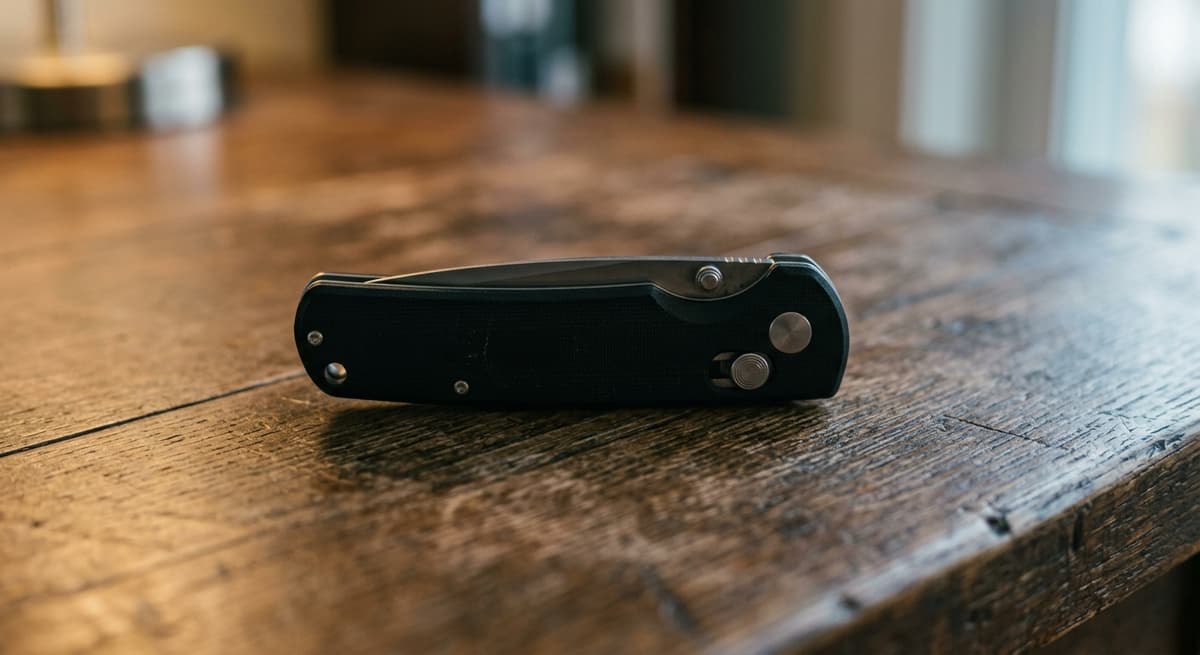
NRS 202.350(1)(d)(3) bans concealed carry of a "[p]istol, revolver or other firearm, other dangerous or deadly weapon or pneumatic gun." The phrase "other dangerous or deadly weapon" is not defined anywhere in the statute. In Knight v. State, 116 Nev. 140, 993 P.2d 67 (2000), the defendant was convicted of carrying a concealed weapon after police found a steak knife hidden in his back pocket. The Nevada Supreme Court first held that a steak knife is not a "dirk" or "dagger" as a matter of law, reasoning that it lacks handguards, is not primarily designed as a weapon, and that the legislature did not intend to bar concealing common household items under that clause.
That did not end the case. The court went on to hold that the separate "other dangerous or deadly weapon" clause could still reach the same knife, and that whether it did was a jury question. The Nevada Supreme Court adopted the approach of the Missouri Supreme Court in State v. Baldwin, 571 S.W.2d 236 (Mo. 1978), quoting the Missouri court's own explanation that "[i]t is obvious that there are many useful and practical items which are carried by persons for peaceful purposes," including pocketknives and steak knives, and that "[s]uch everyday instruments become dangerous or deadly only when they are used or carried for use as a weapon," a determination that depends on "the nature of the instrument itself, the circumstances under which it is carried, including time, place, and situation in which defendant is found in possession, the manner in which it is carried, the particular person carrying it, and perhaps other factors such as possible peaceful uses therefor which the possessor might have." Applying that test, the court affirmed Knight's conviction based on the events shortly before his arrest: the jury's guilty verdict on the trespass count showed it believed testimony that he had improperly entered a Las Vegas apartment without permission, and further testimony established that he behaved in an aggressive and threatening manner while carrying the steak knife at that time. A separate battery-with-a-deadly-weapon count, involving testimony that he had cut a resident's hand, had already been dismissed after the preliminary hearing and formed no part of the court's stated basis for affirmance.
This means the statute's silence on ordinary knives is not the last word. Whether carrying a given knife concealed is lawful in Nevada can turn on the surrounding circumstances, not just the blade itself.
At the time of Knight's arrest, NRS 202.350's concealed-carry clause separately named a "[d]irk, dagger or machete," and the court first had to decide whether a steak knife fell within that named category before turning to the catch-all. It does not today: the current clause lists only "Machete" alongside the undefined "dangerous or deadly weapon" phrase, so a knife once analyzed as a dirk or dagger under this statute is now analyzed, if at all, the same way the steak knife in Knight was, under the catch-all. The Nevada Supreme Court has described a dagger as "a short weapon used for thrusting and stabbing," Huebner v. State, 103 Nev. 29, 30 n.1 (1987), and in Bradvica v. State, 104 Nev. 475 (1988), identified handguards and a blade that locks in place as relevant factors, holding that a small pocketknife with a spring-loaded blade under 2 inches along the sharpened edge was not a dirk or dagger. That definition remains relevant today because "dirk, dagger" is still separately named, and still undefined, in Nevada's school-property statute, NRS 202.265, discussed below.
NRS 202.350's three different rules
NRS 202.350 groups weapons into three categories, each with its own trigger for liability, and reading only one clause misstates the others.
The first category is an outright ban regardless of intent or manner of carry. Except as otherwise provided in the section and in NRS 202.3653 to 202.369, NRS § 202.350(1)(a) provides that a person "shall not: (a) Manufacture or cause to be manufactured, or import into the State, or keep, offer or expose for sale, or give, lend or possess any instrument or weapon of the kind commonly known as a blackjack, slungshot, billy, sand-club, sandbag or metal knuckles." None of these are knives, but they sit in the same subsection as the knife-adjacent items below.
The second category requires intent to harm. NRS § 202.350(1)(c) bans possessing or using "a nunchaku or trefoil" only "with the intent to inflict harm upon the person of another." Simple possession of a nunchaku or trefoil, without that intent, is not an offense under this clause.
The third category is concealed-carry-specific. NRS § 202.350(1)(d) provides that a person shall not "[c]arry concealed upon his or her person any: (1) Explosive substance, other than ammunition or any components thereof; (2) Machete; or (3) Pistol, revolver or other firearm, other dangerous or deadly weapon or pneumatic gun." A machete may be carried openly under this statute; only concealed carry is restricted.
Penalties differ by category. Violating paragraph (a) or (c), or the machete clause in (d)(2), is a gross misdemeanor for a first offense and a category D felony for a subsequent offense, under NRS § 202.350(2)(a). Violating paragraph (b) (machine guns and silencers) or the explosive-substance or firearm clauses in (d)(1) or (d)(3) is a category C felony under § 202.350(2)(b).
The section does not apply to sheriffs, constables, marshals, peace officers, correctional officers, other appointed officers, persons summoned to assist an officer, full-time peace officers of another jurisdiction on duty in Nevada, and members of the armed forces on duty, under subsection 4, or to qualified and qualified retired law enforcement officers authorized to carry concealed under 18 U.S.C. § 926B or § 926C, under subsection 7. A sheriff may issue a permit authorizing an applicant to carry "the concealed weapon described in the permit," under § 202.350(3), but this subsection expressly does not authorize a permit for a pistol, revolver, or other firearm. Because "concealed weapon" is defined broadly in § 202.350(8)(a) as "a weapon described in this section that is carried upon a person in such a manner as not to be discernible by ordinary observation," this permit mechanism could in principle cover a machete carried concealed, though the statute prescribes no application or review procedure for a non-firearm concealed-weapon permit.
Threatening display: NRS 202.320
Separately from the concealed-carry rules above, NRS § 202.320 makes it a misdemeanor for a person carrying "any dirk, dirk-knife, sword, sword cane, pistol, gun or other deadly weapon" to draw or exhibit it "in the presence of two or more persons, ... in a rude, angry or threatening manner not in necessary self-defense," or to unlawfully use that weapon in a fight or quarrel. This offense does not require the weapon to have been carried concealed, and it applies regardless of whether anyone was injured. A sheriff, deputy sheriff, marshal, constable, or other peace officer is not liable under this section for drawing or exhibiting a weapon while lawfully discharging official duties.
Schools and child care facilities
Two separate statutes reach knives around Nevada schools, and they are not the same rule.
NRS § 202.265(1) bars carrying or possessing, on the property of the Nevada System of Higher Education, a private or public school, or a child care facility, or in a vehicle of a private or public school or child care facility, several listed items, including "[a] dirk, dagger or switchblade knife." The statute defines "switchblade knife," for this section, as "a spring-blade knife, snap-blade knife or any other knife having the appearance of a pocketknife, any blade of which is 2 or more inches long and which can be released automatically by a flick of a button, pressure on the handle or other mechanical device, or is released by any type of mechanism," but excludes "a knife which has a blade that is held in place by a spring if the blade does not have any type of automatic release." It does not separately define dirk or dagger; NRS 202.350's concealed-carry clause used to name the same two terms but no longer does, so this is the section where they currently apply, and Nevada courts have looked to whether a knife has handguards and a blade that locks in place when deciding whether it is one, per Bradvica v. State, 104 Nev. 475 (1988). Violation is a gross misdemeanor under § 202.265(2). Exceptions exist for a peace officer, a school security guard, a person with written permission from the college or school's president or principal (or a child care facility's designee), and the operator of a home-based child care facility during business hours, per § 202.265(3)-(4).
A second statute, NRS § 393.410, reaches a different set of conduct on and around a "public schoolhouse" specifically: willfully and maliciously damaging a public schoolhouse or its fixtures, committing a nuisance in a public schoolhouse, loitering on or near the grounds attached to a public schoolhouse, or purposely and maliciously trespassing on those grounds. Simple violation is a public offense scaled to any property damage, no less than a misdemeanor, under § 393.410(2). But possessing a "dangerous weapon" while committing the nuisance, loitering, or trespass violations raises the offense to a gross misdemeanor under § 393.410(3). The statute defines "dangerous knife," for this purpose, as "a knife having a blade that is 2 inches or more in length when measured from the tip of the knife which is customarily sharpened to the unsharpened extension of the blade which forms the hinge connecting the blade to the handle," a measurement of the sharpened edge rather than the knife's overall length, and includes a dirk, dagger, switchblade knife, or dangerous knife within its "dangerous weapon" definition, alongside an explosive or incendiary device, a nunchaku or trefoil, a blackjack, billy club, or metal knuckles, and a pistol, revolver, or other firearm. Unlike § 202.265, which bans simple possession of a listed item on school property generally, § 393.410 applies specifically to a public schoolhouse and its grounds, and sets this sharpened-edge blade-length threshold for a person loitering, trespassing, or committing a nuisance there while carrying a knife.
Correctional facilities
NRS § 212.185(1) makes it a category B felony for a person incarcerated in a Nevada state prison, county or city jail, or other correctional facility (including while being transferred for treatment or in transit) to possess or control a "[d]irk, dagger, switchblade knife or sharp instrument," along with several other listed weapons. Conviction carries a minimum term of 1 year and a maximum of 6 years in state prison. Incarceration, for this statute, "begins upon assignment to a cell or other place within the correctional facility after completion of the initial booking procedure," per § 212.185(2).
No statewide knife preemption
Nevada's three local-control preemption statutes address firearms only, not knives. NRS § 268.418 (cities) provides that "[t]he regulation of the transfer, sale, purchase, possession, carrying, ownership, transportation, storage, registration and licensing of firearms, firearm accessories and ammunition in this State and the ability to define such terms is within the exclusive domain of the Legislature," and voids any conflicting city ordinance. NRS § 244.364 states the identical rule for counties, and NRS § 269.222 states it again for unincorporated towns. All three statutes define "firearm" in their own definitions subsections as including, "without limitation, a pistol, revolver, rifle, shotgun, machine gun, submachine gun, black powder weapon, muzzle-loading firearm or any device which is designed to, able to or able to be readily converted to expel a projectile through the barrel by the action of an explosive, other form of combustion or expanding gases." None of the three definitions subsections, and none of the three statutes' operative text, mentions a knife. A Nevada city, county, or town ordinance that restricts knives is not displaced by any of the three statutes' text.
Federal law: what it does and does not reach
Federal law does not ban an individual from owning or carrying a switchblade. The Federal Switchblade Act, 15 U.S.C. §§ 1241 to 1245, instead restricts interstate commerce in switchblade knives, barring their manufacture for, or introduction, transport, and sale in, interstate commerce, and, in 15 U.S.C. § 1245, makes it a federal offense to knowingly possess, manufacture, sell, or import a ballistic knife in or affecting interstate commerce or within federal territorial jurisdiction. The two switchblade offense sections, §§ 1242 and 1243, do not apply to certain knives and people; § 1244, captioned "Exceptions," lists them. A 2009 amendment, § 1244(5), exempts any knife with a spring, detent, or other closure-bias mechanism that requires hand, wrist, or arm exertion on the blade itself to overcome the bias and assist opening, the carve-out that keeps modern assisted-opening folding knives legal in interstate commerce. A separate exemption, § 1244(4), covers a person with only one arm possessing or carrying a switchblade with a blade three inches or less. Nevada's own switchblade-related restrictions, at NRS 202.265, 393.410, and 212.185, apply only to schools, child-care property, and correctional facilities, not to general possession or interstate transport.
Disclaimer: This article provides general legal information about Nevada's knife laws as of September 2026. It is not legal advice. Consult a lawyer licensed in Nevada for advice about a specific situation. Local city, county, and town ordinances on knives, which Nevada's preemption statutes do not address, can vary and are not covered here.
For a state-by-state comparison, see knife laws by state. Nevada's self-defense statutes are covered separately on the Nevada self-defense laws page.
Statutes cited reflect their in-force version as of 2026-09-18. Last updated: 2026-09-18.
Frequently Asked Questions
Is it legal to carry a knife concealed in Nevada?
It depends on the knife and the circumstances. NRS 202.350 does not set a blade-length limit or ban most knife types by name for concealed carry; it names only a machete, banned concealed outright, and separately bans concealed carry of an unnamed 'other dangerous or deadly weapon.' In Knight v. State (2000), the Nevada Supreme Court held that whether an ordinary knife falls under that last catch-all is a question of fact for the jury, based on the circumstances of the carry, such as the manner in which the knife is carried and whether the person was using it as a weapon, not on the type of knife alone.
Are switchblades illegal in Nevada?
Nevada's general weapons statute, NRS 202.350, does not ban switchblades by name for ordinary adult possession or carry, though carrying one concealed could still fall under the undefined 'dangerous or deadly weapon' catch-all, depending on the circumstances. A switchblade knife, defined as having a blade of 2 or more inches that opens automatically, is separately banned on school and child-care property under NRS 202.265 and for people incarcerated in a correctional facility under NRS 212.185.
Can you carry a machete openly in Nevada?
Yes. NRS 202.350(1)(d)(2) bans carrying a machete only when it is concealed. Open carry of a machete is not restricted by this statute.
Is it illegal to display a knife in a threatening manner in Nevada?
Yes. NRS 202.320 makes it a misdemeanor to draw or exhibit a dirk, dirk-knife, sword, sword cane, or other deadly weapon in front of two or more people in a rude, angry, or threatening manner that is not necessary self-defense, or to use it unlawfully in a fight or quarrel. This applies whether or not the knife was carried concealed.
What knives are banned in Nevada schools?
Two statutes apply. NRS 202.265 bans carrying or possessing a dirk, dagger, or switchblade knife (a knife with a blade of 2 or more inches that opens automatically) on the property of a public or private school, a Nevada System of Higher Education campus, or a child care facility, and in a vehicle of a public or private school or a child care facility (the statute defines 'vehicle' to mean a school bus, and the vehicle branch does not reach Nevada System of Higher Education vehicles), a gross misdemeanor, with exceptions for peace officers, school security guards, and people with written permission. Separately, NRS 393.410 makes it a gross misdemeanor to possess any 'dangerous weapon,' defined there to include a knife with a blade of 2 inches or more measured along the customarily sharpened edge, while loitering on or near the grounds attached to a public schoolhouse, committing a nuisance in a public schoolhouse, or trespassing on those grounds.
Does Nevada preempt local knife ordinances?
No. Nevada's three local-control preemption statutes, NRS 268.418 for cities, NRS 244.364 for counties, and NRS 269.222 for unincorporated towns, are written and defined exclusively in terms of firearms, firearm accessories, and ammunition. None of the three statutes, including their own definitions subsections, mentions a knife, so a local ordinance restricting knives is not displaced by any of them.
Updates
Independently fact-checked against the cited primary sources
Sources and References
- NRS 202.350 - Manufacture, importation, possession or use of dangerous weapon or silencer; carrying concealed weapon without permit; penalties; exceptions(leg.state.nv.us).gov
- NRS 202.265 - Possession of dangerous weapon on property or in vehicle of school or child care facility; penalty; exceptions (switchblade knife definition)(leg.state.nv.us).gov
- NRS 202.320 - Drawing deadly weapon in threatening manner(leg.state.nv.us).gov
- NRS 393.410 - Damage to school property; nuisance; loitering; trespass; penalties (dangerous knife definition)(leg.state.nv.us).gov
- NRS 212.185 - Possession or control of dangerous weapon or facsimile by incarcerated person prohibited(leg.state.nv.us).gov
- NRS 268.418 - State control over regulation of firearms, firearm accessories and ammunition; limited regulatory authority of city(leg.state.nv.us).gov
- NRS 244.364 - State control over regulation of firearms, firearm accessories and ammunition; limited regulatory authority of county(leg.state.nv.us).gov
- NRS 269.222 - State control over regulation of firearms, firearm accessories and ammunition; limited regulatory authority of unincorporated town(leg.state.nv.us).gov
- Knight v. State, 116 Nev. 140, 993 P.2d 67 (2000) - dangerous or deadly weapon catch-all is a jury question(courtlistener.com)
- Bradvica v. State, 104 Nev. 475, 760 P.2d 139 (1988) - dirk or dagger factors(courtlistener.com)
- 15 U.S.C. 1241-1245 - Federal Switchblade Act, interstate commerce and ballistic-knife scope(law.cornell.edu)
- 15 U.S.C. 1244 - exceptions, including the 2009 assisted-opening carve-out and the one-arm exception(law.cornell.edu)