
Missouri
Missouri Knife Laws (2026): Restricted Areas and the Switchblade Trap
Independently fact-checked against primary sources (last audited September 18, 2026). · 5 primary sources cited on this page. How we verify our legal content
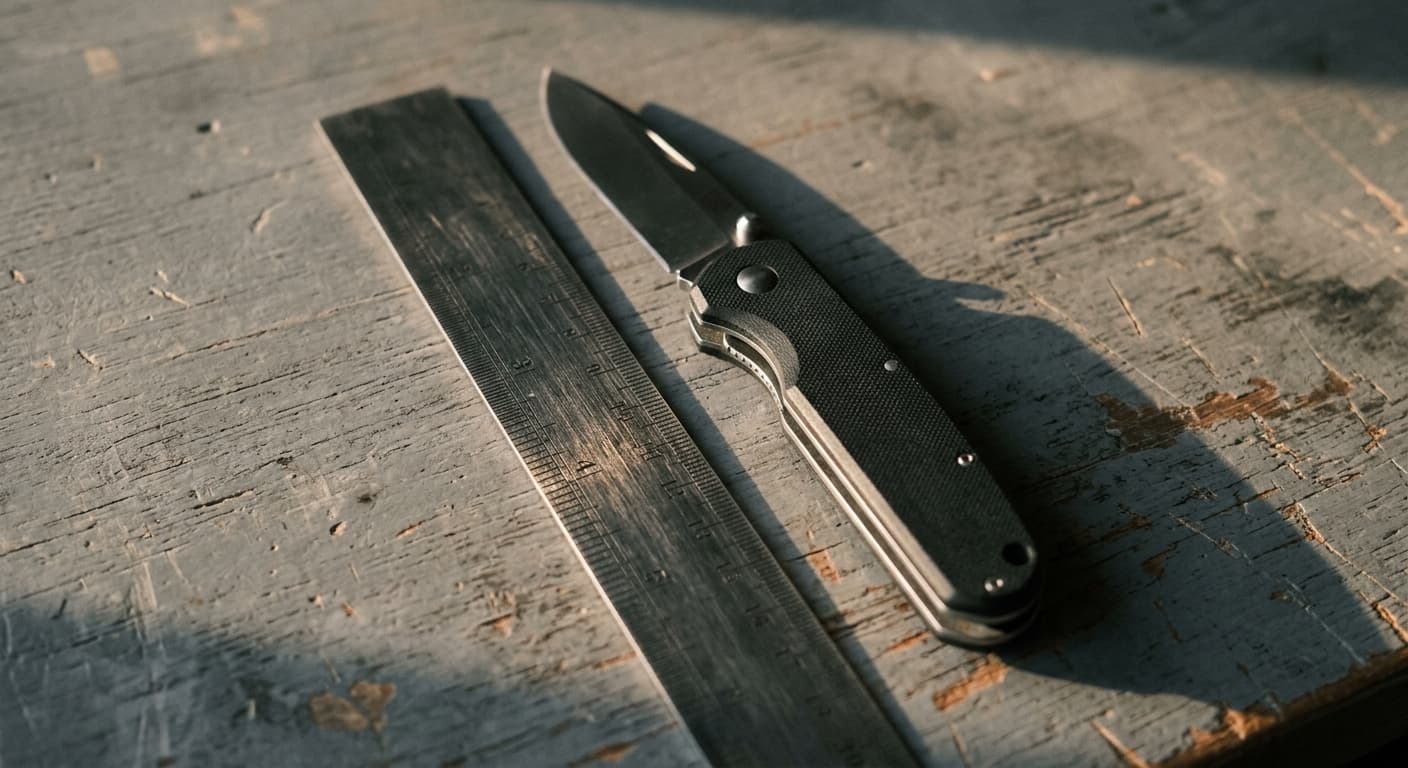
Missouri has no blanket statewide ban on carrying a knife, open or concealed, for ordinary adult carry. RSMo § 571.010 defines "knife" for the whole weapons chapter, and that definition specifically excludes an ordinary pocketknife with a blade no longer than 4 inches. Concealed carry of a knife becomes illegal in specific restricted areas, and carrying one, openly or concealed, into a school, church, election precinct, or government building is separately restricted. A genuine trap also sits in the switchblade statute: RSMo § 571.020's switchblade item is banned only when possessing, manufacturing, transporting, repairing, or selling it also violates federal law, not as a freestanding state possession ban.
Jurisdiction scope: This page covers Missouri state law only, principally RSMo §§ 571.010, 571.020, 571.030, 571.107, and 21.750. It does not cover Missouri's concealed-carry permit statutes (§§ 571.101 to 571.121 and 571.205 to 571.230) in detail or local municipal ordinances outside the firearms-only preemption discussed below.
Can you carry a knife openly or concealed in Missouri?
For an ordinary knife, yes, in most places. Missouri has no general statute banning open or concealed carry of a knife statewide. RSMo § 571.010(12) defines "knife" for the entire weapons chapter as "any dagger, dirk, stiletto, or bladed hand instrument that is readily capable of inflicting serious physical injury or death by cutting or stabbing a person," and the same subdivision expressly carves out "any ordinary pocketknife with no blade more than four inches in length" from that definition entirely. Open carry of a knife within the chapter's definition is unrestricted in general, but RSMo § 571.030.1(8) and (10) restrict carrying one, openly or concealed, into a church or place of worship, an election precinct on election day, a government building, a school, a school bus, or a school-sanctioned function, discussed below. Concealed carry is separately restricted into a longer list of areas, also discussed below.
Concealed carry: restricted areas, not a general ban
RSMo § 571.030.1(1) makes it a crime to "carry[] concealed upon or about his or her person a knife, a firearm, a blackjack or any other weapon readily capable of lethal use into any area where firearms are restricted under section 571.107." That subdivision's chapeau, subsection 1, opens with "except as otherwise provided by sections 571.101 to 571.121 and sections 571.205 to 571.230," Missouri's regular, lifetime, and extended concealed-carry permit statutes, a qualifier that matters for the permit-holder exemption discussed below. The offense does not ban concealed carry everywhere, only into the areas RSMo § 571.107 lists, which run to 17 separate items: a police, sheriff, or highway patrol office or station without the officer in charge's consent; within 25 feet of a polling place on election day; a correctional facility, prison, or jail; a courthouse occupied by the circuit, appellate, or supreme court, along with related judicial offices; a meeting of a local governing body or the general assembly or its committees; a building or portion of a building a unit of government has restricted by rule or ordinance; a bar or establishment licensed to serve liquor for on-site consumption without the consent of the owner or manager (with a carve-out for qualifying restaurants); any area of an airport where access is controlled by inspection of persons and property; anywhere federal law itself bars carrying; a higher-education institution or elementary or secondary school facility without the consent of the governing body or a school official or the district school board; a child care facility without the consent of the manager; a riverboat gambling operation without the consent of the owner or manager; a gated amusement park; a church or place of religious worship without the officiant's consent; posted private property; a sports arena or stadium seating 5,000 or more; and a hospital open to the public. Carrying a concealed knife outside these listed areas is not an offense under this subdivision.
Three further limits on the general concealed-knife offense can decide a real case. Subsection 3 disapplies subdivision (1) when the weapon is being transported in a nonfunctioning state, or in an unloaded state with ammunition not readily accessible, or is otherwise not readily accessible, and separately disapplies it when the person is 19 or older (or 18 and in or honorably discharged from the Armed Forces) transporting a concealable firearm in a vehicle's passenger compartment, or is in that person's own dwelling unit or on premises the person possesses, has authority over, or controls, or is traveling in a continuous journey peaceably through the state. Subsection 5 disapplies subdivisions (3), (4), (5), (6), (7), (8), (9), and (10) for a person engaged in a lawful act of self-defense under RSMo § 563.031. Subdivision (1), the concealed-carry offense this section is about, is not on that list, so the lawful-self-defense exception in subsection 5 does not reach the concealed-knife offense itself.
A violation of subdivision (1) is a class B misdemeanor under RSMo § 571.030.8(2), except that carrying a concealed weapon onto private property posted with a sign of at least 11 by 14 inches, with lettering at least 1 inch tall, shifts the consequence to "the penalties of subsection 2 of section 571.107" instead of the misdemeanor tier. That shift is toward a lighter outcome, not a stricter one: § 571.107.2 imposes no penalty on its own presence at the location; a citation issues only if the person refuses to leave the posted property after a peace officer is summoned, in an amount not to exceed $100 for a first offense, not to exceed $200 for a second citation for a similar violation within six months, and not to exceed $500 for a third citation within one year of the first. The suspension and revocation rungs that follow the second and third citations presuppose a permit to suspend or revoke, so for a person without one, only the fines can operate in practice. § 571.107.2's opening sentence, that carrying into a listed location "shall not be a criminal act," is written for a person who already holds a valid concealed carry permit or endorsement; a permit holder is not reached by the posted-property penalty at all, since RSMo § 571.030.4 (below) removes a permit holder from subdivision (1) entirely. What 571.030.8(2) actually imports for a person without a permit caught on posted private property is the citation ladder itself, not that decriminalization. RSMo § 571.030.4 exempts a valid concealed-carry permit holder, or the holder of a qualifying out-of-state permit or endorsement, from subdivisions (1), (8), and (10) entirely, with no limitation in its text to firearms; because subdivision (1) is the general concealed-knife offense, a permit to carry a concealed firearm does, by the statute's own terms, also exempt that person from the concealed-knife restriction into the same restricted areas.
Schools, churches, and government buildings: a broader phrase than "knife"
Beyond the concealed-carry restriction, RSMo § 571.030.1(8) and (10) separately restrict carrying "a firearm or any other weapon readily capable of lethal use" into a church or place of worship, an election precinct on election day, a building owned or occupied by a federal, state, or local government agency, a school, a school bus, or a school-sanctioned function. The exemptions described above for the concealed-carry offense reach these two subdivisions as well: subsection 3's exemption for a weapon transported in a nonfunctioning state, or unloaded with ammunition not readily accessible, or otherwise not readily accessible, such as a sheathed or boxed knife stowed in a bag or a vehicle, applies to (8) and (10) and not only to (1); subsection 4 exempts a valid concealed-carry permit holder from (8) and (10) on the same terms as (1); and subsection 5's lawful self-defense exemption, which does not reach (1), does reach (8) and (10). Unlike subdivision (1), which names "knife" explicitly, subdivisions (8) and (10) use the broader phrase "weapon readily capable of lethal use," which RSMo § 571.010(12)'s own knife definition tracks closely ("readily capable of inflicting serious physical injury or death"), so a knife meeting that definition would fall within this broader language even though the text of (8) and (10) does not name knives specifically. Violating subdivision (1), (6), (7), or (8) is a class B misdemeanor; violating subdivision (10) is a class A misdemeanor if "the firearm" is unloaded or a class E felony if loaded, a tier the statute's text keys to the firearm and does not itself assign to a subdivision (10) violation committed with a non-firearm weapon, though the unloaded, lower tier is the better reading for a knife, which cannot be loaded. Exhibiting any weapon readily capable of lethal use "in an angry or threatening manner" in the presence of another person, under subdivision (4), is a separate offense punished as a class E felony, a materially heavier penalty than the concealed-carry misdemeanor.
The switchblade statute: a federal-law-contingent ban, not a flat state ban
RSMo § 571.020.1 provides that a person commits an offense if he or she "knowingly possesses, manufactures, transports, repairs, or sells ... (6) Any of the following in violation of federal law: (a) A machine gun; (b) A short-barreled rifle or shotgun; (c) A firearm silencer; or (d) A switchblade knife." Reading this chapeau carefully matters: the switchblade item is grouped with the machine gun, short-barreled firearm, and silencer items under the same "in violation of federal law" qualifier. Missouri does not independently ban possessing, manufacturing, transporting, repairing, or selling a switchblade knife as a matter of state law standing alone; the state offense exists only when that conduct also violates federal law. Because federal law itself does not ban an ordinary individual from owning or carrying a switchblade within a state (see the federal section below), a person who simply possesses a switchblade knife outside a federal enclave, without violating the interstate-commerce restrictions or another federal provision, does not commit an offense under this Missouri statute. Inside a federal enclave in Missouri, such as land under the special maritime and territorial jurisdiction of the United States, simple possession of a switchblade violates 15 U.S.C. § 1243 and would trigger this Missouri offense as well.
RSMo § 571.010(21) defines "switchblade knife" for this purpose as "any knife which has a blade that folds or closes into the handle or sheath, and: (a) That opens automatically by pressure applied to a button or other device located on the handle; or (b) That opens or releases from the handle or sheath by the force of gravity or by the application of centrifugal force." This definition is broader than the federal one, reaching gravity- and centrifugal-force-opening knives (a category sometimes called a "gravity knife") as well as button-release automatics.
An offense under subdivision (6), when it applies, is a class D felony under RSMo § 571.020.3. The exceptions listed in RSMo § 571.020.2, for official military and law enforcement duty, lawful commercial transactions, industrial use, museum display, and dramatic performances, apply only "if his or her conduct involved any of the items in subdivisions (1) to (5) of subsection 1," which by its own terms excludes the switchblade item in subdivision (6); those listed exceptions do not extend to a switchblade knife.
Does Missouri preempt local knife ordinances?
Only for firearms, and only partially even there. RSMo § 21.750.1 provides that "the general assembly hereby occupies and preempts the entire field of legislation touching in any way firearms, components, ammunition and supplies to the complete exclusion of any order, ordinance or regulation by any political subdivision of this state." Its operative text names firearms, components, ammunition, and supplies; it does not mention knives. RSMo § 21.750.3(1) allows a local ordinance that "conforms exactly with any of the provisions of sections 571.010 to 571.070," a range that happens to include the knife definitions (§ 571.010) and the switchblade and unlawful-use-of-weapons offenses (§§ 571.020, 571.030) discussed above, but that clause is a saving provision carved out of the firearms preemption in subsections 1 and 2, letting a local ordinance mirror those sections without being voided by 21.750; it does not limit what a city or county may do about knives. It is not itself a standalone statewide knife preemption statute: Missouri preempts the field for firearms, not knives, and no state statute preempts a political subdivision from regulating knives, so a Missouri city or county may set knife rules stricter than state law.
Federal law: what it does and does not reach
Federal law does not ban an ordinary individual from owning or carrying a switchblade within a state. The Federal Switchblade Act, 15 U.S.C. §§ 1241 to 1245, restricts interstate commerce in switchblade knives, barring their manufacture for, or introduction, transport, and sale in, interstate commerce. Separately, 15 U.S.C. § 1243 bars manufacturing, selling, or possessing a switchblade knife within any territory or possession of the United States, within Indian country, or within the special maritime and territorial jurisdiction of the United States, a flat possession ban that reaches those federal enclaves rather than an interstate-commerce restriction. 15 U.S.C. § 1245 separately makes it a federal offense to knowingly possess, manufacture, sell, or import a ballistic knife in or affecting interstate commerce or within federal territorial jurisdiction. Sections 1242 and 1243 do not apply to certain knives and people, listed as exemptions in 15 U.S.C. § 1244. A 2009 amendment, § 1244(5), exempts any knife with a spring, detent, or other closure-bias mechanism that requires hand, wrist, or arm exertion on the blade itself to overcome the bias and assist opening, the carve-out that keeps modern assisted-opening folding knives legal in interstate commerce. A separate exemption, § 1244(4), covers a person with only one arm possessing or carrying a switchblade with a blade three inches or less. Because RSMo § 571.020's switchblade provision only reaches conduct that already violates federal law, these federal exemptions matter directly to whether Missouri's own statute applies at all.
Disclaimer: This article provides general legal information about Missouri's knife laws as of September 2026. It is not legal advice. Consult a lawyer licensed in Missouri for advice about a specific situation. Because Missouri's preemption statute reaches firearms, not knives, local ordinances can add restrictions beyond the statewide rules described here.
For a state-by-state comparison, see knife laws by state. Missouri's self-defense statutes are covered separately on the Missouri self-defense laws page.
Statutes cited reflect their in-force version as of 2026-09-18. Last updated: 2026-09-18.
Frequently Asked Questions
Is it legal to carry a knife concealed in Missouri?
Generally yes, outside specific restricted areas. Missouri has no blanket statewide concealed-knife ban. RSMo 571.030.1(1) makes concealed carry of a knife illegal only when carried into an area where firearms are restricted under RSMo 571.107, a list of 17 items that includes police stations, courthouses, polling places within 25 feet, correctional facilities, certain government meetings, posted private property, bars, secured airport areas, schools and higher-education facilities, child care facilities, and several others. A person with a valid concealed-carry permit is exempt from this restriction entirely under RSMo 571.030.4, and several other exceptions apply, including transporting the weapon unloaded and inaccessible, being in one's own dwelling or on property one controls, or traveling in a continuous journey peaceably through the state.
What size pocketknife is legal to carry in Missouri?
An ordinary pocketknife with a blade no longer than 4 inches is not a 'knife' under RSMo 571.010(12)'s definition at all, so it falls outside the weapons chapter's knife-specific restrictions entirely. A dagger, dirk, stiletto, or other bladed instrument readily capable of inflicting serious physical injury or death, regardless of that 4-inch figure, is covered.
Are switchblade knives illegal in Missouri?
Only when possessing, manufacturing, transporting, repairing, or selling one also violates federal law. RSMo 571.020.1(6)(d) bans a switchblade knife only under that federal-law-contingent chapeau, alongside a machine gun, short-barreled firearm, and firearm silencer; it is not a freestanding state possession ban. 'Switchblade knife' is defined broadly under RSMo 571.010(21) to include both button-release and gravity- or centrifugal-force-opening knives.
Can you carry a knife into a Missouri courthouse or government building?
Not concealed, unless an exception applies. A courthouse and several other government locations are restricted areas under RSMo 571.107, so carrying a knife concealed into one violates RSMo 571.030.1(1), unless the person holds a valid concealed-carry permit, which RSMo 571.030.4 exempts from this restriction, or another statutory exception applies. Carrying a firearm or other weapon readily capable of lethal use, a category that can include a knife, into a government-owned building is separately restricted under RSMo 571.030.1(8).
Does a concealed carry permit let you carry a knife into a restricted area in Missouri?
Yes. RSMo 571.030.4 states that subdivisions (1), (8), and (10) of subsection 1, which include the general concealed-knife offense, 'shall not apply to any person who has a valid concealed carry permit issued pursuant to sections 571.101 to 571.121 or sections 571.205 to 571.230, a valid concealed carry endorsement issued before August 28, 2013, or a valid permit or endorsement to carry concealed firearms issued by another state or political subdivision of another state.' The text applies to the whole subdivision, not just its firearm-related conduct, so a valid permit, including a lifetime or extended permit, exempts a person from the concealed-knife restriction as well.
Does Missouri preempt local knife ordinances?
No. RSMo 21.750 preempts the field for firearms, not knives, and its text does not reach knife ordinances. It permits a local ordinance that conforms exactly to RSMo 571.010 through 571.070, a range that includes the knife statutes, but that clause is a saving provision carved out of the firearms preemption, not a limit on knife regulation. Because knives sit outside the preempted field, a Missouri political subdivision may regulate knives more strictly than state law.
Updates
Independently fact-checked against the cited primary sources
Sources and References
- RSMo 571.010 - Definitions (knife: dagger/dirk/stiletto/bladed instrument, excludes ordinary pocketknife 4in or under; switchblade knife defined)(revisor.mo.gov).gov
- RSMo 571.020 - Possession, manufacture, transport, repair, sale of certain weapons a crime, exceptions, penalties (switchblade knife banned only in violation of federal law)(revisor.mo.gov).gov
- RSMo 571.030 - Unlawful use of weapons, exceptions, penalties (concealed knife into restricted areas, schools/churches/government buildings, brandishing; subsection 4 permit exemption; subsection 3 transport/dwelling/journey exemptions)(revisor.mo.gov).gov
- RSMo 571.107 - Areas where a concealed carry permit does not authorize firearms, 17-item list (referenced by 571.030.1(1)); subsection 2's citation ladder for posted private property, whose 'not a criminal act' opening sentence is scoped to permit holders(revisor.mo.gov).gov
- RSMo 21.750 - Firearms preemption (firearms, components, ammunition, supplies; narrow mirror-ordinance carve-out referencing 571.010-571.070)(revisor.mo.gov).gov
- 15 U.S.C. 1241-1245 - Federal Switchblade Act, interstate commerce, federal-territorial possession ban (1243), and ballistic-knife scope(law.cornell.edu)
- 15 U.S.C. 1244 - exceptions, including the 2009 assisted-opening carve-out and the one-arm exception(law.cornell.edu)