
Idaho
Idaho Knife Laws (2026): Carry, Blade Length, Preemption
Independently fact-checked against primary sources (last audited September 18, 2026). · 5 primary sources cited on this page. How we verify our legal content

Idaho excludes most knives from its concealed-weapons law by two separate routes, and on top of that, most adults do not need a license to carry a covered knife concealed at all. Idaho also has a knife-specific statewide preemption statute, one most other states lack in this form, that names the handful of local government bodies still allowed to regulate knives.
Jurisdiction scope: This page covers Idaho state law only, principally Idaho Code §§ 18-3302, 18-3302A, 18-3302C, 18-3302D, and 18-3327. It does not cover Idaho's separate assault or robbery statutes, which apply to a knife used as a weapon regardless of how it was carried.
Can you own a knife in Idaho?
Ordinary knife ownership is not restricted by Idaho's concealed-weapons statute; the statute regulates carrying, not owning. Selling a weapon, defined for this purpose as "any dirk, dirk knife, bowie knife, dagger, pistol, revolver or gun," to a minor under 18 without the written consent of a parent or guardian is a misdemeanor under Idaho Code § 18-3302A, punishable by a fine of up to $1,000, up to 6 months in the county jail, or both.
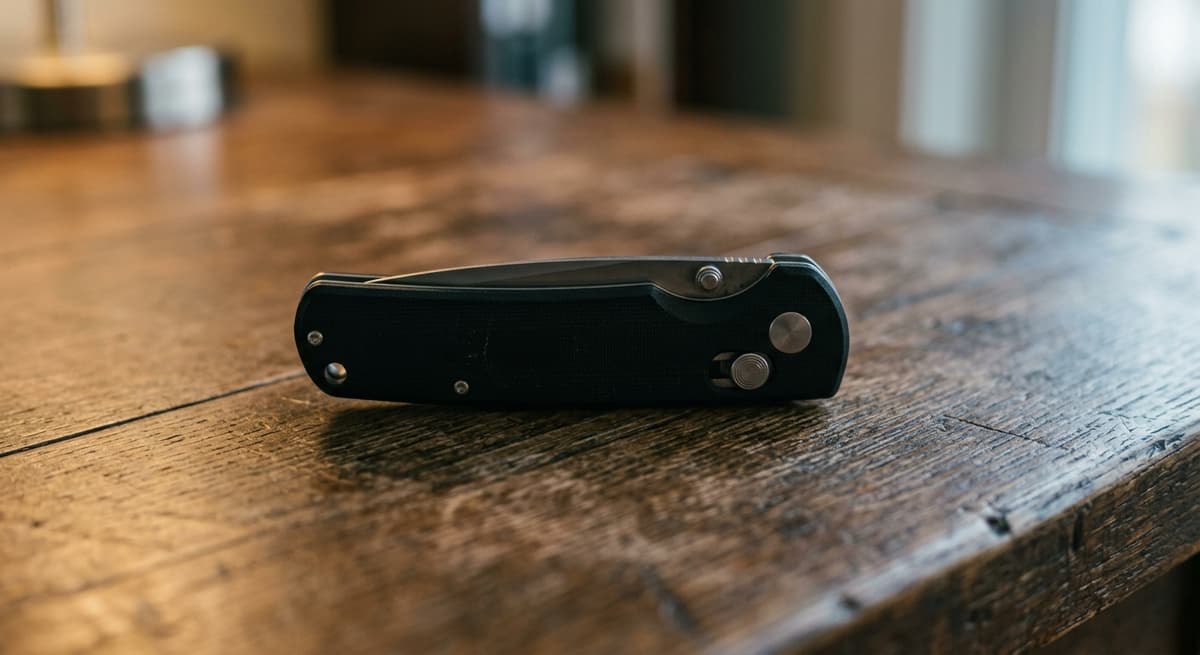
Two ways a knife is excluded from Idaho's carry law
Idaho's carry statute, Idaho Code § 18-3302, opens with an unusually explicit legislative finding: "the people of Idaho have reserved for themselves the right to keep and bear arms while granting the legislature the authority to regulate the carrying of weapons concealed," and directs that the chapter "must be strictly construed so as to give maximum scope to the rights retained by the people."
Subsection (2)(b) defines "deadly weapon," the term that triggers the concealed-carry rule, to include "(i) Any dirk, dirk knife, bowie knife, dagger or firearm," plus catch-all language for items designed or intended to be readily capable of causing death or serious bodily injury. Subsection (2)(c) then excludes two categories:
The term "deadly weapon" does not include: (i) Any knife, cleaver or other instrument that is intended by the person to be used in the processing, preparation or eating of food; (ii) Any knife with a blade six (6) inches or less; or (iii) Any taser, stun-gun, pepper spray or mace.
These are two independent exclusions, connected by "or." A knife intended for food processing, preparation, or eating is excluded regardless of blade length. Separately, and independently, any knife with a blade of six inches or less is excluded regardless of the carrier's intent. A knife only needs to satisfy one of the two to fall outside "deadly weapon."
Subsection (2)(b)(i) separately lists "any dirk, dirk knife, bowie knife, dagger or firearm" as a deadly weapon by name. Whether that naming carves those types back out of the (2)(c)(ii) six-inch exclusion, or whether the six-inch exclusion applies across the whole of (2)(b) including its named types, is not resolved by the statute's own text. Subsection (2)(c) opens with the unqualified sentence "The term 'deadly weapon' does not include," followed by three disjunctive items with no language limiting item (ii) to unnamed knife types. Read that way, a dirk, dirk knife, bowie knife, or dagger with a blade of six inches or less would fall outside "deadly weapon" the same as any other short knife. No Idaho case, attorney general opinion, or other authority resolving this construction question was found; treat it as an open question rather than a settled rule in either direction.
Open carry
Idaho's carry statute regulates concealed carry specifically; subsection (4)(a) confirms that the license requirement in subsection (3) "shall not apply to restrict or prohibit the carrying or possession of... any deadly weapon located in plain view." Openly carrying a knife, including one over the 6-inch threshold, is not restricted by this statute.
Concealed carry: most adults need no license at all
A license to carry a concealed weapon is required under subsection (3), with broad exceptions: a person's own home or fixed place of business, property they own or lease, private property where they have the owner's permission, and anywhere outside city limits for a person 18 or older who is not disqualified.
The exception that matters most in practice is subsection (4)(f). It removes the license requirement entirely for "any deadly weapon concealed by a person who: (i) Is over eighteen (18) years of age; (ii) Is a citizen of the United States or a current member of the armed forces of the United States; and (iii) Is not disqualified from being issued a license under paragraphs (b) through (n) of subsection (11)." Those disqualifying criteria include a pending felony charge, a prior felony conviction, fugitive status, unlawful drug use, certain mental-health adjudications, a dishonorable discharge, and several other categories. In practice, most adult Idaho residents can carry a covered knife (a "deadly weapon" under the definition above, which the statute's own text does not clearly resolve for a short-bladed dirk, bowie knife, or dagger, see above) concealed without any license at all.
A license remains available, and is required for anyone who does not meet the permitless-carry exception, such as a resident who wants reciprocity in another state or does not meet the age-18/citizenship/non-disqualification test. It is issued by the sheriff of the applicant's county of residence, requires the applicant to be at least 21, and is valid for five years from issuance.
Where you can't carry at all: courts, jails, and schools
Idaho Code § 18-3302C applies to a license holder and to a person carrying under the permitless-carry exception alike:
Any person obtaining a license under the provisions of section 18-3302, Idaho Code, or carrying a concealed deadly weapon pursuant to the provisions of section 18-3302(4)(f), Idaho Code, shall not: (1) Carry a concealed weapon in a courthouse; juvenile detention facility or jail; public or private school, except as provided in subsection (4)(g) of section 18-3302D, Idaho Code; provided that this subsection shall not apply to...
The subsection (4)(g) exception it cross-references is narrow: it lets a person, or a school or school-district employee, carry a firearm on school property with the permission of the school district's board of trustees or governing board, notwithstanding this section's ban. Separately, exceptions in 18-3302C itself apply to peace officers acting within their employment, security personnel on duty, and anyone specifically authorized by the entity in control of the building. A violation is a misdemeanor.
A separate, broader school statute, Idaho Code § 18-3302D, bans possessing a firearm or other "deadly or dangerous weapon," a term this section cross-references to the federal definition in 18 U.S.C. § 930, on school property or at a school-sponsored activity regardless of location. Exceptions cover peace officers, certain retired law-enforcement officers, board-approved programs, and an adult 18 or older who is not a student and keeps the item secured and locked in a vehicle. A violation is punishable by up to 1 year in jail, a fine of up to $1,000, or both; a student violator under 18 may instead be placed on probation tied to completing an educational program, at the court's discretion.
Does Idaho preempt local knife ordinances?
Yes, and Idaho is unusual in having a knife-specific preemption statute rather than only a firearms-specific one. Idaho Code § 18-3327, titled "Consistency in Knife regulation," provides:
Except as provided in sections 18-3302 and 18-3302A, Idaho Code, a city, county, or other political subdivision of this state shall not enact any ordinance, rule, or tax relating to the transportation, possession, carrying, sale, transfer, purchase, gift, devise, licensing, registration, or use of a knife or knife making components in this state.
The statute names five categories of entity that may still regulate knife possession despite the preemption: public schools (including public charter schools), any courthouse, law enforcement facilities, places of involuntary confinement such as prisons and jails, and a local government regulating knives as part of child care facility safety standards. It also separately bars a local knife-manufacturing rule stricter than the rule applied to other commercial goods, and voids any conflicting local ordinance. Idaho's separate firearms preemption statute, § 18-3302J, is scoped to firearms and ammunition only and does not itself reach knives, but § 18-3327 independently covers that ground for knives.
Federal law: what it does and does not reach
Federal law does not ban an individual from owning or carrying a switchblade nationwide. The Federal Switchblade Act, 15 U.S.C. §§ 1241 to 1245, instead regulates interstate commerce in switchblade knives, barring their manufacture, sale, transport, or introduction into interstate commerce, and, in 15 U.S.C. § 1245, makes it a federal offense to knowingly possess, manufacture, sell, or import a ballistic knife in or affecting interstate commerce or within federal territorial jurisdiction. 15 U.S.C. § 1244, captioned "Exceptions," provides that §§ 1242 and 1243 "shall not apply to" a list of specific knives; it is an exemption from those two interstate-commerce and importation offenses, not a change to the switchblade definition itself, which sits in § 1241(b) and was not amended. A 2009 addition, § 1244(5), exempts from §§ 1242 and 1243 any knife with a spring, detent, or other closure-bias mechanism that requires hand, wrist, or arm exertion to overcome the bias and assist opening, the exception that keeps modern assisted-opening folding knives legal in interstate commerce. A separate exception, § 1244(4), exempts a person with only one arm from those same two offenses when possessing or carrying a switchblade with a blade three inches or less.
Disclaimer: This article provides general legal information about Idaho's knife laws as of September 2026. It is not legal advice. Consult a lawyer licensed in Idaho for advice about a specific situation. Idaho's carry statute is currently in effect "until January 1, 2027" per its own heading, with a second version headed "effective January 1, 2027" already published alongside it. Both versions carry the same "deadly weapon" definition and the same (2)(c) exclusions described on this page, so the rules here are not expected to change at that date, but check the statute's current text before relying on this page after that date.
For a state-by-state comparison, see knife laws by state. Idaho's self-defense statutes are covered separately on the Idaho self-defense laws page.
Statutes cited reflect their in-force version as of 2026-09-18. Last updated: 2026-09-18.
Frequently Asked Questions
What size knife is legal to carry concealed in Idaho?
A knife with a blade of six inches or less is excluded from Idaho's 'deadly weapon' definition regardless of intent, and a knife of any length intended for food processing, preparation, or eating is separately excluded. Whether that six-inch exclusion also covers a short-bladed dirk, dirk knife, bowie knife, or dagger, which the same statute separately names as a deadly weapon, is an open question the statute's own text does not resolve.
Do I need a permit to carry a knife concealed in Idaho?
Usually not for an adult. Idaho Code 18-3302(4)(f) lets a person 18 or older who is a U.S. citizen or current armed forces member, and not disqualified, carry a covered deadly weapon (including a qualifying knife) concealed without any license.
Can I carry a knife at school or a courthouse in Idaho?
No. Idaho Code 18-3302C bars carrying a concealed deadly weapon in a courthouse, juvenile detention facility or jail, or public or private school, whether or not the carrier holds a license, a misdemeanor. The one exception, 18-3302D(4)(g), covers only a school-board-authorized firearm carrier, not knives. A separate statute, 18-3302D, bans possessing a deadly or dangerous weapon on school property more broadly.
Does Idaho preempt local knife ordinances?
Yes. Idaho Code 18-3327 bars a city, county, or other political subdivision from regulating a knife's transportation, possession, carrying, sale, or manufacture, except that public schools, courthouses, law enforcement facilities, jails and prisons, and child care facility safety rules remain allowed to regulate knife possession.
Is an ordinary folding pocketknife legal to carry concealed in Idaho?
Yes. A folding pocketknife typically has a blade of six inches or less, which Idaho Code 18-3302(2)(c)(ii) excludes from the 'deadly weapon' definition outright, regardless of the carrier's intent. That takes it outside the concealed-weapons law entirely, no license needed.
Updates
Independently fact-checked against the cited primary sources
Sources and References
- Idaho Code 18-3302 - Concealed weapons: deadly-weapon definition, 6-inch/food-use exclusions, permitless-carry exception (4)(f), license requirements(legislature.idaho.gov).gov
- Idaho Code 18-3302A - Sale of weapons to minors (dirk, dirk knife, bowie knife, dagger, pistol, revolver, gun)(legislature.idaho.gov).gov
- Idaho Code 18-3302C - Prohibited conduct: courthouse, juvenile detention/jail, school; misdemeanor(legislature.idaho.gov).gov
- Idaho Code 18-3302D - Possessing weapons or firearms on school property; misdemeanor, penalty up to 1 year/$1,000(legislature.idaho.gov).gov
- Idaho Code 18-3327 - Consistency in Knife regulation (statewide knife preemption with named carve-out entities)(legislature.idaho.gov).gov
- 15 U.S.C. 1241-1245 - Federal Switchblade Act, interstate commerce and importation scope(law.cornell.edu)
- 15 U.S.C. 1244 - exceptions, including the 2009 assisted-opening carve-out and the one-arm exception(law.cornell.edu)