
Wisconsin
Is Jaywalking Illegal in Wisconsin? Crossing Rules and Fines (2026)
Independently fact-checked against primary sources (last audited October 10, 2026). · 20 primary sources cited on this page. How we verify our legal content
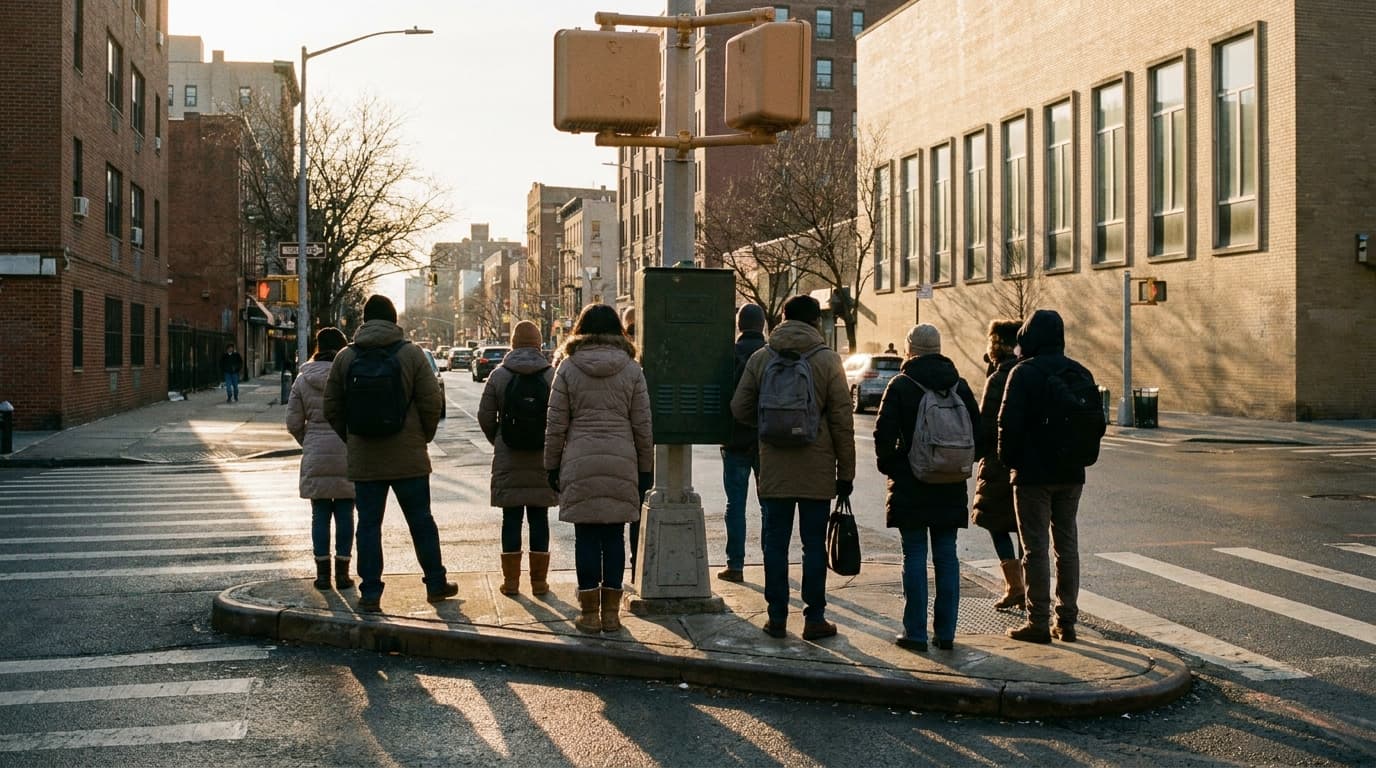
Under Wisconsin state law, crossing a road outside a crosswalk is not banned: a pedestrian crossing a roadway anywhere other than a marked or unmarked crosswalk must yield the right-of-way to all vehicles (Wis. Stat. 346.25). A local authority can prohibit crossings at places state law otherwise allows (Wis. Stat. 349.185(2)), and crossing against a Don't Walk signal is barred (Wis. Stat. 346.38(2)). The penalty is a forfeiture of $2 to $20 for a first offense (Wis. Stat. 346.30(1)(a)), but the 2026 court deposit schedule puts the total for crossing outside a crosswalk at $150.10 in circuit court once surcharges and costs are added. To compare other states, see our guide to jaywalking laws by state.
Information last verified on 2026-10-10. This article has not been reviewed by a licensed lawyer.
Jurisdiction scope: This article covers Wisconsin state law: the pedestrian and driver sections of chapter 346 (Wis. Stat. 346.16(2)(a), 346.23 to 346.30, 346.37, 346.38 and 346.43), the crosswalk definition in 340.01(10), the deposit procedure in 345.20 and 345.26, local authority under 349.185(2), and the Wisconsin Court System's 2026 Revised Uniform State Traffic Deposit Schedule. It does not cover the text of any city, village, town or county ordinance, municipal court cost totals, injury claims after a crash, or the law of other states.
Is jaywalking illegal in Wisconsin?
Mostly not, as a matter of state law. Wisconsin's basic crossing rule is a duty to yield, not a ban: you may cross away from a crosswalk, but vehicles on the roadway go first. The firm rules are about signals, freeways and the local exception: you may not start across on Don't Walk, you may not walk onto an expressway or freeway where signs prohibit pedestrians, and a local authority can prohibit crossing at specific places.
| Situation | Wisconsin rule |
|---|---|
| Crossing outside a marked or unmarked crosswalk | Allowed if the pedestrian yields the right-of-way to all vehicles (346.25), unless a local authority has prohibited crossing there (349.185(2)) |
| Crossing between signalized intersections, or diagonally | Sections 346.23 to 346.30 contain no separate rule; the 346.25 yield duty applies, and local rules may add one |
| Suddenly leaving a curb or other place of safety into the path of a vehicle too close to yield | Barred (346.24(2)) |
| Starting to cross on Don't Walk, steady or flashing | Barred (346.38(2)) |
| Entering the roadway on a red light with no pedestrian signal | Only if it can be done safely and without interfering with any vehicular traffic (346.37) |
| Walking along a highway with no sidewalk | Travel on the left side (346.28(1)) |
| Standing or loitering on a roadway, outside a safety zone, in a way that interferes with traffic | Barred (346.29(2)) |
| Going on an expressway or freeway | Barred where official signs prohibit it (346.16(2)(a)) |
| Crossing through, around, over or under a railroad crossing gate or barrier while it is closed or being opened or closed | Barred (346.445(2)) |
Crossing outside a crosswalk
The whole rule is one sentence in Wis. Stat. 346.25:
"Every pedestrian, bicyclist, or rider of an electric scooter or an electric personal assistive mobility device crossing a roadway at any point other than within a marked or unmarked crosswalk shall yield the right-of-way to all vehicles upon the roadway."
A pedestrian who crosses mid-block, waits for a gap and lets traffic pass complies with this section. Sections 346.23 through 346.30, the run of pedestrian rights and duties, contain no rule requiring pedestrians to use a marked crosswalk between adjacent signalized intersections, no diagonal-crossing rule and no rule for places where a pedestrian tunnel or overpass is provided. That describes state law only: a city or county can add crossing restrictions, as explained below.
One more rule applies everywhere, in a crosswalk or not. Wis. Stat. 346.24(2) provides that no pedestrian "may suddenly leave ... a curb or other place of safety and walk, run, or ride into the path of a vehicle which is so close that it is difficult for the operator of the vehicle to yield."
What counts as a crosswalk in Wisconsin
Whether you are "in a crosswalk" decides who must yield. Wis. Stat. 340.01(10) defines the term this way:
"'Crosswalk' means either of the following, except where signs have been erected by local authorities indicating no crossing: (a) Marked crosswalk. Any portion of a highway clearly indicated for pedestrian crossing by signs, or pavement markings; or (b) Unmarked crosswalk. In the absence of signs or pavement markings, that part of a roadway, at an intersection, which is included within the transverse lines which would be formed on such roadway by connecting the corresponding lateral lines of the sidewalks on opposite sides of such roadway or, in the absence of a corresponding sidewalk on one side of the roadway, that part of such roadway which is included within the extension of the lateral lines of the existing sidewalk across such roadway at right angles to the center line thereof, except in no case does an unmarked crosswalk include any part of the intersection and in no case is there an unmarked crosswalk across a street at an intersection of such street with an alley."
Three features matter. An unmarked crosswalk exists only at an intersection, measured from the sidewalk lines, and the definition says it does not "include any part of the intersection." There is no unmarked crosswalk across a street where it meets an alley. And the opening words carve out any place where local authorities have put up signs indicating no crossing: at those places there is no crosswalk at all.
Walk signals and traffic lights
Where pedestrian signals are installed, Wis. Stat. 346.38(2) controls Don't Walk:
"No pedestrian, personal delivery device, bicyclist, or rider of an electric scooter or an electric personal assistive mobility device may start to cross, and no personal delivery device operator may allow a personal delivery device to start to cross, the roadway or other vehicular crossing in the direction of a pedestrian signal limiting crossing, regardless of whether the signal is steady or flashing, but any pedestrian, personal delivery device, bicyclist, or rider of an electric scooter or an electric personal assistive mobility device that has partially completed crossing on the pedestrian signal authorizing crossing may proceed to a sidewalk or safety zone while a pedestrian signal limiting crossing is showing."
So a flashing Don't Walk means the same as a steady one for someone who has not started. A pedestrian already partway across on Walk may continue to a sidewalk or safety zone.
Where there is no pedestrian signal, the ordinary traffic light in Wis. Stat. 346.37 binds pedestrians. On green, pedestrians "may proceed ... across the roadway within any marked or unmarked crosswalk." On red, the text turns on safety and traffic:
"No pedestrian, personal delivery device, bicyclist, or rider of an electric scooter or an electric personal assistive mobility device facing such signal shall enter, and no personal delivery device operator may allow a personal delivery device facing such signal to enter, the roadway unless he or she can do so safely and without interfering with any vehicular traffic."
At a signalized intersection, Wis. Stat. 346.23(1) also says that, apart from the driver duty described below, "in all other cases pedestrians ... shall yield ... the right-of-way to vehicles lawfully proceeding directly ahead on a green signal."
Walking along the road, freeways and standing in traffic
Wis. Stat. 346.28(1) provides: "Any pedestrian traveling along and upon a highway other than upon a sidewalk shall travel on and along the left side of the highway and upon meeting a vehicle shall, if practicable, move to the extreme outer limit of the traveled portion of the highway."
Wis. Stat. 346.29 adds two rules: "No person shall be on a roadway for the purpose of soliciting a ride from the operator of any vehicle other than a public passenger vehicle," and "No person shall stand or loiter on any roadway other than in a safety zone if such act interferes with the lawful movement of traffic."
Freeways have their own rule. Wis. Stat. 346.16(2)(a) provides: "Except as provided in par. (b), no pedestrian or person riding a bicycle or other nonmotorized vehicle and no person operating a moped or motor bicycle may go upon any expressway or freeway when official signs have been erected prohibiting such person from using the expressway or freeway." The ban turns on posted official signs.
What drivers owe pedestrians
The pedestrian's duty to yield outside a crosswalk sits next to separate driver duties, and the driver penalties are higher.
- Uncontrolled crosswalks. "At an intersection or crosswalk where traffic is not controlled by traffic control signals or by a traffic officer, the operator of a vehicle shall yield the right-of-way to a pedestrian ... that is crossing the highway within a marked or unmarked crosswalk" (Wis. Stat. 346.24(1)).
- No passing a stopped car. When a vehicle is stopped at an intersection or crosswalk to let a pedestrian cross, "the operator of any other vehicle approaching from the rear may not overtake and pass the stopped vehicle" (Wis. Stat. 346.24(3)).
- Signalized intersections. Drivers must yield to a pedestrian "that has started to cross the highway on a green signal or a pedestrian signal authorizing crossing" (Wis. Stat. 346.23(1)).
- Turning on green. "No operator of a vehicle proceeding ahead on a green signal may begin a turn at a controlled intersection or crosswalk when a pedestrian ... crossing in the crosswalk on a green signal or a pedestrian signal authorizing crossing would be endangered or interfered with in any way" (Wis. Stat. 346.23(1)).
- Turning on red. "In making a turn on a red signal vehicular traffic shall yield the right-of-way to pedestrians ... lawfully within a crosswalk" (Wis. Stat. 346.37(1)(c)3.).
- White cane or service animal. A driver must stop before approaching closer than 10 feet to a pedestrian carrying a raised white, or white and red, cane or walking stick, or using a service animal. "The fact that the pedestrian may be violating any of the laws applicable to pedestrians does not relieve the operator of a vehicle from the duties imposed by this subsection" (Wis. Stat. 346.26(1)). The forfeiture is $25 to $200 for a first offense (Wis. Stat. 346.30(3)).
A driver who violates 346.24(1) or (3) may be required to forfeit $30 to $300 (Wis. Stat. 346.30(2)). A driver who violates 346.23 faces $20 to $40 for a first offense and $50 to $100 for a 2nd or subsequent conviction within a year (Wis. Stat. 346.30(1)(b)1.). If a person violates 346.23 and the violation results in great bodily harm, the forfeiture is $500; if it results in death, $1,000 (Wis. Stat. 346.30(5)).
Jaywalking fine and penalty in Wisconsin
Wisconsin sets the pedestrian penalty as a forfeiture, and Wis. Stat. 939.12 provides that "Conduct punishable only by a forfeiture is not a crime." Wis. Stat. 346.30(1)(a) provides:
"Any pedestrian violating s. 346.23, 346.24 (2), 346.25, 346.28 or 346.29 and any personal delivery device operator violating s. 346.23 or 346.24 (2) may be required to forfeit not less than $2 nor more than $20 for the first offense and not less than $10 nor more than $50 for the 2nd or subsequent conviction within a year."
Signal violations carry the same range. Wis. Stat. 346.43(1)(a) provides that "Any pedestrian or personal delivery device operator violating s. 346.37 or 346.38 may be required to forfeit not less than $2 nor more than $20 for the first offense and not less than $10 nor more than $50 for the 2nd or subsequent conviction within a year." A provision of chapters 341 to 349 whose penalty is a forfeiture is a "traffic regulation" under Wis. Stat. 345.20(1)(b).
The statutory forfeiture is not what a ticket costs. The Wisconsin Court System's 2026 Revised Uniform State Traffic Deposit Schedule adds a penalty surcharge, other state surcharges and court costs. In circuit court it lists:
| Violation | Statutory range | Deposit | Total in circuit court | Demerit points |
|---|---|---|---|---|
| Pedestrian failing to yield when crossing a roadway (346.25), first | $2 to $20 | $10.00 | $150.10 | None listed |
| Same, 2nd violation within 1 year | $10 to $50 | $20.00 | $162.70 | None listed |
| Signal violation by a pedestrian (346.38(2)) | $2 to $20 | $10.00 | $150.10 | None listed |
| Pedestrian failing to walk on the left side (346.28(1)) | $2 to $20 | $10.00 | $150.10 | None listed |
| Pedestrian on an expressway where prohibited (346.16(2)(a)) | $30 to $300 | $30.00 | $175.30 | None listed |
| Driver failing to yield to a pedestrian at an uncontrolled intersection (346.24(1)) | $30 to $300 | $150.00 | $326.50 | 4 |
For the $10.00 crossing deposit, the add-ons are a $2.60 penalty surcharge, $23.00 and $89.50 in further surcharges, and $25.00 in court costs. The schedule notes that municipal court totals differ and that Milwaukee County circuit court adds $3.50.
Paying is a plea. Under Wis. Stat. 345.26(1)(b)1., a person who makes a deposit for a traffic regulation violation "need not appear in court at the time fixed in the citation, and the person will be deemed to have tendered a plea of no contest and submitted to a forfeiture, plus costs, fees, and surcharges imposed under ch. 814, not to exceed the amount of the deposit."
If you neither pay the deposit nor appear, "the court may enter a default judgment finding the person guilty of the offense or issue a warrant for his or her arrest" (Wis. Stat. 345.26(1)(b)2.).
An officer can act on these violations on the spot. Wis. Stat. 345.22 provides that "A person may be arrested without a warrant for the violation of a traffic regulation if the traffic officer has reasonable grounds to believe that the person is violating or has violated a traffic regulation." Under Wis. Stat. 345.23, the officer then issues a citation and may release the person, and must release a person who makes a deposit under 345.26.
City, village and county rules
State law expressly lets local governments go further. Wis. Stat. 349.185 provides that "The authority in charge of the maintenance of a highway may by order, ordinance or resolution: ... (2) Regulate the traffic of pedestrians upon highways within its jurisdiction, including the prohibition of pedestrian crossings at places otherwise permitted by law and the erection of signs indicating such prohibition."
That power works together with the crosswalk definition, which excludes any place "where signs have been erected by local authorities indicating no crossing" (Wis. Stat. 340.01(10)). A crossing that is lawful under 346.25 on one street can be prohibited on another, so read posted signs and check your city's or county's ordinances before crossing mid-block downtown.
If a pedestrian is hit by a car
Whether a pedestrian yielded as 346.25 requires, and whether a driver yielded as 346.23 and 346.24 require, can matter after a collision. Young children are treated differently: Wis. Stat. 891.44 provides that "It shall be conclusively presumed that an infant minor who has not reached the age of 7 shall be incapable of being guilty of contributory negligence or of any negligence whatsoever," and the annotation to 346.25 notes that 891.44 provides an exception to that section. For how fault and insurance work after a crash, see Wisconsin car accident laws. The crossing rule in 346.25 also names riders of electric scooters; their other rules are covered in Wisconsin e-scooter laws.
Related pages
- Jaywalking laws by state
- Wisconsin car accident laws
- Wisconsin e-scooter laws
- Minnesota jaywalking laws
- Illinois jaywalking laws
This article provides general legal information about Wisconsin law, not legal advice. For advice about a specific situation, contact a lawyer licensed in Wisconsin or the court named on your citation.
Last updated: 2026-10-10.
Frequently Asked Questions
Is jaywalking illegal in Wisconsin?
Crossing outside a crosswalk is allowed under state law if you yield the right-of-way to all vehicles on the roadway (Wis. Stat. 346.25). Local authorities can prohibit crossings at particular places (Wis. Stat. 349.185(2)), and crossing against a Don't Walk signal is barred (Wis. Stat. 346.38(2)).
What is the jaywalking fine in Wisconsin?
The statute sets a forfeiture of $2 to $20 for a first offense and $10 to $50 for a 2nd or subsequent conviction within a year (Wis. Stat. 346.30(1)(a)). The 2026 deposit schedule lists a $10.00 deposit for crossing outside a crosswalk, which comes to $150.10 in circuit court with surcharges and costs; municipal court totals differ.
Can I cross in the middle of the block in Wisconsin?
Under state law, yes, if you yield the right-of-way to all vehicles (Wis. Stat. 346.25). A local authority may prohibit crossings at places otherwise permitted and erect signs saying so (Wis. Stat. 349.185(2)), so check posted signs and your local ordinances.
Does a jaywalking ticket put points on my Wisconsin license?
The 2026 Revised Uniform State Traffic Deposit Schedule shows no demerit points for the pedestrian lines, including crossing outside a crosswalk (346.25). A driver who fails to yield to a pedestrian at an uncontrolled crosswalk (346.24(1)) is listed at 4 points.
What happens if I just pay a Wisconsin jaywalking ticket?
Paying the deposit for a traffic regulation violation means you are deemed to have entered a plea of no contest and submitted to a forfeiture plus costs, fees and surcharges, up to the amount of the deposit (Wis. Stat. 345.26(1)(b)1.).
Can I cross on a red light in Wisconsin if no cars are coming?
Where there is no pedestrian signal, a pedestrian facing a red signal may enter the roadway only if he or she can do so safely and without interfering with any vehicular traffic (Wis. Stat. 346.37). A Don't Walk signal, steady or flashing, bars starting to cross (Wis. Stat. 346.38(2)).
Which side of the road should I walk on in Wisconsin?
When walking along a highway other than on a sidewalk, travel on the left side, and on meeting a vehicle move, if practicable, to the extreme outer limit of the traveled portion (Wis. Stat. 346.28(1)).
Can pedestrians walk on a Wisconsin freeway?
No pedestrian may go upon an expressway or freeway where official signs prohibit it, subject to an exception in the statute (Wis. Stat. 346.16(2)(a)). The 2026 deposit schedule lists that violation at a $30.00 deposit and $175.30 in total.
Do drivers have to stop for pedestrians in Wisconsin crosswalks?
At an uncontrolled intersection or crosswalk, a driver must yield to a pedestrian crossing within a marked or unmarked crosswalk (Wis. Stat. 346.24(1)). At signals, a driver must yield to a pedestrian who has started across on a green or a pedestrian signal authorizing crossing (Wis. Stat. 346.23(1)).
Updates
Independently fact-checked against the cited primary sources
The Law Behind This Article
This article rests on the statutory provisions below, held in our own legal record and retrieved from the official source. Tap a section to read the operative text.
Wisconsin Statutes, Chapter 346: Rules Of The Road
§ 346.25Crossing at place other than crosswalk.In force
Every pedestrian, bicyclist, or rider of an electric scooter or an electric personal assistive mobility device crossing a roadway at any point other than within a marked or unmarked crosswalk shall yield the right-of-way to all vehicles upon the roadway.
Official text (excerpt) · last checked 2026-07-29 · Read the full text in our law library · Verify at docs.legis.wisconsin.gov
§ 346.24Crossing at uncontrolled intersection or crosswalk.In force
(1) At an intersection or crosswalk where traffic is not controlled by traffic control signals or by a traffic officer, the operator of a vehicle shall yield the right-of-way to a pedestrian or personal delivery device, or to a person riding a bicycle, electric scooter, or electric personal assistive mobility device in a manner which is consistent with the safe use of the crosswalk by pedestrians, that is crossing the highway within a marked or unmarked crosswalk. (2) No pedestrian, personal delivery device, bicyclist, or rider of an electric scooter or an electric personal assistive mobility device may suddenly leave, and no personal delivery device operator may allow a personal delivery device to suddenly leave, a curb or other place of safety and walk, run, or ride into the path of a vehicle which is so close that it is difficult for the operator of the vehicle to yield.
Official text (excerpt) · last checked 2026-07-29 · Read the full text in our law library · Verify at docs.legis.wisconsin.gov
§ 346.23Crossing controlled intersection or crosswalk.In force
(1) At an intersection or crosswalk where traffic is controlled by traffic control signals or by a traffic officer, the operator of a vehicle shall yield the right-of-way to a pedestrian or personal delivery device, or to a person who is riding a bicycle, electric scooter, or electric personal assistive mobility device in a manner which is consistent with the safe use of the crosswalk by pedestrians, that has started to cross the highway on a green signal or a pedestrian signal authorizing crossing and in all other cases pedestrians, bicyclists, and riders of electric scooters and electric personal assistive mobility devices shall yield, and personal delivery device operators shall ensure that personal delivery devices yield, the right-of-way to vehicles lawfully proceeding directly ahead on a green signal.
Official text (excerpt) · last checked 2026-07-29 · Read the full text in our law library · Verify at docs.legis.wisconsin.gov
§ 346.37Traffic-control signal legend.In force
(1) Whenever traffic is controlled by traffic control signals exhibiting different colored lights successively, or with arrows, the following colors shall be used and shall indicate and apply to operators of vehicles, personal delivery device operators, and pedestrians as follows: (a) Green. 1. Vehicular traffic facing a green signal may proceed straight through, make a U-turn, or turn right or left unless a sign at such place prohibits the turning maneuver, but vehicular traffic shall yield the right-of-way to other vehicles and to pedestrians lawfully within the intersection or an adjacent crosswalk at the time the signal is exhibited. 2. Pedestrians, and persons who are riding bicycles, electric scooters, or electric personal assistive mobility devices in a manner which is consistent with the safe use of the crosswalk by pedestrians, facing the signal may proceed, and personal delivery device operators may allow personal delivery devices to proceed, across the roadway within any marked or unmarked crosswalk. (b) Yellow. Except as provided in par. (e) and s.
Official text (excerpt) · last checked 2026-07-29 · Read the full text in our law library · Verify at docs.legis.wisconsin.gov
Search our full record of US law — 2.1 million sections, every state + federal →
Sources and References
- Wis. Stat. 346.25, Crossing at place other than crosswalk(docs.legis.wisconsin.gov).gov
- Wis. Stat. 349.185, Pedestrian traffic regulation by local authorities(docs.legis.wisconsin.gov).gov
- Wis. Stat. 346.38, Pedestrian control signals(docs.legis.wisconsin.gov).gov
- Wis. Stat. 346.30, Penalty for violating sections 346.23 to 346.29(docs.legis.wisconsin.gov).gov
- Wis. Stat. 340.01(10), Definition of crosswalk(docs.legis.wisconsin.gov).gov
- Wis. Stat. 346.37, Traffic-control signal legend(docs.legis.wisconsin.gov).gov
- Wis. Stat. 346.43, Penalty for violating sections 346.37 to 346.42(docs.legis.wisconsin.gov).gov
- Wisconsin Court System, 2026 Revised Uniform State Traffic Deposit Schedule(wicourts.gov).gov
- Wis. Stat. 345.26, Deposit(docs.legis.wisconsin.gov).gov
- Wis. Stat. 345.20, General provisions in traffic forfeiture actions(docs.legis.wisconsin.gov).gov
- Wis. Stat. 345.22, Authority to arrest without a warrant(docs.legis.wisconsin.gov).gov
- Wis. Stat. 345.23, Officer's action after arrest without a warrant(docs.legis.wisconsin.gov).gov
- Wis. Stat. 346.24, Crossing at uncontrolled intersection or crosswalk(docs.legis.wisconsin.gov).gov
- Wis. Stat. 346.23, Crossing controlled intersection or crosswalk(docs.legis.wisconsin.gov).gov
- Wis. Stat. 346.28 and 346.29, Pedestrians on highways; standing on roadway(docs.legis.wisconsin.gov).gov
- Wis. Stat. 346.16, Expressways and freeways(docs.legis.wisconsin.gov).gov
- Wis. Stat. 939.12, Crime defined(docs.legis.wisconsin.gov).gov
- Wis. Stat. 346.26, Blind pedestrian on highway(docs.legis.wisconsin.gov).gov
- Wis. Stat. 346.445, Limitations on pedestrians crossing railroad tracks(docs.legis.wisconsin.gov).gov
- Wis. Stat. 891.44, Presumption of lack of contributory negligence for infant minor(docs.legis.wisconsin.gov).gov