
Minnesota
Is Jaywalking Illegal in Minnesota? Crossing Rules and Fines (2026)
Independently fact-checked against primary sources (last audited October 10, 2026). · 11 primary sources cited on this page. How we verify our legal content
Minnesota lets a pedestrian cross outside a crosswalk only by yielding the right-of-way to all vehicles, and it bars crossing between adjacent intersections with operating traffic signals except in a marked crosswalk (Minn. Stat. 169.21, subd. 3). Section 169.21 sets no penalty of its own for those crossing rules, so the traffic chapter's default applies: a petty misdemeanor with a fine of not more than $300 and no jail (Minn. Stat. 169.89). A violation committed in a way that endangers or is likely to endanger a person or property is a misdemeanor instead. Cities and counties may adopt traffic regulations that do not conflict with chapter 169 (Minn. Stat. 169.022), so check the local code. For how other states handle the same question, see our guide to jaywalking laws by state.
Information last verified on 2026-10-10. This article has not been reviewed by a licensed lawyer.
Jurisdiction scope: This article covers Minnesota state statutes: the pedestrian section Minn. Stat. 169.21, the signal rules in 169.06, the crosswalk definition in 169.011, the local-authority sections 169.022 and 169.04, controlled-access highways (169.305), roadway solicitation (169.22), the penalty and citation sections 169.89 and 169.91, the civil-evidence rule in 169.96, and the 2026 Statewide Payables List. It does not cover city or county ordinances, injury claims after a crash, or the law of other states.
Is jaywalking illegal in Minnesota?
Under state law, crossing outside a crosswalk is lawful in Minnesota when the pedestrian yields to traffic, though a local ordinance may add rules that do not conflict with chapter 169 (Minn. Stat. 169.022). The flat prohibition is narrower: where traffic signals operate at adjacent intersections, a pedestrian must use a marked crosswalk to cross between them. Minn. Stat. 169.21, subd. 3 provides:
"(a) Every pedestrian crossing a roadway at any point other than within a marked crosswalk or at an intersection with no marked crosswalk shall yield the right-of-way to all vehicles upon the roadway. (b) Any pedestrian crossing a roadway at a point where a pedestrian tunnel or overhead pedestrian crossing has been provided shall yield the right-of-way to all vehicles upon the roadway. (c) Between adjacent intersections at which traffic-control signals are in operation pedestrians shall not cross at any place except in a marked crosswalk."
Paragraphs (a) and (b) are duties to yield. Paragraph (b) does not require a pedestrian to use a tunnel or overhead crossing; it requires a pedestrian who crosses at street level where one exists to yield to all vehicles. Paragraph (c) is a ban, and it applies only between adjacent intersections that both have operating signals.
| Situation | Minnesota rule |
|---|---|
| Crossing outside a marked crosswalk, other than at an intersection with no marked crosswalk | Allowed under state law, but yield to all vehicles (169.21, subd. 3(a)); check local ordinances (169.022) |
| Crossing at street level where a tunnel or overhead crossing is provided | Yield to all vehicles (169.21, subd. 3(b)) |
| Crossing between adjacent intersections with operating signals | Only in a marked crosswalk (169.21, subd. 3(c)) |
| Steady red signal alone, no pedestrian signal directing otherwise | Do not enter the roadway (169.06, subd. 5(a)(3)(ii)) |
| Yellow signal, no pedestrian signal directing otherwise | Do not start to cross (169.06, subd. 5(a)(2)(ii)) |
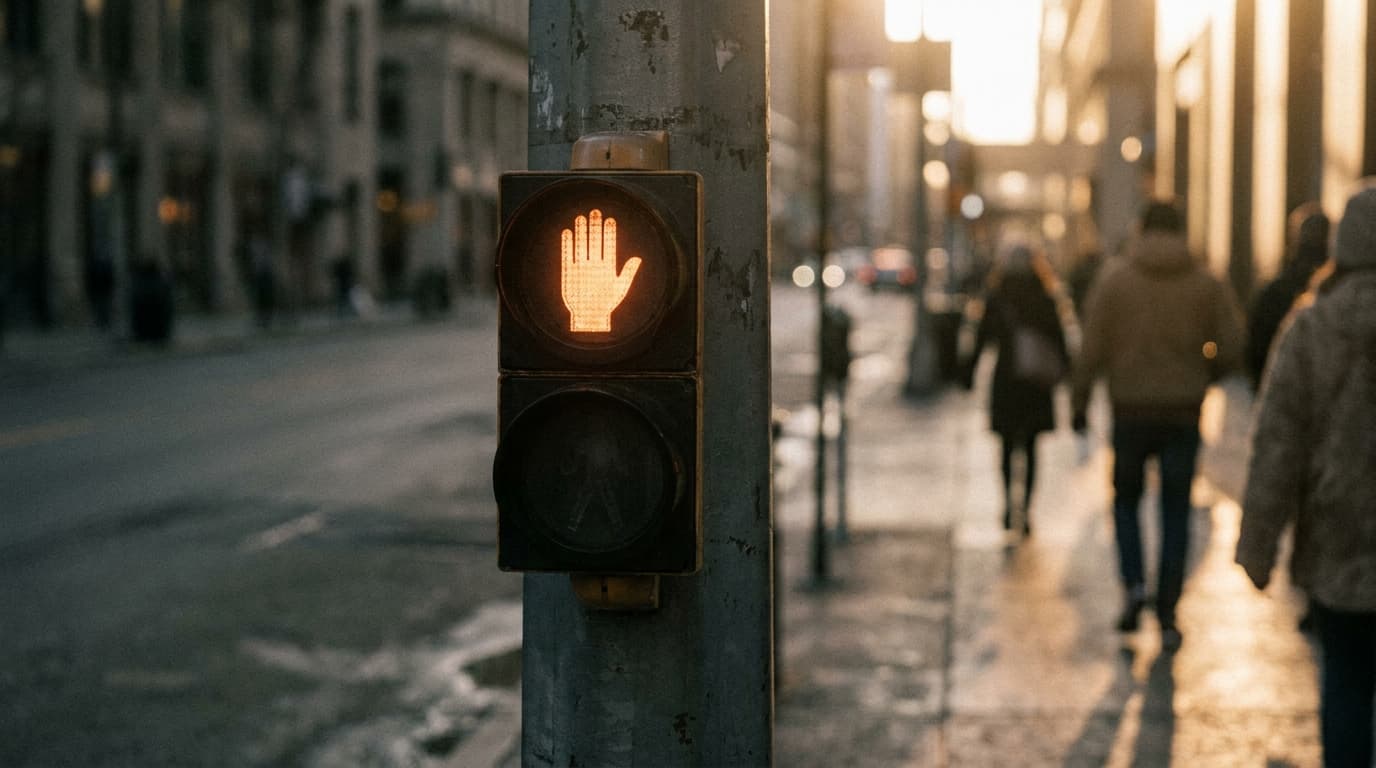
| DON'T WALK or upraised hand, flashing or steady | Do not start to cross (169.06, subd. 6(a)(2)) |
| Walking along a roadway next to an accessible, usable sidewalk | Unlawful (169.21, subd. 5) |
| Suddenly leaving a curb into the path of a vehicle so close the driver cannot yield | Barred (169.21, subd. 2(a)) |
| Walking on a controlled-access highway where signs prohibit pedestrians | Barred; a petty misdemeanor (169.305, subds. 1(c)-(d), 3) |
| Standing in a roadway to solicit a ride, employment, business or contributions | Barred (169.22) |
The crossing rules in 169.21, subd. 3 and the sidewalk rule in subd. 5 carry the chapter default penalty, a petty misdemeanor, unless the circumstances in 169.89, subd. 1 make the violation a misdemeanor. The curb-dart rule is different: it is a misdemeanor under 169.21, subd. 2(d). Both are covered in the fine section below.
What counts as a crosswalk in Minnesota
Minn. Stat. 169.011 defines a crosswalk as "(1) that portion of a roadway ordinarily included with the prolongation or connection of the lateral lines of sidewalks at intersections; (2) any portion of a roadway distinctly indicated for pedestrian crossing by lines or other markings on the surface."
Part (1) is an unmarked crosswalk at an intersection, defined by where the sidewalk lines would continue across the street. The yield rule in 169.21, subd. 3(a) separately treats "an intersection with no marked crosswalk" as a place where the pedestrian does not have to yield to all vehicles, and the driver rule in subd. 2(a) requires drivers to stop for a pedestrian crossing there.
Traffic lights and WALK signals in Minnesota
Section 169.21, subd. 1 provides that "Pedestrians shall be subject to traffic-control signals at intersections as heretofore declared in this chapter." Those signal rules are in Minn. Stat. 169.06.
Ordinary traffic lights. Under 169.06, subd. 5(a)(1)(iii), (2)(ii) and (3)(ii), and unless a pedestrian-control signal directs otherwise:
- Green: pedestrians facing any green signal, "except when the sole green signal is a turn arrow, may proceed across the roadway within any marked or unmarked crosswalk." Drivers must yield to them, "except that the pedestrian must yield the right-of-way to vehicles lawfully within the intersection at the time that the green signal indication is first shown."
- Yellow: pedestrians "are thereby advised that there is insufficient time to cross the roadway before a red indication is shown and a pedestrian must not then start to cross the roadway."
- Steady red: "pedestrians facing a steady red signal alone must not enter the roadway."
Pedestrian signals. Under 169.06, subd. 6(a)(1)-(2), a steady WALK or walking-person symbol means a pedestrian "may proceed across the roadway in the direction of the signal, possibly in conflict with turning vehicles," and every driver shall yield, except that the pedestrian yields to vehicles lawfully within the intersection when the signal first appears. A DON'T WALK or upraised hand, "flashing or steady, indicates that a pedestrian shall not start to cross the roadway in the direction of either signal, but any pedestrian who has partially crossed on the 'Walk' or 'walking person' signal indication shall proceed to a sidewalk or safety island while the signal is showing." A pedestrian crossing in conformity with these rules "is lawfully within the intersection and, when in a crosswalk, is lawfully within the crosswalk" (169.06, subd. 6(b)).
Walking along the road in Minnesota
Minn. Stat. 169.21, subd. 5 provides: "Pedestrians when walking or moving in a wheelchair along a roadway shall, when practicable, walk or move on the left side of the roadway or its shoulder giving way to oncoming traffic. Where sidewalks are provided and are accessible and usable it shall be unlawful for any pedestrian to walk or move in a wheelchair along and upon an adjacent roadway."
The sidewalk rule applies only where the sidewalk is "accessible and usable." Subdivision 4 adds that pedestrians "shall move when practicable upon the right half of crosswalks."
Freeways and other controlled-access highways. Under Minn. Stat. 169.305, subd. 1(c), the commissioner of transportation by order, and any public authority by ordinance, may "prohibit or regulate the use of any such highway by pedestrians, bicycles, or other nonmotorized traffic" on a controlled-access highway under their jurisdiction. Once the required signs are erected, "no person shall disobey the restrictions stated on such signs" (subd. 1(d)), and a violation is a petty misdemeanor (subd. 3).
Jaywalking fine and penalty in Minnesota
Section 169.21 states a penalty only in subdivision 2(d), and that clause covers subdivision 2. The pedestrian crossing rules in subdivisions 3 to 5 therefore fall under the chapter's default in Minn. Stat. 169.89, subd. 1:
"Unless otherwise declared in this chapter with respect to particular offenses, it is a petty misdemeanor for any person to do any act forbidden or fail to perform any act required by this chapter; except that: (1) a violation which is committed in a manner or under circumstances so as to endanger or be likely to endanger any person or property; or (2) exclusive of violations relating to the standing or parking of an unattended vehicle, a violation of any of the provisions of this chapter, classified therein as a petty misdemeanor, when preceded by two or more petty misdemeanor convictions within the immediate preceding 12-month period; is a misdemeanor to which the provisions of subdivision 2 shall not apply."
Subdivision 2 sets the petty misdemeanor penalty: "A person charged with a petty misdemeanor is not entitled to a jury trial but shall be tried by a judge without a jury. If convicted, the person is not subject to imprisonment but shall be punished by a fine of not more than $300."
The statute sets $300 as a ceiling, not a fixed amount. The Minnesota Judicial Branch's 2026 Statewide Payables List, effective January 1, 2026, lists the pedestrian signal and crossing violations in 169.06, subd. 5(a)(1)(iii), 5(a)(2)(ii) and 6 and 169.21, subds. 1, 3(a), 3(c), 4 and 5 at a $20 fine plus the $75 general surcharge, $95 in total. Under the list's policies, payable offenses charged by citation "are presumed to be payable, unless the endangerment box is checked."
Ignoring the ticket has consequences. For a petty misdemeanor, the notice to appear "must include a statement that a failure to appear will be considered a plea of guilty and waiver of the right to trial, unless the failure to appear is due to circumstances beyond the person's control" (Minn. Stat. 169.91, subd. 3). A petty misdemeanor conviction also counts toward the rule in 169.89, subd. 1 that makes a later petty misdemeanor violation a misdemeanor after two convictions in the preceding 12 months.
The curb-dart exception. The sentence "No pedestrian shall suddenly leave a curb or other place of safety and walk or run into the path of a vehicle which is so close that it is impossible for the driver to yield" is part of 169.21, subd. 2(a). Subdivision 2(d) provides that "A person who violates this subdivision is guilty of a misdemeanor," and a second or later violation within one year of a prior conviction under the subdivision is a gross misdemeanor.
What drivers owe pedestrians in Minnesota
Stop and stay stopped. Under Minn. Stat. 169.21, subd. 2(a), "Where traffic-control signals are not in place or in operation, the driver of a vehicle shall stop to yield the right-of-way to a pedestrian crossing the roadway within a marked crosswalk or at an intersection with no marked crosswalk. The driver must remain stopped until the pedestrian has passed the lane in which the vehicle is stopped."
No passing a stopped vehicle. When a vehicle has stopped at a marked crosswalk or at an intersection with no marked crosswalk to let a pedestrian cross, a driver approaching from the rear "shall not overtake and pass the stopped vehicle" (subd. 2(b)).
School crossings. It is unlawful to drive through a column of school children crossing a street or past a school safety patrol member or adult crossing guard who is directing children across and holding an official signal in the stop position (subd. 2(c)).
A driver who violates subdivision 2 is guilty of a misdemeanor, and a second or later violation within one year of a prior conviction is a gross misdemeanor (subd. 2(d)).
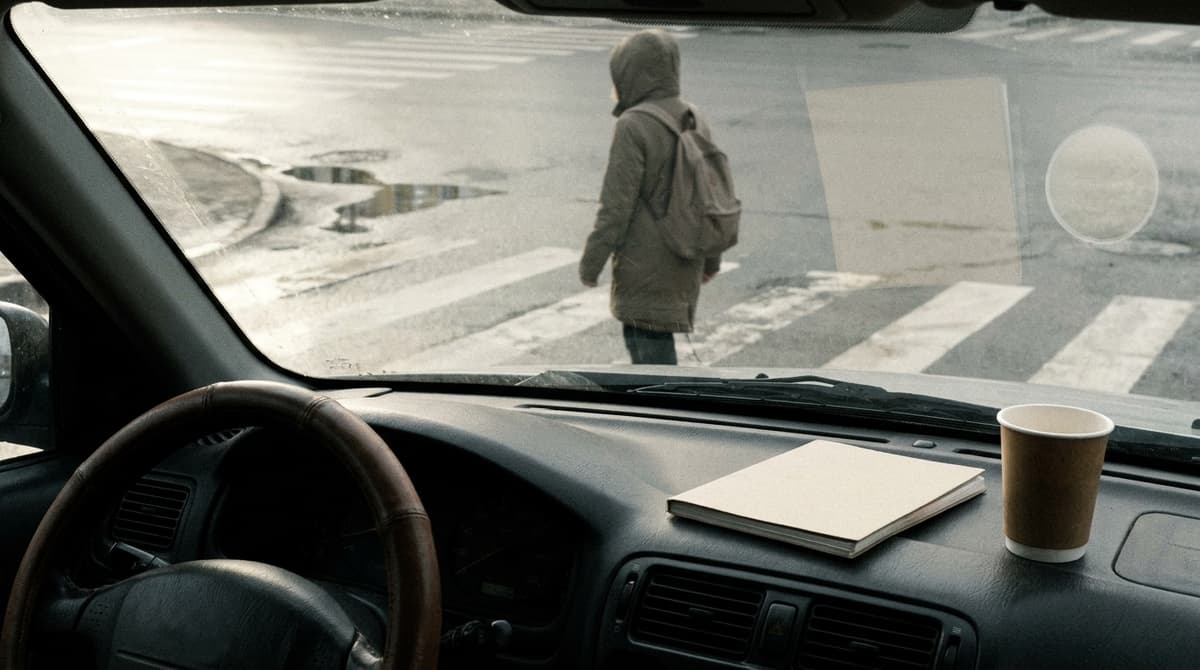
At traffic lights. On a green signal, "vehicular traffic, including vehicles turning right or left, must yield the right-of-way to other vehicles and to pedestrians lawfully within the intersection or adjacent crosswalk at the time this signal is exhibited" (169.06, subd. 5(a)(1)(i)). Drivers turning right on red after stopping "must yield the right-of-way to pedestrians and other traffic lawfully proceeding as directed by the signal at that intersection" (169.06, subd. 5(a)(3)(i)(A)).
Due care. Under 169.21, subd. 3(d), "Notwithstanding the other provisions of this section every driver of a vehicle shall (1) exercise due care to avoid colliding with any bicycle or pedestrian upon any roadway and (2) give an audible signal when necessary and exercise proper precaution upon observing any child or any obviously confused or incapacitated person upon a roadway."
Local jaywalking rules in Minnesota
Minn. Stat. 169.022 provides that "no local authority shall enact or enforce any rule or regulation in conflict with the provisions of this chapter unless expressly authorized herein. Local authorities may adopt traffic regulations which are not in conflict with the provisions of this chapter; provided, that when any local ordinance regulating traffic covers the same subject for which a penalty is provided for in this chapter, then the penalty provided for violation of said local ordinance shall be identical with the penalty provided for in this chapter for the same offense."
Separately, Minn. Stat. 169.04(a) lists the traffic powers local authorities keep, "with respect to streets and highways under their jurisdiction" and "within the reasonable exercise of the police power." The list covers parking, regulating traffic by police officers or traffic-control signals, processions, one-way roads, through highways, load restrictions, and speed and red light camera systems. None of the listed items names pedestrian crossing, but 169.022 still lets local authorities adopt traffic regulations that do not conflict with chapter 169. City and county ordinances are outside the scope of this page; the local code is the place to check any rule on a particular street.
If a pedestrian is hit by a car in Minnesota
Under Minn. Stat. 169.96(b), "In all civil actions, a violation of any of the provisions of this chapter, by either or any of the parties to such action or actions shall not be negligence per se but shall be prima facie evidence of negligence only." That applies to the pedestrian rules in 169.21, subd. 3 and to the driver's duty to stop under subd. 2 and the due-care rule in subd. 3(d). For how no-fault benefits and claims work after a crash, see Minnesota car accident laws. Scooter riders follow their own rules, covered in Minnesota e-scooter laws.
Related pages
This article provides general legal information about Minnesota law, not legal advice. For advice about a specific situation, contact a lawyer licensed in Minnesota.
Last updated: 2026-10-10.
Frequently Asked Questions
Is jaywalking illegal in Minnesota?
Under state law, crossing outside a marked crosswalk is allowed if you yield the right-of-way to all vehicles (Minn. Stat. 169.21, subd. 3(a)). Between adjacent intersections with operating traffic signals, you may cross only in a marked crosswalk (169.21, subd. 3(c)). Cities and counties may adopt traffic regulations that do not conflict with chapter 169 (Minn. Stat. 169.022), so check the local code.
What is the fine for jaywalking in Minnesota?
A pedestrian crossing violation is a petty misdemeanor punishable by a fine of not more than $300, with no jail and no jury trial (Minn. Stat. 169.89, subds. 1-2). It is a misdemeanor if it endangers or is likely to endanger any person or property, or follows two petty misdemeanor convictions in the preceding 12 months. On the 2026 Statewide Payables List, the pedestrian rows for 169.06, subd. 5(a)(1)(iii), 5(a)(2)(ii) and 6 and 169.21, subds. 1, 3(a), 3(c), 4 and 5 are listed at a $20 fine plus the $75 general surcharge, $95 in total; other pedestrian rules carry different amounts.
Can you cross on a red light as a pedestrian in Minnesota?
Unless a pedestrian-control signal directs otherwise, pedestrians facing a steady red signal alone must not enter the roadway (Minn. Stat. 169.06, subd. 5(a)(3)(ii)). On a DON'T WALK or upraised hand, flashing or steady, a pedestrian shall not start to cross (169.06, subd. 6(a)(2)).
Do cars have to stop for pedestrians in Minnesota?
Where signals are not in place or in operation, a driver must stop for a pedestrian crossing within a marked crosswalk or at an intersection with no marked crosswalk and remain stopped until the pedestrian has passed the lane (Minn. Stat. 169.21, subd. 2(a)). A violation is a misdemeanor, and a second within one year of a prior conviction is a gross misdemeanor.
Which side of the road should you walk on in Minnesota?
When practicable, walk on the left side of the roadway or its shoulder, giving way to oncoming traffic. Where sidewalks are provided and are accessible and usable, walking along the adjacent roadway is unlawful (Minn. Stat. 169.21, subd. 5).
Updates
Independently fact-checked against the cited primary sources
The Law Behind This Article
This article rests on the statutory provisions below, held in our own legal record and retrieved from the official source. Tap a section to read the operative text.
Minnesota Statutes, Chapter 169: TRAFFIC REGULATIONS
§ 169.21PEDESTRIANIn force
Subdivision 1. Obey traffic-control signals. Pedestrians shall be subject to traffic-control signals at intersections as heretofore declared in this chapter, but at all other places pedestrians shall be accorded the privileges and shall be subject to the restrictions stated in this section and section 169.22. Subd. 2. Rights in absence of signal. (a) Where traffic-control signals are not in place or in operation, the driver of a vehicle shall stop to yield the right-of-way to a pedestrian crossing the roadway within a marked crosswalk or at an intersection with no marked crosswalk. The driver must remain stopped until the pedestrian has passed the lane in which the vehicle is stopped. No pedestrian shall suddenly leave a curb or other place of safety and walk or run into the path of a vehicle which is so close that it is impossible for the driver to yield. This provision shall not apply under the conditions as otherwise provided in this subdivision.
Official text (excerpt) · last checked 2026-07-29 · Read the full text in our law library · Verify at revisor.mn.gov
§ 169.06SIGNS, SIGNALS, MARKINGSIn forcecited in 2 of our articles
Subdivision 1. Uniform system. The commissioner shall adopt a manual and specifications for a uniform system of traffic-control devices consistent with the provisions of this chapter for use upon highways within this state. Such uniform system shall correlate with and so far as possible conform to the system then current as approved by the American Association of State Highway and Transportation Officials. The manual and specifications must include the design and wording of minimum-maintenance road signs. The adoption of the manual and specifications by the commissioner as herein provided is specifically exempted from chapter 14, including section 14.386. Subd. 2. Placement and maintenance on trunk highway. (a) The commissioner shall place and maintain such traffic-control devices, conforming to the manual and specifications, upon all state trunk highways as the commissioner shall deem necessary to indicate and to carry out the provisions of this chapter or to regulate, warn, or guide traffic. The commissioner may construct and maintain signs at the entrance of each city, which sign shall have placed thereon the name of the city and the population thereof.
Official text (excerpt) · last checked 2026-07-29 · Read the full text in our law library · Verify at revisor.mn.gov
Cited in 27 court opinions in our collectionLatest citing opinion in our collection: 2024
Opinions citing this section in our collection:
- State v. Kuhlman (Supreme Court of Minnesota 2007, 729 N.W.2d 577)“…vehicle drivers for red-light violations. See Minn.Stat. § 169.06, subds. 4(a), 5(a) (2006). The A…”
- State v. Kilmer (Court of Appeals of Minnesota 2007, 741 N.W.2d 607)“…c law when he entered the intersection on a yellow light is Minn.Stat. § 169.06, subd. 5(a)(2)(i) (Supp.2005), which pr…”
- State v. Williams (Court of Appeals of Minnesota 1987, 415 N.W.2d 351)“…udge. The trial court found that both appellants violated Minn.Stat. § 169.06, subd. 4 by turning their taxicabs from…”
Identified automatically from the court opinions citing this section — not a ranking of which case controls.
Also relied on in: Minnesota Traffic Camera Ticket Laws: The 2025-2029 Pilot Program Explained
Search our full record of US law — 2.1 million sections, every state + federal →
Sources and References
- Minn. Stat. 169.21 (pedestrian)(revisor.mn.gov).gov
- Minn. Stat. 169.89 (penalties)(revisor.mn.gov).gov
- Minn. Stat. 169.011 (definitions; crosswalk)(revisor.mn.gov).gov
- Minn. Stat. 169.06 (signs, signals, markings)(revisor.mn.gov).gov
- Minn. Stat. 169.04 (local authority)(revisor.mn.gov).gov
- Minn. Stat. 169.022 (uniform application; local traffic regulations)(revisor.mn.gov).gov
- Minn. Stat. 169.305 (controlled-access highways)(revisor.mn.gov).gov
- Minn. Stat. 169.22 (soliciting rides, employment, business or contributions)(revisor.mn.gov).gov
- Minn. Stat. 169.91 (arrest; notice to appear)(revisor.mn.gov).gov
- Minn. Stat. 169.96 (civil actions; prima facie evidence of negligence)(revisor.mn.gov).gov
- Minnesota Judicial Branch, 2026 Statewide Payables List, Traffic/Criminal (effective January 1, 2026)(mncourts.gov).gov