
Oklahoma
Is Jaywalking Illegal in Oklahoma? Rules and Fines (2026)
Independently fact-checked against primary sources (last audited October 10, 2026). · 2 primary sources cited on this page. How we verify our legal content
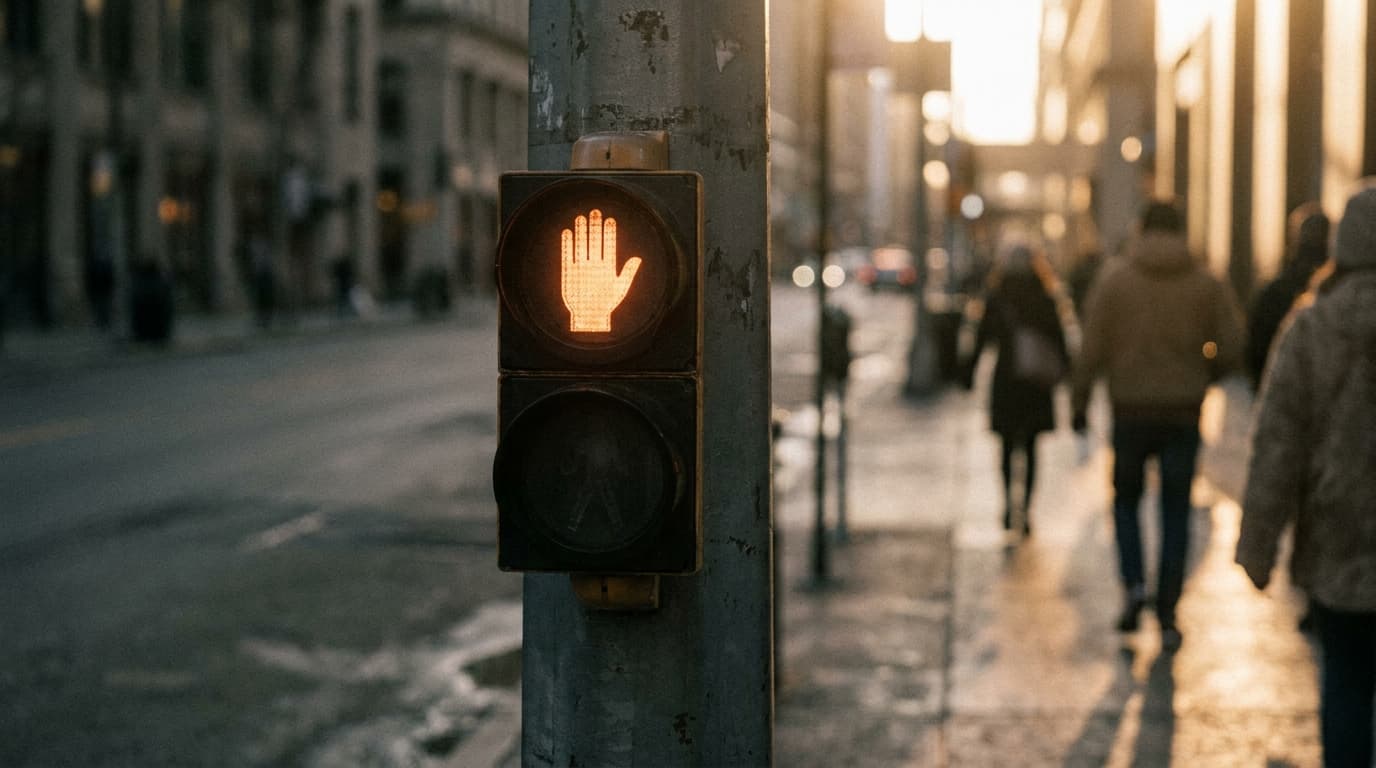
In Oklahoma, crossing outside a crosswalk is allowed, but only if you yield, and one kind of mid-block crossing is barred outright. Cities and towns may also require crosswalk-only crossing in a business district or on designated highways (47 O.S. 15-107). Under 47 O.S. 11-503, a pedestrian crossing anywhere other than a marked crosswalk or an unmarked crosswalk at an intersection must yield the right-of-way to all vehicles, and between adjacent intersections where traffic-control signals are operating, a pedestrian may cross only in a marked crosswalk. Breaking a Chapter 11 traffic rule is a misdemeanor (47 O.S. 11-102), and where no other penalty is set, a conviction carries a fine of $5 to $500 or up to 10 days in jail (47 O.S. 17-101(B)(1)). To compare other states, see our guide to jaywalking laws by state.
Information last verified on 2026-10-10. This article has not been reviewed by a licensed lawyer.
Jurisdiction scope: This article covers Oklahoma statutes in Title 47 of the Oklahoma Statutes: the crosswalk definition in 47 O.S. 1-111, the signal rules in 11-202 and 11-203, the pedestrian sections 11-501 to 11-507, the misdemeanor rule in 11-102, local authority in 15-102 and 15-107, controlled-access roadways in 11-313, and the penalty section 17-101. It does not cover any city's or town's traffic ordinances, court costs or a court's fine schedule, driver license points, injury claims after a crash, tribal law, or the law of other states.
Is jaywalking illegal in Oklahoma?
Oklahoma's crossing rule is 47 O.S. 11-503. It does not ban crossing outside a crosswalk in general; it puts the duty on the pedestrian to yield, and it bars one specific crossing. The full section reads:
"(a) Every pedestrian crossing a roadway at any point other than within a marked crosswalk or within an unmarked crosswalk at an intersection shall yield the right-of-way to all vehicles upon the roadway. (b) Any pedestrian crossing a roadway at a point where a pedestrian tunnel or overhead pedestrian crossing has been provided shall yield the right-of-way to all vehicles upon the roadway. (c) Between adjacent intersections at which traffic-control signals are in operation pedestrians shall not cross at any place except in a marked crosswalk."
So under state law a mid-block crossing where there are not signals at both ends is lawful if the pedestrian yields to all vehicles, unless a city or town ordinance under 47 O.S. 15-107 requires crosswalk-only crossing in a business district or on a designated highway. Between two signalized intersections, the only lawful crossing point is a marked crosswalk. Section 11-503 has no diagonal-crossing clause, but a diagonal path across an intersection is outside the crosswalk, so the pedestrian must yield to all vehicles (11-503(a)), and a green light lets pedestrians proceed only "within any marked or unmarked crosswalk" (11-202(1)(c)). Posted traffic-control devices still bind pedestrians (11-501(a)), so the signs at a particular intersection matter.
Controlled-access roadways have their own rule. Under 47 O.S. 11-313, the Department of Transportation, the Oklahoma Transportation Authority, or local authorities "may, with respect to any controlled-access roadway under their respective jurisdictions, prohibit the use of any such roadway by pedestrians," and once official signs are erected, "no person shall disobey the restrictions stated on such signs."
| Situation | Rule under Oklahoma law | Source |
|---|---|---|
| Crossing outside a marked crosswalk or an unmarked crosswalk at an intersection | Allowed, but the pedestrian must yield to all vehicles; a local ordinance may require crosswalk-only crossing in a business district or on designated highways | 47 O.S. 11-503(a), 15-107 |
| Crossing where a pedestrian tunnel or overhead crossing has been provided | Pedestrian yields to all vehicles | 11-503(b) |
| Crossing between adjacent intersections with traffic-control signals in operation | Only in a marked crosswalk | 11-503(c) |
| Using a controlled-access roadway where official signs prohibit pedestrians | Barred | 11-313 |
| Stepping off the curb into the path of a vehicle too close to yield | Barred | 11-502(b) |
| Starting to cross on a steady yellow | Barred unless a pedestrian-control signal directs otherwise | 11-202(2)(b) |
| Entering the roadway on a steady red alone | Barred unless a pedestrian-control signal directs otherwise | 11-202(3)(e) |
| Starting to cross on a flashing Don't Walk or upraised hand | Barred; a pedestrian partly across proceeds to a sidewalk or pedestrian refuge | 11-203(2) |
| Entering the roadway on a steady Don't Walk or upraised hand | Barred | 11-203(3) |
What counts as a crosswalk in Oklahoma
Because the yield duty depends on whether you were in a crosswalk, the definition decides many cases. 47 O.S. 1-111 provides:

"(a) That part of a roadway at an intersection included within the connections of the lateral lines of the sidewalks on opposite sides of the highway measured from the curbs or, in the absence of curbs, from the edges of the traversable roadway; (b) Any portion of a roadway at an intersection or elsewhere distinctly indicated for pedestrian crossing by lines or other markings on the surface."
Part (a) is the unmarked crosswalk at an intersection, tied to the lines of the sidewalks on opposite sides of the highway. Part (b) is a painted crossing, at an intersection or mid-block. Under 1-143, a pedestrian is "Any person afoot."
Traffic lights and WALK signals
Pedestrians are bound by the signals. Section 11-501 provides: "(a) A pedestrian shall obey the instructions of any official traffic-control device specifically applicable to him, unless otherwise directed by a police officer. (b) Pedestrians shall be subject to traffic and pedestrian-control signals as provided in Sections 11-202 and 11-203 of this title."
Under the ordinary traffic lights in 11-202, each rule applies "unless otherwise directed by a pedestrian-control signal as provided in Section 11-203":
- Green. Pedestrians "facing any green signal, except when the sole green signal is a turn arrow, may proceed across the roadway within any marked or unmarked crosswalk" (11-202(1)(c)).
- Steady yellow. Pedestrians are "advised that there is insufficient time to cross the roadway before a red indication is shown, and no pedestrian shall then start to cross the roadway" (11-202(2)(b)).
- Steady red alone. Pedestrians "shall not enter the roadway" (11-202(3)(e)).
Where pedestrian-control signals are installed, 11-203 controls:
"1. Walk. Pedestrians facing such signal may proceed across the roadway in the direction of the signal and shall be given the right-of-way in the direction of the signal by the drivers of all vehicles; 2. Flashing Don't Walk or flashing UPRAISED HAND. No pedestrian shall start to cross the roadway in the direction of such signal, but any pedestrian who has partially completed his or her crossing on the walk signal shall proceed to a sidewalk or pedestrian refuge while the steady Don't Walk or UPRAISED HAND signal is showing; and 3. Steady Don't Walk or steady UPRAISED HAND. No pedestrian shall enter the roadway in the direction of the signal indication."
The current text of 11-203 took effect November 1, 2024. If the hand starts flashing while you are crossing, the rule is to continue to a sidewalk or pedestrian refuge.
Walking along the road and other pedestrian rules
Section 11-506 governs walking along a road:
"(a) Where sidewalks are provided, it shall be unlawful for any pedestrian to walk along and upon an adjacent roadway. (b) Where sidewalks are not provided, any pedestrian walking along and upon a highway shall, when practicable, walk only on the left side of the roadway or its shoulder facing traffic which may approach from the opposite direction and shall yield to approaching vehicles."
Subsection (c) adds that "it shall be unlawful for any person to enter upon any portion of a bridge for the purpose of diving or jumping therefrom into a lake, river or stream for recreation, and it shall be unlawful for a pedestrian to use a bridge where sidewalks are not provided for the purpose of standing or sightseeing."
Two more rules apply to people on foot:
- "Pedestrians shall move, whenever practicable, upon the right half of crosswalks" (11-505).
- "No person shall stand in a roadway for the purpose of soliciting a ride, donation, employment or business from the occupant of any vehicle; provided, that persons shall not be prohibited from soliciting pursuant to this section if performed on a roadway maintained by a city or town in compliance with a permit and regulations adopted by ordinance" (11-507).
What drivers owe pedestrians in Oklahoma
Drivers carry their own duties. Section 11-502(a) provides:
"(a) When traffic-control signals are not in place or not in operation, the driver of a vehicle shall yield the right-of-way, slowing down or stopping if need be to so yield, to a pedestrian crossing the roadway within a crosswalk when the pedestrian is upon the half of the roadway upon which the vehicle is traveling, or when the pedestrian is approaching so closely from the opposite half of the roadway as to be in danger."
Other driver duties:
- No passing a stopped car at a crosswalk. "Whenever any vehicle is stopped at a marked crosswalk or at any unmarked crosswalk at an intersection to permit a pedestrian to cross the roadway, the driver of any other vehicle approaching from the rear shall not overtake and pass such stopped vehicle" (11-502(d)).
- Turning on green. Vehicular traffic facing a circular green "shall yield the right-of-way to other vehicles and to pedestrians lawfully within the intersection or an adjacent crosswalk at the time such signal is exhibited" (11-202(1)(a)).
- Turning on red. Traffic turning on a red "shall yield the right-of-way to pedestrians lawfully within an adjacent crosswalk and to other traffic lawfully using the intersection" (11-202(3)(b)).
- Green arrow. Traffic facing a green arrow "shall yield the right-of-way to pedestrians lawfully within an adjacent crosswalk and to other traffic lawfully using the intersection" (11-202(1)(b)).
- WALK signal. A pedestrian facing WALK "shall be given the right-of-way in the direction of the signal by the drivers of all vehicles" (11-203(1)).
- Due care. "Notwithstanding the foregoing provisions of this chapter, every driver of a vehicle shall exercise due care to avoid colliding with any pedestrian upon any roadway and shall give warning by sounding the horn when necessary and shall exercise proper precaution upon observing any child or any confused or incapacitated person upon a roadway" (11-504).
The pedestrian side of 11-502 is subsection (b): "No pedestrian shall suddenly leave a curb or other place of safety and walk or run into the path of a vehicle which is so close that it is impossible for the driver to yield."
Jaywalking fine and penalty in Oklahoma
Oklahoma treats a pedestrian violation as a misdemeanor, not a civil infraction. Section 11-102 provides: "It is unlawful and, unless otherwise declared in this chapter with respect to particular offenses, it is a misdemeanor for any person to do any act forbidden or fail to perform any act required in this chapter." Section 17-101(A) states the same rule for the whole title: "It is a misdemeanor for any person to violate any of the provisions of this title unless such violation is by this title or other law of this state declared to be a felony."
Section 11-503 does not set its own penalty, so the general Chapter 10 to 14 penalty applies. 47 O.S. 17-101(B)(1) provides:
"B. 1. Every person convicted of a misdemeanor for a violation of any of the provisions of Sections 10-101 through 14-121 or Sections 16-101 through 16-114 of this title for which another penalty is not provided shall upon conviction thereof be punished by a fine of not less than Five Dollars ($5.00) nor more than Five Hundred Dollars ($500.00) or by imprisonment for not more than ten (10) days; for a second such conviction within one (1) year after the first conviction by imprisonment for not more than twenty (20) days; upon a third or subsequent conviction within one (1) year after the first conviction by imprisonment for not more than six (6) months, or by both such fine and imprisonment."
| Conviction | Statutory limit | Source |
|---|---|---|
| First conviction for a pedestrian rule with no other penalty | Fine of $5 to $500, or up to 10 days in jail | 47 O.S. 17-101(B)(1) |
| Second conviction within one year after the first | Up to 20 days in jail | 17-101(B)(1) |
| Third or later conviction within one year after the first | Up to six months in jail | 17-101(B)(1) |
The penalty sentence ends "or by both such fine and imprisonment." These are statutory limits, not the amount on a typical ticket; the citation or the court shows what is due, and court costs are separate.
Paying the ticket has consequences. Under 17-101(B)(2), where a jail sentence is not mandatory, the person charged may, "in the discretion of the district attorney wherein the offense occurred, be permitted to enter a plea of guilty by written statement," and "A remittance covering the fine and costs may be considered and received with the same force and effect as a written plea of guilty." A person who intends to contest a ticket should not send in the payment.
Local rules and posted signs
Cities and towns have some room to regulate their own streets. Under 47 O.S. 15-102(A), "The provisions of this title shall not be deemed to prevent local authorities with respect to streets and highways under their jurisdiction and within the reasonable exercise of the police power from" a list of activities, ending with "11. Adopting such other traffic regulations as are specifically authorized by this title." Section 15-107 goes further: "Local authorities are hereby empowered by ordinance to require that pedestrians shall strictly comply with the directions of any official traffic-control signal and may by ordinance prohibit pedestrians from crossing any roadway in a business district or any designated highways except in a crosswalk." In a city or town that has adopted such an ordinance, the yield-and-cross rule in 11-503(a) does not make a mid-block crossing lawful in those areas. Section 11-507 also refers to city permits and ordinances for roadside soliciting. Since pedestrians must obey official traffic-control devices applicable to them (11-501(a)), the signs posted at a crossing matter. To see whether your city adds pedestrian rules, look up its code of ordinances or ask the municipal court named on a citation.
Proposed changes
A 2024 bill, House Bill 4146, was introduced as "An Act relating to pedestrian safety; amending 47 O.S. 2021, Section 11-502." It did not change the codified text: the current official Title 47 carries 11-502 and 11-503 in their original 1961 form.
If a pedestrian is hit by a car
Whether a pedestrian crossed lawfully can matter after a collision, alongside the driver's yield duties and the duty of due care in 11-504. For how fault and insurance claims work after a crash, see Oklahoma car accident laws. E-scooter riders follow their own rules, covered in Oklahoma e-scooter laws.
Related pages
- Jaywalking laws by state
- Oklahoma car accident laws
- Oklahoma e-scooter laws
- Kansas jaywalking laws
- Texas jaywalking laws
This article provides general legal information about Oklahoma law, not legal advice. For advice about a specific situation, contact a lawyer licensed in Oklahoma.
Last updated: 2026-10-10.
Frequently Asked Questions
Is jaywalking illegal in Oklahoma?
Crossing outside a crosswalk is allowed in Oklahoma if you yield the right-of-way to all vehicles (47 O.S. 11-503(a)), unless a city or town ordinance under 47 O.S. 15-107 requires crosswalk-only crossing in a business district or on a designated highway. Between adjacent intersections with operating traffic-control signals, you may cross only in a marked crosswalk (11-503(c)). Posted signs and local rules can also apply.
What is the fine for jaywalking in Oklahoma?
A pedestrian violation is a misdemeanor (47 O.S. 11-102). With no other penalty provided, a first conviction carries a fine of $5 to $500 or up to 10 days in jail (17-101(B)(1)); court costs are separate.
Can you go to jail for jaywalking in Oklahoma?
The statute allows it: up to 10 days for a first conviction, up to 20 days for a second within one year, and up to six months for a third or later within one year (47 O.S. 17-101(B)(1)).
Is paying a jaywalking ticket a guilty plea in Oklahoma?
Under 47 O.S. 17-101(B)(2), a remittance covering the fine and costs may be received with the same force and effect as a written plea of guilty.
Can I cross on a flashing upraised hand in Oklahoma?
You may not start to cross on a flashing Don't Walk or upraised hand, but if you are partly across on the walk signal you should proceed to a sidewalk or pedestrian refuge (47 O.S. 11-203(2)). On a steady Don't Walk or upraised hand, do not enter the roadway (11-203(3)).
Is crossing diagonally illegal in Oklahoma?
Section 11-503, Oklahoma's crossing rule, contains no diagonal-crossing clause. A diagonal path is outside the crosswalk, so the pedestrian must yield to all vehicles (11-503(a)), and a green light lets pedestrians cross only within a marked or unmarked crosswalk (11-202(1)(c)). Posted traffic-control devices still bind pedestrians (47 O.S. 11-501(a)), and local ordinances adopted under 15-107 can require crosswalk-only crossing.
Do drivers have to stop for pedestrians in Oklahoma?
When signals are not in place or not operating, drivers must yield, slowing or stopping if needed, to a pedestrian in a crosswalk on their half of the road or approaching so closely from the other half as to be in danger (47 O.S. 11-502(a)). Drivers must also exercise due care to avoid any pedestrian (11-504).
Which side of the road should I walk on in Oklahoma?
Use the sidewalk where one is provided. Where there is none, walk when practicable only on the left side of the roadway or its shoulder, facing traffic, and yield to approaching vehicles (47 O.S. 11-506(b)).
Updates
Independently fact-checked against the cited primary sources
The Law Behind This Article
This article rests on the statutory provisions below, held in our own legal record and retrieved from the official source. Tap a section to read the operative text.
Oklahoma Statutes, Title 47: MOTOR VEHICLES
§ 11-503Crossing at other than cross walksIn force
(a) Every pedestrian crossing a roadway at any point other than within a marked crosswalk or within an unmarked crosswalk at an intersection shall yield the right-of-way to all vehicles upon the roadway. (b) Any pedestrian crossing a roadway at a point where a pedestrian tunnel or overhead pedestrian crossing has been provided shall yield the right-of-way to all vehicles upon the roadway. (c) Between adjacent intersections at which traffic-control signals are in operation pedestrians shall not cross at any place except in a marked crosswalk. Laws 1961, p. 380, § 11-503.
Official text (excerpt) · last checked 2026-07-31 · Read the full text in our law library · Verify at oklegislature.gov
§ 11-502Pedestrians' right-of-way in crosswalksIn force
(a) When traffic-control signals are not in place or not in operation, the driver of a vehicle shall yield the right-of-way, slowing down or stopping if need be to so yield, to a pedestrian crossing the roadway within a crosswalk when the pedestrian is upon the half of the roadway upon which the vehicle is traveling, or when the pedestrian is approaching so closely from the opposite half of the roadway as to be in danger. (b) No pedestrian shall suddenly leave a curb or other place of safety and walk or run into the path of a vehicle which is so close that it is impossible for the driver to yield. (c) Paragraph (a) shall not apply under the conditions stated in Section 11-503(b). (d) Whenever any vehicle is stopped at a marked crosswalk or at any unmarked crosswalk at an intersection to permit a pedestrian to cross the roadway, the driver of any other vehicle approaching from the rear shall not overtake and pass such stopped vehicle. Laws 1961, p. 380, § 11-502.
Official text (excerpt) · last checked 2026-07-31 · Read the full text in our law library · Verify at oklegislature.gov
§ 11-202Traffic-control signal legendIn force
Whenever traffic is controlled by traffic-control signals exhibiting different colored lights or colored lighted arrows successively one at a time, or in combination, only the colors green, red and yellow shall be used, except for special pedestrian signals carrying a word legend, and the lights shall indicate and apply to drivers of vehicles and pedestrians as follows: 1. Green indication: a. vehicular traffic facing a circular green signal, except when prohibited under Section 11-1302 of this title, may proceed straight through or turn right or left unless a sign at such place prohibits either such turn. But vehicular traffic, including vehicles turning right or left, shall yield the right-of-way to other vehicles and to pedestrians lawfully within the intersection or an adjacent crosswalk at the time such signal is exhibited, b. vehicular traffic facing a green arrow signal, shown alone or in combination with another indication, may cautiously enter the intersection only to make the movement indicated by such arrow, or such other movement as is permitted by other indications shown at the same time.
Official text (excerpt) · last checked 2026-07-31 · Read the full text in our law library · Verify at oklegislature.gov
Search our full record of US law — 2.1 million sections, every state + federal →
Sources and References
- Oklahoma Statutes Title 47, Motor Vehicles (sections 1-111, 11-102, 11-202, 11-203, 11-313, 11-501 to 11-507, 15-102, 15-107, 17-101)(oklegislature.gov).gov
- Oklahoma House Bill 4146 (2024), introduced text(oklegislature.gov).gov