
Massachusetts
Is Jaywalking Illegal in Massachusetts? Rules and $1 Fine (2026)
Independently fact-checked against primary sources (last audited October 10, 2026). · 7 primary sources cited on this page. How we verify our legal content
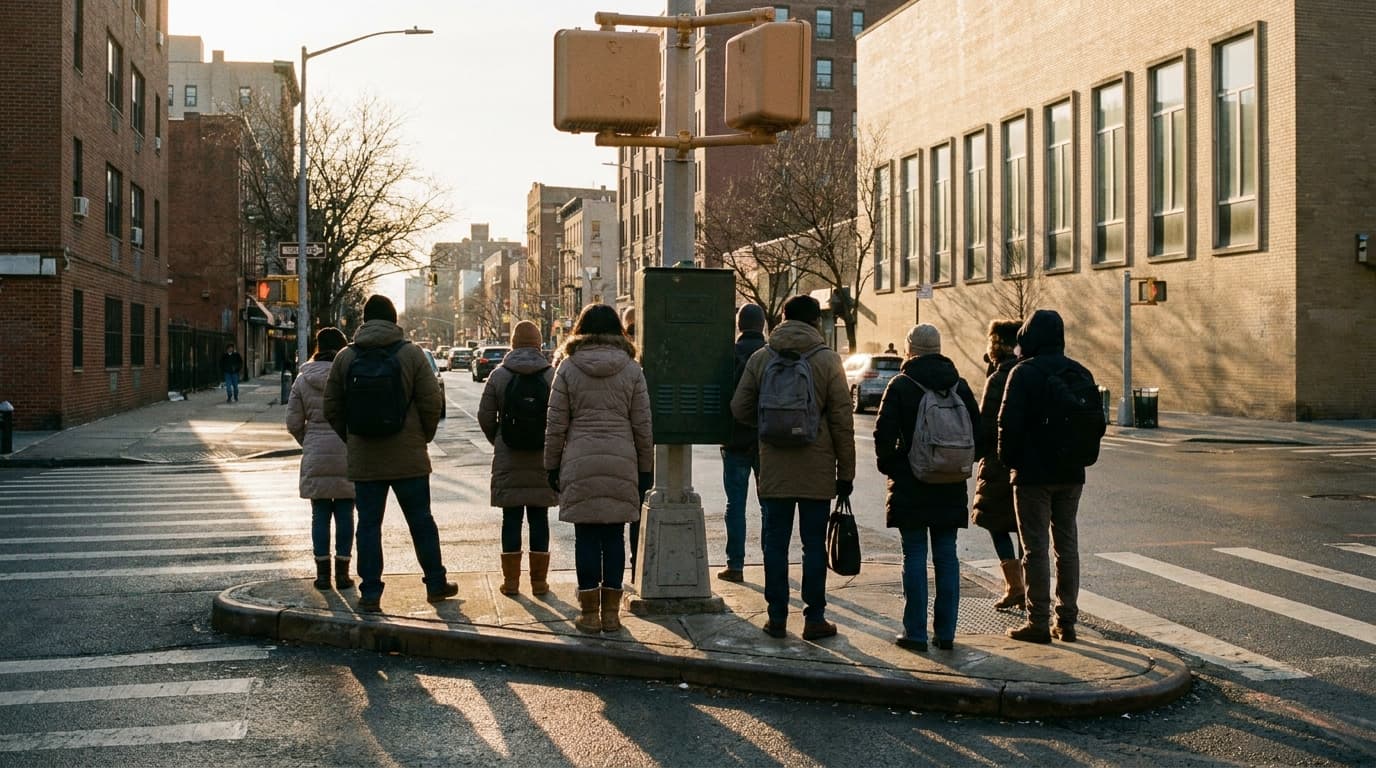
Massachusetts treats jaywalking as a breach of a pedestrian rule, and the penalty is set by statute at $1 for each of a person's first three offenses in a calendar year within a district court's jurisdiction and $2 for the fourth or later (M.G.L. c. 90, s. 18A). The crossing rules themselves sit in state regulations for state highways (700 CMR 9.09) and in local pedestrian rules that s. 18A lets state and local bodies adopt. On a state highway, a pedestrian within 300 feet of a traffic signal, a marked crosswalk or an officer directing traffic must cross in the marked crosswalk (700 CMR 9.09(1)). For how other states handle the same question, see our guide to jaywalking laws by state.
Information last verified on 2026-10-10. This article has not been reviewed by a licensed lawyer.
Jurisdiction scope: This article covers Massachusetts state law on pedestrian crossings: M.G.L. c. 90, s. 18A (pedestrian rules and fines), the state-highway regulation 700 CMR 9.00 (including the pedestrian rules in 9.09 and the penalty clause in 9.07(5)), and the driver duties in M.G.L. c. 89, ss. 8 and 11 and c. 90, ss. 14 and 14A. It does not cover the text of any city or town pedestrian rule, injury claims after a crash, or the law of other states.
Is jaywalking illegal in Massachusetts?
It depends on where you cross and what is nearby. Chapter 89 of the General Laws, which regulates the use of ways, contains no rule directing how pedestrians cross; its crosswalk section, s. 11, binds drivers. The rules pedestrians must follow come from two places that M.G.L. c. 90, s. 18A ties together: the state's own regulation for state highways, 700 CMR 9.00, and rules adopted by local bodies for the ways they control.
On a state highway, 700 CMR 9.09 sets both kinds of rule. Some are duties to yield: crossing outside a marked crosswalk in an urban area is lawful if the pedestrian yields to traffic. Others are flat bans, most importantly the 300-foot rule, which requires a pedestrian near a signal, a marked crosswalk or an officer directing traffic to use the marked crosswalk.
| Situation on a state highway | Massachusetts rule |
|---|---|
| An officer directing traffic, a traffic control signal or a marked crosswalk is within 300 feet | Cross only within the limits of a marked crosswalk (700 CMR 9.09(1)) |
| Crossing in an urban area outside a marked crosswalk | Allowed, but yield the right of way to all vehicles (9.09(5)) |
| A pedestrian tunnel or overpass is provided | Cross only by using the tunnel or overpass (9.09(5)) |
| Push-button pedestrian signal | Do not cross until the button has been pressed, then cross only on the proper pedestrian indication (9.09(2)(a)) |
| Flashing or steady DON'T WALK or upraised hand | Do not start to cross; a person already crossing may continue on the flashing signal (9.09(3)(b)-(c)) |
| No working pedestrian signal, steady yellow or red | Do not start to cross; a person already crossing may continue (9.09(3)(e)-(f)) |
| Suddenly leaving a sidewalk or safety island into the path of a close vehicle | Barred (9.09(4)(a)) |
| Walking along the roadway where an open sidewalk is provided | Unlawful (9.09(4)(c)) |
| Pressing a pedestrian button or entering a marked crosswalk without intending to cross | Unlawful (9.09(4)(f)) |
| Standing in the roadway to solicit a ride, employment or business | Barred without written permission from the board or officer controlling the road (9.09(6)) |
| Getting out on the roadway side of a car parked at the curb in an urban area within 300 feet of a marked crosswalk | Go straight to the sidewalk or roadway edge, then cross only as 700 CMR 9.00 allows (9.09(4)(e)) |
| A bridge operation signal has been given | Do not enter or remain on the bridge or its approach beyond the signal, gate or barrier (9.09(7)) |
| Limited-access or express state highway with official signs prohibiting pedestrians | No foot traffic except in an emergency (700 CMR 9.08(2)(c)); fine of not more than $20 (9.07(5)) |
Each 9.09 rule in this table is punished under c. 90, s. 18A, as 700 CMR 9.07(5) provides: "Any person convicted of a violation of any of the provisions of 700 CMR 9.09 shall be punished as provided in M.G.L. c. 90, s. 18A."
The 300-foot crosswalk rule on state highways
700 CMR 9.09(1) is the main crossing rule on state highways:

"Pedestrians shall obey the directions of police officers directing traffic and whenever there is an officer directing traffic, a traffic control signal or a marked crosswalk within 300 feet of a pedestrian, no such pedestrian shall cross a way or roadway except within the limits of a marked crosswalk and as hereinafter provided in 700 CMR 9.00."
The rule is triggered by any one of the three: an officer directing traffic, a signal, or a marked crosswalk within 300 feet. Where none of them is that close, the urban-area yield rule in 9.09(5) takes over:
"Every pedestrian crossing a roadway in an urban area at any point other than within a marked crosswalk shall yield the right of way to all vehicles upon the roadway. At a point where a pedestrian tunnel or overpass has been provided, pedestrians shall cross the roadway only by the proper use of the tunnel or overpass."
The yield rule applies in an "urban area," which 700 CMR 9.01 defines as "The territory contiguous to and including any street which is built up with structures devoted to business, industry or dwelling houses situated at intervals of less than 100 feet for a distance of a quarter of a mile or more."
The regulation defines a crosswalk in 700 CMR 9.01 as "That portion of a roadway ordinarily included within the extensions of the sidewalk lines, or, if none then the footpath lines, and, at any place in a highway, clearly indicated for pedestrian crossing by lines or markers upon the roadway surface." Both rules speak of a marked crosswalk, so in an urban area a pedestrian crossing anywhere other than a marked crosswalk falls under the duty to yield in 9.09(5).
Walk signals and traffic lights for pedestrians in Massachusetts
700 CMR 9.09(3) sets out what each pedestrian signal means on a state highway:
- Steady WALK or walking person: a pedestrian facing it "may proceed across the roadway and in the direction of such signal only" (9.09(3)(a)).
- Flashing DON'T WALK or upraised hand: a pedestrian already crossing may continue to the sidewalk, the edge of the roadway or a traffic-island refuge. "A Pedestrian that has not started to cross shall not start" (9.09(3)(b)).
- Steady DON'T WALK or upraised hand: "a Pedestrian that has not started to cross shall not start" (9.09(3)(c)).
Where there is no pedestrian signal, or the pedestrian signal is dark or not working, the ordinary traffic light controls. Under 9.09(3)(d)-(h), a pedestrian may cross within any marked crosswalk on a steady green; may not start to cross on a steady yellow or steady red, though a person already crossing may continue; and may proceed with due care within a marked crosswalk on a flashing yellow or flashing red. Subsection (2)(a) adds that where no pedestrian indication is provided, "pedestrians shall cross only on the green indication," and that at push-button signals no pedestrian may cross until the button has been pressed.
At any signal, pedestrians must yield to a funeral or other procession and to an authorized emergency vehicle on emergency duty "regardless of the signal indication given" (9.09(2)(b)).
Walking along the road
Two rules in 700 CMR 9.09(4) govern walking along a state highway:
"(c) Where sidewalks are provided, it shall be unlawful for any pedestrian to walk along and upon an adjacent roadway whenever the sidewalk is open to pedestrian use. (d) Where sidewalks are not provided, any pedestrian walking along and upon an undivided highway shall, when practicable, walk only on the left side of the roadway on its unfinished shoulder facing traffic which may approach from the opposite direction. On any divided highway pedestrians not in violation of 700 CMR 9.08(2)(c) shall walk only on the right side of the roadway on the unfinished shoulder."
The same subsection asks pedestrians to "at all times attempt to cross a roadway using the right half of crosswalks" (9.09(4)(b)).
Under 9.09(8), the pedestrian rules do not apply to people working on a road that is closed or under construction or repair, to municipal, state, federal or public service corporation employees performing their duties, to officers performing their public duties, or to pedestrians acting in an emergency that requires departing from the rules.
Jaywalking fine in Massachusetts
The fine is written into M.G.L. c. 90, s. 18A:
"Whoever violates any provision of any such rule shall be punished by a fine of one dollar for the first, second or third such offense committed by such person within the jurisdiction of the district court in the particular calendar year, and by a fine of two dollars for the fourth or subsequent such offense so committed in such calendar year."
The count runs per person, per district court's jurisdiction, per calendar year. For s. 18A, "the word ''pedestrian'' shall include a person in or on any conveyance, other than a bicycle, constructed and designed for propulsion by human muscular power, as well as including a person on foot." 700 CMR 9.07(5) applies this same penalty to violations of the state-highway pedestrian rules in 9.09, rather than the $20 maximum the regulation sets for its other, non-parking rules.
A ticket comes as a written notice, not an arrest. Under s. 18A, an officer who takes cognizance of a violation "shall forthwith give to the offender a written notice to appear before the clerk of the district court having jurisdiction, at any time during office hours, not later than twenty-one days after the time of such violation."
The person may confess and pay the clerk in person, through an agent authorized in writing, or by mail, with payment only by postal note, money order or check. Payment of the $1 (or $2) fine "shall operate as a final disposition of the case." Section 18A adds: "Proceedings under this paragraph shall not be deemed criminal; and no person notified to appear before the clerk of a district court as provided herein shall be required to report to any probation officer, and no record of the case shall be entered in the probation records."
Ignoring the notice has consequences. If the person does not appear, or appears but does not want to use the non-criminal procedure, the officer "shall forthwith make a complaint and follow the procedure established for criminal cases." If the person then fails to appear on the summons, the clerk mails a notice, and "If any person fails to appear within twenty-one days from the sending of such notice the court shall issue a warrant for his arrest."
Giving your name and the limit on arrest
Section 18A makes refusing to identify a separate offense, and it is the one situation in which a pedestrian can be arrested without a warrant:
"Whoever, upon such request, refuses to state his name and address, or states a false name and address or a name and address which is not his name and address in ordinary use, shall be punished by a fine of not less than twenty nor more than fifty dollars. Any such offender who refuses upon such request to state his name and address may be arrested without a warrant; but no person shall be arrested without a warrant for any other violation of any provision of this paragraph or for any violation of any provision of any such rule."
In practical terms, the $1 or $2 crossing fine is small, but refusing to give a name and address, or giving a false one, carries a fine of $20 to $50 and allows an arrest without a warrant. Separately, a person who ignores the notice to appear can end up facing a criminal complaint and, after a further missed 21-day notice, a court-issued arrest warrant (s. 18A).
Local pedestrian rules in Massachusetts cities and towns
Section 18A is also the source of local jaywalking rules. It provides that the department, on ways within its control, and local bodies including "the city council of any other city, and the board of selectmen of any other town may, subject to the provisions of section two of chapter eighty-five, adopt, amend and repeal rules, not repugnant to law, regulating the use by pedestrians of ways within their respective control."

The same paragraph limits that power. A rule adopted by a local traffic commission, traffic director, city council or board of selectmen does not "take effect until approved in writing by the department," and it must also be published in a newspaper in the city or town where it will apply. A local rule must also be "not repugnant to law." The text of any particular city's or town's pedestrian rule is outside the scope of this page; check with the city or town for the rule on a given street. The parts of s. 18A that concern ways controlled by cities or towns "shall be effective in cities or towns accepting said provisions," and a city or town may later revoke its acceptance after two years. Where a local rule was adopted under s. 18A, the fine for breaking it is the s. 18A fine.
What drivers owe pedestrians in Massachusetts
The driver's crosswalk duty is a statute, M.G.L. c. 89, s. 11, and it carries a fine of up to $200:
"When traffic control signals are not in place or not in operation the driver of a vehicle shall yield the right of way, slowing down or stopping if need be so to yield, to a pedestrian crossing the roadway within a crosswalk marked in accordance with standards established by the department of highways if the pedestrian is on that half of the traveled part of the way on which the vehicle is traveling or if the pedestrian approaches from the opposite half of the traveled part of the way to within 10 feet of that half of the traveled part of the way on which said vehicle is traveling."
The section's duty to yield is tied to a crosswalk marked to state standards and to locations without working signals. Two further rules in s. 11 apply even at signals: no driver may pass a vehicle stopped at a marked crosswalk to let a pedestrian cross, and no driver may enter a marked crosswalk while a pedestrian is crossing or until there is room beyond it for the vehicle, "notwithstanding that a traffic control signal may indicate that vehicles may proceed." Violations are punished by "a fine of not more than $200."
Slowing down and passing. Under M.G.L. c. 90, s. 14, "Upon approaching a pedestrian who is upon the traveled part of any way and not upon a sidewalk, every person operating a motor vehicle shall slow down." The same section requires a driver passing a vulnerable user, a term that includes a pedestrian (c. 90, s. 1), to pass "at a safe distance of not less than 4 feet and at a reasonable and proper speed."
Turns and green lights. A driver turning right on red must "yield the right-of-way to pedestrians and other traffic proceeding as directed by the signal" (M.G.L. c. 89, s. 8), with a fine of not less than $35. On state highways, traffic facing a steady circular green "shall yield the right of way to pedestrians lawfully within a crosswalk," and turning traffic must yield to pedestrians crossing with the flow of traffic (700 CMR 9.06(10)(a)).
Blind pedestrians. Under M.G.L. c. 90, s. 14A, when a totally or partially blind pedestrian guided by a guide dog, or carrying a raised or extended white cane or a white cane tipped with red, crosses or attempts to cross a way, every approaching driver "shall bring his vehicle to a full stop" and take the precautions needed to avoid injuring the pedestrian. The fine is $100 to $500.
Due care. On state highways, the driver rules in 700 CMR 9.00 add: "Notwithstanding the provisions of 700 CMR 9.00 every operator of a vehicle shall exercise due care to avoid colliding with any pedestrian upon the roadway and shall give warning by sounding the horn when necessary and shall exercise proper precautions which may become necessary for safe operation."
If a pedestrian is hit by a car in Massachusetts
Under M.G.L. c. 90, s. 18A, "A violation of any provision of any such rule or of any provision of this section shall not, in any civil proceeding, constitute negligence or be admissible as evidence of negligence, nor shall a conviction for such a violation be shown to affect the credibility of a witness in any proceeding." The driver's duties under c. 89, s. 11 and c. 90, ss. 14 and 14A still apply. For how fault, insurance and claims work after a crash, see Massachusetts car accident laws. Scooter riders follow their own rules, covered in Massachusetts e-scooter laws.
Related pages
This article provides general legal information about Massachusetts law, not legal advice. For advice about a specific situation, contact a lawyer licensed in Massachusetts or your city or town's traffic authority.
Last updated: 2026-10-10.
Frequently Asked Questions
Is jaywalking illegal in Massachusetts?
On state highways, a pedestrian with a signal, a marked crosswalk or an officer directing traffic within 300 feet must cross in the marked crosswalk (700 CMR 9.09(1)); elsewhere in an urban area, crossing outside a marked crosswalk is allowed if the pedestrian yields to all vehicles (9.09(5)). Cities and towns may adopt their own pedestrian rules under M.G.L. c. 90, s. 18A.
How much is a jaywalking ticket in Massachusetts?
M.G.L. c. 90, s. 18A sets the fine at $1 for each of the first three offenses in a calendar year within a district court's jurisdiction and $2 for the fourth or later. The same fine applies to the state-highway pedestrian rules under 700 CMR 9.07(5).
Can you be arrested for jaywalking in Massachusetts?
Under M.G.L. c. 90, s. 18A, no person may be arrested without a warrant for violating a pedestrian rule. The exception is refusing to state a name and address when asked, which allows arrest without a warrant and carries a fine of $20 to $50. Ignoring the notice to appear is different: the officer files a criminal complaint, and if the person misses the summons and then a mailed 21-day notice, the court issues a warrant for arrest.
Can you cross on a red light as a pedestrian in Massachusetts?
On a state highway where no pedestrian signal is working, a pedestrian who has not started to cross on a steady red or steady yellow shall not start, though one already crossing may continue (700 CMR 9.09(3)(e)-(f)). Where a pedestrian signal shows a flashing or steady DON'T WALK, a pedestrian may not start to cross (9.09(3)(b)-(c)).
Do drivers have to stop for pedestrians in crosswalks in Massachusetts?
Where signals are not in place or not operating, a driver must yield, slowing or stopping if needed, to a pedestrian in a marked crosswalk on the driver's half of the road or within 10 feet of it (M.G.L. c. 89, s. 11). The fine is up to $200, and drivers may not pass a vehicle stopped at a marked crosswalk for a pedestrian.
Which side of the road should you walk on in Massachusetts?
On state highways, use an open sidewalk where one is provided (700 CMR 9.09(4)(c)). Where there is no sidewalk on an undivided highway, walk when practicable on the left side of the roadway on the unfinished shoulder, facing oncoming traffic; on a divided highway, walk only on the right side on the unfinished shoulder (9.09(4)(d)).
Updates
Independently fact-checked against the cited primary sources
The Law Behind This Article
This article rests on the statutory provisions below, held in our own legal record and retrieved from the official source. Tap a section to read the operative text.
Massachusetts General Laws, Chapter 90
§ 18APedestrians, use of ways; rules and regulations; violations; noticeIn force
Section 18A. The department on ways within their control and at the intersection of state highways, and other ways, the metropolitan district commission on ways within their control and at the intersection of metropolitan district commission roadways, except state highways, and other ways, the traffic and parking commission of the city of Boston, the traffic commission or traffic director of any city or town having such a commission or director with authority to promulgate traffic rules, the city council of any other city, and the board of selectmen of any other town may, subject to the provisions of section two of chapter eighty-five, adopt, amend and repeal rules, not repugnant to law, regulating the use by pedestrians of ways within their respective control; provided, however, that no such rule adopted by said traffic and parking commission or by any such traffic commission or traffic director, any city council or any board of selectmen shall take effect until approved in writing by the department, nor, in the case of any such rule adopted by said traffic and parking commission, until published in the City Record, or, in the case of any other such rule, until published in a…
Official text (excerpt) · last checked 2026-07-29 · Read the full text in our law library · Verify at malegislature.gov
§ 14AProtection of blind pedestrians crossing or attempting to cross waysIn force
Section 14A. Whenever a totally or partially blind pedestrian, guided by a guide dog or carrying in a raised or extended position a cane or walking stick which is white in color or white tipped with red, crosses or attempts to cross a way, the driver of every vehicle approaching the place where such pedestrian is crossing or attempting to cross shall bring his vehicle to a full stop, and before proceeding shall take such precautions as may be necessary to avoid injuring such pedestrian. A person who owns an animal shall restrain and control such animal on a leash when in proximity to a guide dog that is on a public or private way. Nothing contained in this section shall be construed to deprive any totally or partially blind person, not carrying such a cane or walking stick or not being guided by a dog, of the rights and privileges conferred by law upon pedestrians crossing ways, nor shall the failure of such blind person to carry a cane or walking stick or to be guided by a guide dog while on the ways of this commonwealth be held to constitute or be evidence of contributory negligence.
Official text (excerpt) · last checked 2026-07-29 · Read the full text in our law library · Verify at malegislature.gov
Massachusetts General Laws, Chapter 89
§ 11Marked crosswalks; yielding right of way to pedestrians; penaltyIn force
Section 11. When traffic control signals are not in place or not in operation the driver of a vehicle shall yield the right of way, slowing down or stopping if need be so to yield, to a pedestrian crossing the roadway within a crosswalk marked in accordance with standards established by the department of highways if the pedestrian is on that half of the traveled part of the way on which the vehicle is traveling or if the pedestrian approaches from the opposite half of the traveled part of the way to within 10 feet of that half of the traveled part of the way on which said vehicle is traveling. No driver of a vehicle shall pass any other vehicle which has stopped at a marked crosswalk to permit a pedestrian to cross, nor shall any such operator enter a marked crosswalk while a pedestrian is crossing or until there is a sufficient space beyond the crosswalk to accommodate the vehicle he is operating, notwithstanding that a traffic control signal may indicate that vehicles may proceed. Whoever violates any provision of this section shall be punished by a fine of not more than $200.
Official text (excerpt) · last checked 2026-07-29 · Read the full text in our law library · Verify at malegislature.gov
Search our full record of US law — 2.1 million sections, every state + federal →
Sources and References
- M.G.L. c. 90, s. 18A (pedestrians, use of ways; rules and regulations; violations; notice)(malegislature.gov).gov
- 700 CMR 9.00 (driving on state highways), including 9.01, 9.06, 9.07(5), 9.08 and 9.09(mass.gov).gov
- M.G.L. c. 89, s. 11 (driver duty to yield in marked crosswalks)(malegislature.gov).gov
- M.G.L. c. 90, s. 14A (blind pedestrians; driver duty to stop)(malegislature.gov).gov
- M.G.L. c. 90, s. 14 (precautions for safety of other travelers; slowing for pedestrians; passing vulnerable users)(malegislature.gov).gov
- M.G.L. c. 90, s. 1 (definitions, including vulnerable user)(malegislature.gov).gov
- M.G.L. c. 89, s. 8 (right turn on red; yield to pedestrians)(malegislature.gov).gov