
Delaware
Is Jaywalking Illegal in Delaware? Crossing Rules and Fines (2026)
Independently fact-checked against primary sources (last audited October 10, 2026). · 16 primary sources cited on this page. How we verify our legal content
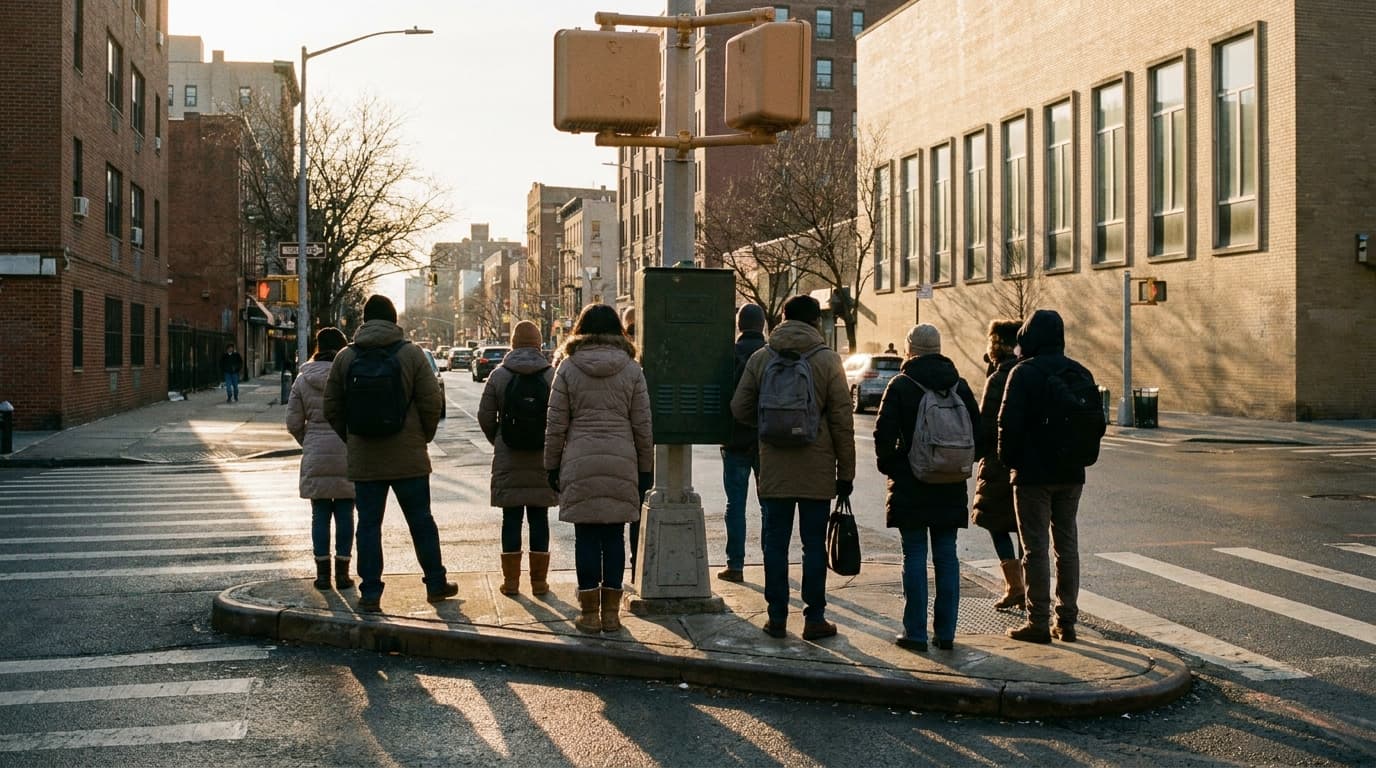
In Delaware, crossing outside a crosswalk is lawful only if you yield, and in some places it is not allowed at all. Under 21 Del. C. § 4143, a pedestrian crossing anywhere other than a marked crosswalk or an unmarked crosswalk at an intersection must yield the right-of-way to all vehicles, may not cross between adjacent signalized intersections except in a marked crosswalk, and may not cross an intersection diagonally unless traffic-control devices authorize it. Section 4143 has no penalty of its own, so the general penalty in § 4205(a) applies: a fine of $25 to $75 for a first offense. Under § 4140, a conviction under § 4143 is not entered on a driver's motor vehicle record. For how other states compare, see our guide to jaywalking laws by state.
Information last verified on 2026-10-10. This article has not been reviewed by a licensed lawyer.
Jurisdiction scope: This article covers Delaware state law in Title 21 of the Delaware Code: the general provisions of chapter 41 (§§ 4101 and 4102), the signal rules in §§ 4108 and 4109, the pedestrian subchapter (§§ 4140 to 4151), the penalty section in chapter 42 (§ 4205) and voluntary assessment payment (§ 709). It does not cover city or town ordinances, court costs and assessments added to a fine, injury claims after a crash, or the law of other states.
Is jaywalking illegal in Delaware?
Delaware's pedestrian subchapter separates a duty to yield from a few outright bans. Crossing mid-block on an ordinary street is allowed if you give way to all vehicles. Crossing mid-block between two intersections with working traffic signals, outside a marked crosswalk, is not allowed. Neither is crossing an intersection diagonally without authorization.
Section 4102 is what makes a breach an offense: "It is unlawful for any person to do any act forbidden or fail to perform any act required in this chapter."
| Situation | Delaware rule |
|---|---|
| Crossing outside a marked crosswalk or an unmarked crosswalk at an intersection | Allowed, but the pedestrian must yield to all vehicles (§ 4143(a)) |
| Crossing between adjacent intersections where traffic-control signals are operating | Only in a marked crosswalk (§ 4143(c)) |
| Crossing an intersection diagonally | Only when official traffic-control devices authorize it, and then only as they direct (§ 4143(d)) |
| Traffic-control devices that apply to pedestrians | Must be obeyed unless a police officer or uniformed adult school crossing guard directs otherwise (§ 4141(a)) |
| Facing a yellow signal with no pedestrian signal directing otherwise | Do not start to cross (§ 4108) |
| Facing a red signal with no pedestrian signal directing otherwise | Enter the roadway only if it can be done safely and without interfering with any vehicle traffic (§ 4108(a)(3)d) |
| Walk signal | May cross in the direction of the signal; drivers must yield (§ 4109) |
| Don't Walk, flashing Don't Walk or Don't Start signal | Do not start to cross; a pedestrian partly across continues to the nearest sidewalk or safety island (§ 4109) |
| Crossing where a pedestrian tunnel or overhead crossing is provided | The pedestrian must yield to all vehicles (§ 4143(b)) |
| Stepping suddenly off a curb into the path of a close vehicle | Barred (§ 4142(b)) |
| Walking on the roadway where an accessible sidewalk is provided | Unlawful (§ 4146(a)) |
| Walking along a highway with no sidewalk | Facing traffic on the shoulder; with no shoulder, facing traffic at the outside edge (§ 4146(b), (c)) |
| Walking on a roadway or shoulder outside city or town limits from sunset to sunrise | Carry a light or reflector device (§ 4148(a)) |
| Being on a highway while impaired to the point of being a hazard | Barred (§ 4149) |
Crossing outside a crosswalk
The core rule is § 4143(a):

"(a) Every pedestrian crossing a roadway at any point other than within a marked crosswalk or within an unmarked crosswalk at an intersection shall yield the right-of-way to all vehicles upon the roadway."
That is a duty to give way, not a ban. The bans are in § 4143(c) and (d):
"(c) Between adjacent intersections at which traffic-control signals are in operation pedestrians shall not cross at any place except in a marked crosswalk. (d) No pedestrian shall cross a roadway intersection diagonally unless authorized by official traffic-control devices; and, when authorized to cross diagonally, pedestrians shall cross only in accordance with the official traffic-control devices pertaining to such crossing movements."
Under § 4143(b), "Any pedestrian crossing a roadway at a point where pedestrian tunnel or overhead pedestrian crossing has been provided shall yield the right-of-way to all vehicles upon the roadway." Within a crosswalk, "Pedestrians shall move, whenever practicable, upon the right half of crosswalks" (§ 4145).
So on a block with working signals at both ends, the mid-block crossing itself is the violation unless a marked crosswalk is there. Section 4143(a) also recognizes an "unmarked crosswalk at an intersection," so a crossing at an intersection can be a crosswalk without paint.
Walk signals and red lights
Section 4141 ties pedestrians to the signals:
"(a) A pedestrian shall obey the instructions of a traffic-control device specifically applicable to the pedestrian, unless otherwise directed by a police officer or uniformed adult school crossing guard. ... (b) Pedestrians shall be subject to traffic and pedestrian control signals as provided in §§ 4108 and 4109 of this title."
Section 4108, the traffic-control signal legend, includes this rule for the yellow light: "Pedestrians facing a yellow signal, unless otherwise directed by a pedestrian-control signal, are thereby advised that there is insufficient time to cross the roadway before a red indication is shown and no pedestrian shall then start to cross the roadway."
Where no pedestrian signal directs otherwise, a pedestrian facing a green signal may cross within any marked or unmarked crosswalk, except when the only green signal is a turn arrow (§ 4108(a)(1)b). For the red indication, § 4108(a)(3)d provides: "No pedestrian facing such signal shall enter the roadway unless the pedestrian can do so safely and without interfering with any vehicular traffic." The same limit applies to a pedestrian facing a green arrow (§ 4108(a)(4)c).
Walk / Don't Walk signals "shall take precedence over pedestrian movements outlined in § 4108" (§ 4109). On Walk, pedestrians may proceed in the direction of the signal "and shall be given the right-of-way by the driver of all vehicles." On Don't Walk, flashing Don't Walk or Don't Start, "No pedestrian shall start to cross the roadway in the direction of such signal, but any pedestrian who has partially completed crossing on the walk signal shall proceed to the nearest sidewalk or safety island."
Walking along the road
Section 4146(a) provides: "Where a sidewalk is provided and is accessible, it shall be unlawful for any pedestrian to walk along and upon an adjacent roadway." Where a sidewalk is not available, a pedestrian walking along a highway "shall walk facing traffic only on a shoulder, as far as practicable from the edge of the roadway"; where there is neither a sidewalk nor a shoulder, the pedestrian walks as near as practicable to an outside edge of the roadway, facing traffic (§ 4146(b), (c)). Except as otherwise provided in chapter 41, a pedestrian on a highway yields the right-of-way to all vehicles (§ 4146(d)). The section sets its own penalty (see below).
Outside the corporate limits of a city or town, § 4148(a) bars walking on a roadway or its shoulders "without carrying a lighted lantern, lighted flashlight or other similar light or reflector type device during the period of time from sunset to sunrise and at any other time when there is not sufficient light to render clearly visible any person or vehicle on the highway."
Section 4147 bars standing in a highway to solicit a ride, or to solicit employment, business or contributions from a vehicle occupant.
Section 4142(b) bars darting into traffic: "No pedestrian shall suddenly leave a curb or other place of safety and walk or run into the path of a vehicle which is so close as to constitute an immediate hazard."
Under § 4149, "No person shall walk or be upon a highway of this State while under the influence of intoxicating liquor and/or narcotic drugs to a degree which renders the person a hazard."
What drivers owe pedestrians
The pedestrian's duty to yield outside a crosswalk does not remove the driver's duties. Section 4144 provides: "Notwithstanding any other provisions of this chapter every driver of a vehicle shall exercise due care to avoid colliding with any pedestrian upon any roadway and shall give warning by sounding the horn when necessary ..." The same sentence requires drivers to exercise proper precaution on observing a child, an obviously confused or incapacitated person, or a blind pedestrian carrying a white cane or accompanied by a guide dog.

- Crosswalks. "When traffic-control signals are not in place or not in operation or when the operator of a vehicle is making a turn at an intersection, the driver of a vehicle shall yield the right-of-way, slowing down or stopping if need be to so yield, to a pedestrian crossing the roadway within a crosswalk when the pedestrian is upon the half of the roadway upon which the vehicle is traveling, or when the pedestrian is approaching so closely from the opposite half of the roadway as to be in danger" (§ 4142(a)). That rule does not apply where a pedestrian tunnel or overhead crossing has been provided (§ 4142(c)).
- No passing at a crosswalk. When a vehicle is stopped at a marked crosswalk or an unmarked crosswalk at an intersection to let a pedestrian cross, a driver approaching from the rear may not overtake and pass it (§ 4142(d)).
- Signals. On a Walk signal, pedestrians "shall be given the right-of-way by the driver of all vehicles" (§ 4109). Drivers facing green, including those turning, must yield to pedestrians lawfully within the intersection or an adjacent crosswalk (§ 4108(a)(1)a).
- Sidewalks. "The driver of a vehicle shall yield the right-of-way to any pedestrian on a sidewalk" (§ 4151).
Jaywalking fine and penalty in Delaware
Section 4143 contains no penalty clause, so the general penalty for chapter 41 applies. Section 4205 provides:
"(a) Whoever violates this chapter or Chapter 41 of this title shall for the first offense be fined not less than $25 nor more than $75. For each subsequent like offense, the person shall be fined not less than $57.50 nor more than $95. All second offenses, before being punishable as such, shall have been committed within 24 months after the commission of the first offense unless otherwise specifically provided. (b) Subsection (a) of this section shall not apply to violations for which penalties are prescribed elsewhere in this chapter or Chapter 41 of this title."
Section 4146, the walking-along-the-road rule, prescribes its own lower range under subsection (f): "Whoever violates this section shall for the first offense be fined not less than $10 nor more than $28.75. For each subsequent like offense, the person shall be fined not less than $25 nor more than $50."
| Violation | First offense | Later like offense |
|---|---|---|
| Crossing rules in § 4143 (general penalty, § 4205(a)) | $25 to $75 | $57.50 to $95 (second offense within 24 months) |
| Pedestrian yellow and red signal rules in § 4108 (§ 4108(d)) | $75 to $115; $75 to $230 for a violation of the red-indication paragraph (a)(3) | $75 to $115 (same range); for a subsequent paragraph (a)(3) offense within 2 years, $100 to $575, or 10 to 60 days in jail, or both |
| Walking on the roadway, § 4146 (§ 4146(f)) | $10 to $28.75 | $25 to $50 |
| Walking without a light or reflector outside city or town limits at night, § 4148 (§ 4148(b)) | $2.30 to $28.25 | $11.50 to $28.25 (within 1 year) |
These are statutory fine ranges. Title 21 offenses, other than a listed set of exceptions that does not include the pedestrian sections, are subject to voluntary assessment (21 Del. C. § 709(e)). If the officer marks the summons for voluntary assessment, the fine can be paid without a court appearance; when payment is received within 30 days, the penalty is "the minimum fine for each specific offense charged" ($25 for § 4143, $10 for § 4146), plus costs and penalty assessments (§ 709(b), (g)). "Payment of the prescribed fine, costs and penalty assessment is an admission of guilt, a waiver of the right to a hearing, and a complete satisfaction of the violation" (§ 709(i)(1)). A driver may instead request a hearing within 30 days (§ 709(f)(3)).
Driving record
Section 4140 provides: "Arrests and or convictions for offenses in §§ 4141, 4143, 4145-4150 of this title shall not be entered on a driver's motor vehicle record." A conviction for crossing outside a crosswalk under § 4143, or for disobeying a pedestrian traffic-control device under § 4141, stays off a driving record.
Local rules
Under § 4101(b), "Local authorities, except as expressly authorized by law, shall not enact or enforce any rules or regulations contrary to this chapter. Traffic ordinances and regulations adopted by local authorities, and substantially conforming to the sections of this chapter, shall have the same force and effect as the traffic laws of this title." A city or town ordinance that tracks the state pedestrian rules carries the same force as the state rule.
Pedestrian stops
Subchapter V of chapter 41 (§§ 4140 to 4151), together with §§ 4101, 4102, 4108 and 4205, contains no provision that limits police stops for pedestrian violations or removes the penalty for them.
If a pedestrian is hit by a car
Whether a pedestrian was crossing lawfully can come up after a collision, alongside the driver's duty of due care under § 4144. For how fault, insurance and filing deadlines work after a crash, see Delaware car accident laws. Scooter riders follow a different set of rules, covered in Delaware e-scooter laws.
Related pages
This article provides general legal information about Delaware law, not legal advice. For advice about a specific situation, contact a lawyer licensed in Delaware.
Last updated: 2026-10-10.
Frequently Asked Questions
Is jaywalking illegal in Delaware?
Crossing outside a crosswalk is allowed if you yield the right-of-way to all vehicles (21 Del. C. § 4143(a)). Crossing between adjacent signalized intersections outside a marked crosswalk, and crossing an intersection diagonally without authorization, are prohibited (§ 4143(c), (d)).
What is the fine for jaywalking in Delaware?
Section 4143 has no penalty clause, so the general penalty in § 4205(a) applies: $25 to $75 for a first offense and $57.50 to $95 for a later like offense committed within 24 months. If the summons is marked for voluntary assessment and paid within 30 days, the penalty is the $25 minimum plus costs and penalty assessments, and payment is an admission of guilt (§ 709(g), (i)).
Does a jaywalking ticket go on my driving record in Delaware?
No. Under 21 Del. C. § 4140, arrests and convictions for offenses in §§ 4141, 4143 and 4145 to 4150 are not entered on a driver's motor vehicle record.
Can I cross in the middle of the block in Delaware?
Yes, if you yield to all vehicles (§ 4143(a)), unless the intersections at both ends of the block have traffic-control signals in operation. In that case you may cross only in a marked crosswalk (§ 4143(c)).
Can I cross against a red light on foot in Delaware?
Under § 4108(a)(3)d, a pedestrian facing a red signal shall not enter the roadway unless the pedestrian can do so safely and without interfering with any vehicular traffic. Section 4108 sets its own fine: $75 to $115, and $75 to $230 for a violation of the red-indication paragraph (a)(3) (§ 4108(d)). Where Walk / Don't Walk signals are in place, they take precedence, and a pedestrian may not start to cross on Don't Walk (§ 4109).
Can I start crossing on a yellow light in Delaware?
No. Under § 4108, a pedestrian facing a yellow signal, unless a pedestrian-control signal directs otherwise, shall not start to cross the roadway.
Is it illegal to walk in the road in Delaware?
Where a sidewalk is provided and is accessible, it is unlawful to walk along and upon the adjacent roadway (§ 4146(a)). A first offense carries a fine of $10 to $28.75 (§ 4146(f)).
Do drivers have to watch for jaywalkers in Delaware?
Yes. Section 4144 requires every driver to exercise due care to avoid colliding with any pedestrian upon any roadway and to sound the horn when necessary, notwithstanding any other provision of chapter 41, and to exercise proper precaution on observing a child, an obviously confused or incapacitated person, or a blind pedestrian. Where signals are absent or not working, and whenever turning at an intersection, a driver must yield to a pedestrian in a crosswalk as § 4142(a) describes.
Updates
Independently fact-checked against the cited primary sources
The Law Behind This Article
This article rests on the statutory provisions below, held in our own legal record and retrieved from the official source. Tap a section to read the operative text.
Delaware Code, Title 21 (Motor Vehicles), Chapter 041 (RULES OF THE ROAD)
§ 4143Crossing at other than crosswalks.In force
(a) Every pedestrian crossing a roadway at any point other than within a marked crosswalk or within an unmarked crosswalk at an intersection shall yield the right-of-way to all vehicles upon the roadway. (b) Any pedestrian crossing a roadway at a point where pedestrian tunnel or overhead pedestrian crossing has been provided shall yield the right-of-way to all vehicles upon the roadway. (c) Between adjacent intersections at which traffic-control signals are in operation pedestrians shall not cross at any place except in a marked crosswalk. (d) No pedestrian shall cross a roadway intersection diagonally unless authorized by official traffic-control devices; and, when authorized to cross diagonally, pedestrians shall cross only in accordance with the official traffic-control devices pertaining to such crossing movements.
Official text (excerpt) · last checked 2026-07-29 · Read the full text in our law library · Verify at delcode.delaware.gov
§ 4142Pedestrians’ right-of-way in crosswalks.In force
(a) When traffic-control signals are not in place or not in operation or when the operator of a vehicle is making a turn at an intersection, the driver of a vehicle shall yield the right-of-way, slowing down or stopping if need be to so yield, to a pedestrian crossing the roadway within a crosswalk when the pedestrian is upon the half of the roadway upon which the vehicle is traveling, or when the pedestrian is approaching so closely from the opposite half of the roadway as to be in danger. (b) No pedestrian shall suddenly leave a curb or other place of safety and walk or run into the path of a vehicle which is so close as to constitute an immediate hazard. (c) Subsection (a) of this section shall not apply under the conditions stated in § 4143(b) of this title. (d) Whenever any vehicle is stopped at a marked crosswalk or at any unmarked crosswalk at an intersection to permit a pedestrian to cross the roadway, the driver of any other vehicle approaching from the rear shall not overtake and pass such stopped vehicle.
Official text (excerpt) · last checked 2026-07-29 · Read the full text in our law library · Verify at delcode.delaware.gov
§ 4108Traffic-control signal legend.In force
(a) Whenever traffic is controlled by official traffic-control signals showing different colored circular lights, color-lighted arrows, or color-lighted bicycle symbols, successively 1 at a time or in combination, only the colors green, red and yellow shall be used, except for pedestrian control signals, and such lights shall indicate and apply to drivers of vehicles, operators of bicycles and pedestrians as follows: (1) Green indication: a. Vehicular traffic facing the signal may proceed straight through or turn right or left unless a traffic-control device at such place prohibits either such turn. Vehicular traffic, including vehicles turning right or left, shall yield the right-of-way to other vehicles and to pedestrians lawfully within the intersection or an adjacent crosswalk at the time such signal is exhibited. b. Unless otherwise directed by a pedestrian-control signal as provided in § 4109 of this title, pedestrians facing any green signal, except when the sole green signal is a turn arrow, may proceed across the roadway within any marked or unmarked crosswalk. (2) Circular yellow or yellow arrow: a.
Official text (excerpt) · last checked 2026-07-29 · Read the full text in our law library · Verify at delcode.delaware.gov
Search our full record of US law — 2.1 million sections, every state + federal →
Sources and References
- 21 Del. C. § 4143, Crossing at other than crosswalks(delcode.delaware.gov).gov
- 21 Del. C. § 4205, Penalties (chapter 42)(delcode.delaware.gov).gov
- 21 Del. C. § 4140 (pedestrian offenses and driving records)(delcode.delaware.gov).gov
- 21 Del. C. § 4102 (unlawful acts under chapter 41)(delcode.delaware.gov).gov
- 21 Del. C. § 4141 (pedestrians subject to traffic-control devices)(delcode.delaware.gov).gov
- 21 Del. C. § 4108, Traffic-control signal legend(delcode.delaware.gov).gov
- 21 Del. C. § 4146 (pedestrians walking on roadways)(delcode.delaware.gov).gov
- 21 Del. C. § 4142 (pedestrians and crosswalks)(delcode.delaware.gov).gov
- 21 Del. C. § 4144 (drivers to exercise due care)(delcode.delaware.gov).gov
- 21 Del. C. § 4101 (local traffic ordinances)(delcode.delaware.gov).gov
- 21 Del. C. § 4109, Pedestrian-control signals(delcode.delaware.gov).gov
- 21 Del. C. § 4142(a), (d) (driver yield at crosswalks; no passing stopped vehicle)(delcode.delaware.gov).gov
- 21 Del. C. § 4148 (lights or reflector devices for pedestrians)(delcode.delaware.gov).gov
- 21 Del. C. § 4147 (pedestrians soliciting rides or business)(delcode.delaware.gov).gov
- 21 Del. C. § 4151 (pedestrians on sidewalks)(delcode.delaware.gov).gov
- 21 Del. C. § 709, Payment of motor vehicle fines (voluntary assessment)(delcode.delaware.gov).gov