
Maine
Maine Fireworks Laws (2026): Age 21, Hours, Penalties
Independently fact-checked against primary sources (last audited September 18, 2026). · 10 primary sources cited on this page. How we verify our legal content
Maine allows "consumer fireworks," defined by cross-reference to the federal 27 CFR 555.11 standard but with three device classes carved back out, missile-type rockets, helicopters and aerial spinners, and sky and bottle rockets of 20 grams or less, to be sold only by a seller who is at least 21 and holds three stacked credentials: a federal ATF permit under 18 U.S.C. § 843, a state license, and a municipal permit if the seller's municipality requires one. Anything outside that federally-and-state-defined, licensed category is treated as plain "fireworks," and simple possession of plain fireworks, including the three excluded device classes, is prohibited outright under 8 M.R.S. § 222(1), except for the items § 221-A(4) excludes from "fireworks" altogether: ordinary sparklers that do not contain magnesium chlorates or perchlorates, paper-cap toys and toy pistols, signal devices, and antique or replica cannons that fire no projectile. Consumer fireworks may be used 9:00 a.m. to 10:00 p.m. daily, extended to 12:30 a.m. the following day on July 4, December 31, and the surrounding weekends, only on the user's own property or property where the owner has consented.
Jurisdiction scope: This article covers Maine's state fireworks law under 8 M.R.S. §§ 221-A through 237, including the consumer fireworks licensing framework, the plain-fireworks possession ban, use hours, age, local option, permits, and penalties. It does not catalog individual municipal ordinances that further restrict sale or use; those must be checked with the specific municipality.
What's Legal: A Licensed Consumer Fireworks Framework
Maine's "consumer fireworks" category starts from federal law, but the state statute then carves three device classes back out of it. 8 M.R.S. § 221-A(1-A) states:
"'Consumer fireworks' has the same meaning as in 27 Code of Federal Regulations, Section 555.11 or subsequent provision, but includes only products that are tested and certified by a 3rd-party testing laboratory as conforming with United States Consumer Product Safety Commission standards, in accordance with 15 United States Code, Chapter 47. 'Consumer fireworks' does not include the following products: A. Missile-type rockets, as defined by the State Fire Marshal by rule; B. Helicopters and aerial spinners, as defined by the State Fire Marshal by rule; and C. Sky rockets and bottle rockets. For purposes of this paragraph, 'sky rockets and bottle rockets' means cylindrical tubes containing not more than 20 grams of chemical composition...with a wooden stick attached for guidance and stability that rise into the air upon ignition and that may produce a burst of color or sound at or near the height of flight."
Selling a consumer firework requires a seller to hold three separate credentials at once: a federal ATF permit under 18 U.S.C. § 843, a state license, and, where the seller's municipality requires one, a municipal permit, under 8 M.R.S. § 223-A(1). Firecrackers and pyrotechnic ship and railway signals are separately classed as "fireworks" under 8 M.R.S. § 228, though ship and railway signal storage and transport carry their own carve-out from the general fireworks storage and transport rules in §§ 222 and 224-225.
Maine's only Maine-specific device number is the 20-gram cap in the sky-rocket/bottle-rocket exclusion above; otherwise, the consumer fireworks category adopts the federal 27 CFR 555.11 definition without a separate state gram or tube limit layered on top.
What's Banned: Plain Fireworks
Anything outside the "consumer fireworks" category is treated as plain "fireworks," and simple possession of it is banned outright, not just its unlicensed sale, except for the specific items 8 M.R.S. § 221-A(4) excludes from "fireworks" altogether. That matters concretely because of the three device classes § 221-A(1-A) carves out of "consumer fireworks" above: missile-type rockets, helicopters and aerial spinners, and sky rockets or bottle rockets of 20 grams or less of chemical composition are plain "fireworks" in Maine, not consumer fireworks, so possessing any of them is itself illegal, independent of any sale. 8 M.R.S. § 222(1) states:
"A person may not possess or have under that person's control fireworks."
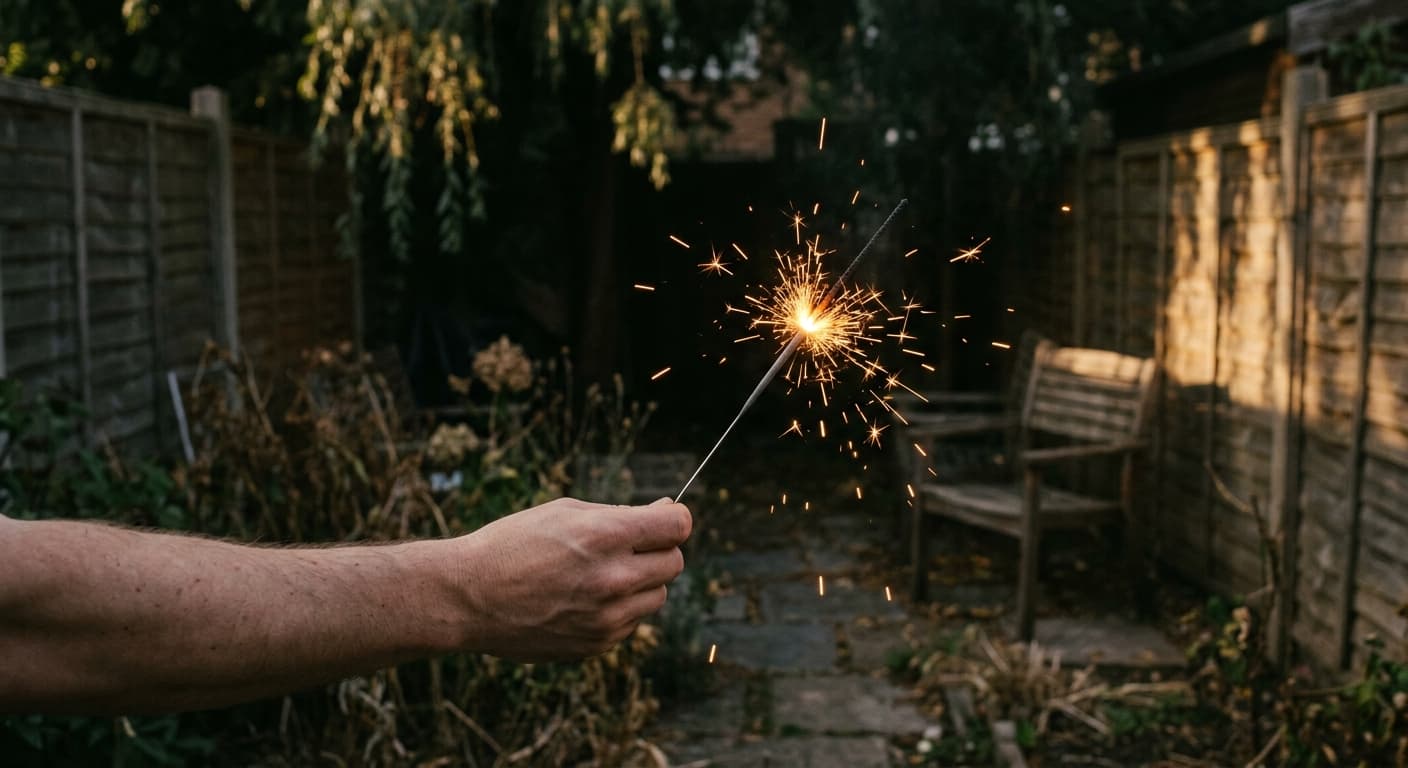
Section 221-A(4) itself excludes several everyday items from "fireworks," so they are not reached by that possession ban at all: an ordinary sparkler that does not contain magnesium chlorates or perchlorates, toy pistols, toy canes, toy guns, or similar devices using paper or plastic caps of 25/100 grain or less that are built so the hand cannot touch the cap when it fires, toy pistol paper or plastic caps under 20/100 grain, and antique or replica cannons that fire no projectile. In plain terms, an ordinary sparkler is legal to possess and use in Maine; a sparkler that does contain magnesium chlorates or perchlorates is not excluded and falls back into the banned "fireworks" category.
Selling, or possessing with intent to sell, non-consumer fireworks is separately prohibited under 8 M.R.S. § 223(1), with criminal penalties tiered by the dollar value of the contraband, covered in Penalties below. A person holding a display permit under § 227-A is exempt from the possession ban for purposes of that display.
No Statewide Sale-Date Window
Maine's fireworks chapter sets no calendar date range restricting when consumer fireworks may be sold. Sale is gated by the three-credential licensing stack described above rather than by a fixed date range: a properly licensed seller may sell whenever licensed and operating. A municipality may separately restrict or prohibit sale by its own ordinance under the local-option provision discussed below, which functions as the practical limit on sale timing in a given Maine town rather than a statewide calendar rule.
When You Can Use Fireworks
Use of consumer fireworks is restricted by hour and by where they may be used. 8 M.R.S. § 223-A(8) states:

"A. Consumer fireworks may be used between the hours of 9:00 a.m. and 10:00 p.m., except that on the following dates they may be used between the hours of 9:00 a.m. and 12:30 a.m. the following day: (1) July 4th; (2) December 31st; and (3) The weekends immediately before and after July 4th and December 31st. B. A person may use consumer fireworks only on that person's property or on the property of a person who has consented to the use of consumer fireworks on that property."
Standard hours are 9:00 a.m. to 10:00 p.m. every day. That extends to 9:00 a.m. through 12:30 a.m. the following day on July 4, December 31, and the Saturdays and Sundays immediately before and after each of those two dates. Separate from the hours, use is limited to the user's own property or property whose owner has consented; a person who violates either the hours rule or the property-consent rule commits a civil violation carrying a fine of not less than $50 and not more than $500, plus court costs, for any one offense.
Age
Maine sets its age line at 21, not the 18 many states use, and it reaches every side of the transaction, not just the sale. 8 M.R.S. § 223-A(11)(B) provides:
"A person licensed to sell consumer fireworks under this chapter may not sell consumer fireworks to a person under 21 years of age or who appears to be under the influence of alcohol or drugs."
Separately, § 223-A(11)(D) bars the minor directly: "A person under 21 years of age may not purchase, use or possess consumer fireworks within the State or present to a person licensed to sell consumer fireworks any evidence of age that is false, fraudulent or not actually the person's own for the purpose of purchasing consumer fireworks." And § 223-A(11)(C) bars any adult, licensed seller or not, from knowingly procuring, furnishing, giving, or selling consumer fireworks to a person under 21, or from allowing an under-21 person under that adult's control to possess or use them. A licensed seller must also be at least 21. The statute's own required point-of-sale notice states the rule in plain terms: "MAINE LAW EXPRESSLY PROHIBITS PERSONS UNDER 21 YEARS OF AGE FROM PURCHASING, POSSESSING OR USING CONSUMER FIREWORKS."
Local Option
Maine gives municipalities a direct, express power to override the state's baseline consumer fireworks rule. 8 M.R.S. § 223-A(2) states:
"The legislative body of a municipality may adopt an ordinance to prohibit or restrict the sale or use of consumer fireworks within the municipality."
That means a Maine town or city can ban consumer fireworks sale, ban their use, restrict either one short of a full ban, or leave the state's baseline framework untouched, entirely by its own ordinance. The same subsection attaches conditions to that power: a municipality that prohibits or restricts sale or use must give the Office of the State Fire Marshal a copy of the ordinance within 60 days of adoption, and a municipality that wants to run its own municipal-permit program for consumer fireworks sellers must notify that office at least 60 days before the program starts. A municipal permit itself cannot issue unless the applicant is 21 or older, holds the federal ATF permit, complies with the building/storage requirements described below, and is approved by the municipality's police chief, fire chief, and code enforcement officer, where those positions exist. Because Maine's state statute sets no calendar sale-date window of its own, this local-option power functions as the practical control on both when and whether consumer fireworks can be sold or used in a given municipality.
Permits: Displays and Technicians
Retail sale of consumer fireworks requires more than the three-credential stack named earlier; the state license itself carries a real cost and a physical-facility requirement. Under 8 M.R.S. § 223-A(3), the commissioner charges $5,000 for a seller's initial state license and $1,500 for each annual renewal; the license runs for one year, and a separate license is required for each location. To hold that license, the applicant must also have gone two years without a fireworks- or explosives-related conviction or violation. Section 223-A(4) then requires the seller to operate out of a permanent, fixed, stand-alone building dedicated solely to consumer fireworks, built and stocked to NFPA 1124, at least 60 feet from another building and 300 feet from a structure where gasoline, propane, or other flammable material is dispensed, with no smoking materials inside, no unaccompanied admission for anyone under 21, and any 18-to-20-year-old staff working only under the direct supervision of someone 21 or older. Section 223-A(5) separately requires the seller to carry at least $2,000,000 in public and product liability insurance at all times.
A public fireworks or flame-effects display needs its own permit from the Department of Public Safety, separate from the retail-sale licensing stack. 8 M.R.S. § 227-A states:
"1. Permits; requirements. A person may not conduct a display without a permit. The commissioner shall issue a permit to possess and conduct a fireworks or flame effects display to an applicant who: A. Applies in writing to the commissioner for a permit at least 20 days in advance of the proposed display..."
An application must be filed at least 20 days in advance and must include $1,000,000 in liability insurance and a site diagram showing discharge points, fallout areas, nearby structures, and the audience area. The permit fee is $30 per display plus a $111 site-inspection fee; an indoor pyrotechnic or flame-effects event inspected outside normal business hours adds a $100 fee. Conducting a display without a permit is a Class D crime; conducting one in violation of the permit issued is a Class E crime, and both are strict-liability offenses, meaning intent is not an element. Anyone who fires a display, sets flame effects, or works a proximate-audience pyrotechnic show must separately hold their own individual technician license, issued annually and renewable. A permit or license can be denied, suspended, or revoked on grounds including a failed inspection, use of an unlicensed technician, incompetence, aiding unlicensed practice, or a rule violation, under 8 M.R.S. §§ 227-C and 234.
Regulations
Maine's Commissioner of Public Safety has rulemaking authority reaching well beyond the display-permit process. 8 M.R.S. § 236 states:
"The commissioner may adopt rules concerning the sale, use, storage, transportation and display of consumer fireworks, fireworks and special effect pyrotechnics and to carry out the purposes of this chapter."
Some substantive rule changes adopted under that authority go through Maine's "major substantive" legislative-review track rather than taking effect on the commissioner's authority alone.
Federal Layer
Federal law does more than set a floor under Maine's rules; Maine's own statute incorporates it directly, since "consumer fireworks" is defined by cross-reference to 27 CFR 555.11. A federal ATF permit under 18 U.S.C. § 843 is one of the three credentials a Maine retail seller must hold. Separately, it is a federal crime under 18 U.S.C. § 836 to transport fireworks, other than in the course of continuous interstate transportation through a state, into any state whose law specifically prohibits or regulates the use of fireworks, knowing they will be delivered, possessed, stored, transshipped, distributed, sold, or otherwise dealt with in a manner or for a use prohibited by that state's law; a violation is punishable by a fine or up to one year of imprisonment, or both. The statute exempts common and contract carriers, international or domestic water carriers engaged in interstate commerce, and transportation into a state for federal agencies' own operations. That has real bite in Maine, where simple possession of non-consumer fireworks, including the three device classes Maine carves back out of the federal "consumer fireworks" definition, is itself a state-law violation. USPS Publication 52 § 341.22 separately classifies all fireworks as nonmailable explosives.
Penalties
Maine ties its fireworks penalties to both the type of conduct and, for non-consumer fireworks, the dollar value involved. Selling non-consumer fireworks is a Class B crime if the value exceeds $5,000, a Class C crime for a value of $1,001 to $5,000, or a Class D crime for a value up to $1,000. Simple possession of non-consumer fireworks is a civil violation, carrying a fine of up to $50, if the value is $100 or less, or a Class E crime if the value exceeds $100.
Within the licensed consumer fireworks regime, the penalties fall into two tiers depending on who violated what. 8 M.R.S. § 223-A(12) states:
"A. A person who violates subsection 11, paragraph A, B or C commits a Class D crime. If the violation involves furnishing consumer fireworks to a minor, a fine of not less than $500 must be imposed in addition to any term of imprisonment the court may impose. If a person violates subsection 11, paragraph A, B or C after having been convicted of violating the same paragraph one or more times within the previous 6-year period, a fine of not less than $1,000 must be imposed in addition to any term of imprisonment the court may impose. B. A person who violates subsection 11, paragraph D commits a civil violation for which a fine of not less than $200 and not more than $400 must be imposed. If the person has been previously convicted of violating subsection 11, paragraph D one or more times, a fine of not less than $300 and not more than $600 must be imposed."
Selling consumer fireworks without a license, selling to a minor or to someone who appears intoxicated, or an adult furnishing consumer fireworks to a minor, is a Class D crime under paragraph A; if the violation involved furnishing to a minor, the court must impose at least a $500 fine on top of any jail time, rising to a mandatory $1,000 minimum if the same person has a conviction for the same violation within the prior six years. A minor who purchases, uses, or possesses consumer fireworks, or presents false proof of age to buy them, instead commits a civil violation under paragraph B, carrying a $200 to $400 fine that rises to $300 to $600 on a repeat conviction, rather than a Class D charge. Illegally transporting fireworks is a Class E crime. The jail exposure attached to each Class B through E crime classification is set by Maine's general criminal sentencing statute, Title 17-A, rather than restated in the fireworks chapter itself.
For how Maine's rule compares with the rest of the country, see fireworks laws by state. Maine also has its own Maine open container law covering a different vehicle-related rule.
Disclaimer: This article provides general legal information about fireworks laws in the United States as of September 2026. It is not legal advice. Fireworks statutes, local ordinances, use hours, and penalties change frequently and are often further restricted by municipal ordinance beyond what state law requires; verify the current rule for your specific municipality before buying, selling, or using fireworks, and consult a lawyer licensed in your state for advice about a specific situation.
Statutes cited reflect their in-force version as of 2026-09-17. Last updated: 2026-09-17.
Frequently Asked Questions
Are fireworks legal in Maine?
Consumer fireworks, as defined by the federal 27 CFR 555.11 standard, may be sold by a licensed seller holding a federal ATF permit, a state license, and a municipal permit if required, under 8 M.R.S. § 223-A(1). Missile-type rockets, helicopters and aerial spinners, and sky/bottle rockets of 20 grams or less are carved out of "consumer fireworks" by § 221-A(1-A) and are illegal to possess at all, along with everything else outside the consumer fireworks category, under § 222(1), except for the items § 221-A(4) excludes from "fireworks" altogether: ordinary sparklers without magnesium chlorates or perchlorates, paper-cap toys and toy pistols, signal devices, and antique or replica cannons that fire no projectile.
Are sparklers legal in Maine?
Yes, an ordinary sparkler that does not contain magnesium chlorates or perchlorates is excluded from the definition of "fireworks" altogether under 8 M.R.S. § 221-A(4), so it is not reached by the § 222(1) possession ban that applies to other non-consumer fireworks. A sparkler that does contain magnesium chlorates or perchlorates is not excluded and falls back into the banned "fireworks" category.
When can you use fireworks in Maine?
Consumer fireworks may be used 9:00 a.m. to 10:00 p.m. daily, extended to 12:30 a.m. the following day on July 4, December 31, and the weekends immediately before and after those two dates, and only on the user's own property or property whose owner has consented, under 8 M.R.S. § 223-A(8). Violating either rule is a civil violation carrying a $50-$500 fine.
What is the minimum age to buy fireworks in Maine?
21. A licensed seller may not sell consumer fireworks to anyone under 21, and a person under 21 may not purchase, use, or possess consumer fireworks at all, under 8 M.R.S. § 223-A(11)(B) and (D).
Is there a specific sale season for fireworks in Maine, like other states?
No. Maine's statute sets no statewide calendar sale-date window. Retail sale is gated by a licensing stack, a federal ATF permit, a state license, and sometimes a municipal permit, rather than a fixed date range.
Can a Maine town ban fireworks even though state law allows them?
Yes. Under 8 M.R.S. § 223-A(2), a municipality's legislative body may adopt an ordinance to prohibit or restrict either the sale or the use of consumer fireworks within its own borders, after notifying the Office of the State Fire Marshal.
What happens if a minor is caught with fireworks in Maine?
A minor who purchases, uses, or possesses consumer fireworks faces a civil fine of $200 to $400, rising to $300 to $600 on a repeat conviction, rather than a criminal charge, under 8 M.R.S. § 223-A(12)(B).
What is the penalty for selling illegal fireworks in Maine?
Selling non-consumer fireworks is a Class B crime if the value exceeds $5,000, a Class C crime for $1,001 to $5,000, or a Class D crime for up to $1,000. Unlicensed sale of consumer fireworks, or a sale to a minor, is also a Class D crime; furnishing to a minor adds a mandatory $500 minimum fine, rising to $1,000 on a repeat within 6 years, under § 223-A(12)(A).
Updates
Independently fact-checked against the cited primary sources
Sources and References
- 8 M.R.S. § 221-A - Definitions, including the federal 27 CFR 555.11 cross-reference for consumer fireworks; (1-A)(A)-(C) carve missile-type rockets, helicopters/aerial spinners, and sky/bottle rockets over 20g back OUT of that definition(legislature.maine.gov).gov
- 8 M.R.S. § 222 - Possession of fireworks prohibited(legislature.maine.gov).gov
- 8 M.R.S. § 223 - Sale or possession with intent to sell non-consumer fireworks prohibited; value-tiered penalties(legislature.maine.gov).gov
- 8 M.R.S. § 223-A - Licensed sale of consumer fireworks (1); municipal local-option ordinance power (2); $5,000/$1,500 license fee (3); stand-alone-building requirement (4); $2M insurance (5); use hours + property-consent (8); age-21 seller/buyer/possession rules (11); Class D crime + mandatory-minimum fines (12)(legislature.maine.gov).gov
- 8 M.R.S. § 227-A - Fireworks and flame-effects display permit application, $1M insurance, $30/display + $111 site-inspection fees, Class D/Class E strict-liability penalties(legislature.maine.gov).gov
- 8 M.R.S. § 236 - Commissioner of Public Safety rulemaking authority(legislature.maine.gov).gov
- 16 CFR 1500.17 / 1507 - CPSC consumer fireworks (1.4G) construction and safety standards(ecfr.gov).gov
- 27 CFR 555.11 - Federal definition of consumer fireworks (adopted by Maine's statute by cross-reference)(ecfr.gov).gov
- 18 U.S.C. § 836 - Federal crime to transport fireworks into any state whose law specifically prohibits or regulates fireworks use; fine or up to one year imprisonment; carrier, water-carrier, federal-agency, and agricultural-use exceptions(uscode.house.gov).gov
- USPS Publication 52 § 341.22 - Fireworks classified as nonmailable explosives(pe.usps.com).gov