
West Virginia
West Virginia Disorderly Conduct and Trespass Laws (2026)
Independently fact-checked against primary sources (last audited October 19, 2026). · 39 primary sources cited on this page. How we verify our legal content
West Virginia has one disorderly conduct statute, W. Va. Code 61-6-1b, and it works differently from most states: the offense requires that a person disturb the peace in a listed public or semi-public place and then persist after a law-enforcement officer asks them to stop. It is a misdemeanor punishable by confinement in jail for 24 hours or a fine of not more than $100.
Criminal trespass sits in Article 3B of Chapter 61 and has no degrees. Section 61-3B-2 covers structures and conveyances and section 61-3B-3 covers other property; both are misdemeanors that mostly carry fines. Trespass becomes a felony only in special forms, such as entering an underground coal mine without permission; willfully damaging or tampering with critical infrastructure equipment and causing more than $2,500 in damage is a separate felony. For other states, see our guide to disorderly conduct and trespass laws by state.
Information last verified on 2026-10-18. This article has not been reviewed by a licensed lawyer.
Jurisdiction scope: This article covers West Virginia's state criminal statutes on disorderly conduct (W. Va. Code 61-6-1b), related public-order offenses in Article 6 of Chapter 61 and elsewhere in the Code, and criminal trespass (Article 3B of Chapter 61, section 61-10-34 and the criminal provisions of the Stop Squatters Act in Article 3C of Chapter 55). It does not cover local noise ordinances and quiet hours (see West Virginia noise laws), the procedure for removing squatters (see West Virginia squatters' rights), use of force against an intruder (see West Virginia self-defense laws), municipal ordinances, civil trespass lawsuits, or federal property rules.
Disorderly conduct in West Virginia: section 61-6-1b
Section 61-6-1b(a) is the only West Virginia offense named disorderly conduct. Its full text reads:
"Any person who, in a public place, any office or office building of the State of West Virginia, or in the State Capitol complex, or on any other property owned, leased, occupied or controlled by the State of West Virginia, a mobile home park, a public parking area, a common area of an apartment building or dormitory, or a common area of a privately owned commercial shopping center, mall or other group of commercial retail establishments, disturbs the peace of others by violent, profane, indecent or boisterous conduct or language or by the making of unreasonably loud noise that is intended to cause annoyance or alarm to another person, and who persists in such conduct after being requested to desist by a law-enforcement officer acting in his or her lawful capacity, is guilty of disorderly conduct, a misdemeanor and, upon conviction thereof, may be confined in jail for twenty-four hours or fined not more than $100: Provided, That nothing in this subsection should be construed as a deterrence to the lawful and orderly public right to demonstrate in support or protest of public policy issues." (W. Va. Code 61-6-1b(a))
Broken into its parts, the offense has three elements:
- Where: a public place, a state office or office building, the State Capitol complex, other state-controlled property, a mobile home park, a public parking area, or a common area of an apartment building, dormitory, shopping center, mall or other group of retail stores.
- What: disturbing the peace of others by violent, profane, indecent or boisterous conduct or language, or by unreasonably loud noise "that is intended to cause annoyance or alarm to another person."
- The officer's request: the person "persists in such conduct after being requested to desist by a law-enforcement officer acting in his or her lawful capacity."
The section has no felony form and no higher penalty for repeat offenses.
The noise clause covers only unreasonably loud noise made with that intent, in one of the listed places, and continued after an officer's request; quiet hours and decibel limits come from local ordinances, covered on our West Virginia noise ordinance laws page.
Subsection (b) defines terms "for purposes of this section." A public parking area is "an area, whether publicly or privately owned or maintained, open to the use of the public for parking motor vehicles," so a private lot open to public parking counts. The section also defines mobile home park and mobile home, but it does not define "public place."
Public intoxication, riot and other public-order offenses
Among the other offenses in Article 6 of Chapter 61 are riot, disturbance of religious worship, disturbance of schools and assemblies, loitering on school property, camping on governmental grounds, disruption of governmental processes and offenses at the State Capitol Complex, wearing a mask to conceal identity, false bomb reports, falsely reporting an emergency, threats of a crime of violence, and terrorist threats and hoaxes. Article 6 contains no separately named breach of the peace, disturbing the peace or affray offense, and its only loitering offense is the school-property offense in section 61-6-14a. Public intoxication and funeral demonstrations sit in other parts of the Code.
Public intoxication (section 60-6-9). Chapter 60 provides that a person may not "appear in a public place in an intoxicated condition." A violation is a misdemeanor:
- First offense: a fine of $5 to $100.
- Second offense: a fine of $5 to $100 and not more than 60 days in jail or at least five hours of alcoholism counseling.
- Third and later offenses: a fine of $5 to $100 plus 5 to 60 days in jail, or the fine plus at least five hours of alcoholism counseling.
Under section 60-6-9(f), a person charged under that subdivision who is an alcoholic "shall be found not guilty by reason of addiction." Section 60-6-9(b)(1) lets an officer release an intoxicated person on a citation to a sober person who accepts responsibility for them, and provides that "the issuance of a citation shall be used whenever feasible."
Riot and unlawful assembly (sections 61-6-1 and 61-6-6). Under section 61-6-1, officers may command an unlawful assembly to disperse, and a person present who is required to give assistance and departs or fails to obey "shall be deemed a rioter." Section 61-6-6 sets the penalties: a rioter who pulls down or destroys a dwelling, courthouse, jail, prison, asylum, hospital, school or college building or any public building commits a felony punishable by 1 to 10 years. Otherwise "every rioter, and every person unlawfully or tumultuously assembled, shall be guilty of a misdemeanor," punishable by up to 1 year in jail and a fine of up to $500.
Riot-area orders and curfews (section 61-6-1a). During a riot, officers may cordon off areas, restrict the sale and transport of firearms and alcohol, and impose curfews. Willfully failing to obey a lawful order given under the section is a misdemeanor punishable by a fine of up to $500, up to 6 months in the county jail, or both.
Conspiracy to injure or damage property (section 61-6-7). This is a misdemeanor punishable by a fine of $50 to $500 and, at the court's discretion, 1 to 12 months in jail. It becomes a felony, 1 to 10 years, when injury or property destruction results.
Disturbing religious worship (section 61-6-13). A person who "willfully interrupts, obstructs, or substantially disturbs any assembly of people meeting for religious worship" commits a misdemeanor punishable by up to 1 year in jail and a fine of $250 to $1,000 "for each violation." Subsection (b) states that the section does not prohibit "peaceful picketing, protest, or other expressive conduct protected by the First Amendment" that does not willfully interrupt, obstruct or substantially disturb the worship. This version took effect June 12, 2026 (see recent changes below).
Disturbing schools and other assemblies (section 61-6-14). Willfully interrupting, molesting or disturbing a school, a society or meeting, or a gathering such as a Fourth of July celebration or church festival is a misdemeanor with a fine of $10 to $50 and, at the court's discretion, up to 30 days in jail in addition.
Loitering on school property (section 61-6-14a). A person who is not a student in regular attendance may not loiter in or about a school or its grounds in violation of posted rules without the principal's written permission. A first offense carries a fine of up to $100, up to 30 days in the county jail, or both; a second or later conviction carries a fine of up to $500, up to 1 year, or both.
Camping on governmental grounds (section 61-6-18). Placing or using shelter on the grounds next to the Capitol or a state office building in the Capitol complex, a county courthouse or a municipal office building without written permission is a misdemeanor with a fine of $25 to $100 or up to 30 days in jail. Each day a violation continues is a separate offense.
Disrupting governmental processes (section 61-6-19(a)). Willfully interrupting or molesting the orderly and peaceful process of any part of state government or its political subdivisions is a misdemeanor with a fine of up to $100, up to 6 months in jail, or both. The subsection states that "any assembly in a peaceable, lawful, and orderly manner for a redress of grievances is not a violation of this section."
State Capitol Complex (section 61-6-19(b)). It is a misdemeanor at the State Capitol Complex to bring a deadly weapon (a person who may lawfully possess a firearm may keep it in a locked vehicle, out of normal view), to willfully deface its trees, buildings, monuments or artwork, or to willfully block or obstruct a public access, stair or elevator after a law-enforcement officer asks the person to desist. The penalty is a fine of not less than $100, up to 6 months in jail, or both.
False reports and threats (sections 61-6-17, 61-6-20 and 61-6-24). Knowingly giving false information about the presence of a bomb or other explosive device is a felony punishable by a fine of $100 to $2,000, 1 to 3 years, or both; if the violation results in another person suffering serious bodily injury, the penalty is 1 to 5 years, a fine of up to $10,000, or both (section 61-6-17). Knowingly making a false report or warning of a fire, explosion, crime or other emergency where severe public alarm or inconvenience is likely to result or emergency apparatus might be summoned, falsely reporting an offense to law enforcement, or summoning emergency vehicles without just cause is a misdemeanor punishable by up to $500, up to 6 months, or both; a second or later violation, or one that results in bodily injury to another person, is a felony punishable by $5,000 to $10,000, 1 to 5 years, or both (section 61-6-20(b) to (d)). Intentionally communicating a threat to commit a crime of violence that causes severe public alarm or inconvenience, or recklessly disregards that risk, is a felony punishable by $2,500 to $10,000, 1 to 10 years, or both (section 61-6-20(e), (f)). Knowingly and willfully threatening a terrorist act, or conveying false information about one, is a felony punishable by $5,000 to $25,000, 1 to 3 years, or both; using a hoax substance or device with the specific intent to commit a terrorist act carries $10,000 to $50,000, 1 to 5 years, or both (section 61-6-24).
Masks (section 61-6-22). Wearing a mask, hood or device that conceals identity on public ways, in public lobbies and concourses, on government grounds or in government buildings, while asking or demanding entry to another person's premises, or at a meeting on another's private property without written permission is a misdemeanor with a fine of up to $500, up to 1 year in the county jail, or both; the section lists exceptions such as persons under 16 and traditional holiday costumes.
Funeral demonstrations (section 61-8-15). No person may carry out a demonstration within 500 feet of a cemetery or building where a funeral or memorial service is held, from 60 minutes before to 60 minutes after the service, that includes someone willfully making noise or a diversion that "disturbs or tends to disturb the peace or good order" of the service. A violation is a misdemeanor punishable by up to 1 year in jail and a fine of $200 to $500.
Criminal trespass in West Virginia: Article 3B
West Virginia trespass has no first, second or third degrees. Article 3B splits the offense by object: section 61-3B-2 covers structures and conveyances, and section 61-3B-3 covers all other property. Separate sections cover student residence halls, state government property, coal mines and animal or crop facilities.
Section 61-3B-1(8) defines trespass as "the willful unauthorized entry upon, in or under the property of another." The definition excludes several kinds of entry, including entry by the state, entry under utility or easement rights, and surveying or line-fence work. It also provides:
"(C) Permissive entry, whether written or oral, and entry from a public road by the established private ways to reach a residence for the purpose of seeking permission shall not be trespass unless signs are posted prohibiting such entry." (W. Va. Code 61-3B-1(8)(C))
A "structure" is any roofed building, temporary or permanent, "together with the curtilage thereof," and a "conveyance" includes motor vehicles, vessels, railroad cars and engines, trailers, aircraft and sleeping cars (section 61-3B-1(1), (2)).
Being told to leave
Both core offenses reach a person who stays after being told to go:
- Buildings and vehicles: a person who was "authorized, licensed, or invited" commits trespass under section 61-3B-2(a) if "requested to depart by the owner, tenant, or the agent of the owner or tenant, and refuses to do so."
- Land: under section 61-3B-3(a), notice can be "given by actual communication to such person." A trespasser who "defies an order to leave, personally communicated to him or her by the owner, tenant, or agent" faces the higher penalty in section 61-3B-3(e).
- Student residence halls: section 61-3B-4 makes it unlawful to remain in a residence hall or student facility after being asked to leave by the officials the section lists.
Posting, fencing and purple paint
For land, section 61-3B-3(a) requires notice "by actual communication to such person or by posting, fencing, or cultivation." Section 61-3B-1 defines each method:
- Signs: posted land includes land with no trespassing signs not more than 500 feet apart along and at each corner of the boundary, with letters at least 2 inches high, and signs at all roads, driveways and gates of entry.
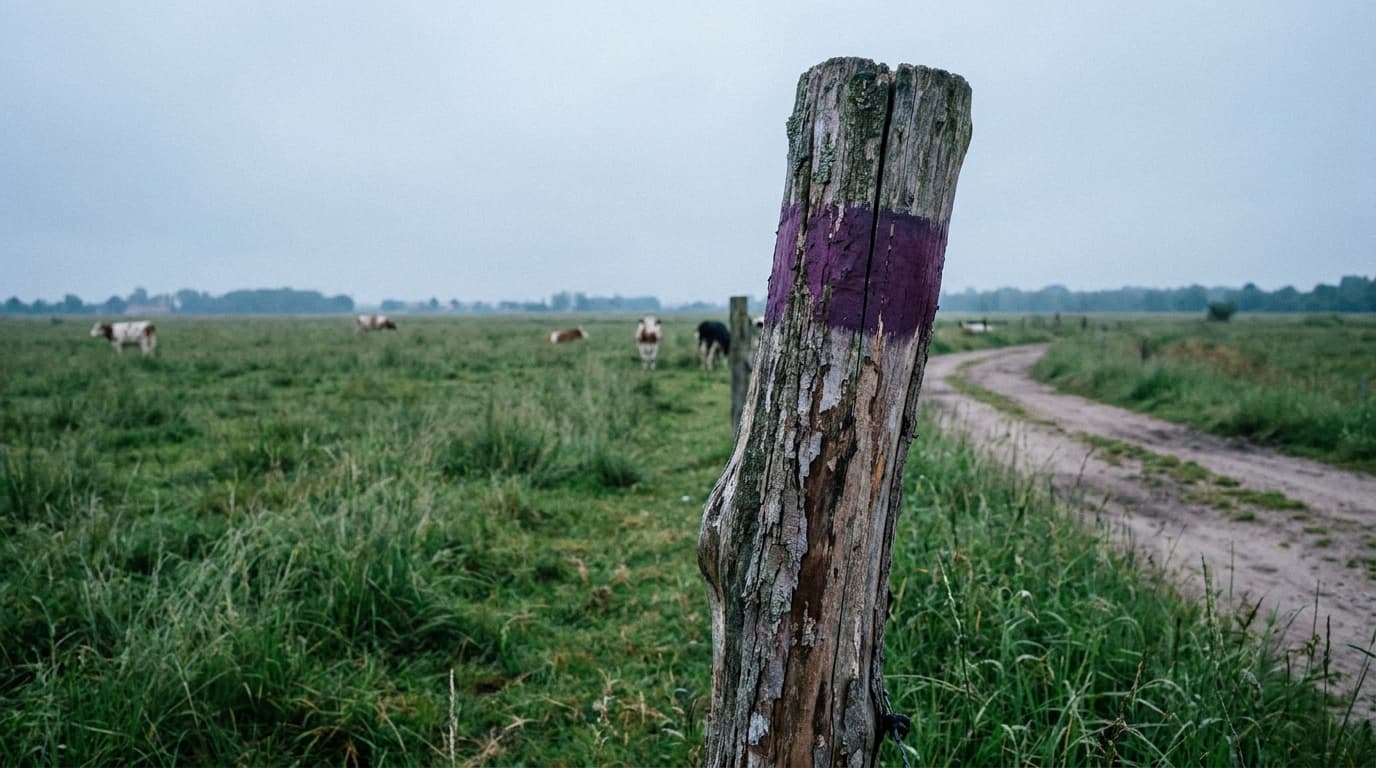
- Purple paint: boundaries may instead be marked with "one vertical line no less than eight inches in length and two inches in width, and the bottom of the mark not less than three nor more than six feet from the ground or normal water surface," on "immovable, permanent objects that are no more than one hundred feet apart and readily visible to any person approaching the property." Even then, "Signs shall also be posted at all roads, driveways or gates of entry onto the posted land so as to be clearly noticeable from outside the boundary line" (section 61-3B-1(4)(B)).
- Fencing: a fence "of substantial construction" that stands at least three feet high (section 61-3B-1(6)).
- Cultivation: land cleared and planted with a crop, orchard, grove, pasture or trees, or fallow in rotation (section 61-3B-1(5)).
Land that is posted, cultivated or fenced is "considered as enclosed and posted" for the article (section 61-3B-1(7)). Under section 61-3B-1(4)(C), no posting is necessary for "any enclosed land or place not exceeding five acres in area on which there is a dwelling house or property that by its nature and use is obviously private."
Penalties for ordinary trespass
Structures and conveyances (section 61-3B-2). Knowingly entering without authorization, or refusing to depart on request, is a misdemeanor with a fine of up to $100. Knowingly and willfully entering a structure clearly posted as condemned by a city or county as unfit for human habitation or use is a misdemeanor with a fine of up to $100, up to 6 months in jail, or both (section 61-3B-2(b)). A trespasser "armed with a firearm or other dangerous weapon" with "the intent to do bodily injury to a human being" in the structure or conveyance is still guilty of a misdemeanor, punishable by a fine of $100 to $1,000, up to 1 year in jail, or both (section 61-3B-2(c)).
Land (section 61-3B-3). Trespass on noticed land is punished by a fine ladder based on the number of trespassing convictions:
- First conviction: a fine of $100 to $500.
- Second conviction: a fine of $500 to $1,000.
- Third and later convictions: a fine of $1,000 to $1,500.
Under section 61-3B-3(e), defying a personally communicated order to leave, opening a door, fence or gate and thereby exposing animals, crops or other property "to waste, destruction, or freedom," or causing any damage to property is a misdemeanor punishable by a fine of $100 to $500, up to 6 months in jail, or both. Armed trespass on land with "the unlawful and felonious intent to do bodily injury to a human being" is a misdemeanor with up to 6 months in jail, a fine of $100 to $1,000, or both (section 61-3B-3(f)). Subsection (g) states that nothing in the section prevents "lawful assembly and petition for the lawful redress of grievances."
Damages and deferred judgment (section 61-3B-8). A person who damages property in the course of a willful trespass is liable to the owner for twice the damage, including the cost of cleanup. For a misdemeanor under Article 3B, a court may defer entry of judgment for up to six months and dismiss the charge if those damages are paid within that time.
Special trespass offenses and the felony forms
- Student residence halls (section 61-3B-4). Remaining in a residence hall or student facility after being asked to leave is a misdemeanor with a fine of $15; a second or later conviction for a violation within one year after a previous violation for similar conduct carries a fine of up to $100.
- State government property (section 61-3B-5). Knowingly and willfully violating a court administrative order, a rule of the secretary of administration or a legislative rule on access to government buildings is a misdemeanor; subsection (a) reads, as codified, "confined for not more than thirty days or fined more than $500, or both." A higher misdemeanor penalty applies when the person intends to commit a misdemeanor, and acting "with the intent to commit a crime which constitutes a felony" is a felony punishable by 1 to 5 years, a fine of up to $5,000, or both (section 61-3B-5(c)).
- Underground coal mines (section 61-3B-6(a)). Willfully entering an underground coal mine, "whether active workings, inactive workings, or abandoned workings, without permission," is a felony punishable by 1 to 10 years and a fine of $5,000 to $10,000. For inactive or abandoned workings, the mine must be sealed or carry a sign near the entrance giving notice that unauthorized entry is a felony. Willfully entering a surface coal mine without permission with intent to commit a felony or any larceny is a misdemeanor punishable by 1 week to 1 month in jail and a fine of $1,000 to $5,000; a second conviction is a felony punishable by 1 to 5 years and $5,000 to $10,000, and a third or later by 5 to 10 years and $10,000 to $25,000 (section 61-3B-6(b)). If another person is injured during rescue efforts for the trespasser, the offense is a misdemeanor punishable by 1 week to 1 year and $1,000 to $5,000; a serious injury makes it a felony punishable by 2 to 10 years and $5,000 to $10,000, and a death a felony punishable by 3 to 15 years and $10,000 to $25,000 (section 61-3B-6(c) to (e)).
- Animal and crop facilities (section 61-3B-7). Willfully trespassing on an animal or crop facility (a broad term that includes fields, pastures, greenhouses and livestock markets) with intent to commit larceny, destroy property or disrupt operations is a misdemeanor with a fine of $500 to $1,000, up to 30 days in jail, or both. A second or later violation, or a violation of the conspiracy provision in subsection (c), is a felony punishable by a fine of $5,000 to $10,000, 1 to 5 years, or both.
- Critical infrastructure (section 61-10-34). Willfully and knowingly trespassing on or entering property containing a critical infrastructure facility without the owner's or lawful occupant's permission is a misdemeanor punishable by a fine of $250 to $1,000, 30 days to 1 year in jail, or both (section 61-10-34(c)(1)). Trespass with intent to damage or tamper with the facility's equipment or to impede its operations is a misdemeanor punishable by a fine of $100 to $1,000, up to 1 year in jail, or both. Willfully damaging or tampering with a facility's physical or digital equipment and causing more than $2,500 in damage is a separate felony under section 61-10-34(c)(2), punishable by a fine of $3,000 to $10,000, 1 to 5 years, or both; a second offense carries $10,000 to $15,000, 2 to 10 years, or both. The facility list includes refineries, power and water facilities, telecommunications, dams, airports, health care facilities and fenced or signed above-ground pipelines. Under subsection (g), the section does not apply to "the right to free speech or assembly including, but not limited to, protesting and picketing."
- Hunting on posted land (section 20-2-7). It is unlawful to shoot, hunt, fish or trap on the "fenced, enclosed or posted lands of another person" without "written permission in his or her possession from the owner, tenant or agent." Hunting, trapping or fishing on land without the owner's permission is a misdemeanor, and the person is also liable for damages. Section 20-2-8 separately makes it a misdemeanor to enter lawfully posted unenclosed land to hunt, trap or fish. Section 20-7-9 sets the penalty for both: a first offense carries a fine of $100 to $500, 10 to 100 days in jail, or both; a second, $500 to $1,000, 10 to 100 days, or both; a third or later, $1,000 to $1,500, 10 to 100 days, or both. Under section 20-2-38, any Chapter 20 violation by a licence holder is sufficient cause for the director to refuse or revoke a licence.
- Railroads (section 61-3-43). A person who is not a passenger or employee and is found jumping on or off a moving railroad car or train, or driving a vehicle on a railroad track or bridge except at crossings, "shall be deemed a disorderly person" and is guilty of a misdemeanor with a fine of up to $25, up to 30 days in the county jail, or both.
Burglary is a separate, more serious crime: entering a dwelling house of another or an adjoining outbuilding "with the intent to commit a violation of the criminal laws of this state" is a felony punishable by 1 to 15 years (section 61-3-11(a)).
Squatting
Under the Stop Squatters Act, "Squatting is synonymous with trespass, and is a criminal act under §61-3B-2 or §61-3B-3 of this Code," and squatters "are not considered tenants" (section 55-3C-2(b), (c)). Two squatting-related offenses took effect July 10, 2025. Under section 55-3C-4, a person who unlawfully occupies a residential dwelling or commercial building and causes damage of less than $1,000 commits a misdemeanor punishable by up to 1 year in jail, a fine of up to $2,500, or both, and damage "in an amount more than $1,000" is a felony punishable by 1 to 10 years in the penitentiary or, at the court's discretion, up to 1 year in jail and a fine of up to $2,500. Under section 55-3C-6, knowingly listing or advertising residential real property or a commercial building "for sale or renting without legal title or authority" is a felony carrying the same range. The removal procedure for owners is covered on our West Virginia squatters' rights page.
Questions about using force against a trespasser or intruder belong to self-defense law; see West Virginia self-defense laws.
West Virginia disorderly conduct and trespass penalties at a glance
| Offense | Statute | What it prohibits | Class | Statutory penalty |
|---|---|---|---|---|
| Disorderly conduct | 61-6-1b(a) | Disturbing the peace in a listed place and persisting after an officer's request to desist | Misdemeanor | Jail for 24 hours or a fine of up to $100 |
| Public intoxication | 60-6-9(a)(1), (e) | Appearing in a public place in an intoxicated condition | Misdemeanor | First: $5 to $100; second adds up to 60 days or counseling; third or later adds 5 to 60 days or counseling |
| Riot or unlawful assembly | 61-6-6 | Rioting or being unlawfully or tumultuously assembled | Misdemeanor | Up to 1 year and up to $500 |
| Riot destroying a building | 61-6-6 | A rioter pulling down or destroying a dwelling or listed public building | Felony | 1 to 10 years |
| Disobeying a riot-area order or curfew | 61-6-1a | Willfully failing to obey a lawful order given under the section | Misdemeanor | Up to $500, up to 6 months, or both |
| Conspiracy to injure or damage property | 61-6-7 | Conspiring to inflict injury or damage property | Misdemeanor; felony if injury or destruction results | Misdemeanor: $50 to $500, plus 1 to 12 months at the court's discretion; felony: 1 to 10 years |
| Disturbing religious worship | 61-6-13(a) | Willfully interrupting, obstructing or substantially disturbing worship | Misdemeanor | Up to 1 year and $250 to $1,000 per violation |
| Disturbing schools and assemblies | 61-6-14 | Willfully interrupting or disturbing a school, meeting or listed gathering | Misdemeanor | $10 to $50, plus up to 30 days at the court's discretion |
| Loitering on school property | 61-6-14a | A non-student loitering at a school against posted rules without permission | Misdemeanor | First: up to $100, up to 30 days, or both; second or later: up to $500, up to 1 year, or both |
| Camping on governmental grounds | 61-6-18 | Shelter on Capitol, courthouse or municipal office grounds without permission | Misdemeanor | $25 to $100 or up to 30 days; each day separate |
| Disrupting governmental processes | 61-6-19(a) | Willfully interrupting or molesting government processes | Misdemeanor | Up to $100, up to 6 months, or both |
| State Capitol Complex offenses | 61-6-19(b) | Bringing a deadly weapon, defacing, or blocking access after an officer's request | Misdemeanor | Not less than $100, up to 6 months, or both |
| False bomb report | 61-6-17 | Knowingly giving false information about a bomb or explosive device | Felony | $100 to $2,000, 1 to 3 years, or both; serious bodily injury: 1 to 5 years, up to $10,000, or both |
| Falsely reporting an emergency | 61-6-20(b) to (d) | Knowingly false emergency report or warning, false report to police, or summoning emergency vehicles without cause | Misdemeanor; felony for a second violation or bodily injury | Misdemeanor: up to $500, up to 6 months, or both; felony: $5,000 to $10,000, 1 to 5 years, or both |
| Threat of a crime of violence | 61-6-20(e), (f) | Intentionally threatening a crime of violence, causing or recklessly risking severe public alarm or inconvenience | Felony | $2,500 to $10,000, 1 to 10 years, or both |
| Terrorist threats, false information and hoaxes | 61-6-24 | Threatening a terrorist act, false information about one, or a hoax device with intent | Felony | Threat or false information: $5,000 to $25,000, 1 to 3 years, or both; hoax device: $10,000 to $50,000, 1 to 5 years, or both |
| Wearing a mask to conceal identity | 61-6-22 | Wearing a mask or hood concealing identity in listed public places, while demanding entry to another's premises, or at a private-property meeting without written permission | Misdemeanor | Up to $500, up to 1 year, or both |
| Funeral demonstration | 61-8-15 | Disruptive demonstration within 500 feet, 60 minutes before to 60 minutes after | Misdemeanor | Up to 1 year and $200 to $500 |
| Trespass in a structure or conveyance | 61-3B-2(a) | Knowingly entering without authorization, or refusing to depart on request | Misdemeanor | Up to $100 |
| Entering a condemned structure | 61-3B-2(b) | Knowingly and willfully entering a structure clearly posted as condemned | Misdemeanor | Up to $100, up to 6 months, or both |
| Armed trespass in a structure | 61-3B-2(c) | Trespassing while armed with intent to do bodily injury | Misdemeanor | $100 to $1,000, up to 1 year, or both |
| Trespass on land | 61-3B-3(a) to (d) | Knowingly entering or remaining on noticed land | Misdemeanor | First: $100 to $500; second: $500 to $1,000; third or later: $1,000 to $1,500 |
| Aggravated land trespass | 61-3B-3(e) | Defying an order to leave, opening a gate exposing animals or crops, or causing damage | Misdemeanor | $100 to $500, up to 6 months, or both |
| Armed trespass on land | 61-3B-3(f) | Trespassing while armed with felonious intent to do bodily injury | Misdemeanor | Up to 6 months, $100 to $1,000, or both |
| Residence hall trespass | 61-3B-4(c), (d) | Remaining after being asked to leave by listed officials | Misdemeanor | $15; repeat within one year: up to $100 |
| State property access violation with intent to commit a felony | 61-3B-5(c) | Violating access rules for government buildings with intent to commit a felony | Felony | 1 to 5 years, up to $5,000, or both |
| Underground coal mine entry | 61-3B-6(a) | Willfully entering an underground coal mine without permission | Felony | 1 to 10 years and $5,000 to $10,000 |
| Surface coal mine entry | 61-3B-6(b) | Willfully entering a surface coal mine without permission with intent to commit a felony or larceny | Misdemeanor; felony for a second or later conviction | Misdemeanor: 1 week to 1 month and $1,000 to $5,000; second: 1 to 5 years and $5,000 to $10,000; third or later: 5 to 10 years and $10,000 to $25,000 |
| Injury or death during a mine rescue | 61-3B-6(c) to (e) | Another person injured or killed during rescue efforts for a mine trespasser | Misdemeanor; felony for serious injury or death | Injury: 1 week to 1 year and $1,000 to $5,000; serious injury: 2 to 10 years and $5,000 to $10,000; death: 3 to 15 years and $10,000 to $25,000 |
| Animal or crop facility trespass | 61-3B-7(d), (e) | Willful trespass with intent to steal, destroy property or disrupt operations | Misdemeanor; felony for a second or later violation | Misdemeanor: $500 to $1,000, up to 30 days, or both; felony: $5,000 to $10,000, 1 to 5 years, or both |
| Critical infrastructure trespass | 61-10-34(c)(1) | Willfully and knowingly entering property containing a critical infrastructure facility | Misdemeanor | $250 to $1,000, 30 days to 1 year, or both; with intent to damage, tamper or impede operations: $100 to $1,000, up to 1 year, or both |
| Damaging critical infrastructure equipment | 61-10-34(c)(2) | Willfully damaging or tampering with facility equipment, causing more than $2,500 in damage | Felony | $3,000 to $10,000, 1 to 5 years, or both; second offense: $10,000 to $15,000, 2 to 10 years, or both |
| Hunting on posted land without permission | 20-2-7, 20-2-8 | Hunting, trapping or fishing on another's land without permission, or entering posted unenclosed land to do so | Misdemeanor | First: $100 to $500; second: $500 to $1,000; third or later: $1,000 to $1,500 (each with 10 to 100 days possible, or both) (20-7-9) |
| Railroad trespass | 61-3-43 | Jumping on or off moving trains, or driving on tracks except at crossings | Misdemeanor | Up to $25, up to 30 days, or both |
| Squatting damage | 55-3C-4 | Unlawfully occupying a dwelling or commercial building and causing damage | Misdemeanor under $1,000; felony over $1,000 | Misdemeanor: up to 1 year, up to $2,500, or both; felony: 1 to 10 years, or up to 1 year in jail and up to $2,500 |
| Listing property without authority | 55-3C-6 | Knowingly listing or advertising property for sale or rent without title or authority | Felony | 1 to 10 years, or up to 1 year in jail and up to $2,500 |
Each penalty above is stated in the offense's own section, except the hunting-trespass penalties, which section 20-7-9 sets. For how West Virginia classifies and sentences misdemeanors and felonies generally, see West Virginia felony and misdemeanor classes.
Recent changes
- 2024, Senate Bill 164 (effective June 7, 2024). Amended sections 61-3B-2, 61-3B-3, 61-3B-6 and 61-3B-7 and added section 61-3B-8. Its title describes "clarifying protected activities relating to trespass on property other than a structure or conveyance; making double damages applicable to all violations of the article including cleanup costs; authorizing courts presiding in cases for misdemeanor violations of the article to defer entry of judgment and dismiss the charges if payment of ordered damages is made within six months after conviction."
- 2024, House Bill 4940 (effective June 4, 2024). Created the first sections of the Stop Squatters Act, sections 55-3C-1 and 55-3C-2.
- 2024, House Bill 5091 (effective June 5, 2024) and 2025, House Bill 3504 (effective July 10, 2025). Both amended the Critical Infrastructure Protection Act, section 61-10-34.
- 2025, House Bill 2434 (effective July 10, 2025). Amended section 55-3C-2 and added sections 55-3C-3 to 55-3C-6, including the law-enforcement removal procedure, the squatting damage offenses and the felony for listing property without authority.
- 2026, Senate Bill 1026 (effective June 12, 2026). Amended section 61-6-13 on disturbing religious worship. Its title describes "increasing the criminal penalties and fines for disturbing religious worship; clarifying that this section does not prohibit conduct protected by the First Amendment; and removing antiquated language." The current penalty is up to 1 year in jail and a fine of $250 to $1,000 for each violation.
- 2026, House Bill 4996 (effective June 12, 2026). Amended section 61-6-20 on false emergency reports and threats of a crime of violence; its short title is "Relating to bail in cases involving terroristic threats to schools or children."
Federal law separately governs conduct on federal property and at the U.S. Capitol; see the disorderly conduct and trespass laws by state hub.
Related West Virginia laws
- Disorderly conduct and trespass laws by state
- West Virginia noise ordinance laws
- West Virginia felony and misdemeanor classes
- West Virginia squatters' rights
- West Virginia self-defense laws
- West Virginia expungement laws
- How to charge someone with trespassing
This article provides general legal information about West Virginia's disorderly conduct, public-order and criminal trespass statutes as of 2026-10-18. It is not legal advice. For advice about a specific situation, contact a lawyer licensed in West Virginia.
Last updated: 2026-10-18.
Frequently Asked Questions
What is disorderly conduct in West Virginia?
Under W. Va. Code 61-6-1b, a person commits disorderly conduct by disturbing the peace of others, in a public place or another listed place, through violent, profane, indecent or boisterous conduct or language, or unreasonably loud noise intended to cause annoyance or alarm, and then persisting after a law-enforcement officer asks them to desist.
Is disorderly conduct a misdemeanor in West Virginia?
Yes. Section 61-6-1b makes it a misdemeanor punishable by confinement in jail for 24 hours or a fine of not more than $100. The section has no felony form and no repeat-offender escalation.
Can you get disorderly conduct for swearing in West Virginia?
Profane language is one of the listed ways to disturb the peace, but section 61-6-1b also requires that the conduct happen in a listed place, disturb the peace of others, and continue after a law-enforcement officer requests that it stop.
Is public intoxication a crime in West Virginia?
Yes. Section 60-6-9 bars appearing in a public place in an intoxicated condition. A first offense carries a fine of $5 to $100, and later offenses add jail or alcoholism counseling. A person charged under that subdivision who is an alcoholic is found not guilty by reason of addiction under section 60-6-9(f).
Is trespassing a felony in West Virginia?
Ordinary trespass under sections 61-3B-2 and 61-3B-3 is a misdemeanor, even when the trespasser is armed. Felony forms include entering an underground coal mine without permission, a second or later surface-mine conviction, a serious injury or death during a mine rescue, a second or later animal or crop facility violation, violating state-property access rules with intent to commit a felony, and the 2025 squatting felonies. Willfully damaging or tampering with critical infrastructure equipment and causing more than $2,500 in damage is a separate felony under section 61-10-34(c)(2).
Does West Virginia have a purple paint law?
Yes. Section 61-3B-1(4)(B) counts purple vertical lines at least 8 inches long and 2 inches wide, with the bottom of the mark 3 to 6 feet above the ground or normal water surface, on permanent objects no more than 100 feet apart. Signs must also be posted at all roads, driveways or gates of entry.
Do I need a No Trespassing sign in West Virginia?
For land, notice can come from actual communication, posting, fencing or cultivation (section 61-3B-3(a)). Under section 61-3B-1(4)(C), enclosed land of 5 acres or less with a dwelling on it, or property obviously private by its nature and use, needs no posting.
What happens if a store tells you to leave in West Virginia?
A person who was authorized or invited into a structure and refuses to depart when the owner, tenant or their agent asks commits trespass under section 61-3B-2(a), a misdemeanor with a fine of up to $100.
Is squatting a crime in West Virginia?
Yes. Section 55-3C-2(b) says squatting is synonymous with trespass and is a criminal act under section 61-3B-2 or 61-3B-3. Since July 10, 2025, section 55-3C-4 adds a misdemeanor for squatting damage under $1,000 and a felony for damage of more than $1,000.
Updates
Independently fact-checked against the cited primary sources
The Law Behind This Article
This article rests on the statutory provisions below, held in our own legal record and retrieved from the official source. Tap a section to read the operative text.
West Virginia Code
§ 61-6-1BDisorderly conduct; penalty.In forcecited in 2 of our articles
(a) Any person who, in a public place, any office or office building of the State of West Virginia, or in the State Capitol complex, or on any other property owned, leased, occupied or controlled by the State of West Virginia, a mobile home park, a public parking area, a common area of an apartment building or dormitory, or a common area of a privately owned commercial shopping center, mall or other group of commercial retail establishments, disturbs the peace of others by violent, profane, indecent or boisterous conduct or language or by the making of unreasonably loud noise that is intended to cause annoyance or alarm to another person, and who persists in such conduct after being requested to desist by a law-enforcement officer acting in his or her lawful capacity, is guilty of disorderly conduct, a misdemeanor and, upon conviction thereof, may be confined in jail for twenty-four hours or fined not more than $100: Provided, That nothing in this subsection should be construed as a deterrence to the lawful and orderly public right to demonstrate in support or protest of public policy issues.
Official text (excerpt) · last checked 2026-07-30 · Read the full text in our law library · Verify at code.wvlegislature.gov
Also relied on in: West Virginia Noise Laws (2026): Disorderly Conduct, Quiet Hours
§ 61-3B-3Trespass on property other than structure or conveyance.In forcecited in 3 of our articles
(a) It is an unlawful trespass for any person to knowingly, and without being authorized, licensed, or invited, to enter or remain on any property, other than a structure or conveyance, as to which notice against entering or remaining is either given by actual communication to such person or by posting, fencing, or cultivation. (b) First offense conviction. — Upon a first trespassing conviction pursuant to subsection (a) of this section, the person is guilty of a misdemeanor and shall be fined not less than $100 nor more than $500. (c) Second offense conviction. — Upon a second trespassing conviction pursuant to subsection (a) of this section, the person is guilty of a misdemeanor and shall be fined not less than $500 nor more than $1,000. (d) Third offense conviction. — Upon a third and subsequent trespassing conviction pursuant to subsection (a) of this section, the person is guilty of a misdemeanor and shall be fined not less than $1,000 nor more than $1,500.
Official text (excerpt) · last checked 2026-07-30 · Read the full text in our law library · Verify at code.wvlegislature.gov
Cited in 1 court opinions in our collectionLatest citing opinion in our collection: 1999
Opinions citing this section in our collection:
- United States v. Hughes (Court of Appeals for the Fourth Circuit 1999)“…4 See W. Va. Code § 61-3B-3 (1997). 3 that h…”
Identified automatically from the court opinions citing this section — not a ranking of which case controls.
Also relied on in: West Virginia Squatters Rights and Adverse Possession Laws (2026)
§ 61-3B-2Trespass in structure or conveyance.In forcecited in 3 of our articles
(a) Any person who knowingly enters in, upon, or under a structure or conveyance without being authorized, licensed, or invited, or having been authorized, licensed, or invited is requested to depart by the owner, tenant, or the agent of the owner or tenant, and refuses to do so, is guilty of a misdemeanor, and, upon conviction thereof, shall be fined not more than $100. (b) Notwithstanding the provisions of subsection (a) of this section, any person who, without permission, knowingly and willfully enters a structure which has a clear posting that the structure has been condemned by any municipal or county government as unfit for human habitation or use, is guilty of a misdemeanor and, upon conviction thereof, shall be fined not more than $100, or confined in jail not more than six months, or both fined and confined: Provided, That for any first violation of this subsection offense of trespass on condemned property, a court may substitute community service or pretrial diversion in lieu of a fine or confinement for trespassing on condemned property.
Official text (excerpt) · last checked 2026-07-30 · Read the full text in our law library · Verify at code.wvlegislature.gov
Cited in 1 court opinions in our collectionLatest citing opinion in our collection: 2018
Opinions citing this section in our collection:
- Distinguished Executives Transportation, LLC v. Cracker Barrel Old Country Store, Inc. (District Court, S.D. West Virginia 2018)“…fine[ment] in jail for twenty-four hours.” See W. Va. Code Ann. §§ 61-3B-2 (trespass), 61-6-1b (disorderly…”
Identified automatically from the court opinions citing this section — not a ranking of which case controls.
§ 61-3B-1Definitions.In force
As used in this article: (1) “Structure” means any building of any kind, either temporary or permanent, which has a roof over it, together with the curtilage thereof. (2) “Conveyance” means any motor vehicle, vessel, railroad car, railroad engine, trailer, aircraft or sleeping car, and “to enter a conveyance” includes taking apart any portion of the conveyance. (3) An act is committed “in the course of committing” if it occurs in an attempt to commit the offense or in flight after the attempt or commission. (4) “Posted land” is land that has: (A) Signs placed not more than five hundred feet apart, along and at each corner of the boundaries of the land. The signs shall be reasonably maintained, with letters of not less than two inches in height and the words “no trespassing”.
Official text (excerpt) · last checked 2026-07-30 · Read the full text in our law library · Verify at code.wvlegislature.gov
§ 60-6-9Intoxication or drinking in public places; illegal possession of alcoholic liquor; arrests by sheriffs or their deputies for violation in their presence; penalties.In force
(a) A person may not: (1) Appear in a public place in an intoxicated condition; (2) Drink alcoholic liquor in a public place; (3) Tender a drink of alcoholic liquor to another person in a public place; (4) Operate a business without a license issued under §60-1-1 et seq. of this code which knowingly facilitates the consumption of alcoholic liquors in a public place by providing for on-site items such as cups, glasses, ice, and nonalcoholic beverages used to mix with alcoholic liquors, refrigeration, or on-site storage of alcoholic liquors in a lounge area or space for persons to gather, perhaps offering musical entertainment, exotic dancing, or other such nude entertainment, or other similar activity or entertainment. Such business may be commonly known as a "bring your own bottle", "bring your own booze", or "BYOB" establishments; (5) Possess alcoholic liquor in the amount in excess of 10 gallons, in containers not bearing stamps or seals of the commissioner, without having first obtained written authority from the commissioner therefor; or (6) Possess any alcoholic liquor which was manufactured or acquired in violation of the provisions of this chapter.
Official text (excerpt) · last checked 2026-07-30 · Read the full text in our law library · Verify at code.wvlegislature.gov
§ 61-6-6Destruction of building by rioters; penalty therefor and for rioting without such injury.In force
If any person engaged in a riot, rout or unlawful assemblage, pull down or destroy, in whole or in part, any dwelling house, courthouse, jail, prison, asylum, hospital, school or college building, or any public building of any character, or assist therein, he shall be guilty of a felony, and, upon conviction, shall be confined in the penitentiary not less than one nor more than ten years; and though no such building be injured, every rioter, and every person unlawfully or tumultuously assembled, shall be guilty of a misdemeanor, and, upon conviction, shall be confined in jail not more than one year and fined not exceeding $500.
Official text (excerpt) · last checked 2026-07-30 · Read the full text in our law library · Verify at code.wvlegislature.gov
§ 61-10-34Critical Infrastructure Protection Act; prohibiting certain acts, including trespass and conspiracy to trespass against property designated a critical infrastructure facility; criminal penalties; and civil action.In forcecited in 3 of our articles
(a) This section may be referred to as the "West Virginia Critical Infrastructure Protection Act". (b) For purposes of this section: "Critical Infrastructure" means systems and assets, whether physical or virtual, so vital to the United States of America or the State of West Virginia that the incapacity or destruction of such systems and assets would have a debilitating impact on security, national economic security, state economic security, national public health or safety, state public health or safety, or any combination of those matters, whether such systems or assets are in operation or are under any state of construction.
Official text (excerpt) · last checked 2026-07-30 · Read the full text in our law library · Verify at code.wvlegislature.gov
Cited in 1 court opinions in our collectionLatest citing opinion in our collection: 2025
Opinions citing this section in our collection:
- Mountain Valley Pipeline, LLC v. Wagner (District Court, N.D. West Virginia 2025)“…ction; (3) Tortious Interference; (4) Violation of W.Va. Code § 61-10-34; (5) Civil Conspiracy; and (…”
Identified automatically from the court opinions citing this section — not a ranking of which case controls.
Also relied on in: How to Charge Someone With Trespassing, West Virginia Drone Laws (2026): Privacy & Penalties
§ 55-3C-2Squatters defined: squatters not tenants; squatting constitutes criminal trespass; petition and eviction not appropriate remedies for squatters; remedy is arrest for trespass.In forcecited in 4 of our articles
(a) “Squatter” means a person unlawfully occupying a dwelling unit or other structure who is not entitled under a rental or lease agreement or who is not authorized by the tenant or owner to occupy that dwelling unit or structure. “Squatter” does not include a tenant who holds over in a periodic tenancy as described in §37-6-5 of this code, or an owner. (b) “Squatting” means the act of being a squatter. Squatting is synonymous with trespass, and is a criminal act under §61-3B-2 or §61-3B-3 of this Code. (c) Squatters are not considered tenants for purposes of this code and are not entitled to eviction proceedings afforded to lawful tenants. A Court of this state shall not require the use of eviction, or a similar procedure such as those found under §55-3A-1, et seq. or §55-3B-1, et seq. of this Code, by an owner in any instance involving the removal of a squatter from possession of a property.
Official text (excerpt) · last checked 2026-07-30 · Read the full text in our law library · Verify at code.wvlegislature.gov
Also relied on in: Squatters Rights by State: Adverse Possession Laws (2026)
Search our full record of US law — 2.1 million sections, every state + federal →
Sources and References
- W. Va. Code 61-6-1b, disorderly conduct; penalty(code.wvlegislature.gov).gov
- W. Va. Code 61-3B-2, trespass in structure or conveyance(code.wvlegislature.gov).gov
- W. Va. Code 61-3B-3, trespass on property other than structure or conveyance(code.wvlegislature.gov).gov
- W. Va. Code 61-3B-6, trespass on coal mine property(code.wvlegislature.gov).gov
- W. Va. Code 61-10-34, Critical Infrastructure Protection Act(code.wvlegislature.gov).gov
- W. Va. Code 60-6-9, intoxication or drinking in public places; penalties(code.wvlegislature.gov).gov
- W. Va. Code 61-6-6, riot and unlawful assembly; penalties(code.wvlegislature.gov).gov
- W. Va. Code 61-6-13, disturbance of religious worship(code.wvlegislature.gov).gov
- W. Va. Code 61-3B-1, trespass definitions, including posted land and purple paint(code.wvlegislature.gov).gov
- W. Va. Code 61-3B-7, trespass on animal or crop facilities(code.wvlegislature.gov).gov
- W. Va. Code 55-3C-2, squatters defined; squatting constitutes criminal trespass(code.wvlegislature.gov).gov
- W. Va. Code 55-3C-4, squatting damage offenses(code.wvlegislature.gov).gov
- W. Va. Code 55-3C-6, listing or advertising property without authority(code.wvlegislature.gov).gov
- W. Va. Code Chapter 61, Article 6, crimes against the peace(code.wvlegislature.gov).gov
- W. Va. Code 61-6-1, riot and unlawful assembly; dispersal(code.wvlegislature.gov).gov
- W. Va. Code 61-6-1a, riot emergency powers and curfews(code.wvlegislature.gov).gov
- W. Va. Code 61-6-7, conspiracy to inflict injury or damage property(code.wvlegislature.gov).gov
- W. Va. Code 61-6-14, disturbance of schools, societies and assemblies(code.wvlegislature.gov).gov
- W. Va. Code 61-6-14a, loitering on school property(code.wvlegislature.gov).gov
- W. Va. Code 61-6-18, camping on governmental grounds(code.wvlegislature.gov).gov
- W. Va. Code 61-6-19, willful disruption of governmental processes(code.wvlegislature.gov).gov
- W. Va. Code 61-6-22, wearing masks or hoods(code.wvlegislature.gov).gov
- W. Va. Code 61-8-15, funeral demonstrations(code.wvlegislature.gov).gov
- W. Va. Code 61-3B-4, trespass in student residence halls and facilities(code.wvlegislature.gov).gov
- W. Va. Code 61-3B-8, double damages; deferred judgment(code.wvlegislature.gov).gov
- W. Va. Code 61-3B-5, trespass on state government property(code.wvlegislature.gov).gov
- W. Va. Code 20-2-7, hunting, trapping or fishing on posted lands(code.wvlegislature.gov).gov
- W. Va. Code 61-3-43, trespassing on railroad cars and tracks(code.wvlegislature.gov).gov
- W. Va. Code 61-3-11, burglary(code.wvlegislature.gov).gov
- Enrolled Senate Bill 164 (2024 Regular Session)(www.wvlegislature.gov).gov
- Enrolled Committee Substitute for House Bill 2434 (2025 Regular Session)(www.wvlegislature.gov).gov
- Enrolled Committee Substitute for Senate Bill 1026 (2026 Regular Session)(www.wvlegislature.gov).gov
- W. Va. Code 61-6-17, false reports concerning bombs or other explosive devices(code.wvlegislature.gov).gov
- W. Va. Code 61-6-20, falsely reporting an emergency incident; threats of a crime of violence(code.wvlegislature.gov).gov
- W. Va. Code 61-6-24, threats of terrorist acts, false information and hoaxes(code.wvlegislature.gov).gov
- W. Va. Code 20-2-8, posting unenclosed lands; hunting on posted land(code.wvlegislature.gov).gov
- W. Va. Code 20-7-9, violations of Chapter 20; penalties(code.wvlegislature.gov).gov
- W. Va. Code 20-2-38, refusal or revocation of license or permit(code.wvlegislature.gov).gov
- House Bill 4996 (2026 Regular Session), bill history(www.wvlegislature.gov).gov
Paid attorney referral. RecordingLaw may receive compensation when you use an attorney-help link. RecordingLaw is not a law firm. Submitting a request does not guarantee that an attorney will accept your case and does not create an attorney-client relationship.