
Iowa
Is Disorderly Conduct a Misdemeanor in Iowa? Penalties, Trespass
Independently fact-checked against primary sources (last audited October 18, 2026). · 24 primary sources cited on this page. How we verify our legal content
Iowa's disorderly conduct statute, Iowa Code section 723.4, makes fighting in public, loud and raucous noise near a residence or public building, abusive epithets likely to provoke violence, disrupting a lawful meeting, false reports of a fire or catastrophe, and certain disrespectful uses of the U.S. flag simple misdemeanors, punishable by a fine of $105 to $855 and up to 30 days in jail. Obstructing a street, sidewalk or highway to hinder others is a serious misdemeanor, and it climbs to an aggravated misdemeanor, a class D felony or a class C felony when it involves a controlled-access highway, property damage, an unlawful assembly or riot, or injury.
Iowa criminal trespass is a single offense defined in section 716.7 with several forms, not degrees. Knowing trespass is a simple misdemeanor punished by a scheduled fine of $500 for a first violation, $1,000 for a second and $1,500 for a third or later (sections 716.8(1) and 805.8C(12)); trespass on enclosed public utility property is a class D felony. For other states, see our guide to disorderly conduct and trespass laws by state.
Information last verified on 2026-10-18. This article has not been reviewed by a licensed lawyer.
Jurisdiction scope: This article covers Iowa state criminal statutes on disorderly conduct and public disorder (Iowa Code chapter 723), public intoxication (section 123.46), false reports and bomb threats (sections 718.6, 712.7 and 712.8), and trespass and related offenses (sections 716.7 to 716.14, 727.8A, chapter 717A, the hunting-license rules in 483A.21 and 481A.134, and the burglary line in chapter 713). It does not cover local noise ordinances and quiet hours (see Iowa noise laws), the civil procedure for removing squatters (see Iowa squatters' rights), use of force against an intruder (see Iowa self-defense laws), city and county ordinances, civil trespass lawsuits, or federal property rules.
What is disorderly conduct in Iowa?
Section 723.4 is Iowa's umbrella public-disorder statute; chapter 723 has no separate breach of the peace or disturbing the peace offense. Subsection 1 lists six simple misdemeanor forms. A person commits disorderly conduct when the person:
- (a) Fights. "Engages in fighting or violent behavior in any public place or in or near any lawful assembly of persons," with an exception for conduct in an athletic contest "which is reasonably related to that sport."
- (b) Makes noise. "Makes loud and raucous noise in the vicinity of any residence or public building which intentionally or recklessly causes unreasonable distress to the occupants thereof." Quiet hours and decibel limits are usually local; see our Iowa noise ordinance laws page.
- (c) Uses provoking words or gestures. "Directs abusive epithets or makes any threatening gesture which the person knows or reasonably should know is likely to provoke a violent reaction by another."
- (d) Disrupts a meeting. "Without lawful authority or color of authority, the person disturbs any lawful assembly or meeting of persons by conduct intended to disrupt the meeting or assembly."
- (e) Spreads a false alarm. "By words or action, initiates or circulates a report or warning of fire, epidemic, or other catastrophe, knowing such report to be false or such warning to be baseless."
- (f) Misuses the flag. "Knowingly and publicly uses the flag of the United States in such a manner as to show disrespect for the flag as a symbol of the United States, with the intent or reasonable expectation that such use will provoke or encourage another to commit trespass or assault." "Show disrespect" means to deface, defile, mutilate or trample, each defined in the paragraph, and the paragraph does not apply to a flag retirement ceremony conducted under federal law.
The false-report statutes described below separately cover false reports made to public safety agencies.
Each clause carries its own mental state or test. The noise clause requires that the noise "intentionally or recklessly" cause unreasonable distress to occupants of a nearby residence or public building. The language clause is limited to abusive epithets or threatening gestures the person "knows or reasonably should know" are likely to provoke a violent reaction. Where fighting causes injury, Iowa's assault laws may also apply.
Penalty for the subsection 1 forms
Each form in subsection 1 is a simple misdemeanor. Under section 903.1(1)(a), a simple misdemeanor carries "a fine of at least one hundred five dollars but not to exceed eight hundred fifty-five dollars," and the court "may order imprisonment not to exceed thirty days in lieu of a fine or in addition to a fine." Section 723.4 sets no repeat-offense increase for these forms.
Obstructing a public way and its escalators
Subsection 2 makes it a serious misdemeanor when a person, "without lawful authority or color of authority, obstructs any street, sidewalk, highway, or other public way, with the intent to prevent or hinder its lawful use by others." A serious misdemeanor carries a fine of $430 to $2,560 and up to 1 year (903.1(1)(b)). The grade rises with what else happens:
- Aggravated misdemeanor (723.4(3)). The obstruction also obstructs or attempts to obstruct a fully controlled-access highway facility (one whose speed restriction is set by section 321.285, subsection 3 or 5), involves property damage, or occurs while the person "is present during an unlawful assembly." Up to 2 years and a fine of $855 to $8,540 (903.1(2)).
- Class D felony (723.4(4)). The person "is present during a riot" or "causes bodily injury." Up to 5 years and a fine of $1,025 to $10,245 (902.9(1)(e)).
- Class C felony (723.4(5)). The person "causes serious bodily injury or death." Up to 10 years and a fine of $1,370 to $13,660 (902.9(1)(d)).
Subsections 2 through 5 were restated by 2021 Acts chapter 183 (Senate File 342), effective on enactment.
False reports, 911 misuse and bomb threats
Reporting information to a fire department, law enforcement or another public safety entity knowing it is false, or reporting a crime knowing it did not occur, is a simple misdemeanor, or a serious misdemeanor if the reported crime is a serious or aggravated misdemeanor or a felony (Iowa Code 718.6(1)). It is a class D felony if the false report is of a forcible felony, intimidation with a dangerous weapon, terrorism, a biological-agent offense or an arson or explosives offense under chapter 712, and a class C felony if that false report results in serious bodily injury or death (718.6(2), (3)). Calling 911 knowing there is no emergency and no need for emergency information or help is a simple misdemeanor (718.6(4)).
Knowingly conveying false information that a bomb, incendiary or other destructive device has been placed where people or property would be endangered is a class D felony (712.7), as is threatening to place or attempting to place one (712.8).
Funeral and memorial service disruption: section 723.5
Section 723.5 bars three kinds of conduct within 1,000 feet of the building or other location where a funeral or memorial service is being conducted, or within 1,000 feet of a funeral procession or burial: loud and raucous noise "which causes unreasonable distress to the persons attending" or participating; abusive epithets or threatening gestures the person knows or reasonably should know are likely to provoke a violent reaction; and conduct "intended to disturb or disrupt" the funeral, memorial service, procession or burial. It applies "within sixty minutes preceding, during, and within sixty minutes after" the event.
Section 723.5 sets its own repeat-offender ladder: a simple misdemeanor for a first offense, a serious misdemeanor for a second offense, and a class D felony (up to 5 years) for a third or subsequent offense.
Riot, unlawful assembly and other public-disorder offenses
- Riot (723.1). "A riot is three or more persons assembled together in a violent and disturbing manner, and with any use of unlawful force or violence by them or any of them against another person, or causing property damage." A person "who willingly joins in or remains a part of a riot, knowing or having reasonable grounds to believe that it is such, commits a class 'D' felony." Senate File 342 (2021) raised riot from an aggravated misdemeanor to a class D felony.
- Unlawful assembly (723.2). Three or more persons assembled together, any of them "acting in a violent manner," with intent that any of them commit a public offense. Willingly joining or remaining, or staying in a lawful assembly after it becomes unlawful, knowing or having reasonable grounds to believe it is unlawful, is an aggravated misdemeanor (up to 2 years). SF 342 raised it from a simple misdemeanor.
- Failure to disperse (723.3). A peace officer may order participants in a riot or unlawful assembly, or persons in its immediate vicinity, to disperse. "Any person within hearing distance of such command, who refuses to obey, commits a simple misdemeanor."
- Interference with public disorder control (723.6). Possessing "a tool, instrument, or device with the intent to suppress or disrupt law enforcement from legally deploying a device to control public disorder" is an aggravated misdemeanor. SF 342 added this section in 2021.
Public intoxication: section 123.46
Iowa's alcohol chapter, not chapter 723, holds public intoxication. Under section 123.46(2)(a), "A person shall not be intoxicated in a public place." The same paragraph bars using or consuming alcoholic liquor, wine or beer on public streets or highways, consuming alcoholic liquor in any public place other than premises covered by a retail alcohol license, and possessing or consuming alcohol on public school property or at a school-related function. Each is a simple misdemeanor, as is simulating intoxication in a public place (123.46(3)). Since July 1, 2026, section 123.46(2)(b), added by House File 2780 (2026), allows possessing or consuming alcoholic liquor, wine or beer on public streets, highways or public places within a city social district when it complies with the city's ordinance under section 414.34; the ban on being intoxicated in a public place is unchanged.
When a peace officer arrests a person on a public intoxication charge, the officer must tell the person that a chemical test may be administered at the person's own expense (123.46(4)). Under subsection 6, two years after a conviction, a person may petition to expunge it, and if the person has had no other criminal convictions in that period, "other than local traffic violations or simple misdemeanor violations of chapter 321," the conviction "shall be expunged as a matter of law." For record relief generally, see Iowa expungement laws. Subsection 7 provides that a person shall not be charged or prosecuted under the section if immune under section 701.12.
Criminal trespass in Iowa
Iowa does not divide criminal trespass into degrees. Section 716.7 defines "trespass" as any of seven acts, and section 716.8 sets the penalty by circumstance.
The forms of trespass
Under section 716.7(2)(a), "trespass" means one or more of these acts:
- Entering property without the express permission of the owner, lessee or person in lawful possession, with intent to commit a public offense, to use, remove, alter, damage, harass, or place anything on it, or to hunt, fish or trap on it (including taking or attempting to take a deer on the property from outside it). The paragraph provides that it does not prohibit the unarmed pursuit of game or fur-bearing animals by a person who lawfully injured or killed the animal and it comes to rest on or escapes to another's property.
- Entering or remaining on property "without justification after being notified or requested to abstain from entering or to remove or vacate therefrom," as described below.
- Entering property "for the purpose or with the effect of unduly interfering with the lawful use of the property by others."
- Being on property and wrongfully using, removing, altering, damaging, harassing or placing anything there without the implied or actual permission of the owner, lessee or person in lawful possession.
- Entering or remaining on railway property without lawful authority or the railway corporation's consent. This does not apply to an unarmed person crossing a railroad right-of-way, other than a track, roadbed, viaduct, bridge, trestle or yard, who has not been told to stay off and does not interfere with the railroad's operation.
- Entering or remaining on public utility property without lawful authority or the utility's consent. Section 716.7 limits public utility property to utility property completely enclosed by a physical barrier, and this form does not apply to passage over a utility right-of-way by a person who has not been notified, by posted signage or other means, to stay off or leave.
- Intentionally viewing, photographing or filming another person through a window or other opening of a dwelling, without legitimate purpose, while on the property, when that person has a reasonable expectation of privacy and does not or cannot consent.
Being told to leave: what counts as notice
The notice form, 716.7(2)(a)(2), covers notice or a request from "the owner, lessee, or person in lawful possession, or the agent or employee of the owner, lessee, or person in lawful possession, or by any peace officer, magistrate, or public employee whose duty it is to supervise the use or maintenance of the property." A person has been notified if either of these applies:
- the person was notified "personally, either orally or in writing, including by a valid court order under chapter 236"; or
- "A printed or written notice forbidding such entry has been conspicuously posted or exhibited at the main entrance to the property or the forbidden part of the property."
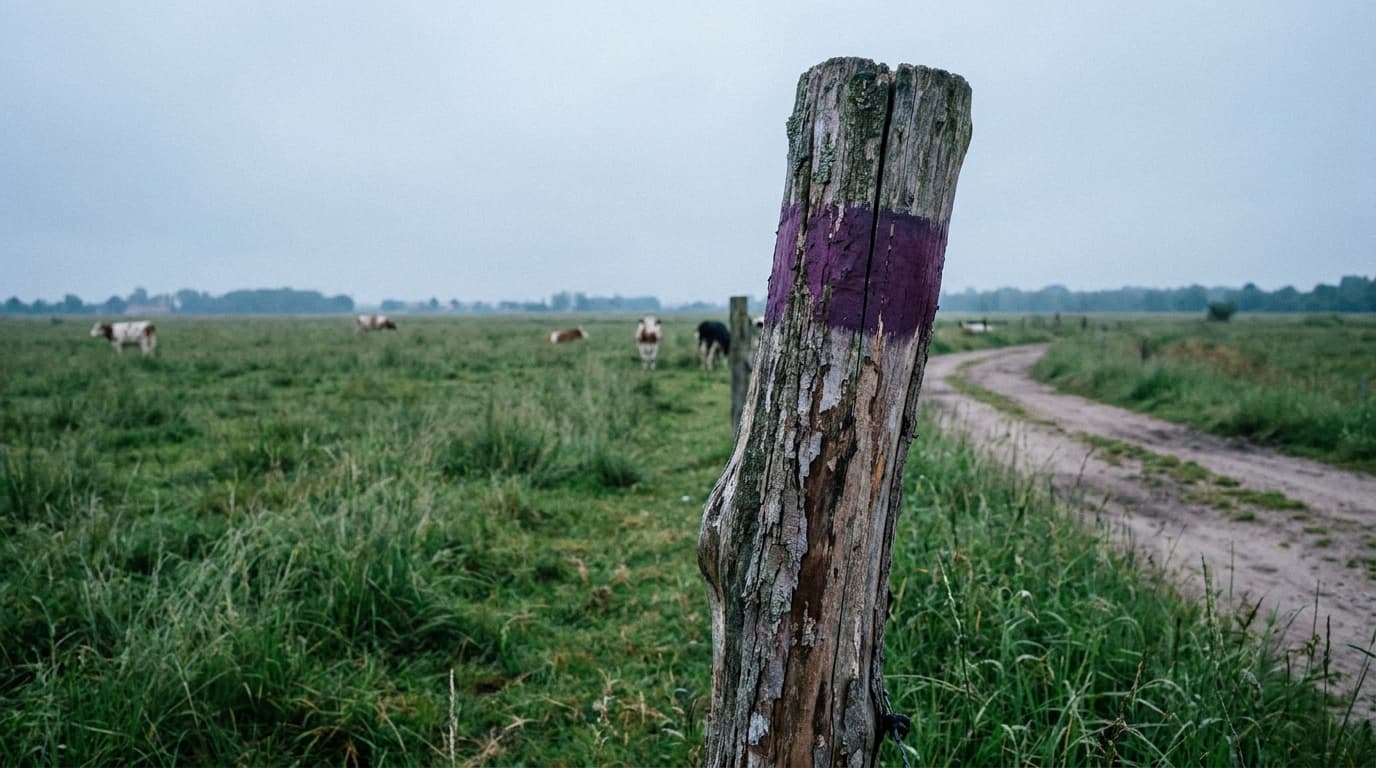
The section sets no sign size, wording or spacing, and the trespass chapter contains no purple paint or paint-mark provision. A separate notice rule applies to animal facilities under section 717A.2(1)(c): notice can be a written or spoken communication from the owner, a fence or other enclosure designed to exclude intruders or contain animals, or a posted sign reasonably likely to come to an intruder's attention that says entry is forbidden, and a person who refuses to leave immediately after being told to is also on notice. A 2019 bill to add purple marks, Senate File 449, passed the Senate but did not become law.
What is not trespass, and who is excluded
Section 716.7(2)(b) provides that trespass does not include entering another's property "for the sole purpose of retrieving personal property which has accidentally or inadvertently been thrown, fallen, strayed, or blown onto the property of another," if the person takes the most direct and accessible route, leaves as quickly as possible and does not unduly interfere with the property's use (this does not apply to public utility property posted against entry), or entering the right-of-way of a public road or highway. Section 716.7(3) excludes transportation and utility regulators performing official duties, railway and utility employees acting in the course of employment, and people operating a lawful business at a railway station or depot.
Trespass penalties: section 716.8
- Knowing trespass (716.8(1)). A simple misdemeanor "punishable as a scheduled violation under section 805.8C, subsection 12." The scheduled fine is $500 for a first violation, $1,000 for a second and $1,500 for a third or subsequent violation. Section 716.8(1) also provides that a peace officer "shall consider arresting and may arrest the person" if the person refuses to leave after receiving a citation or immediately returns.
- Injury or damage (716.8(2)). A trespass (other than the public utility form) "which results in injury to any person or damage in an amount more than three hundred dollars" is a serious misdemeanor.
- Hate crime intent (716.8(3), (4)). Knowing trespass with intent to commit a hate crime as defined in section 729A.2 is a serious misdemeanor; with injury or more than $300 in damage it is an aggravated misdemeanor.
- Hunting (716.8(5)). Trespass while hunting (other than hunting farm deer or preserve whitetail) is a simple misdemeanor scheduled violation with the same $500, $1,000 and $1,500 fines and the same arrest provision. The person is also subject to civil penalties under sections 481A.130 and 481A.131, and any wildlife taken may be seized under section 481A.12. A person convicted twice within a year of trespassing while hunting loses the hunting license, or the privilege of buying one, for one year (Iowa Code 483A.21(2)), and trespass while hunting deer counts toward the Department of Natural Resources' license suspension and revocation point system (481A.134).
- Public utility property (716.8(6)). A class D felony.
- Peeping (716.8(7)). The window-viewing form is a serious misdemeanor.
- Food operation trespass (716.8(8)). An aggravated misdemeanor for a first offense and a class D felony for a second or subsequent offense.
House File 2310 (2024 Acts chapter 1070) raised the scheduled trespass fines from $265, $645 and $1,285 to $500, $1,000 and $1,500, and changed the hunting seizure rule from a deer to any wildlife.
Special trespass and entry offenses
- Food operation trespass (716.7A). "Entering or remaining on the property of a food operation without the consent of a person who has real or apparent authority to allow the person to enter or remain." A food operation includes places where food animals (cattle, goats, sheep, pigs, farm deer, poultry, farmed fish and bees) are produced, kept or processed, livestock markets, fairs, veterinary businesses, and plants that prepare meat, poultry, milk, eggs, aquatic products or honey, but not a food establishment or farmers market. The section does not apply to a person on an unposted right-of-way, a person with lawful authority such as a government official, a person with the owner's express permission, or an employee acting in the course of employment.
- Trespass with a camera (727.8A). A trespasser "who knowingly places or uses a camera or electronic surveillance device that transmits or records images or data while the device is on the trespassed property" commits an aggravated misdemeanor for a first offense and a class D felony for a second or subsequent offense.
- Unauthorized sampling (716.14). Knowingly entering private property without consent and taking samples from an agricultural animal, its products, or the soil, air or water of land used to produce animals or crops is an aggravated misdemeanor, and a class D felony with a prior conviction.
- Interference with transporting agricultural animals (716.13). Knowingly stopping, hindering, boarding or otherwise interfering with a motor vehicle carrying an agricultural animal, or provoking or disturbing an animal confined in such a vehicle, moving or not, is an aggravated misdemeanor, and a class D felony with a prior conviction under the section. The section provides an affirmative defense of consent by the transporter or the animal's owner.
- Animal facility trespass (717A.2(1)(c)). Entering or remaining in an animal facility without the owner's consent, with notice that it is not open to the public, intending to disrupt its agricultural, animal-care, educational, scientific or veterinary operations or to kill or injure an animal, is an aggravated misdemeanor. The notice rule is described above.
- Agricultural production facility trespass and fraud (717A.3B, 717A.3A). Gaining access to, or employment at, a non-public agricultural production facility by deception, with intent to cause physical or economic harm, is a serious misdemeanor for a first offense and an aggravated misdemeanor after that (717A.3B); obtaining access by false pretenses is likewise a serious misdemeanor, then aggravated (717A.3A(1)(a)). The Eighth Circuit upheld 717A.3B and the 717A.3A(1)(a) access provision, but held that 717A.3A(1)(b), which covers false statements on an application to work at such a facility, violates the First Amendment, and its enforcement remains enjoined (Animal Legal Defense Fund v. Reynolds, 8 F.4th 781 (8th Cir. 2021); 89 F.4th 1065 (8th Cir. 2024)).
- Stowing away (716.9). Riding on the outside of a train, or inside a train car that is not a passenger car, without lawful authority or the railway's consent is a simple misdemeanor.
- Critical infrastructure sabotage (716.11, 716.12). "An unauthorized and overt act intended to cause and having the means to cause, and in substantial furtherance of causing, a substantial and widespread interruption or impairment of a fundamental service rendered by the critical infrastructure," which includes power, fuel, telecommunications and broadband, wastewater and water systems and the land and buildings that house them. It is a class B felony (up to 25 years) with an added fine of $85,000 to $100,000. Accidental interruptions during work or lawful activity, and listed farm activities, are excluded.
Squatting, transitional housing and burglary
None of the 2025 and 2026 squatting bills has been enacted, so an unlawful occupant falls under the general trespass definition, whose notice form covers remaining on property after being requested to vacate it. The civil removal process is covered on our Iowa squatters' rights page. For nonprofit transitional or homeless housing, section 648.1A provides that the forcible entry and detainer chapter does not apply and that, absent a lease or agreement provision, "a person who unlawfully remains on the premises of such housing may be subject to criminal trespass penalties pursuant to section 716.8."
Entry becomes burglary under section 713.1 when a person, "having the intent to commit a felony, assault or theft therein," and without right, license or privilege, enters an occupied structure not open to the public, remains after it closes or after the right to be there expires, or breaks an occupied structure. Burglary in the third degree is a class D felony (an aggravated misdemeanor for a first offense involving an unoccupied motor vehicle, truck or vessel). For what the law allows against an intruder, see Iowa self-defense laws.
Penalty table
| Offense | Statute | What it prohibits | Class or grade | Statutory penalty |
|---|---|---|---|---|
| Disorderly conduct | 723.4(1) | Public fighting, loud and raucous noise near a residence or public building, provoking epithets or gestures, disrupting a meeting, false alarms, flag misuse | Simple misdemeanor | $105 to $855; up to 30 days |
| Obstructing a public way | 723.4(2) | Obstructing a street, sidewalk or highway to hinder lawful use | Serious misdemeanor | $430 to $2,560; up to 1 year |
| Obstruction with an aggravator | 723.4(3) | Obstruction of a controlled-access highway, with property damage, or while present at an unlawful assembly | Aggravated misdemeanor | Up to 2 years; $855 to $8,540 |
| Obstruction during a riot or causing injury | 723.4(4) | Obstruction while present during a riot or causing bodily injury | Class D felony | Up to 5 years; $1,025 to $10,245 |
| Obstruction causing serious injury or death | 723.4(5) | Obstruction causing serious bodily injury or death | Class C felony | Up to 10 years; $1,370 to $13,660 |
| Funeral or memorial disruption | 723.5 | Noise, epithets or disruption within 1,000 feet, 60 minutes before to 60 minutes after | Simple misdemeanor (1st); serious (2nd); class D felony (3rd or later) | Class D: up to 5 years |
| Riot | 723.1 | Willingly joining or remaining in a violent assembly of three or more using unlawful force or causing damage | Class D felony | Up to 5 years; $1,025 to $10,245 |
| Unlawful assembly | 723.2 | Joining or remaining in a violent assembly of three or more intending a public offense | Aggravated misdemeanor | Up to 2 years; $855 to $8,540 |
| Failure to disperse | 723.3 | Refusing an officer's order to disperse within hearing | Simple misdemeanor | $105 to $855; up to 30 days |
| Interference with public disorder control | 723.6 | Possessing a device to disrupt lawful deployment of disorder-control devices | Aggravated misdemeanor | Up to 2 years; $855 to $8,540 |
| Public intoxication | 123.46(2)(a) | Being intoxicated in a public place | Simple misdemeanor | $105 to $855; up to 30 days |
| Public drinking | 123.46(2) | Drinking on public streets or highways, or liquor in a public place outside licensed premises; lawful in a city social district under the city ordinance since July 1, 2026 | Simple misdemeanor | $105 to $855; up to 30 days |
| False report to a public safety entity | 718.6(1) | Knowingly false report, or report of a crime that did not occur | Simple misdemeanor; serious if the reported crime is a serious or aggravated misdemeanor or felony | Simple: $105 to $855, up to 30 days; serious: $430 to $2,560, up to 1 year |
| False report of a forcible felony, terrorism or explosives offense | 718.6(2), (3) | False report of the listed crimes | Class D felony; class C if it results in serious bodily injury or death | Class D: up to 5 years; class C: up to 10 years |
| Non-emergency 911 call | 718.6(4) | Calling 911 knowing there is no emergency | Simple misdemeanor | $105 to $855; up to 30 days |
| False bomb report or bomb threat | 712.7; 712.8 | Knowingly false information about, or a threat to place, an explosive or destructive device | Class D felony | Up to 5 years; $1,025 to $10,245 |
| Knowing trespass | 716.7; 716.8(1) | Any trespass form, knowingly | Simple misdemeanor (scheduled violation) | $500 (1st); $1,000 (2nd); $1,500 (3rd or later) |
| Trespass while hunting | 716.8(5) | Trespass while hunting (not farm deer or preserve whitetail) | Simple misdemeanor (scheduled violation) | $500, $1,000, $1,500, plus civil penalties; 1-year license revocation after two convictions in a year (483A.21) |
| Trespass with injury or damage over $300 | 716.8(2) | Trespass resulting in injury or more than $300 damage | Serious misdemeanor | $430 to $2,560; up to 1 year |
| Trespass with hate crime intent | 716.8(3), (4) | Trespass intending a hate crime | Serious misdemeanor; aggravated with injury or over $300 damage | Up to 1 year; aggravated up to 2 years |
| Peeping trespass | 716.8(7) | Viewing or filming through a dwelling window while on the property | Serious misdemeanor | $430 to $2,560; up to 1 year |
| Public utility property | 716.8(6) | Entering or remaining on enclosed public utility property without consent | Class D felony | Up to 5 years; $1,025 to $10,245 |
| Food operation trespass | 716.7A; 716.8(8) | Entering or remaining on a food operation without consent | Aggravated misdemeanor (1st); class D felony (2nd or later) | Up to 2 years; class D up to 5 years |
| Trespass with a camera | 727.8A | Placing or using a recording or transmitting device while trespassing | Aggravated misdemeanor (1st); class D felony (2nd or later) | Up to 2 years; class D up to 5 years |
| Unauthorized sampling | 716.14 | Entering private property without consent to take agricultural samples | Aggravated misdemeanor; class D felony with a prior | Up to 2 years; class D up to 5 years |
| Interference with transporting agricultural animals | 716.13 | Knowingly stopping or boarding a vehicle carrying farm animals, or disturbing animals confined in it | Aggravated misdemeanor; class D felony with a prior | Up to 2 years; class D up to 5 years |
| Animal facility trespass | 717A.2(1)(c) | Entering or remaining in a non-public animal facility, with notice, intending to disrupt operations or harm an animal | Aggravated misdemeanor | Up to 2 years; $855 to $8,540 |
| Agricultural production facility trespass or fraud | 717A.3B; 717A.3A | Gaining access or employment by deception with intent to cause harm, or access by false pretenses | Serious misdemeanor (1st); aggravated (2nd or later) | Up to 1 year; aggravated up to 2 years |
| Stowing away | 716.9 | Riding outside a train, or in a non-passenger car, without consent | Simple misdemeanor | $105 to $855; up to 30 days |
| Critical infrastructure sabotage | 716.11; 716.12 | Overt act intended and able to cause a widespread service interruption | Class B felony | Up to 25 years plus $85,000 to $100,000 |
| Burglary, third degree | 713.1; 713.6A | Entering an occupied structure without right, intending a felony, assault or theft | Class D felony (aggravated misdemeanor for a first unoccupied-vehicle offense) | Up to 5 years; $1,025 to $10,245 |
Misdemeanor ranges come from section 903.1 and felony ranges from section 902.9, which also adds surcharges on top of class C and D felony fines. For the full class table, see Iowa felony classes and misdemeanor penalties.

Recent changes
- July 1, 2026: social districts. House File 2780 (2026 Acts chapter 1114), signed May 15, 2026, added an exception to the public-drinking ban in section 123.46(2) for drinking inside a city-created social district that complies with the city's ordinance. The ban on public intoxication is unchanged.
- 2025: critical infrastructure. 2025 Iowa Acts chapters 42 and 134 amended the critical infrastructure sabotage definitions in section 716.11 (subsection 1(c) on telecommunications, wireless and broadband, and subsection 2).
- July 1, 2024: higher trespass fines. House File 2310 (2024 Acts chapter 1070) raised the scheduled fines for knowing trespass and hunting trespass to $500, $1,000 and $1,500.
- 2021: riot and unlawful assembly. Senate File 342 (2021 Acts chapter 183), effective on enactment, made riot a class D felony, raised unlawful assembly to an aggravated misdemeanor, restated the obstruction escalators in 723.4(2) to (5), and added interference with public disorder control (723.6).
- 2026 bills not enacted. House File 2629, a 2026 trespass bill whose amendment would add a squatting form of trespass, passed the Iowa House on March 12, 2026 by a vote of 89 to 2 and was referred to Senate Judiciary; it has not become law. House File 2317, a 2026 squatting bill, was referred to committee without further action.
Related Iowa pages
- Disorderly conduct and trespass laws by state
- Iowa noise laws and quiet hours
- Iowa felony classes and misdemeanor penalties
- Iowa squatters' rights
- Iowa self-defense laws
- Iowa expungement laws
- How to charge someone with trespassing
Federal law separately governs conduct on federal property and at the U.S. Capitol; the disorderly conduct and trespass laws by state hub covers it.
This article provides general legal information about Iowa law, not legal advice. For advice about a specific situation, contact a lawyer licensed in Iowa.
Last updated: 2026-10-18.
Frequently Asked Questions
Is disorderly conduct a misdemeanor in Iowa?
Yes, in most forms. The forms in Iowa Code 723.4(1), such as public fighting or loud and raucous noise near a residence, are simple misdemeanors ($105 to $855, up to 30 days). Obstructing a public way is a serious misdemeanor and can become an aggravated misdemeanor or a class D or C felony with the aggravators in 723.4(3) to (5).
Can you get disorderly conduct for swearing in Iowa?
Section 723.4(1)(c) covers directing abusive epithets or making a threatening gesture that the person knows or reasonably should know is likely to provoke a violent reaction by another. The statute does not list profanity as a separate form.
Is public intoxication a crime in Iowa?
Yes. Under Iowa Code 123.46(2)(a), being intoxicated in a public place is a simple misdemeanor; since July 1, 2026, drinking (but not intoxication) is allowed inside a city social district that follows the city ordinance (123.46(2)(b)). A person may petition to expunge the conviction after two years if the person has had no other criminal convictions in that time, other than local traffic violations or simple misdemeanor violations of chapter 321.
What is the fine for trespassing in Iowa?
Knowing trespass is a simple misdemeanor scheduled violation with a fine of $500 for a first violation, $1,000 for a second and $1,500 for a third or later (Iowa Code 716.8(1), 805.8C(12)). Trespass causing injury or more than $300 in damage is a serious misdemeanor.
Is trespassing a felony in Iowa?
Ordinary trespass is not. Felony forms include trespass on enclosed public utility property (class D) and a second or later food operation trespass, trespass with a recording camera or unauthorized-sampling offense (class D). Entering an occupied structure without right intending a felony, assault or theft is burglary.
Does Iowa require a no trespassing sign?
Notice can be given personally, orally or in writing (including by a chapter 236 court order), or by a printed or written notice conspicuously posted at the main entrance to the property or the forbidden part (Iowa Code 716.7(2)(a)(2)). Other trespass forms, such as entering with intent to commit a public offense, do not depend on notice.
Does Iowa have a purple paint law?
No. Iowa's trespass chapter contains no purple paint provision; a 2019 bill to add one (SF 449) passed the Senate but did not become law. For animal facilities, section 717A.2 counts a fence or a posted sign forbidding entry as notice.
Is riot a felony in Iowa?
Yes. Since 2021 (SF 342), willingly joining or remaining in a riot, knowing or having reasonable grounds to believe it is one, is a class D felony under Iowa Code 723.1, punishable by up to 5 years.
Updates
Independently fact-checked against the cited primary sources
The Law Behind This Article
This article rests on the statutory provisions below, held in our own legal record and retrieved from the official source. Tap a section to read the operative text.
Iowa Code, Chapter 723: PUBLIC DISORDER
§ 723.4Disorderly conduct.In forcecited in 2 of our articles
1. A person commits a simple misdemeanor when the person does any of the following: a. Engages in fighting or violent behavior in any public place or in or near any lawful assembly of persons, provided, that participants in athletic contests may engage in such conduct which is reasonably related to that sport. b. Makes loud and raucous noise in the vicinity of any residence or public building which intentionally or recklessly causes unreasonable distress to the occupants thereof. c. Directs abusive epithets or makes any threatening gesture which the person knows or reasonably should know is likely to provoke a violent reaction by another. d. Without lawful authority or color of authority, the person disturbs any lawful assembly or meeting of persons by conduct intended to disrupt the meeting or assembly. e. By words or action, initiates or circulates a report or warning of fire, epidemic, or other catastrophe, knowing such report to be false or such warning to be baseless. f.
Official text (excerpt) · last checked 2026-07-29 · Read the full text in our law library · Verify at legis.iowa.gov
Also relied on in: Iowa Noise Laws (2026): Quiet Hours, Disorderly Conduct, Fines
§ 723.5Disorderly conduct — funeral or memorial service.In force
1. A person shall not do any of the following within one thousand feet of the building or other location where a funeral or memorial service is being conducted, or within one thousand feet of a funeral procession or burial: a. Make loud and raucous noise which causes unreasonable distress to the persons attending the funeral or memorial service, or participating in the funeral procession. b. Direct abusive epithets or make any threatening gesture which the person knows or reasonably should know is likely to provoke a violent reaction by another. c. Disturb or disrupt the funeral, memorial service, funeral procession, or burial by conduct intended to disturb or disrupt the funeral, memorial service, funeral procession, or burial. 2. This section applies to conduct within sixty minutes preceding, during, and within sixty minutes after a funeral, memorial service, funeral procession, or burial. 3. A person who commits a violation of this section commits: a. A simple misdemeanor for a first offense. b. A serious misdemeanor for a second offense. c. A class “D” felony for a third or subsequent offense.
Official text (excerpt) · last checked 2026-07-29 · Read the full text in our law library · Verify at legis.iowa.gov
§ 723.1Riot.In force
A riot is three or more persons assembled together in a violent and disturbing manner, and with any use of unlawful force or violence by them or any of them against another person, or causing property damage. A person who willingly joins in or remains a part of a riot, knowing or having reasonable grounds to believe that it is such, commits a class “D” felony.
Official text (excerpt) · last checked 2026-07-29 · Read the full text in our law library · Verify at legis.iowa.gov
Iowa Code, Chapter 716: DAMAGE AND TRESPASS TO PROPERTY
§ 716.8Penalties.In forcecited in 2 of our articles
1. Any person who knowingly trespasses upon the property of another commits a simple misdemeanor punishable as a scheduled violation under section 805.8C, subsection 12. A peace officer shall consider arresting and may arrest the person under section 805.9, subsection 3, paragraph “c”, if the person refuses to leave the property after receiving a citation or immediately returns to the property after receiving a citation, or may arrest the person as otherwise provided under law. 2. Any person committing a trespass as defined in section 716.7, other than a trespass as defined in section 716.7, subsection 2, paragraph “a”, subparagraph (6), which results in injury to any person or damage in an amount more than three hundred dollars to anything, animate or inanimate, located thereon or therein commits a serious misdemeanor. 3. A person who knowingly trespasses on the property of another with the intent to commit a hate crime, as defined in section 729A.2, commits a serious misdemeanor. 4.
Official text (excerpt) · last checked 2026-07-29 · Read the full text in our law library · Verify at legis.iowa.gov
Cited in 12 court opinions in our collectionLatest citing opinion in our collection: 2025
Opinions citing this section in our collection:
- State v. Lawler (Supreme Court of Iowa 1997, 571 N.W.2d 486)“…g their entrance into the Gomez apartment, see Iowa Code section 716.8(2), kidnapping in the third degree,…”
- State v. Lacey (Supreme Court of Iowa 1991, 465 N.W.2d 537)“…appeal from convictions of criminal trespass as defined in Iowa Code section 716.8(1) (1989). Defendants were charged afte…”
- State v. Chase (Supreme Court of Iowa 1983, 335 N.W.2d 630)“…se appeals from his conviction for trespass in violation of Iowa Code section 716.8(2). Although he makes several challenge…”
Identified automatically from the court opinions citing this section — not a ranking of which case controls.
Also relied on in: Iowa Squatters Rights and Adverse Possession Laws (2026)
§ 716.7Trespass defined.In forcecited in 6 of our articles
1. For purposes of this section: a. “Property” shall include any land, dwelling, building, conveyance, vehicle, or other temporary or permanent structure whether publicly or privately owned. b. “Public utility” is a public utility as defined in section 476.1 or an electric transmission line as provided in chapter 478. c. “Public utility property” means any land, dwelling, building, conveyance, vehicle, or other temporary or permanent structure owned, leased, or operated by a public utility and that is completely enclosed by a physical barrier of any kind. d. “Railway corporation” means a corporation, company, or person owning, leasing, or operating any railroad in whole or in part within this state. e. “Railway property” means all tangible real and personal property owned, leased, or operated by a railway corporation with the exception of any administrative building or offices of the railway corporation. f.
Official text (excerpt) · last checked 2026-07-29 · Read the full text in our law library · Verify at legis.iowa.gov
Cited in 45 court opinions in our collectionLatest citing opinion in our collection: 2026
Opinions citing this section in our collection:
- State v. Lewis (Supreme Court of Iowa 2004, 675 N.W.2d 516)“…e of criminal trespass was being committed as defined under Iowa Code section 716.7(2)( a ). As they arrived on the scene t…”
- State v. Hutchison (Supreme Court of Iowa 2006, 721 N.W.2d 776)“…rrested and charged with criminal trespass, in violation of Iowa Code section 716.7(2)(6) (2003), a simple misdemeanor.…”
- State v. Wales (Supreme Court of Iowa 1982, 325 N.W.2d 87)“…Code section 713.1, defines burglary and, as relevant here, Iowa Code section 716.7(2)(a), defines criminal trespass. Thus,…”
Identified automatically from the court opinions citing this section — not a ranking of which case controls.
Also relied on in: Iowa Surveillance Camera Laws (2026 Guide), Iowa Recording Laws (2026): One-Party Consent Rules, Iowa Video Recording Laws: Where You Can and Cannot Film (2026)
Iowa Code, Chapter 123: ALCOHOLIC BEVERAGE CONTROL
§ 123.46Consumption or intoxication in public places — notifications — chemical tests — expungement.In forcecited in 2 of our articles
1. As used in this section unless the context otherwise requires: a. “Arrest” means the same as defined in section 804.5 and includes taking into custody pursuant to section 232.19. b. “Chemical test” means a test of a person’s blood, breath, or urine to determine the percentage of alcohol present by a qualified person using devices and methods approved by the commissioner of public safety. c. “Peace officer” means the same as defined in section 801.4. 2. A person shall not use or consume alcoholic liquor, wine, or beer upon the public streets or highways. A person shall not use or consume alcoholic liquor in any public place except premises covered by a retail alcohol license. A person shall not possess or consume alcoholic liquors, wine, or beer on public school property or while attending a public or private school-related function. A person shall not be intoxicated in a public place. A person violating this subsection is guilty of a simple misdemeanor. 3. A person shall not simulate intoxication in a public place. A person violating this subsection is guilty of a simple misdemeanor. 4.
Official text (excerpt) · last checked 2026-07-29 · Read the full text in our law library · Verify at legis.iowa.gov
Cited in 32 court opinions in our collectionLatest citing opinion in our collection: 2022
Opinions citing this section in our collection:
- State of Iowa v. Patience Paye (Supreme Court of Iowa 2015, 865 N.W.2d 1)“…State v. Booth, 670 N.W.2d 209, 215–16 (Iowa 2003); see Iowa Code § 123.46(2) (2013) (“A person shall not be into…”
- State v. Lake (Supreme Court of Iowa 1991, 476 N.W.2d 55)“…t, she was charged with public intoxication in violation of Iowa Code section 123.46 (1989). The public intoxication charg…”
- State v. Allen (Supreme Court of Iowa 2005, 690 N.W.2d 684)“…intoxication, an aggravated misdemeanor. See Iowa Code §§ 123.46 (2), .91 (2003). 1 Allen d…”
Identified automatically from the court opinions citing this section — not a ranking of which case controls.
Also relied on in: Iowa Open Container Law (2026): Rules, THC, Penalties
Iowa Code, Chapter 727: HEALTH, SAFETY, AND WELFARE
§ 727.8ACameras or electronic surveillance devices — trespass.In forcecited in 11 of our articles
A person committing a trespass as defined in section 716.7 who knowingly places or uses a camera or electronic surveillance device that transmits or records images or data while the device is on the trespassed property commits an aggravated misdemeanor for a first offense and a class “D” felony for a second or subsequent offense.
Official text (excerpt) · last checked 2026-07-29 · Read the full text in our law library · Verify at legis.iowa.gov
Cited in 2 court opinions in our collectionLatest citing opinion in our collection: 2026
Opinions citing this section in our collection:
- Animal Legal Defense Fund v. Kimberly Reynolds (Court of Appeals for the Eighth Circuit 2024, 89 F.4th 1071)“…or data while the device is on the trespassed property[.]” Iowa Code § 727.8A (“the Act”). Five animal-welfare groups…”
- Iowa Citizens for Community Improvement v. Kimberly Reynolds (Court of Appeals for the Eighth Circuit 2026)“…animal-welfare groups sued several Iowa officials, alleging Iowa Code § 727.8A violates their members’ First Amendment…”
Identified automatically from the court opinions citing this section — not a ranking of which case controls.
Also relied on in: Iowa Ring Doorbell Laws: What You Need to Know in 2026, Iowa Smart Glasses Recording Laws (2026), Iowa Dashcam Laws: Recording Rules, Windshield Mounting, and Legal Limits (2026)
Iowa Code, Chapter 481A: WILDLIFE CONSERVATION
§ 481A.134Authority to cancel, suspend, or revoke license — point system.In force
The department shall establish rules pursuant to chapter 17A providing for the suspension or revocation of licenses issued by the department. The rules may include procedures for summary cancellation of a license based on documentation that the licensee failed to pay the applicable fee for the license. For purposes of determining when to suspend or revoke a license issued by the department under this section, the department shall adopt a point system pursuant to chapter 17A for the purpose of weighing the seriousness of violations of the provisions of this chapter or chapter 481B, 482, 483A, 484A, or 484B, or of committing trespass as defined in section 716.7 while hunting deer, other than farm deer as defined in section 170.1 or preserve whitetail as defined in section 484C.1. The weighted scale may be amended from time to time as experience dictates.
Official text (excerpt) · last checked 2026-07-29 · Read the full text in our law library · Verify at legis.iowa.gov
Search our full record of US law — 2.1 million sections, every state + federal →
Sources and References
- Iowa Code chapter 723 (public disorder), including 723.1 to 723.6(www.legis.iowa.gov).gov
- Iowa Code 903.1, maximum sentence for misdemeanants(www.legis.iowa.gov).gov
- Iowa Code 902.9, maximum sentence for felons(www.legis.iowa.gov).gov
- Iowa Code chapter 716 (damage and trespass to property), including 716.7, 716.7A, 716.8 and 716.11 to 716.14(www.legis.iowa.gov).gov
- Iowa Code 805.8C, scheduled fines (trespassing violations)(www.legis.iowa.gov).gov
- Senate File 342 (2021), enrolled(www.legis.iowa.gov).gov
- Iowa Code 123.46, public intoxication and public drinking(www.legis.iowa.gov).gov
- House File 2310 (2024), enrolled(www.legis.iowa.gov).gov
- Iowa Code 648.1A, nonprofit transitional housing(www.legis.iowa.gov).gov
- Iowa Code chapter 713, burglary (713.1, 713.6A)(www.legis.iowa.gov).gov
- Iowa Legislature bill history, House File 2629 (2026)(www.legis.iowa.gov).gov
- House File 2780 (2026), enrolled (social districts, amending 123.46(2))(www.legis.iowa.gov).gov
- Iowa Legislature bill history, House File 2780 (2026)(www.legis.iowa.gov).gov
- Iowa Code 718.6, false reports to or communications with public safety entities(www.legis.iowa.gov).gov
- Iowa Code 712.7, false reports of explosive or incendiary devices(www.legis.iowa.gov).gov
- Iowa Code 712.8, threats to place explosive or incendiary devices(www.legis.iowa.gov).gov
- Iowa Code 483A.21, revocation or suspension of hunting licenses(www.legis.iowa.gov).gov
- Iowa Code 481A.134, license suspension and revocation point system(www.legis.iowa.gov).gov
- Iowa Code 717A.2, animal facilities(www.legis.iowa.gov).gov
- Iowa Code 717A.3A, agricultural production facility fraud(www.legis.iowa.gov).gov
- Iowa Code 717A.3B, agricultural production facility trespass(www.legis.iowa.gov).gov
- Iowa Code 716.9, stowing away(www.legis.iowa.gov).gov
- Iowa Code 716.11, critical infrastructure sabotage definitions(www.legis.iowa.gov).gov
- Iowa Code 3.7, effective dates of Acts(www.legis.iowa.gov).gov
- Animal Legal Defense Fund v. Reynolds, 8 F.4th 781 (8th Cir. 2021) (Iowa Code 717A.3A)(courtlistener.com)
- Animal Legal Defense Fund v. Reynolds, 89 F.4th 1065 (8th Cir. 2024) (Iowa Code 717A.3B)(courtlistener.com)
Paid attorney referral. RecordingLaw may receive compensation when you use an attorney-help link. RecordingLaw is not a law firm. Submitting a request does not guarantee that an attorney will accept your case and does not create an attorney-client relationship.