
United Kingdom
Getting Married in the UK: Notice, Fees and Minimum Age
Independently fact-checked against primary sources (last audited October 26, 2026). · 41 primary sources cited on this page. How we verify our legal content

To get married in the UK you give formal notice to a registrar, wait at least 28 days, then marry in front of two witnesses with an authorised officiant, but the age limit, fees and ceremony rules differ between England and Wales, Scotland and Northern Ireland. The biggest differences are the minimum age (18 in England and Wales, 16 elsewhere) and where a ceremony can happen. This guide walks through each nation's process, what it costs as of October 2026, and the points couples most often trip over.
The rules at a glance
| England and Wales | Scotland | Northern Ireland | |
|---|---|---|---|
| Minimum age | 18 | 16 | 16 (consent needed under 18) |
| Notice form | Notice at a register office appointment | M10 marriage notice, one each | Marriage notice form, one each |
| Notice fee per person | £46.50 or £63 | £45 | £22 |
| Legal waiting period | 28 days after notice is recorded | 28 days after notice is received | 28 days minimum |
| How long notice lasts | 12 months | Can go stale after 3 months | Given within 12 months of the wedding |
| Where the ceremony can be | Register office, approved premises, registered religious building, Anglican church | Any indoor or outdoor location | Registrar's office, approved place, temporary venue, or anywhere for religious or belief ceremonies |
| Humanist weddings legally binding | No | Yes | Yes, through temporary officiant status |
| Witnesses | 2 | 2 | 2, aged 16 or over |
Fees are the official figures as of October 2026; councils and celebrants add their own charges for venues and ceremonies.

England and Wales: giving notice of marriage
For most weddings, each of you must give notice of marriage to a superintendent registrar. You usually book an appointment at your local register office, and you must have lived in that registration district for the past 7 days (Marriage Act 1949, section 27).
If you live in different districts, you each give notice at your own register office, and you do not have to do it on the same day. The exception is where one of you is not British, Irish or covered by the EU Settlement Scheme: then you must give notice together, at a register office in a district where at least one of you lives (gov.uk).
When you give notice you sign a legal statement that includes your final venue, so you need to have booked it first (gov.uk).
The 28-day wait, and why gov.uk says 29
The law sets a waiting period of 28 days after the day your notice is recorded (Marriage Act 1949, section 31). Because the day you give notice does not count, gov.uk tells couples to give notice at least 29 days before the ceremony: if you give notice on 1 May, the earliest you can marry is 30 May. Both describe the same rule.
The Registrar General can shorten the 28 days if there are compelling reasons because of exceptional circumstances (if your notice has been referred to the Home Office, the Home Office decides instead). The application fee is £73.
Once given, notice lasts 12 months. If you do not marry within that period the notices and marriage schedule become void, and you would have to give notice again (section 33). The Act sets a shorter 3-month period for a few special cases.
Documents you need
You must bring originals to your notice appointment (gov.uk):
- details of your final venue
- proof of your home address, such as a UK or Irish driving licence, a utility bill from the last 3 months, a bank statement from the last month, or a Council Tax bill from the last 12 months
- proof of any name change, such as a deed poll
- a valid passport or UK birth certificate (if you use a UK birth certificate and were born after 1 January 1983, you also need evidence of your parents' nationalities)
If you have been married or in a civil partnership before, bring your decree absolute or final order, or your former partner's death certificate. If either of you is from outside the UK, you each bring a passport-sized photo, plus proof of current immigration status and translations of any documents not in English.
What it costs
The statutory fees come from the Registration of Births, Deaths, Marriages and Civil Partnerships (Fees) Regulations 2016, as raised from 6 April 2026 (Schedule 1; SI 2026/233).
| Item | Fee (from 6 April 2026) |
|---|---|
| Giving notice, per person, where both of you are exempt persons | £46.50 |
| Giving notice, per person, in any other case | £63.00 |
| Registrar at a register office ceremony | £62.00 |
| Registrar at a registered religious building | £114.50 |
| Application to shorten the 28-day wait | £73.00 |
Broadly, you count as exempt if you are British or Irish, have settled or pre-settled status under the EU Settlement Scheme, have indefinite leave to remain or are otherwise settled in the UK, or hold a visa granted so that you can marry your partner, such as a Marriage Visitor visa or a fiancé(e) visa (Immigration Act 2014, section 49; SI 2015/122, regulation 4). Another visa, even a long one, does not on its own make you exempt, so the higher fee applies and the notice is referred to the Home Office. So the lowest statutory cost of a register office wedding for two exempt people is £155: two notices at £46.50 plus £62 for the registrar.
That is not the full bill. Councils set their own charges for ceremony rooms and for registrars attending approved venues such as hotels, and gov.uk notes that costs may be different at other approved premises. If you applied before 6 April 2026, the old fees applied.
If one partner is not British, Irish or otherwise exempt
At every notice appointment the registrar decides whether each of you is an exempt person. If either of you is not, the registrar must refer the marriage to the Home Office (section 28H). The Home Office may decide to investigate whether the marriage is genuine, and if it does, you may have to wait up to 70 days rather than 28 (Immigration Act 2014, section 48; section 50). A referral does not automatically mean 70 days.
If the Home Office decides not to approve your notice, you cannot marry in the UK on it (gov.uk). The same referral scheme applies in Scotland and Northern Ireland.
Someone coming to the UK only to marry, without settling, usually needs a Marriage Visitor visa. You cannot give notice or marry on a Standard Visitor visa.
Choosing a ceremony in England and Wales
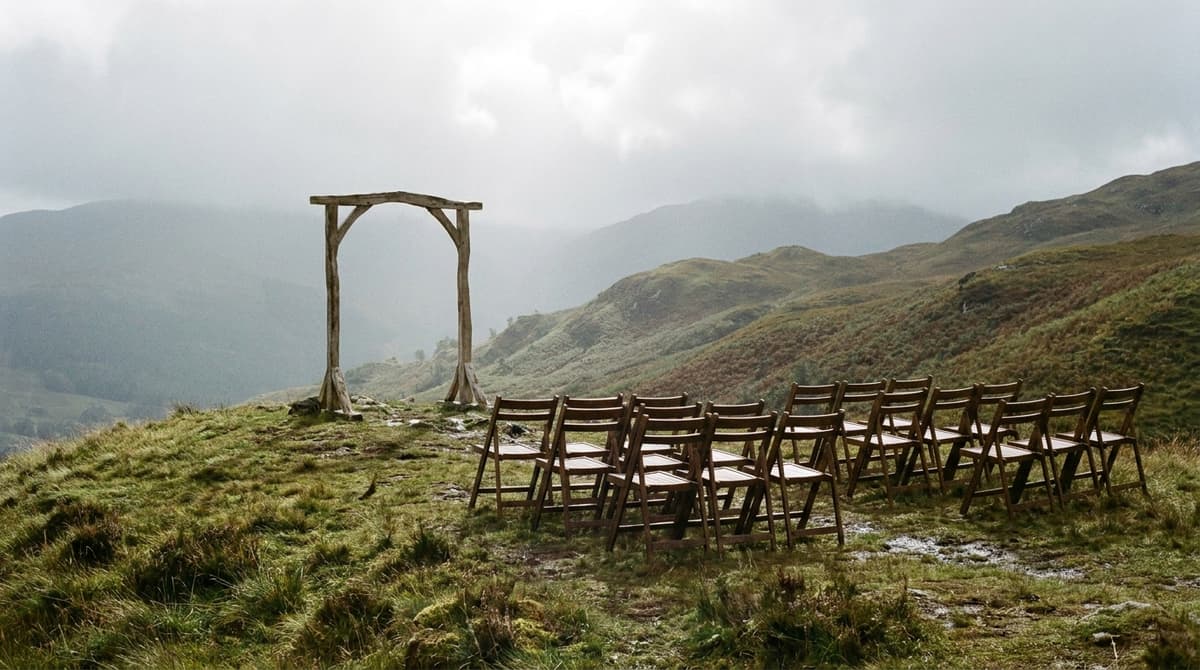
Civil ceremonies take place at a register office or at council-approved premises, such as a stately home or hotel, with a registrar. Since 6 April 2022 an approved venue can also hold the ceremony outdoors within its own grounds (SI 2022/295). They can include readings, songs or music, but nothing religious. At a register office the marriage takes place in the presence of two witnesses, and no religious service may be used (section 45).
Religious ceremonies can take place in any registered religious building. An authorised person, such as a minister, must attend and sign the marriage schedule; if the building has no authorised person, you book a registrar for £114.50.
Church of England weddings have their own routes. A marriage can be solemnised after banns are read, on a common licence, on a special licence, or on a marriage schedule like any other wedding (section 5). Banns become void if the wedding does not take place within 3 months of their completion (section 12), which is much shorter than the 12 months civil notice lasts. If either of you is not a relevant national (broadly, British, Irish or holding EU Settlement Scheme status), neither banns nor a common licence is normally available, so the wedding goes ahead on a marriage schedule after notice at the register office, or on a special licence (section 5(3)). Ask the parish about the notice process, since gov.uk says it can be different for Anglican weddings.
Humanist and other belief ceremonies are not legally binding in England and Wales. The Ministry of Justice's 2026 consultation confirms that non-religious belief organisations such as Humanists cannot conduct legally binding weddings at all (consultation paper), so couples who want one also marry legally with a registrar.
Every wedding needs at least 2 witnesses.
Welsh-language ceremonies
The Marriage Act 1949 requires the Registrar General to give registrars in Wales, and anywhere Welsh is commonly used, an official Welsh translation of the declarations and words that must be spoken, and that translation may be used there (section 52). Whether a particular ceremony can be conducted in Welsh depends on your registrar or officiant, so raise it when you book. Church in Wales weddings follow some separate rules under the Marriage (Wales) Act 2010; ask the parish.
Minimum age to marry
England and Wales: 18. A marriage where either person is under 18 is void (Marriage Act 1949, section 2). This has applied since 27 February 2023, when the Marriage and Civil Partnership (Minimum Age) Act 2022 came into force.
Scotland: 16. No one domiciled in Scotland may marry before 16, and a marriage in Scotland where either person is under 16 is void (Marriage (Scotland) Act 1977, section 1). The 2022 Act's age change applies to England and Wales only (section 6).
Northern Ireland: 16. Young people aged 16 and 17 can marry with parental or equivalent consent. The Marriage and Civil Partnership Bill would raise the minimum to 18 (Department of Finance). nidirect also warns that a marriage of a 16 or 17 year old in Northern Ireland will not be legally recognised in the Republic of Ireland, where the minimum age is 18.

Getting married in Scotland
Giving notice with the M10 form
Each of you completes an M10 marriage notice form and sends it, with the fee and your documents, to the registration office for the district where you plan to marry (Marriage (Scotland) Act 1977, section 3). The fee is £45 per person (National Records of Scotland). Ceremony and registration charges come separately from your registrar or celebrant.
You need your birth or adoption certificate, proof of usual residence such as a utility bill no older than 3 months, and a valid passport or other nationality document, plus divorce or death evidence if you have been married before.
Timing
The registrar cannot issue the marriage schedule for a religious or belief ceremony, or conduct a civil marriage, within 28 days of receiving a notice, unless the Registrar General authorises an earlier date on a written request (section 6; section 19). National Records of Scotland therefore asks for notices to arrive at least 29 days before the wedding, and recommends sending them 10 to 12 weeks in advance (NRS).
Do not send notice too early either. If more than 3 months have passed since a notice was received, the Registrar General can direct that a new notice be submitted before the schedule is completed.
The marriage schedule
For a civil ceremony, the registrar brings the marriage schedule on the day. For a religious or belief ceremony, one of you collects the schedule from the registration office no more than 7 days before the ceremony. After the wedding it is signed by both of you, the celebrant and two witnesses, and you must return it to the registrar within 3 days.
Celebrants, venues and language
You can choose a registrar for a civil ceremony or an approved religious or belief celebrant, and belief bodies include humanist organisations (NRS). Independent or private civil celebrants are not authorised to solemnise a marriage, so a ceremony led only by one of them is not a legal wedding.
Ceremonies in Scotland can take place at any indoor or outdoor location, as long as it is accessible to your celebrant or registrar (NRS). For a civil ceremony, the Act requires two witnesses who say they are 16 or over.
Getting married in Northern Ireland
Each of you gives the registrar a marriage notice (Marriage (Northern Ireland) Order 2003, article 3). You present it in person or by post to the registrar for the area where you plan to marry, with your long birth or adoption certificate and passport (nidirect).
Notice must be given within the 12 months before the wedding and at least 28 days before it, but nidirect advises getting notices to the registrar about 8 weeks before the wedding, or 10 weeks if either of you has been married or in a civil partnership before. nidirect says the Registrar General allows a shorter period only in exceptional circumstances. The fee listed is £22 per notice form, with a separate form for each person.
A civil ceremony can be held in the registrar's office, in an approved place, or at a temporary venue you apply for, such as your own home. nidirect lists a solemnisation fee from £36 for a civil ceremony, with council charges for rooms and venues on top (nidirect). A religious or belief ceremony can take place anywhere in Northern Ireland with the officiant's agreement. Either way you need two witnesses aged 16 or over.
If you do not have the right immigration status or evidence, the Home Office may investigate and the notice period may be extended to 70 days.
Humanist and belief weddings
Humanist weddings are possible in Northern Ireland, but through temporary arrangements: belief bodies can only apply for temporary officiant status (nidirect), an arrangement that followed a 2018 Court of Appeal ruling. The Department of Finance says the Marriage and Civil Partnership Bill would put belief marriages on a permanent legal footing.
The Marriage and Civil Partnership Bill
The Bill was introduced in the Northern Ireland Assembly on 16 March 2026 and passed its Second Stage on 20 April 2026. As of 25 October 2026 it is at Committee Stage, with later stages not yet scheduled (NI Assembly). Until it passes and comes into force, the minimum age stays at 16.
Same-sex marriage
- England and Wales: same-sex couples have been able to marry since 29 March 2014 under the Marriage (Same Sex Couples) Act 2013 (gov.uk). A religious building must be registered for same-sex marriages, and you cannot marry as a same-sex couple in a Church of England or Church in Wales church.
- Scotland: same-sex marriage is provided for by the Marriage and Civil Partnership (Scotland) Act 2014, and same-sex couples have been able to marry there since 16 December 2014 (section 2). Religious and belief bodies decide whether to nominate celebrants for same-sex weddings.
- Northern Ireland: same-sex couples have been able to marry since 13 January 2020 (SI 2019/1514). Religious same-sex weddings have been possible since 1 September 2020, but only where the religious body consents, and no religious body can be compelled (SI 2020/742).
Couples in a civil partnership have their own options, including converting it to a marriage in England and Wales; see our guide to civil partnership in the UK.
Reform in England and Wales: proposals only
The government has committed to reform weddings law in England and Wales. In July 2026 the Ministry of Justice published a consultation, Tying the Knot: Reforming weddings law in England and Wales (CP 1653), which closed on 24 September 2026. Its proposals include moving from rules based on the building to rules based on the officiant, an online first stage for notice, abolishing the 7-day residence rule, and opening legal weddings to belief organisations such as humanists.
None of this is law. The paper says legislation will be introduced when parliamentary time allows. As of October 2026 the rules in this guide still apply.
After the wedding
In England and Wales you can order a marriage certificate from the General Register Office or your local register office; GRO certificates cost £12.50 (gov.uk). Our guide to birth, marriage and death certificates in the UK covers ordering in each nation.
For what comes next, see changing your name after marriage or divorce, prenuptial agreements, and why living together does not create a common law marriage. More guides are on our UK family law hub.
Frequently Asked Questions
How far in advance do I need to give notice of marriage?
The legal waiting period is 28 days after your notice is recorded, which is why gov.uk and National Records of Scotland both tell couples to give notice at least 29 days before the wedding. Giving notice on 1 May means the earliest wedding date in England and Wales is 30 May. In practice, book your notice appointment well before that, because register offices can be busy, and Scotland recommends 10 to 12 weeks.
How long is a notice of marriage valid?
In England and Wales the wedding must take place within 12 months of notice being recorded (Marriage Act 1949, section 33), counted from the earlier notice if you gave notice on different days. In Northern Ireland notice must be given in the 12 months before the wedding. In Scotland the Registrar General can require a fresh notice if more than 3 months have passed since it was received, so do not submit too early.
How much does a register office wedding cost in England?
The statutory fees are £46.50 per person to give notice (£63 each if either of you is not an exempt person) and £62 for the registrar at a register office ceremony, so a couple who are both exempt pay at least £155 in statutory fees. Councils set their own charges for ceremony rooms and approved venues on top of this, and a marriage certificate costs extra.
Can 16 and 17 year olds get married in the UK?
Not in England and Wales, where the minimum age has been 18 since 27 February 2023 and a marriage involving anyone under 18 is void. In Scotland the minimum age is 16. In Northern Ireland it is also 16, with parental or equivalent consent needed for 16 and 17 year olds, but a Bill to raise it to 18 is going through the Northern Ireland Assembly.
Can I have a humanist wedding that is legally binding?
In Scotland, yes: humanist celebrants are authorised belief celebrants. In Northern Ireland, belief bodies can currently apply only for temporary officiant status, and a Bill would make this permanent. In England and Wales a humanist ceremony is not legally binding on its own, so couples also need a civil ceremony or a legal marriage with a registrar.
Can we get married outdoors?
In Scotland, yes, at any indoor or outdoor location your celebrant or registrar can reach. In Northern Ireland a religious or belief ceremony can take place anywhere with the officiant's agreement, and you can apply for a temporary venue for a civil ceremony. In England and Wales civil ceremonies must be held at a register office or council-approved premises, but since 6 April 2022 an approved venue can hold the ceremony outdoors in its own grounds. Religious weddings take place in a registered religious building or under Church of England rules, and Jewish and Quaker weddings follow their own rules.
Do we both have to give notice at the same register office?
In England and Wales you each give notice at the register office for the district where you have lived for the past 7 days, so if you live in different districts you give notice separately, and not necessarily on the same day. If either of you is not British, Irish or covered by the EU Settlement Scheme, you must give notice together at a register office in a district where at least one of you lives.
Can someone visiting the UK get married here?
A visitor who wants to give notice and marry in the UK without staying usually needs a Marriage Visitor visa. You cannot give notice or marry on a Standard Visitor visa. People planning to settle with a British partner apply through the family visa route instead.
Updates
Independently fact-checked against the cited primary sources
Sources and References
- Marriage Act 1949, section 27 (notice of marriage)(legislation.gov.uk).gov
- Marriage Act 1949, section 31 (waiting period)(legislation.gov.uk).gov
- Marriage Act 1949, section 33 (period of validity)(legislation.gov.uk).gov
- Marriage Act 1949, section 2 (marriages of persons under 18)(legislation.gov.uk).gov
- Marriage Act 1949, section 5 (Church of England marriage)(legislation.gov.uk).gov
- Marriage Act 1949, section 12 (banns void after three months)(legislation.gov.uk).gov
- Marriage Act 1949, section 28H (referral to the Secretary of State)(legislation.gov.uk).gov
- Marriage Act 1949, section 45 (register office marriage)(legislation.gov.uk).gov
- Marriage Act 1949, section 52 (Welsh translation)(legislation.gov.uk).gov
- Registration Fees Regulations 2016, Schedule 1 (as amended)(legislation.gov.uk).gov
- Registration Fees (Amendment and Transitional Provisions) Regulations 2026, SI 2026/233(legislation.gov.uk).gov
- Immigration Act 2014, section 48 (decision whether to investigate)(legislation.gov.uk).gov
- Immigration Act 2014, section 50 (70 day period)(legislation.gov.uk).gov
- Marriage and Civil Partnership (Minimum Age) Act 2022, section 6 (extent)(legislation.gov.uk).gov
- gov.uk: Give notice of marriage(gov.uk).gov
- gov.uk: Documents you need to give notice(gov.uk).gov
- gov.uk: Plan your ceremony(gov.uk).gov
- gov.uk: If you or your partner is from outside the UK or Ireland(gov.uk).gov
- gov.uk: Marriage Visitor visa(gov.uk).gov
- Ministry of Justice: Tying the Knot, Reforming weddings law in England and Wales (CP 1653)(assets.publishing.service.gov.uk).gov
- Marriage (Scotland) Act 1977, section 1 (minimum age)(legislation.gov.uk).gov
- Marriage (Scotland) Act 1977, section 3 (marriage notice)(legislation.gov.uk).gov
- Marriage (Scotland) Act 1977, section 6 (marriage schedule)(legislation.gov.uk).gov
- National Records of Scotland: Fees, forms and documents(nrscotland.gov.uk).gov
- National Records of Scotland: Sending your documents(nrscotland.gov.uk).gov
- National Records of Scotland: Making arrangements(nrscotland.gov.uk).gov
- National Records of Scotland: Marriage and civil partnership celebrants(nrscotland.gov.uk).gov
- Marriage (Northern Ireland) Order 2003, article 3 (marriage notice)(legislation.gov.uk).gov
- nidirect: How and when to give notice for marriage(nidirect.gov.uk).gov
- nidirect: Getting married in a civil ceremony(nidirect.gov.uk).gov
- nidirect: Officiant registration(nidirect.gov.uk).gov
- Department of Finance (NI): Raising marriage age(finance-ni.gov.uk).gov
- Northern Ireland Assembly: Marriage and Civil Partnership Bill(niassembly.gov.uk).gov
- gov.uk: First same sex weddings to happen from 29 March 2014(gov.uk).gov
- Marriage (Same-sex Couples) and Civil Partnership (Opposite-sex Couples) (NI) Regulations 2019, regulation 1(legislation.gov.uk).gov
- Marriage and Civil Partnership (Northern Ireland) Regulations 2020, SI 2020/742(legislation.gov.uk).gov
- gov.uk: Order a copy of a birth, death or marriage certificate(gov.uk).gov
- Immigration Act 2014, section 49 (exempt persons)(legislation.gov.uk).gov
- Proposed Marriages and Civil Partnerships (Meaning of Exempt Persons and Notice) Regulations 2015, regulation 4 (relevant visa)(legislation.gov.uk).gov
- Marriages and Civil Partnerships (Approved Premises) (Amendment) Regulations 2022, SI 2022/295(legislation.gov.uk).gov
- Marriage (Scotland) Act 1977, section 19 (civil marriage)(legislation.gov.uk).gov