
Ireland
E-Scooter Laws in Ireland (2026): Rules, Limits and Fines
Independently fact-checked against primary sources (last audited July 20, 2026). · 5 primary sources cited on this page. How we verify our legal content
E-scooters have been legal to ride on public roads in the Republic of Ireland since 20 May 2024. The Road Traffic and Roads Act 2023 created a new vehicle category called the powered personal transporter (PPT), classed e-scooters as a type of PPT, and the Road Traffic (Electric Scooters) Regulations 2024 (S.I. No. 199/2024) then set out exactly what a legal e-scooter is and how it may be used.
The rules are detailed and specific. Your scooter must meet strict technical standards on power, speed, weight and equipment, you must be at least 16, and a long list of offences carries a flat €50 fixed charge, with drink or drug riding going straight to court. This guide sets out the current rules, verified against the Irish Statute Book, the Department of Transport and Citizens Information.
Information last verified on 20 July 2026. This page is general legal information for the Republic of Ireland, not legal advice.
Are e-scooters legal in Ireland?
Yes. Compliant e-scooters have been legal on Irish public roads since 20 May 2024, the commencement date set by Regulation 1(2) of S.I. No. 199/2024. Before that date there was no legal framework for using them in public at all.
The foundation is Part 12 of the Road Traffic and Roads Act 2023 (No. 16 of 2023), which created the powered personal transporter category in the Road Traffic Act 1961. Under the 2024 Regulations, an electric scooter is a PPT with handlebars, two axles and at least one electric motor, designed to carry one person in a standing position, with no provision for seating.
Companion instruments complete the framework: S.I. 222/2024 brings e-scooters within the general traffic and parking rules, which is what applies the footpath ban to them, S.I. 732/2024 gives An Garda Síochána powers to detain and remove non-compliant machines, S.I. 224/2024 keeps non-compliant PPTs illegal in public places, and S.I. 227/2024 sets the €50 fixed charges.
What counts as a legal e-scooter?
Only scooters that meet the technical standards may be used in a public place. The main requirements are:
| Requirement | Legal standard |
|---|---|
| Maximum continuous rated power | 400 W (0.4 kW) |
| Maximum design speed | 20 km/h |
| Maximum net weight | 25 kg, including batteries |
| Minimum wheel diameter | 200 mm, including the tyre |
| Maximum dimensions | 2,000 mm long, 800 mm wide, 1,500 mm high (including handlebars) |
| Brakes | Two independent brakes, one on the front wheel and one on the rear, both usable without taking a hand off the handlebars |
| Lights | White front lamp and red rear lamp, each visible from at least 50 metres and lit during lighting-up hours; the front lamp must also be capable of adequately illuminating the road, so a marker-style light is not enough |
| Reflectors | White at the front, red at the rear, and white or yellow reflective material on both sides |
| Bell or horn | An audible warning device is mandatory |
| CE marking | Required on the scooter and on its battery |
There are further rules on top of the table. No seat may be fitted. A manufacturer's plate showing the maker, model, design speed, power, weights and serial number is mandatory. Modifying a scooter in any way that raises its speed or power is prohibited, as is fitting anything for towing. Tyres must be pneumatic or soft tyres designed for road use.
One point is often misreported: the 25 kg weight cap does not appear in S.I. 199/2024 itself. It forms part of the statutory definition of a powered personal transporter in section 3(1) of the Road Traffic Act 1961, inserted by section 16 of the Road Traffic Act 2024, with section 17 of the 2023 Act confirming that battery weight counts towards the unladen weight. The practical effect is the same: a scooter over 25 kg is not a legal e-scooter.
When buying, look for the CE mark on both the scooter and the battery, and ask the retailer for the EU Declaration of Conformity they are required to provide.
Do I need a licence, insurance or motor tax?
No. Riding a compliant e-scooter requires no driving licence, no registration, no motor tax and no insurance.
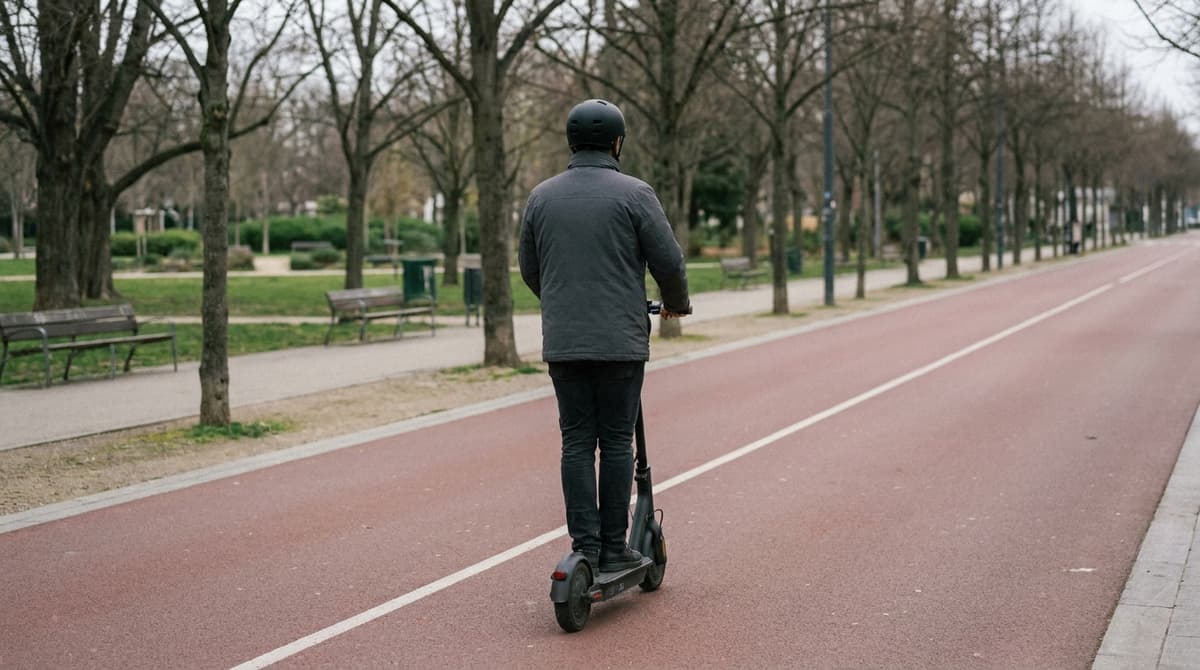
Two personal requirements do apply. You must be at least 16 years old, and the Gardaí can confiscate an e-scooter being ridden by someone under 16. A helmet and high-visibility clothing are recommended in the official road safety guidance, but neither is a legal requirement.
Where can you ride an e-scooter?
You may ride on local, regional and national roads, in cycle lanes and on cycle tracks, and in bus lanes. Footpaths, pedestrianised areas, motorways and busways are all banned. Riding on a footway is a fixed-charge offence except where you are crossing it for direct access or egress. The motorway and busway bans do not come from the 2024 Regulations: the Road Traffic and Roads Act 2023 amended the Roads Act 1993 to keep powered personal transporters off both.
Normal road rules apply. You must keep left, obey traffic lights including cycle traffic lights, obey road signs, stop for pedestrian and zebra crossings, and follow the signals of Gardaí and school wardens. When parking, you must not leave a scooter in no-parking zones such as loading bays, accessible parking spaces or charging bays.
What is banned while riding?
The Regulations ban a specific list of behaviours on top of the general road rules:
- Carrying a passenger. An e-scooter is a one-person, standing-only vehicle, so carrying a child or a friend is an offence.
- Carrying goods. Food and parcel delivery loads are not permitted on an e-scooter.
- Towing anything, or fitting a seat.
- Holding or using a mobile phone while driving.
- Riding under the influence of an intoxicant, whether alcohol or drugs.
Drink and drug riding is the one everyday offence that skips the fixed-charge system entirely. It leads to a court appearance and a fine of up to €2,000. Because no driving licence is involved, no penalty points attach; the offence is simply riding under the influence of an intoxicant.
What are the fines for e-scooter offences?
Nearly all e-scooter offences are fixed-charge offences carrying a flat €50 charge, set by S.I. 227/2024. There are 23 fixed-charge offences in total. These are among the most relevant in practice:
| Offence | Fixed charge |
|---|---|
| Exceeding the 20 km/h speed limit | €50 |
| Driving on a footway (footpath) | €50 |
| Carrying a passenger | €50 |
| Carrying goods | €50 |
| Holding a mobile phone while driving | €50 |
| Prohibited modification (for example, de-restricting speed or power) | €50 |
| No compliant braking device | €50 |
| No compliant lighting or reflectors | €50 |
| Disobeying traffic lights | €50 |
| Driving a scooter that is not roadworthy | €50 |
The full list of 23 also covers items such as having no bell or horn, non-compliant wheels or tyres, entering a pedestrianised street, and failing to stop for a Garda or school warden. There is no NCT for e-scooters, but the owner and driver must keep the scooter roadworthy; serious failures can lead to prosecution beyond the fixed charge.
Can my e-scooter go faster than 20 km/h?
Not legally, and this is the trap that catches most buyers. Two separate 20 km/h rules apply: a legal e-scooter must have a maximum design speed of 20 km/h built in, and a 20 km/h ordinary speed limit applies on all public roads (or lower where a lower limit is posted).
A scooter that exceeds 400 W, 25 kg or a 20 km/h design speed is not a legal e-scooter at all. Under S.I. 224/2024 it remains illegal to use in any public place, and it cannot be registered, taxed or insured into legality.
The Gardaí have dedicated powers under S.I. 732/2024, which replaced S.I. 223/2024 in December 2024, to detain, remove and store non-compliant e-scooters. Reclaiming a detained scooter carries a charge of €40 for the first day and €15 for each further day, and an unclaimed machine can be disposed of. The owner is also liable: where a non-compliant scooter is used in a public place, the owner commits an offence too, so a parent who buys a de-restricted scooter for a teenager shares the risk.
Can I bring my e-scooter on the bus or train?
In practice, no. Since October 2024 the National Transport Authority has instructed the operators it contracts with to refuse e-scooters: Dublin Bus, Bus Éireann, Go-Ahead Ireland, Iarnród Éireann, Luas and TFI Local Link. This is NTA guidance to those operators rather than a statutory prohibition, and the NTA says it is subject to periodic review, but the practical effect is that you cannot bring an e-scooter on board. The reason given is the fire risk from lithium-ion batteries. The guidance does not apply to e-bikes or to mobility scooters.
Has anything changed since 2024?
The core technical and use rules in S.I. 199/2024 remain in force unamended as of July 2026, and the Department of Transport (updated August 2025) and Citizens Information (edited January 2026) both describe the same framework. The surrounding instruments have moved, though. S.I. 223/2024 was revoked and replaced by S.I. 732/2024 in December 2024, and the general traffic and parking rules were recast by S.I. 473/2025 without changing where e-scooters may be ridden. For the rest of our Republic of Ireland coverage, see the Ireland legal hub.

This page is general information about the Republic of Ireland's e-scooter rules, not legal advice. Rules and fixed-charge amounts can change; check the Department of Transport and Citizens Information for the current position, and consult a solicitor if you face prosecution or a Garda seizure over an e-scooter matter.
Frequently Asked Questions
Do I need insurance to ride an e-scooter in Ireland?
No. A compliant e-scooter needs no insurance, motor tax, registration or driving licence. This only applies within the legal limits; an over-spec scooter cannot be insured into legality and is illegal to use in public at all.
Can I ride an e-scooter on the footpath in Ireland?
No. Footpaths and pedestrianised areas are banned, along with motorways. Driving on a footway carries a €50 fixed charge, except where you cross it for direct access or egress. You can ride on roads, cycle lanes and bus lanes.
What is the fine for breaking the e-scooter rules?
Almost every e-scooter offence carries a flat €50 fixed charge, from speeding and phone use to carrying a passenger. Riding under the influence of alcohol or drugs is different: it means a court appearance and a fine of up to €2,000.
Can my e-scooter go faster than 20 km/h?
Not legally. A legal e-scooter must have a 20 km/h maximum design speed, and a separate 20 km/h speed limit applies on public roads. A faster or more powerful scooter is not a legal e-scooter, is banned from all public places, and can be seized by the Gardaí. Modifying a scooter to raise its speed or power is itself an offence.
How old do you have to be to ride an e-scooter in Ireland?
You must be at least 16. The Gardaí can confiscate an e-scooter being ridden by someone under 16.
Do I have to wear a helmet on an e-scooter in Ireland?
No. Helmets and high-visibility clothing are strongly recommended in official road safety guidance, but neither is a legal requirement.
Can I take my e-scooter on public transport in Ireland?
In practice, no. Since October 2024 the National Transport Authority has instructed the operators it contracts with, including Dublin Bus, Iarnród Éireann and Luas, to refuse e-scooters over lithium-ion battery fire risk. It is NTA guidance rather than a statutory ban, and it does not cover e-bikes or mobility scooters.
Updates
Independently fact-checked against the cited primary sources
S.I. No. 732/2024 replaced S.I. No. 223/2024 as the instrument governing Garda detention, removal and storage of powered personal transporters. The substance is unchanged: detention, a €40 first-day charge plus €15 for each further day, and disposal of unclaimed machines.
The Road Traffic (Electric Scooters) Regulations 2024 (S.I. No. 199/2024) came into operation, making compliant e-scooters legal on public roads in Ireland for the first time, alongside companion instruments covering traffic rules, Garda detention powers and €50 fixed charges.
Sources and References
- S.I. No. 199/2024 - Road Traffic (Electric Scooters) Regulations 2024, Irish Statute Book(irishstatutebook.ie).gov
- E-Scooters, Department of Transport (gov.ie), updated 20 August 2025(gov.ie).gov
- S.I. No. 732/2024 - Road Traffic Act 1994 (Detention of Powered Personal Transporters) Regulations 2024 (revoking S.I. No. 223/2024)(irishstatutebook.ie).gov
- Road Traffic Act 2024 (No. 10 of 2024), section 16: definition of a powered personal transporter(irishstatutebook.ie).gov
- E-scooters, Citizens Information Board (statutory body), edited 12 January 2026(citizensinformation.ie).gov