
Mississippi
Mississippi Marriage and Divorce Records: How to Get a Copy (2026)
Independently fact-checked against primary sources (last audited August 4, 2026). · 6 primary sources cited on this page. How we verify our legal content

Mississippi splits marriage and divorce records between two very different offices. The Mississippi State Department of Health holds marriage records going back to 1926, and by its own rule it also maintains the reports of divorce that chancery clerks are required to file with it. What the state will not issue is a certified divorce certificate or decree. That comes only from the county Chancery Clerk.
Information last verified on 2026-08-04. This article has not yet been reviewed by a licensed lawyer.
This page is part of our guide to marriage and divorce records by state. It covers who holds each Mississippi record, what the state can and cannot issue, what it costs, and how far back the files go.
Where Mississippi Marriage Records Live
Two offices hold pieces of a Mississippi marriage. The Circuit Clerk in the county that issued the marriage license keeps the original license and the return filed after the ceremony. The Mississippi State Department of Health (MSDH) maintains a statewide file assembled from those county filings, and it is MSDH that issues a certified state copy.
The MSDH file is not continuous. Its own marriage records page states that "Marriage records are available for January 1, 1926 to June 30, 1938, and for January 1, 1942 to present." Anything solemnized inside the roughly three and a half year gap from mid 1938 to the start of 1942, and anything before 1926, has to be traced through the county Circuit Clerk instead.
MSDH also warns that the statewide file is not complete even inside those ranges: "Though required by law to be registered with MSDH, not all marriage records may be on file with the Office of Vital Records." If the state search comes back empty, that is not proof the marriage did not happen. The next step is the Circuit Clerk in the county where the license was issued, which MSDH itself points applicants toward.
Divorce Records in Mississippi: the Decree Is a Court Record
Start with the distinction that decides where you write. A divorce decree is the court's judgment, signed by a chancellor and filed in the Chancery Court that granted it. A vital-records certificate or verification is a much thinner document created by a health agency to confirm that a divorce was recorded. Many states issue both. Mississippi issues only one of them in certified form.
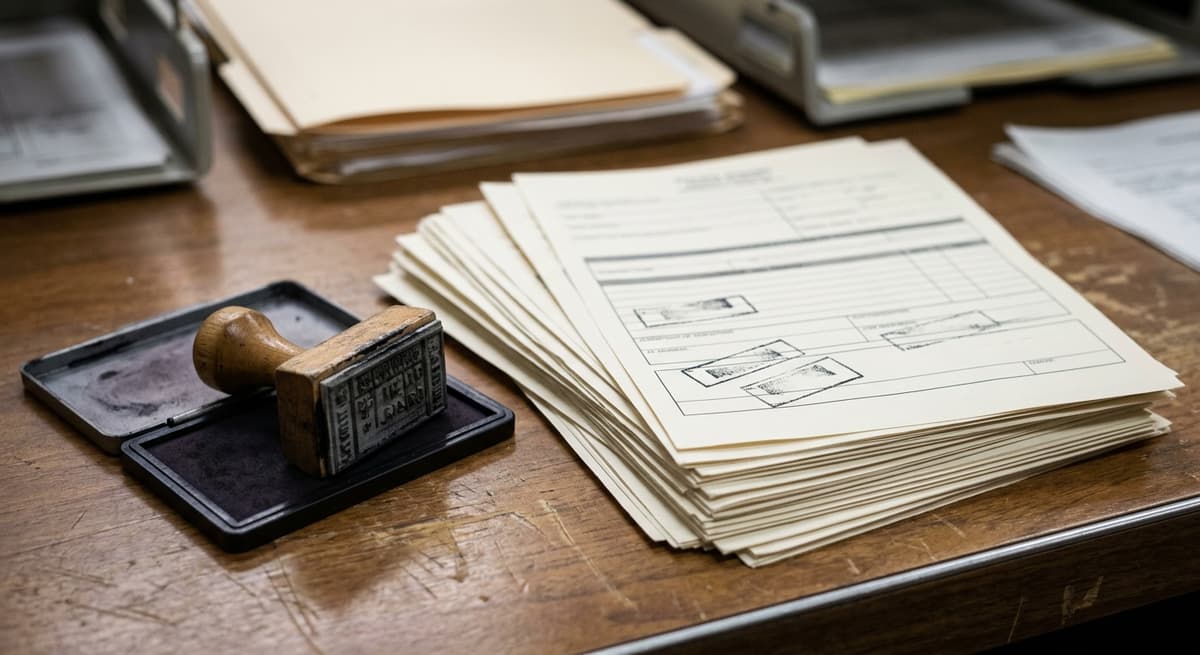
MSDH's consumer page puts it bluntly: "MSDH's Vital Records office does not maintain divorce records." Read on its own that line overstates the position, and it is worth knowing what the state actually holds. Miss. Code Ann. section 93-5-33 makes it "the duty of each chancery clerk in the state to make a report of each divorce granted in his county," on "forms furnished by the State Board of Health," certified under seal and forwarded to the board within ten days after adjournment of each term of court. MSDH's own regulation follows through: Registration and Certification of Vital Events Rule 1.4.2 provides that "The State Registrar shall register and maintain reports of marriage prepared and filed by the clerk of the circuit court of each county, and reports of divorce prepared and filed by each clerk of the chancery court of each county."
So the state does hold divorce material, and it will sell you a copy of it. What MSDH markets is a five-year search of the county divorce indexes for $17, which locates "the county where the divorce was granted, the book, and the page number in the Chancery Clerk's office where it was recorded." Its fee rule also prices the underlying report itself: Rule 2.3.1(2) sets "Seventeen dollars ($17.00) for one non-certified copy of a report on file" for a Statistical Report of Divorce. What no amount of money gets you from MSDH is a certified divorce certificate or a certified copy of the decree, because the rule names the chancery clerk as "the legal custodian of divorce decrees."
The certified decree itself comes from one place. MSDH directs applicants that "The Chancery Clerk's office will need to be contacted directly in order to obtain a certified copy of the divorce decree." Fees for that certified copy are set statewide by statute, not clerk by clerk. Miss. Code Ann. section 25-7-9 fixes the chancery clerk's charge at "$1.00" "For the act of certifying copies of filed documents, for each complete document," and at "$.50" per page for furnishing copies of papers of record "If performed by the clerk or his employee." What genuinely varies between counties is the surrounding practice: accepted payment methods, whether the office takes mail or walk-in requests, and turnaround.
The MSDH divorce index covers the same two windows as the marriage file, January 1, 1926 to June 30, 1938 and January 1, 1942 to the present, and carries the same completeness caveat. Note that the $17 buys a five-year slice of that span rather than the whole of it, so an approximate year matters. If you already know the county, skip the state entirely and go straight to the Chancery Clerk.
Who Can Request a Mississippi Record
Mississippi is not an open-inspection state for certified vital records. Its marriage record application instructions describe the eligible class this way: "If you are applying for yourself, or you are applying for someone else as their spouse, parent, grandparent, sibling, child, grandchild, guardian, or legal representative, then you must provide a completed application and a copy of your valid photo identification."
A guardian or legal representative has to document that status with the application. Attorneys are asked for a bar number, the name of the person represented, and the nature of the representation. Everyone else in the eligible list needs the application and the photo ID, nothing more.
The rule behind that list is a discretionary interest test. MSDH's own regulation, Registration and Certification of Vital Events, provides at Rule 2.1.2 that "The State Registrar shall not permit inspection of, or disclose information contained in any records relating to vital events, or copy or issue a copy of all or part of any such record unless he is satisfied that the applicant has a legitimate and tangible interest in such record," citing Miss. Code Ann. sections 41-57-1, 41-57-2, and 41-57-7 as its source.
The regulation then lists who qualifies, which is where the immediate-family list comes from, and lists who does not. Commercial, political, and for-profit requesters are expressly named as applicants without a legitimate and tangible interest. That is worth knowing if you are considering a paid records service: the state has already decided that a commercial requester does not clear its own bar.
The court layer works differently. Chancery Court files, including divorce files, are court records rather than health-agency records, and access to them runs through the clerk and the court's own rules rather than the MSDH eligibility list. Our guide to Mississippi public records law covers how records requests work in the state generally.
What It Costs and How to Order
MSDH charges $17 for a search of the records and a certified copy, and $6 for each additional copy of the same record ordered at the same time. The $17 is a search fee as much as a copy fee, which means it is charged whether or not a record turns up.
Be clear on how much searching that fee buys. The marriage record application instructions state that "A five year search of our records will be made," and the divorce page describes "A five-year search of county divorce indexes" for the same $17. If you cannot place the event within about five years, the search can come back empty on a record that exists. The wider case is priced separately: Rule 2.3.1(7) of the MSDH regulation provides that "Requests for a record search which cover multiple years, multiple counties or multiple names for the same record shall be charged at twenty-eight dollars ($28.00) per hour." Pinning down the year and the county before you order is the cheapest step in the whole process.
Three ordering channels exist, as of August 2026. You can mail a completed application with payment to Mississippi Vital Records in Jackson. You can order online or by phone through VitalChek, which MSDH describes on its own site as the private company that "provides the following services for Mississippi Vital Records" and which adds a service fee to the $17. Or you can walk into the MSDH office at 222 Marketridge Drive in Ridgeland during business hours.
For the divorce decree, none of that applies. Contact the Chancery Clerk in the county of the divorce, and expect that office's own form and turnaround on top of the statutory copy fees. A step-by-step walkthrough of ordering a marriage certificate copy covers the paperwork common to every state.
Records Before 1926 and Genealogy Research
Because the MSDH file starts in 1926, anything older is county material. The Mississippi Department of Archives and History (MDAH) holds a statewide marriage index compiled by the Works Progress Administration, listing the name of the groom, the name of the bride, the date of record, the presiding official, and the county of marriage. MDAH also holds microfilm of county marriage books, though the extent of that collection varies county to county.

MDAH does not describe an equivalent divorce collection. For a pre-1926 Mississippi divorce, the realistic path is the Chancery Clerk in the county where it was granted, and for very early cases, the legislative session acts, since divorces were once granted by act of the legislature rather than by a court.
Confirming Whether Someone Is Married or Divorced
Mississippi's eligibility list means you cannot simply order a stranger's marriage certificate to check their status. If you have a legitimate personal reason to confirm a marital history, the $17 MSDH five-year index search is the honest route where you fall inside the eligible class, and the Chancery Clerk's index is the route for divorces where you know the county. Our guide to how to find out if someone is married or divorced sets out the lawful routes generally, including the states that publish far more of this than Mississippi does.
Commercial background-check products are unreliable for exactly this data point, because marriage and divorce filings are county-scattered and inconsistently digitized nationwide. Treat any paid "marriage records search" result as a lead to verify at the county, not an answer. None of this may be used for employment, tenant, or credit screening, which are regulated uses under the federal Fair Credit Reporting Act.
If the relationship in question was never licensed at all, no certificate exists to find. Mississippi abolished common law marriage decades ago, and our page on Mississippi common law marriage explains what that means for couples who never got a license. For the law of ending a marriage rather than documenting one, see Mississippi divorce laws. For the sibling records franchise, see Mississippi death records.
Disclaimer
This article provides general information about how Mississippi marriage and divorce records are held and released. It is not legal advice, and record custody, fees, and processing times can change. Figures and procedures described here reflect official Mississippi State Department of Health sources as of August 2026. Anyone dealing with a contested record, a sealed file, or a legal proceeding should consult an attorney licensed in Mississippi.

Last updated: 2026-08-04.
Frequently Asked Questions
Does Mississippi issue divorce certificates?
Not certified ones. Only the Chancery Clerk in the county that granted the divorce can certify the decree, and MSDH's rule names that clerk as the legal custodian of divorce decrees. MSDH does maintain the statutory reports of divorce that chancery clerks file with it: $17 buys a five-year search of the county divorce indexes that returns the county, book, and page where the decree was recorded, and the department's fee rule also prices one non-certified copy of a Statistical Report of Divorce at $17.
How far back do Mississippi marriage records go at the state level?
MSDH holds marriage records for January 1, 1926 to June 30, 1938, and for January 1, 1942 to the present. There is a gap between those windows, and marriages before 1926 were never part of the statewide file. For those, contact the Circuit Clerk in the county that issued the license.
How much does a Mississippi marriage certificate cost?
MSDH charges $17 for a search and a certified copy, and $6 for each additional copy of the same record ordered at the same time, as of August 2026. That $17 covers a five-year search of the records; a search spanning multiple years, counties, or names is billed at $28 per hour. Ordering online or by phone through VitalChek adds that company's own service fee on top.
What does a Chancery Clerk charge for a certified divorce decree?
The copy fees are set statewide by statute rather than by each county. Miss. Code Ann. Section 25-7-9 sets $1.00 for certifying each complete document and $.50 per page for furnishing copies when the work is done by the clerk or an employee. What varies between counties is the surrounding practice, such as accepted payment methods and turnaround.
Who is allowed to order a Mississippi marriage record?
The person named on the record, or that person's spouse, parent, grandparent, sibling, child, grandchild, guardian, or legal representative. Every applicant must include a copy of a valid photo ID, and guardians and legal representatives must document their status.
Which county office holds a Mississippi divorce decree?
The Chancery Clerk in the county where the divorce was granted. Chancery Courts handle divorce in Mississippi, so the decree is filed with the Chancery Clerk rather than the Circuit Clerk who handles marriage licenses.
What if MSDH cannot find the marriage record?
MSDH warns that not all marriage records are on file with the Office of Vital Records even though registration is required by law, and the standard search covers only five years. An empty state search is not proof the marriage did not occur. Widen the year range or ask the Circuit Clerk in the county where the license was issued.
Updates
Corrected the description of Mississippi divorce records at the state level, replaced an inverted claim about Chancery Clerk copy fees with the statewide statutory schedule, and added the five-year limit on the $17 record search.
Independently fact-checked against the cited primary sources
The Law Behind This Article
This article rests on the statutory provisions below, held in our own legal record and retrieved from the official source. Tap a section to read the operative text.
Mississippi Code of 1972 Annotated
§ 41-57-2Certain persons not entitled to access to records.In forcecited in 4 of our articles
Records in the possession of the Mississippi Department of Health, bureau of vital statistics, which would be of no legitimate and tangible interest to a person making a request for access to such records, shall be exempt from the provisions of the Mississippi Public Records Act of 1983;…
Official text (excerpt) · last checked 2026-09-04 · Read the full text in our law library
Cited in 2 court opinions in our collectionLatest citing opinion in our collection: 2011
Opinions citing this section in our collection:
- Birkhead v. State (Mississippi Supreme Court 2011, 57 So. 3d 1223)“…tained therein are admissible. See Miss. R. Evid. 803(9); Miss.Code Ann. § 41-57-2 (Rev.2009); Shell, 554 So.2d at 898…”
- Richard Earl Birkhead v. State of Mississippi (Mississippi Supreme Court 2007)“…ntained therein are admissible. See Miss. R. Evid. 803(9); Miss. Code Ann. § 41-57-2 (Rev. 2009); Shell, 554 So. 2d at 898.…”
Identified automatically from the court opinions citing this section — not a ranking of which case controls.
Also relied on in: Mississippi Death Records: Are They Public + How to Get One, How to Find a Cause of Death in Mississippi (2026), How to Get a Mississippi Death Certificate (2026)
Search our full record of US law — 2.1 million sections, every state + federal →
Sources and References
- Mississippi State Department of Health, Marriage Records(msdh.ms.gov).gov
- Mississippi State Department of Health, Divorce Records(msdh.ms.gov).gov
- Mississippi State Department of Health, Marriage Record Application Instructions(msdh.ms.gov).gov
- Mississippi State Department of Health, Online and Phone Ordering (VitalChek)(msdh.ms.gov).gov
- Mississippi State Department of Health, Registration and Certification of Vital Events (Title 15 rules)(msdh.ms.gov).gov
- Mississippi State Department of Health, Vital Records(msdh.ms.gov).gov
- Miss. Code Ann. Sec. 93-5-33, Statistical requirements (chancery clerk duty to report each divorce to the State Board of Health)(law.justia.com)
- Miss. Code Ann. Sec. 25-7-9, Clerks of the chancery court (statutory fee schedule)(archive.org)