
Colorado
Is Jaywalking Illegal in Colorado? Crossing Rules and Fines (2026)
Independently fact-checked against primary sources (last audited October 10, 2026). · 9 primary sources cited on this page. How we verify our legal content
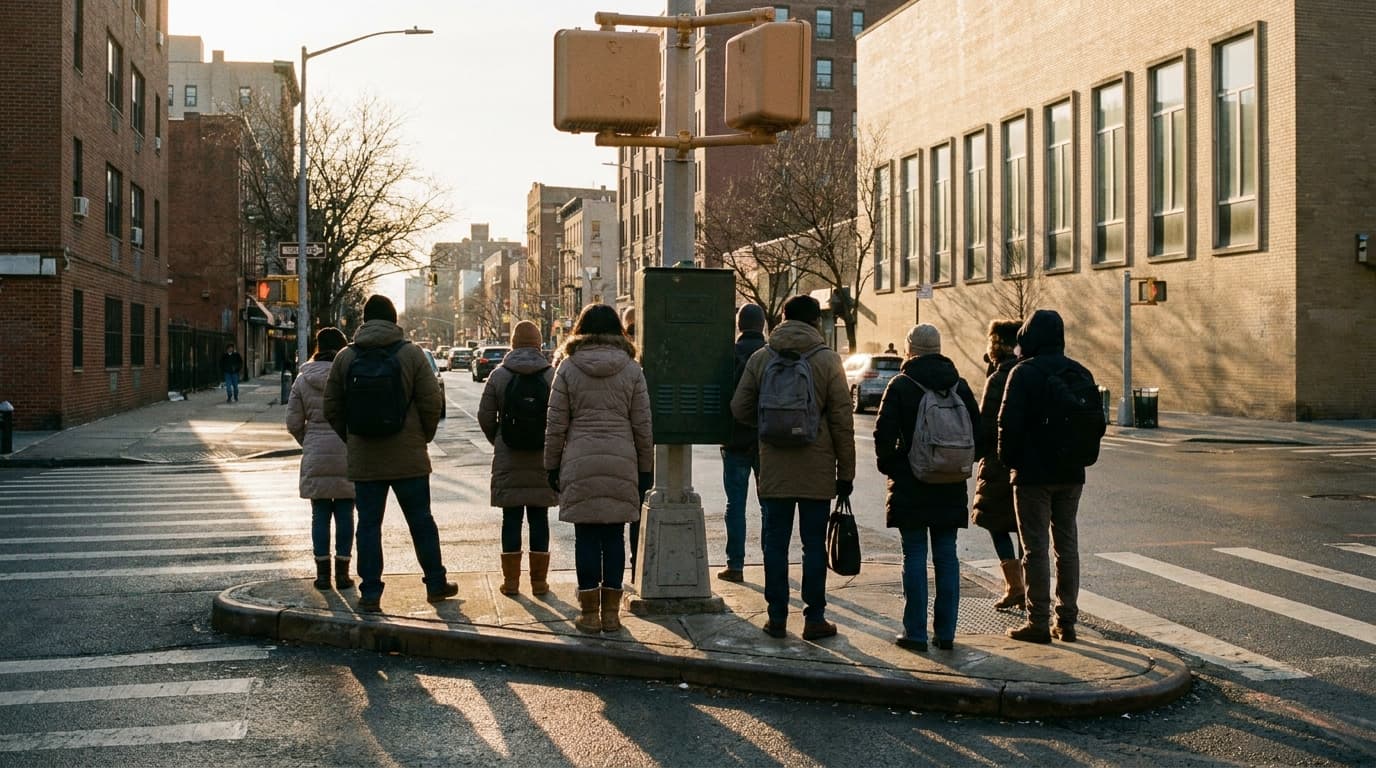
What people call jaywalking is governed in Colorado mainly by C.R.S. 42-4-803. A pedestrian crossing anywhere other than a marked crosswalk or an unmarked crosswalk at an intersection must yield the right-of-way to all vehicles, may cross between adjacent signalized intersections only in a marked crosswalk, and may not cross an intersection diagonally unless traffic control devices allow it. A violation is a class B traffic infraction, and the state penalty schedule lists $15 plus a $6 surcharge (42-4-1701(4)(a)(I)(I)). For how other states handle the same question, see our guide to jaywalking laws by state.
Information last verified on 2026-10-10. This article has not been reviewed by a licensed lawyer.
Jurisdiction scope: This article covers Colorado state law: the pedestrian sections of the traffic code (C.R.S. 42-4-801, 42-4-802, 42-4-803, 42-4-805 and 42-4-807) and the traffic infraction penalties in 42-4-1701, as published in the 2025 Colorado Revised Statutes, plus the school-street section 42-4-119 added by HB26-1318 (2026). It does not cover city or county ordinances, injury claims after a crash, or the law of other states.
Is jaywalking illegal in Colorado?
Colorado sets several distinct crossing rules. Crossing outside a crosswalk is allowed if you yield to traffic. Two rules are flat prohibitions: crossing mid-block between signalized intersections outside a marked crosswalk, and crossing an intersection diagonally where no traffic control device authorizes it.
| Situation | Colorado rule | Scheduled penalty plus surcharge |
|---|---|---|
| Crossing outside a marked crosswalk or an unmarked crosswalk at an intersection | Allowed, but the pedestrian must yield to all vehicles (42-4-803(1)) | $15 + $6 |
| Crossing where a pedestrian tunnel or overhead crossing is provided | Pedestrian must yield to all vehicles (42-4-803(2)) | $15 + $6 |
| Crossing between adjacent intersections with traffic control signals in operation | Only in a marked crosswalk (42-4-803(3)) | $15 + $6 |
| Crossing an intersection diagonally | Only where official traffic control devices authorize it (42-4-803(4)) | $15 + $6 |
| Entering the roadway on a steady Don't Walk, or starting to cross on a flashing Don't Walk | Barred (42-4-802) | $30 + $6 (42-4-802(5)) |
| Disobeying a traffic control device that applies to pedestrians | Must obey unless a police officer directs otherwise (42-4-801) | $15 + $6 |
| Walking along a highway with no sidewalk | On the shoulder; otherwise near an outside edge, on the left facing traffic on a two-way road (42-4-805(1)) | $15 + $6 |
| Suddenly leaving a curb into the path of a vehicle so close as to be an immediate hazard | Barred (42-4-802(3)) | $15 + $6 |
| Starting to cross on a steady yellow, with no pedestrian signal | Barred (42-4-604(1)(b)(II)) | $100 + $10 (42-4-604) |
| Entering the roadway on a steady red or red arrow, with no pedestrian signal | Barred (42-4-604(1)(c)(II), (IV)) | $100 + $10 (42-4-604) |
| On a designated school street (since August 12, 2026) | 42-4-801, 42-4-803 and 42-4-805(1) and (2) do not apply; vehicles must yield to pedestrians (42-4-119) | Not applicable |
Amounts in the last column come from the pedestrian rows of the penalty schedule in C.R.S. 42-4-1701(4)(a)(I)(I), except the 42-4-604 signal rows, which use the schedule's single 42-4-604 entry.
Crossing outside a crosswalk in Colorado
C.R.S. 42-4-803 contains the yield rule, the mid-block ban, the diagonal-crossing rule and the penalty class:

"(1) Every pedestrian crossing a roadway at any point other than within a marked crosswalk or within an unmarked crosswalk at an intersection shall yield the right-of-way to all vehicles upon the roadway. (2) Any pedestrian crossing a roadway at a point where a pedestrian tunnel or overhead pedestrian crossing has been provided shall yield the right-of-way to all vehicles upon the roadway. (3) Between adjacent intersections at which traffic control signals are in operation, pedestrians shall not cross at any place except in a marked crosswalk. (4) No pedestrian shall cross a roadway intersection diagonally unless authorized by official traffic control devices; and, when authorized to cross diagonally, pedestrians shall cross only in accordance with the official traffic control devices pertaining to such crossing movements. (5) Any person who violates any provision of this section commits a class B traffic infraction."
Subsections (1) and (2) are duties to yield, so crossing outside a crosswalk is lawful where the pedestrian yields. Subsections (3) and (4) are prohibitions. On a block with working signals at both adjacent intersections, a mid-block crossing is not allowed unless a marked crosswalk is there. The phrase "unmarked crosswalk at an intersection" matters. C.R.S. 42-1-102(21) defines a crosswalk as the part of a roadway "ordinarily included within the prolongation or connection of the lateral lines of sidewalks at intersections," or any part of a roadway "distinctly indicated for pedestrian crossing by lines or other marking on the surface." So where sidewalks meet at an intersection there is a crosswalk even without paint.
A pedestrian in a crosswalk still has a duty of their own. Under 42-4-802(3), "A pedestrian shall not suddenly leave a curb or other place of safety and ride a bicycle, electrical assisted bicycle, or electric scooter, or walk or run into the path of a moving vehicle that is so close as to constitute an immediate hazard." A violation of 42-4-802 is a class A traffic infraction (42-4-802(6)), listed at $15 plus a $6 surcharge for subsection (3).
The source line for 42-4-803 in the 2025 Colorado Revised Statutes cites only the 1994 session laws (L. 94), with no later amendment.
School streets (2026)
The Liam Stewart School Zone Act, HB26-1318 (Session Laws 2026, chapter 234), added C.R.S. 42-4-119, which took effect August 12, 2026. A county, city and county or municipality may designate as a "school street" a portion of a roadway immediately adjacent to a school property boundary (a state highway only as the act allows). On a school street:
- "SECTIONS 42-4-801, 42-4-803, AND 42-4-805 (1) AND (2) DO NOT APPLY" (42-4-119(8)), so the crossing rules on this page are switched off there.
- "ALL VEHICLES TRAVELING ALONG A SCHOOL STREET SHALL YIELD THE RIGHT-OF-WAY TO A PEDESTRIAN, BICYCLIST, OR MICROMOBILITY USER" (42-4-119(5)).
- The maximum speed limit is 10 miles per hour, and the government in charge must post signs marking the school street and its speed limit (42-4-119(6), (7)).
The exception reaches only roads a local government has designated. Everywhere else, the rules above apply as written.
Walk and Don't Walk signals
Pedestrians must follow the devices aimed at them. Under C.R.S. 42-4-801(1), "A pedestrian shall obey the instructions of any official traffic control device specifically applicable to the pedestrian, unless otherwise directed by a police officer." Subsection (2) adds that pedestrians "shall be subject to traffic and pedestrian-control signals as provided in sections 42-4-604 and 42-4-802 (5)." A violation of 42-4-801 is a class B traffic infraction (42-4-801(4)).
Where no Walk or Don't Walk signal is in place, the ordinary traffic light controls (42-4-604). Pedestrians facing any green signal, "except when the sole green signal is a turn arrow, may proceed across the roadway within any marked or unmarked crosswalk." On a steady yellow, "no pedestrian shall then start to cross the roadway." On a steady red or a red arrow, pedestrians "shall not enter the roadway." A 42-4-604 violation is a class A traffic infraction, and the penalty schedule lists 42-4-604 at $100 plus a $10 surcharge, with no separate pedestrian amount (42-4-1701(4)(a)(I)(G)).
The pedestrian-control signal rules in 42-4-802 provide:
"(b) Don't Walk (steady): While the Don't Walk indication is steadily illuminated, no pedestrian shall enter the roadway in the direction of the signal indication. (c) Don't Walk (flashing): Whenever the Don't Walk indication is flashing, no pedestrian shall start to cross the roadway in the direction of such signal indication, but any pedestrian who has partly completed crossing during the Walk indication shall proceed to a sidewalk or to a safety island, and all drivers of vehicles shall yield to any such pedestrian."
Note the difference. A steady Don't Walk bars entering the roadway at all. A flashing Don't Walk bars starting to cross, but someone already partway across on Walk keeps going to the sidewalk or a safety island, and drivers must yield to that person. The penalty schedule lists $30 plus a $6 surcharge for a violation of 42-4-802(5), compared with $15 plus $6 for the crossing rules in 42-4-803.
Walking along the road in Colorado
C.R.S. 42-4-805 sets where to walk when there is no sidewalk. As amended in 2025 (SB 25-149, effective August 6, 2025, for offenses committed on or after that date), subsection (1) reads in part:
"(1) Pedestrians walking or traveling in a wheelchair along and upon highways where sidewalks are not provided shall walk or travel only on a road shoulder as far as practicable from the edge of the roadway. Where neither a sidewalk nor road shoulder is available, any pedestrian walking or traveling in a wheelchair along and upon a highway shall walk or travel as near as practicable to an outside edge of the roadway and, in the case of a two-way roadway, shall walk or travel only on the left side of the roadway facing traffic that may approach from the opposite direction"
Subsection (1) has two exceptions: a person lawfully soliciting a ride may stand on either side of a two-way road where traffic is visible from both directions, and a person riding or leading a horse may travel on the right side with traffic.
The same section sets further pedestrian rules. No person may stand in a roadway to solicit a ride from the driver of a private vehicle (42-4-805(2)), or solicit a ride on an interstate highway except at an entrance or exit, at places the department of transportation designates, or in an emergency affecting a disabled vehicle (42-4-805(6)). It is unlawful for a person under the influence of alcohol, a controlled substance or a stupefying drug "to walk or be upon that portion of any highway normally used by moving motor vehicle traffic" (42-4-805(3)). When an authorized emergency vehicle approaches using its signals, every pedestrian must yield, leave the roadway and stay off it until the vehicle has passed, unless a police officer directs otherwise (42-4-805(8)).
A violation of any provision of 42-4-805 is a class B traffic infraction (42-4-805(9)), listed at $15 plus a $6 surcharge.
Local jaywalking rules in Colorado
State law lets cities and towns write their own pedestrian rules, with a notice requirement. C.R.S. 42-4-805(5) provides:
"(5) Any city or town may, by ordinance, regulate the use by pedestrians of streets and highways under its jurisdiction to the extent authorized under subsection (6) of this section and sections 42-4-110 and 42-4-111, but no ordinance regulating such use of streets and highways in a manner differing from this section shall be effective until official signs or devices giving notice thereof have been placed as required by section 42-4-111 (2)."
A city or town ordinance can therefore set pedestrian rules that differ from the state sections on this page. Local ordinances are outside the scope of this page; the city's own municipal code is the place to check the rule on your street.
What drivers owe pedestrians in Colorado
A pedestrian's duty to yield outside a crosswalk does not erase the driver's duties. C.R.S. 42-4-807 provides:

"Notwithstanding any of the provisions of this article, every driver of a vehicle shall exercise due care to avoid colliding with any pedestrian upon any roadway and shall give warning by sounding the horn when necessary and shall exercise proper precaution upon observing any child or any obviously confused or incapacitated person upon a roadway. Any person who violates any provision of this section commits a class A traffic infraction."
The penalty schedule lists $70 plus a $10 surcharge for a 42-4-807 violation. Section 42-4-802 adds specific driver duties, each a class A traffic infraction (42-4-802(6)):
- Crosswalks without working signals. "When traffic control signals are not in place or not in operation, the driver of a vehicle shall yield the right-of-way, slowing down or stopping if need be to so yield, to a pedestrian crossing the roadway within a crosswalk when the pedestrian is upon the half of the roadway upon which the vehicle is traveling or when the pedestrian is approaching so closely from the opposite half of the roadway as to be in danger" (42-4-802(1)).
- No passing a car stopped for a pedestrian. When a vehicle is stopped at a marked or unmarked crosswalk to let a pedestrian cross, "the driver of any other vehicle approaching from the rear shall not overtake and pass such stopped vehicle" (42-4-802(4)).
- Walk signals. A pedestrian facing a steady Walk "shall be given the right-of-way by the drivers of all vehicles" (42-4-802(5)(a)), and drivers must yield to a pedestrian who has partly crossed on Walk when the signal changes to a flashing Don't Walk (42-4-802(5)(c)).
- Turning at signals. On green, vehicular traffic, "including vehicles turning right or left, shall yield the right-of-way to other vehicles and to pedestrians lawfully within the intersection and to pedestrians lawfully within an adjacent crosswalk at the time such signal is exhibited" (42-4-604(1)(a)(I)). Drivers on a green arrow, or turning right on red, must yield to pedestrians lawfully within an adjacent crosswalk (42-4-604(1)(a)(II), (1)(c)(I)(A)).
For drivers, the points schedule lists 4 points each for failure to yield right-of-way to a pedestrian, failure to yield to a pedestrian at a walk signal, and failure to exercise due care for a pedestrian under 42-4-807 (42-2-127(5)(y), (z), (cc)).
Jaywalking ticket fine and points in Colorado
The crossing rules in 42-4-803 are a class B traffic infraction. C.R.S. 42-4-1701(3)(a)(I) sets the general range for both class A and class B traffic infractions at a $15 minimum and a $100 maximum penalty. The penalty schedule in 42-4-1701(4)(a)(I)(I) then lists specific amounts for pedestrian violations:
| Section | Penalty | Surcharge |
|---|---|---|
| 42-4-801 (obeying traffic control devices) | $15 | $6 |
| 42-4-802(5) (pedestrian-control signals) | $30 | $6 |
| 42-4-803 (crossing at other than crosswalks) | $15 | $6 |
| 42-4-805 (pedestrians on highways) | $15 | $6 |
| 42-4-807 (driver due care toward pedestrians) | $70 | $10 |
On license points, 42-4-1701(3)(c) provides: "The department has no authority to assess any points under section 42-2-127 upon entry of judgment for any class B traffic infractions." That covers the crossing rules in 42-4-803, which are class B.
A traffic infraction is a civil matter (42-4-1701(1)), not a crime. Paying the penalty and surcharge on the penalty assessment notice "shall be deemed a complete satisfaction for the violation" (42-4-1701(5)(a)(I)), and the scheduled amounts apply whether you pay or are found liable (42-4-1701(4)(a)(I)). A further $1 surcharge is added (42-4-1701(4)(a)(VI)(A)), so a $15 + $6 crossing ticket comes to $22.
Colorado's pedestrian sections (42-4-801 to 42-4-808) contain no limit on when police may stop a pedestrian for these infractions.
If a pedestrian is hit by a car in Colorado
Whether a pedestrian was crossing lawfully can come up after a collision, alongside the driver's due-care duty in 42-4-807. For how fault, insurance and filing deadlines work in a crash claim, see Colorado car accident laws. Electric scooter riders follow a different set of rules, covered in Colorado e-scooter laws.
Related pages
This article provides general legal information about Colorado law, not legal advice. For advice about a specific situation, contact a lawyer licensed in Colorado.
Last updated: 2026-10-10.
Frequently Asked Questions
Is jaywalking illegal in Colorado?
Crossing outside a crosswalk is allowed only if you yield the right-of-way to all vehicles (C.R.S. 42-4-803(1)). Crossing between adjacent intersections with operating traffic signals is allowed only in a marked crosswalk, and diagonal crossing of an intersection only where traffic control devices authorize it (42-4-803(3), (4)). Since August 12, 2026, these crossing rules do not apply on a school street a local government has designated next to a school (42-4-119).
What is the fine for jaywalking in Colorado?
A violation of C.R.S. 42-4-803 is a class B traffic infraction, and the penalty schedule in 42-4-1701(4)(a)(I)(I) lists $15 plus a $6 surcharge. The general range for a class B traffic infraction is a $15 minimum and a $100 maximum penalty (42-4-1701(3)(a)(I)). A further $1 surcharge applies (42-4-1701(4)(a)(VI)(A)), and a traffic infraction is a civil matter, not a crime (42-4-1701(1)).
Do you get points on your license for jaywalking in Colorado?
A violation of 42-4-803 is a class B traffic infraction, and 42-4-1701(3)(c) provides that the department has no authority to assess any points upon entry of judgment for a class B traffic infraction.
What is the ticket for crossing on a Don't Walk signal in Colorado?
Under C.R.S. 42-4-802, no pedestrian may enter the roadway while a steady Don't Walk is lit or start to cross on a flashing Don't Walk. The penalty schedule in 42-4-1701(4)(a)(I)(I) lists $30 plus a $6 surcharge for a 42-4-802(5) violation.
Can Colorado cities have their own jaywalking rules?
Yes, within limits. Under C.R.S. 42-4-805(5), a city or town may regulate pedestrian use of its streets by ordinance, but an ordinance that differs from 42-4-805 is not effective until official signs or devices giving notice have been placed.
Which side of the road should I walk on in Colorado?
Where there is no sidewalk, walk on the shoulder as far as practicable from the roadway. If there is neither a sidewalk nor a shoulder, walk as near as practicable to an outside edge and, on a two-way road, only on the left side facing oncoming traffic (C.R.S. 42-4-805(1)).
Do drivers have to watch out for jaywalkers in Colorado?
Yes. C.R.S. 42-4-807 requires every driver to exercise due care to avoid colliding with any pedestrian upon any roadway, notwithstanding any other provision of the article, and violating it is a class A traffic infraction.
Updates
Independently fact-checked against the cited primary sources
The Law Behind This Article
This article rests on the statutory provisions below, held in our own legal record and retrieved from the official source. Tap a section to read the operative text.
Colorado Revised Statutes, Title 42: Vehicles and Traffic
§ 42-4-803Crossing at other than crosswalksIn force
(1) Every pedestrian crossing a roadway at any point other than within a marked crosswalk or within an unmarked crosswalk at an intersection shall yield the right-of-way to all vehicles upon the roadway. (2) Any pedestrian crossing a roadway at a point where a pedestrian tunnel or overhead pedestrian crossing has been provided shall yield the right-of-way to all vehicles upon the roadway. (3) Between adjacent intersections at which traffic control signals are in operation, pedestrians shall not cross at any place except in a marked crosswalk. (4) No pedestrian shall cross a roadway intersection diagonally unless authorized by official traffic control devices; and, when authorized to cross diagonally, pedestrians shall cross only in accordance with the official traffic control devices pertaining to such crossing movements. (5) Any person who violates any provision of this section commits a class B traffic infraction.
Official text (excerpt) · last checked 2026-07-29 · Read the full text in our law library · Verify at olls.info
§ 42-4-802Pedestrians' right-of-way in crosswalksIn force
(1) When traffic control signals are not in place or not in operation, the driver of a vehicle shall yield the right-of-way, slowing down or stopping if need be to so yield, to a pedestrian crossing the roadway within a crosswalk when the pedestrian is upon the half of the roadway upon which the vehicle is traveling or when the pedestrian is approaching so closely from the opposite half of the roadway as to be in danger. (2) Subsection (1) of this section shall not apply under the conditions stated in section 42-4-803. (3) A pedestrian shall not suddenly leave a curb or other place of safety and ride a bicycle, electrical assisted bicycle, or electric scooter, or walk or run into the path of a moving vehicle that is so close as to constitute an immediate hazard. (4) Whenever any vehicle is stopped at a marked crosswalk or at any unmarked crosswalk at an intersection to permit a pedestrian to cross the roadway, the driver of any other vehicle approaching from the rear shall not overtake and pass such stopped vehicle.
Official text (excerpt) · last checked 2026-07-29 · Read the full text in our law library · Verify at olls.info
Search our full record of US law — 2.1 million sections, every state + federal →
Sources and References
- C.R.S. 42-4-803 (crossing outside crosswalks), Colorado Revised Statutes 2025, Title 42(olls.info).gov
- C.R.S. 42-4-1701 (traffic infraction penalties and penalty schedule)(olls.info).gov
- C.R.S. 42-4-801 (pedestrians and traffic control devices)(olls.info).gov
- C.R.S. 42-4-802 (pedestrian-control signals)(olls.info).gov
- C.R.S. 42-4-805 (pedestrians on highways; local ordinances)(olls.info).gov
- C.R.S. 42-4-807 (driver due care toward pedestrians)(olls.info).gov
- C.R.S. 42-4-604 (traffic control signal legend)(olls.info).gov
- C.R.S. 42-1-102(21) (crosswalk defined) and 42-2-127(5) (points schedule)(olls.info).gov
- HB26-1318, Session Laws of Colorado 2026, chapter 234 (Liam Stewart School Zone Act; adds C.R.S. 42-4-119)(leg.colorado.gov).gov