
Idaho
Idaho Disorderly Conduct Laws: Disturbing the Peace and Trespass
Independently fact-checked against primary sources (last audited October 19, 2026). · 33 primary sources cited on this page. How we verify our legal content
Idaho has no statute named disorderly conduct. Its comparable offense is disturbing the peace under Idaho Code 18-6409, a misdemeanor that requires a person to "maliciously and willfully" disturb the peace of a gathering, neighborhood, family or person, punishable by up to 6 months in jail, a fine of up to $1,000, or both under the general misdemeanor section, 18-113(1).
Criminal trespass is mainly one section, 18-7008. A first offense with no damage, where the person does not remain when ordered to leave, is a $300 infraction; other trespass is a misdemeanor whose penalties climb with prior violations, and under that section it becomes a felony only when a person with two or more prior trespass violations in 10 years causes more than $1,000 in damage. For other states, see our guide to disorderly conduct and trespass laws by state.
Information last verified on 2026-10-18. This article has not been reviewed by a licensed lawyer.
Jurisdiction scope: This article covers Idaho's state criminal statutes on disturbing the peace (Idaho Code 18-6409), riot and unlawful assembly (chapter 64 of Title 18), the intoxication rule in section 39-310, false-report and threat offenses elsewhere in Title 18, and criminal trespass and unlawful entry (sections 18-7008 and 18-7034 and related sections), as amended through July 1, 2026. It does not cover local noise ordinances and quiet hours (see Idaho noise laws), the procedure for removing squatters (see Idaho squatters' rights), use of force against an intruder (see Idaho self-defense laws), city and county ordinances, civil trespass lawsuits, or federal property rules.
Disturbing the peace in Idaho: section 18-6409
Section 18-6409(1), as amended effective July 1, 2026, reads:
"(1) Every person who maliciously and willfully disturbs the peace or quiet of any religious gathering, house of worship, neighborhood, family, or person, by loud or unusual noise, by tumultuous or offensive conduct, by threatening, traducing, quarreling, challenging to fight or fighting, or by firing any gun or pistol, is guilty of a misdemeanor." (Idaho Code 18-6409(1))
The offense has two parts. The first is the mental state: the person must act "maliciously and willfully." The second is one of the listed means:
- loud or unusual noise;
- tumultuous or offensive conduct;
- threatening, traducing, quarreling, challenging to fight or fighting; or
- firing any gun or pistol.
The disturbance can be of the peace or quiet of a religious gathering, a house of worship, a neighborhood, a family or a single person; section 18-6409(1) contains no public-place element. The noise clause is the basis for many neighbor complaints, but quiet hours and decibel limits are set locally; see our Idaho noise ordinance laws page. Where a quarrel turns into a fight, Idaho's assault and battery statutes may also apply; see Idaho assault and battery laws.
Funerals and memorial services. Section 18-6409(2) separately makes it a misdemeanor to maliciously and willfully disturb "the dignity or reverential nature of any funeral, memorial service, funeral procession, burial ceremony or viewing of a deceased person." The subsection sets no distance or time window.
The penalty
Section 18-6409 says only that the offense is a misdemeanor. Under section 18-113(1), "Except in cases where a different punishment is prescribed in this code, every offense declared to be a misdemeanor, is punishable by imprisonment in a county jail not exceeding six (6) months, or by a fine not exceeding one thousand dollars ($1,000), or by both." Section 18-6409 has no infraction form, no felony form and no higher penalty for repeat offenses.
Riot, unlawful assembly, intoxication and camping
Chapter 64 of Title 18 has six sections: riot (18-6401 and 18-6402), unlawful assembly (18-6404 and 18-6405), disturbing the peace (18-6409) and refusal to disperse (18-6410). None of them addresses loitering. False reports, false alarms and threats sit in other chapters of Title 18 and are summarized below.
Riot (sections 18-6401 and 18-6402). A riot is force or violence, or a threat of it accompanied by immediate power of execution, by two or more persons acting together without authority of law, that results in physical injury, property damage or destruction, or a disturbance of the public peace. Section 18-6402 grades it:
- a felony punishable by 5 to 20 years, a fine of up to $25,000, or both, if it occurs on or about the state penitentiary, a county or city jail or any other penal facility, or involves taking one or more hostages;
- a felony punishable by up to 5 years, a fine of up to $10,000, or both, if the destruction of or damage to property exceeds $500;
- a misdemeanor "in all other circumstances," punishable by up to 1 year in the city or county jail and a fine of up to $5,000.
Unlawful assembly (sections 18-6404 and 18-6405). An unlawful assembly exists "Whenever two or more persons assemble together to do an unlawful act, and separate without doing or advancing toward it, or do a lawful act in a violent, boisterous or tumultuous manner." Every person who participates is guilty of a misdemeanor.
Refusal to disperse (section 18-6410). If two or more persons assemble "for the purpose of disturbing the public peace, or committing any unlawful act, and do not disperse on being desired or commanded so to do by a public officer," each commits a misdemeanor. Neither section 18-6405 nor 18-6410 sets its own penalty, so the general range in section 18-113(1) applies.
False reports, false alarms and threats. Knowingly making a false report to police, a 911 center, a fire service, a school district or other listed recipients that a bomb or other explosive has been placed in a public or private place is a felony punishable by up to 5 years (section 18-3313). Since July 1, 2025, knowingly making such a false report that an emergency exists is a misdemeanor punishable by up to 1 year, a fine of up to $5,000, or both; it is a felony punishable by up to 5 years, a fine of up to $25,000, or both if the damages exceed $1,000 or any person suffers great bodily harm, permanent disfigurement or permanent disability, and a felony punishable by up to 10 years and a fine of up to $25,000 if a person dies (section 18-3313A). Calling 911 to make a false alarm or complaint, reporting false information that could or does result in an emergency response, is a misdemeanor punishable by up to 1 year in the county jail, a fine of up to $1,000, or both, and civil damages of three times the response costs may be recovered (section 18-6711A). Knowingly giving false information to law enforcement about an offense that did not occur is a misdemeanor (section 18-5413). Willfully threatening to use a firearm or other deadly or dangerous weapon to do violence on school grounds, or to disrupt a school by a threat of violence, is a misdemeanor, and possessing or making such a weapon to carry out the threat is a felony (section 18-3302I). Using or placing a hoax destructive device to put a reasonable person in fear of serious bodily injury or death is a felony punishable by up to 5 years, or up to 15 years and a fine of up to $15,000 when used in committing or attempting a felony (section 18-3319A).
Intoxication (section 39-310). Idaho does not punish being drunk in public as such. Section 39-310(1) provides that, apart from persons below the drinking age and the cases in subsection (3), "no person shall be incarcerated or prosecuted criminally or civilly for the violation of any law, ordinance, resolution or rule that includes drinking, being a common drunkard, or being found in an intoxicated or addicted condition as one of the elements of the offense." Subsection (3) keeps offenses such as driving under the influence and carrying a concealed weapon while intoxicated.
Public camping (section 67-2341). A 2025 law declares public camping or sleeping on public property, public building grounds and public roads unlawful in cities with 100,000 or more residents. The section sets no criminal penalty for individuals; it is enforced by an attorney general civil action against a city or highway district, with a civil penalty of up to $10,000 per violation.
Criminal trespass in Idaho: section 18-7008
Idaho criminal trespass has no degrees. Section 18-7008 covers the real property of another, with a separate form for churches and a separate tier for trespass with damage. Section 18-7034 covers entering buildings and vehicles without consent. The core offense reads:
"(a) A person commits criminal trespass and is guilty of a misdemeanor, except as provided in subsection (3)(a)(i) of this section, when he enters or remains on the real property of another without permission, knowing or with reason to know that his presence is not permitted." (Idaho Code 18-7008(2)(a))
Two definitions in the section matter. "Permission" means "written authorization from the owner or his agent to enter upon private land," signed and stating the person's name, the dates it is valid and a general description of the property, "or another form of permission or invitation recognized by law." "Remains" means "to fail to depart from the real property of another immediately when notified to do so by the owner or his agent" (section 18-7008(1)(f), (g)). The rule that failing to leave after notice, or returning within a year, gives a person reason to know their presence is not permitted does not apply "under a landlord-tenant relationship" (section 18-7008(2)(a)).
When a person has reason to know: being told to leave
Under section 18-7008(2)(a), a person has reason to know their presence is not permitted when:
- they fail to "depart immediately from the real property of another after being notified by the owner or his agent to do so";
- they return "without permission or invitation within one (1) year, unless a longer period of time is designated by the owner or his agent";
- the property is reasonably associated with a residence or place of business;
- the land is cultivated (which includes artificially irrigated pasture);
- the land is fenced or enclosed in a way that shows a reasonable person it is private (with extra posting where it adjoins public land); or
- unfenced, uncultivated land is posted as described below.
Under section 18-7008(5), the owner may revoke permission "at any time, for any reason, orally, in writing, or by any other form of notice reasonably apparent." A first-offense infraction is available only if the person "does not remain if ordered to depart by the owner of the real property or his agent" (section 18-7008(3)(a)(i)1).
Who is not trespassing
Section 18-7008(6) excludes people with an established right to be there (such as an invitation, including entering property open to the public in compliance with lawful conditions, a license, a lease or an easement), lawful authority (such as law enforcement and emergency personnel) or another legal right. Section 18-7008(7) gives examples:
"a customer entering and remaining in a store during business hours who has not been asked to depart by the property owner or his agent; a person knocking on a front door of a property that is not posted; a meter reader during the scope and course of his employment; a postal employee delivering mail or packages; power company personnel fixing downed power lines; a bail bondsman arresting a person who is in violation of a bail contract; a tenant pursuant to a valid lease; and the owner or operator of any right-of-way or easement for any ditch, canal or other conduit" (Idaho Code 18-7008(7))
Posting navigable streams does not bar access below the high-water mark under section 36-1601 (section 18-7008(4)).
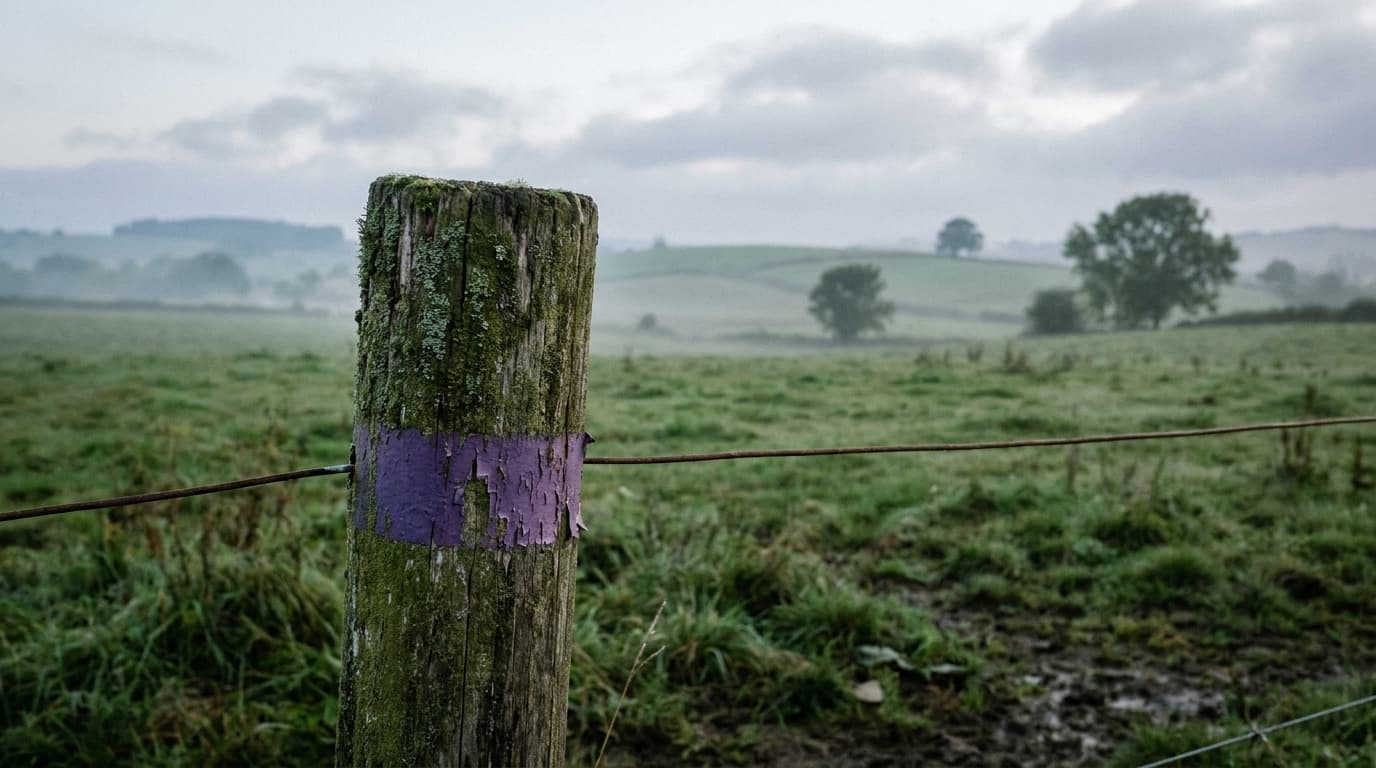
Posting: orange or fluorescent paint, not purple
Idaho's posting rule does not use purple paint. Under section 18-7008(2)(a)(iv), a person has reason to know when "The property is unfenced and uncultivated but is posted with conspicuous no trespassing signs or bright orange or fluorescent paint at all property corners and boundaries where the property intersects navigable streams, roads, gates and rights-of-way entering the land, and is posted in a manner that a reasonable person would be put on notice that it is private land." Fenced land next to or inside public land must be posted the same way along the fence line facing public land. The statute sets no size, height or spacing for the paint marks. Section 18-7008 and the related hunting section, 36-1603, contain no purple paint provision.
Penalties: an infraction, then a misdemeanor ladder
For ordinary criminal trespass under section 18-7008(2)(a), section 18-7008(3)(a) sets the ladder:
- First offense, no damage, leaves when ordered: "If no damage of any kind was committed during the trespass and the person accused does not remain if ordered to depart by the owner of the real property or his agent, then the person shall be guilty of an infraction and fined in the amount of three hundred dollars ($300)." Under section 18-111, an infraction is "a civil public offense, not constituting a crime," and no jail may be imposed.
- Any other first offense: a misdemeanor with up to 6 months in jail and a fine of $500 to $1,000.
- Second violation of subsection (2)(a) or (2)(b) within 5 years: up to 6 months in jail and a fine of $1,500 to $3,000.
- Two or more prior violations within 10 years: up to 1 year in jail and a fine of $5,000 to $10,000, "notwithstanding the form of the judgments or withheld judgments."
When the trespass involved hunting, fishing or trapping, section 36-1603 ties the conduct to section 18-7008 and adds Fish and Game consequences: section 36-1402(e) requires revocation of hunting, fishing or trapping privileges for at least one year for a violation of section 36-1603. Section 18-7008(3) separately requires suspension of any Title 36 chapter 3 hunting, fishing or trapping licence when a repeat trespass can reasonably be construed as committed in a manner described in section 36-1603(a): 1 year for a second offense within 5 years, up to 5 years for a third, and at least 5 years for the felony. Under section 18-7008(3)(c), the court must also order restitution for any criminal trespass under subsection (2).
Church trespass (new in 2026)
Senate Bill 1296 added section 18-7008(2)(b), effective July 1, 2026:
"(b) A person commits criminal trespass and is guilty of a misdemeanor when he enters or remains on the premises of a church or house of worship without permission, knowing or with reason to know that his presence is not permitted and with the intent to intimidate or harass or to disrupt a church service or assemblage of people meeting for religious worship." (Idaho Code 18-7008(2)(b))
A first offense carries up to 6 months in jail and a fine of $500 to $1,000. The $300 infraction option in subsection (3)(a)(i) applies only to subsection (2)(a), not to the church form. A second violation within 5 years falls under the same $1,500 to $3,000 tier as ordinary trespass.
The felony forms
- Trespass with damage (section 18-7008(2)(c), (3)(b)). Criminal trespass that causes more than $1,000 in damage is a misdemeanor for a first offense (up to 6 months in jail and a fine of $1,500 to $5,000) and for a second within 5 years (up to 6 months and a fine of $5,000 to $10,000) (section 18-7008(3)(b)(i), (ii)). A person who "previously has been found guilty of or has pled guilty to two (2) or more violations of the provisions of subsection (2) of this section within ten (10) years" commits a felony and "Shall be sentenced to the custody of the state board of correction for a period of no less than one (1) year and no more than five (5) years" and fined $15,000 to $50,000. This is the only felony form in section 18-7008.
- Unlawful entry while pursued (section 18-7034(2)). "Any person who enters any permanent or temporary dwelling without the consent of the owner of such property or his agent or any person in lawful possession thereof while being pursued by a peace officer is guilty of a felony." The section sets no range, so the general felony section applies: up to 5 years, a fine of up to $50,000, or both (section 18-112).
Other trespass-type offenses
- Unlawful entry (section 18-7034(1)). Except under a landlord-tenant relationship, entering any dwelling house, apartment, store, warehouse, barn, outbuilding, tent, vessel, closed vehicle, closed trailer, airplane or railroad car without the consent of the owner, the owner's agent or a person in lawful possession is a misdemeanor.
- Gates and fences (section 18-7012). "It shall be a misdemeanor for any person to open and leave open any gate not belonging to such person or rightfully under his control," or to cut, break, tear down or otherwise injure another's fence or wall.
- Fur-animal enclosures (section 18-7015). Crossing the fence or clear space around a signed fur-animal enclosure is a misdemeanor.
- Hunting and fishing trespass (section 36-1603). "No person shall enter the real property of another and shoot any weapon or enter such property for the purposes of hunting, retrieving wildlife, fishing or trapping in violation of section 18-7008." The section also bars posting public land as private. Title 36's misdemeanor penalty is a fine of $25 to $1,000, up to 6 months in jail, or both (section 36-1402(c)).
- Agricultural production facilities (section 18-7042). A person who is not employed by an agricultural production facility and knowingly enters it by force, threat or trespass commits interference with agricultural production, a misdemeanor punishable by up to 1 year, a fine of up to $5,000, or both, plus restitution of twice the value of the damage. The section's text also lists entry by misrepresentation and making audio or video recordings inside a facility not open to the public (section 18-7042(1)(a), (d)), but in Animal Legal Defense Fund v. Wasden (9th Cir. 2018) the Ninth Circuit held the misrepresentation-entry ban and the recordings ban unconstitutional under the First Amendment. The same decision upheld the section's clauses on obtaining a facility's records, or obtaining employment with intent to cause injury, by misrepresentation (section 18-7042(1)(b), (c)).
- Agricultural research facilities (section 18-7040). Knowingly entering an agricultural research facility with intent to damage, alter, duplicate or take unauthorized possession of its research records, data, materials, equipment or specimens is a felony punishable by up to 20 years, a fine of up to $10,000, or both, plus restitution of twice the value of the loss.
- Trespass of privacy (section 18-7006). Intentionally looking, peering or peeking into a door, window or other opening of an inhabited building while on another person's private property, without visible or lawful purpose, is a misdemeanor.
Burglary is a separate crime: entering a house, room, store, building, vehicle or other listed place "with intent to commit any theft or any felony" (section 18-1401), punishable by 1 to 10 years in the state prison (section 18-1403). The intent element is what separates it from trespass and unlawful entry.
Chapter 70 of Title 18 has no squatting-specific offense; for how owners remove unauthorized occupants, see Idaho squatters' rights. Questions about using force against a trespasser belong to self-defense law; see Idaho self-defense laws.
Idaho disturbing the peace and trespass penalties at a glance
| Offense | Statute | What it prohibits | Class | Statutory penalty |
|---|---|---|---|---|
| Disturbing the peace | 18-6409(1) | Maliciously and willfully disturbing a gathering, neighborhood, family or person by listed means | Misdemeanor | Up to 6 months, up to $1,000, or both (18-113(1)) |
| Disturbing a funeral or memorial service | 18-6409(2) | Maliciously and willfully disturbing a funeral, procession, burial or viewing | Misdemeanor | Up to 6 months, up to $1,000, or both (18-113(1)) |
| Riot at a penal facility or with hostages | 18-6402(1)(a) | Riot on or about a jail or penal facility, or involving hostages | Felony | 5 to 20 years, up to $25,000, or both |
| Riot with property damage over $500 | 18-6402(1)(b) | Riot causing more than $500 in property damage | Felony | Up to 5 years, up to $10,000, or both |
| Riot (other) | 18-6402(2) | All other riots | Misdemeanor | Up to 1 year and up to $5,000 |
| Unlawful assembly | 18-6405 | Participating in an unlawful assembly | Misdemeanor | Up to 6 months, up to $1,000, or both (18-113(1)) |
| Refusal to disperse | 18-6410 | Not dispersing when commanded by a public officer | Misdemeanor | Up to 6 months, up to $1,000, or both (18-113(1)) |
| Criminal trespass, first offense, no damage and leaves when ordered | 18-7008(3)(a)(i)1 | Entering or remaining without permission, knowing or with reason to know presence is not permitted | Infraction | $300 fine, no jail |
| Criminal trespass, other first offense | 18-7008(3)(a)(i)2 | Same, where the infraction conditions are not met | Misdemeanor | Up to 6 months and $500 to $1,000 |
| Church trespass, first offense | 18-7008(2)(b), (3)(a)(ii) | Entering or remaining at a church without permission, with intent to intimidate, harass or disrupt worship | Misdemeanor | Up to 6 months and $500 to $1,000 |
| Criminal trespass, second within 5 years | 18-7008(3)(a)(iii) | A second violation of (2)(a) or (2)(b) within 5 years | Misdemeanor | Up to 6 months and $1,500 to $3,000 |
| Criminal trespass, two or more priors in 10 years | 18-7008(3)(a)(iv) | A violation after two or more prior violations within 10 years | Misdemeanor | Up to 1 year and $5,000 to $10,000 |
| Trespass with damage over $1,000, first offense | 18-7008(2)(c), (3)(b)(i) | Trespass causing more than $1,000 in damage | Misdemeanor | Up to 6 months and $1,500 to $5,000 |
| Trespass with damage over $1,000, second within 5 years | 18-7008(2)(c), (3)(b)(ii) | A second trespass with damage within 5 years | Misdemeanor | Up to 6 months and $5,000 to $10,000 |
| Trespass with damage over $1,000, two or more priors in 10 years | 18-7008(2)(c), (3)(b)(iii) | Trespass causing damage over $1,000 after two or more prior violations within 10 years | Felony | 1 to 5 years and $15,000 to $50,000 |
| Unlawful entry | 18-7034(1) | Entering a building or closed vehicle without consent | Misdemeanor | Up to 6 months, up to $1,000, or both (18-113(1)) |
| Unlawful entry while pursued by police | 18-7034(2) | Entering a dwelling without consent while pursued by a peace officer | Felony | Up to 5 years, up to $50,000, or both (18-112) |
| Leaving gates open or injuring fences | 18-7012 | Opening and leaving open another's gate, or damaging a fence | Misdemeanor | Up to 6 months, up to $1,000, or both (18-113(1)) |
| Interference with agricultural production | 18-7042 | Entering an agricultural production facility by force, threat or trespass (misrepresentation and recording clauses held unconstitutional) | Misdemeanor | Up to 1 year, up to $5,000, or both; restitution of twice the damage |
| Interference with agricultural research | 18-7040 | Entering a research facility with intent to damage, copy or take records, data or specimens | Felony | Up to 20 years, up to $10,000, or both |
| Trespass of privacy | 18-7006 | Peering into an inhabited building while on another's private property | Misdemeanor | Up to 6 months, up to $1,000, or both (18-113(1)) |
| False report of explosives | 18-3313 | Knowingly false report that a bomb or explosive has been placed | Felony | Up to 5 years |
| False report of an emergency | 18-3313A | Knowingly false report that an emergency exists | Misdemeanor; felony for damage over $1,000, great bodily harm or death | Misdemeanor: up to 1 year, up to $5,000, or both; felony: up to 5 years, up to $25,000, or both; death: up to 10 years and up to $25,000 |
| False 911 alarm | 18-6711A | Calling 911 to make a false alarm or complaint | Misdemeanor | Up to 1 year, up to $1,000, or both; treble civil damages |
| False information to law enforcement | 18-5413 | Knowingly false information about an offense that did not occur | Misdemeanor | Up to 6 months, up to $1,000, or both (18-113(1)) |
| Threatening violence on school grounds | 18-3302I | Threatening to use a deadly weapon on school grounds; possessing or making one to carry out the threat | Misdemeanor; felony for the weapon form | Misdemeanor: up to 6 months, up to $1,000, or both (18-113(1)); felony: up to 5 years, up to $50,000, or both (18-112) |
| Hoax destructive device | 18-3319A | Using or placing a hoax device to cause fear of serious bodily injury or death | Felony | Up to 5 years; in a felony, up to 15 years and up to $15,000 |
| Hunting or fishing trespass | 36-1603 | Entering to hunt, fish or trap in violation of 18-7008 | Misdemeanor (Title 36) | $25 to $1,000, up to 6 months, or both (36-1402(c)); license revocation of at least 1 year (36-1402(e)) |
Where a section names only "misdemeanor," the range in the table comes from section 18-113(1), and where it names only "felony," from section 18-112; each applies only where the code prescribes no different punishment. For Idaho's felony and misdemeanor sentencing rules generally, see Idaho felony and misdemeanor classes.

Recent changes
- 2026, House Bill 615 (Session Law Chapter 94, signed March 20, 2026, effective July 1, 2026). Amended section 18-6409. It added religious gatherings and houses of worship to the settings whose peace the section protects, and it removed the former clause covering anyone who "uses any vulgar, profane or indecent language within the presence or hearing of children, in a loud and boisterous manner." The text quoted on this page is the section as it reads after the amendment.
- 2026, Senate Bill 1296 (Session Law Chapter 78, signed March 19, 2026, effective July 1, 2026). Amended section 18-7008 "TO PROVIDE FOR CRIMINAL TRESPASS OF A CHURCH AND TO PROVIDE A PENALTY," adding the church trespass offense in subsection (2)(b) and its penalty.
- 2025, Senate Bill 1019 (Session Law Chapter 32, effective July 1, 2025). Amended section 18-3313 on false reports of explosives and created section 18-3313A on false reports of violence or emergency.
- 2025, Chapter 248. Created section 67-2341 on public camping and sleeping in cities of 100,000 or more, enforced by civil action against cities and highway districts.
Federal law separately governs conduct on federal property and at the U.S. Capitol; see the disorderly conduct and trespass laws by state hub.
Related Idaho laws
- Disorderly conduct and trespass laws by state
- Idaho noise ordinance laws
- Idaho felony and misdemeanor classes
- Idaho squatters' rights
- Idaho self-defense laws
- Idaho assault and battery laws
- How to charge someone with trespassing
This article provides general legal information about Idaho's disturbing the peace, public-order and criminal trespass statutes as of 2026-10-18. It is not legal advice. For advice about a specific situation, contact a lawyer licensed in Idaho.
Last updated: 2026-10-18.
Frequently Asked Questions
Does Idaho have a disorderly conduct law?
Idaho has no statute named disorderly conduct. The comparable offense is disturbing the peace under Idaho Code 18-6409, which covers maliciously and willfully disturbing the peace of a religious gathering, house of worship, neighborhood, family or person by loud or unusual noise, tumultuous or offensive conduct, threatening, traducing, quarreling, challenging to fight, fighting, or firing a gun or pistol.
Is disturbing the peace a misdemeanor in Idaho?
Yes. Section 18-6409 makes it a misdemeanor, and the general misdemeanor penalty in section 18-113(1) applies: up to 6 months in county jail, a fine of up to $1,000, or both.
Can you get disturbing the peace for swearing in Idaho?
Since July 1, 2026, section 18-6409(1) no longer names profane language: House Bill 615 removed the clause on vulgar, profane or indecent language used in a loud and boisterous manner within the presence or hearing of children, which applied before that date. The section now lists loud or unusual noise, tumultuous or offensive conduct, threatening, traducing, quarreling, challenging to fight, fighting and firing a gun or pistol, and every form requires a malicious and willful disturbance.
Is public intoxication illegal in Idaho?
Section 39-310(1) provides that no person shall be prosecuted criminally or civilly under any law or ordinance that includes being found in an intoxicated condition as an element, subject to exceptions such as persons under the drinking age and the offenses listed in subsection (3), including DUI.
Is trespassing a crime in Idaho?
Usually. Criminal trespass under section 18-7008 is a misdemeanor, except that a first offense is a $300 infraction, which section 18-111 defines as a civil public offense, not a crime, when no damage of any kind was done and the person does not remain when ordered to depart.
Is trespassing a felony in Idaho?
Under section 18-7008, only criminal trespass with damage over $1,000 committed by a person with two or more prior trespass violations within 10 years is a felony, punishable by 1 to 5 years and a fine of $15,000 to $50,000. Entering a dwelling without consent while being pursued by a peace officer is a separate felony under section 18-7034(2), punishable by up to 5 years, a fine of up to $50,000, or both under section 18-112. Interference with an agricultural research facility is a felony under section 18-7040.
Does Idaho have a purple paint law?
No. Section 18-7008(2)(a)(iv) uses conspicuous no trespassing signs or bright orange or fluorescent paint at all property corners and at boundaries where navigable streams, roads, gates and rights-of-way enter the land. The section sets no size, height or spacing for the marks.
What happens if a store tells you to leave in Idaho?
Section 18-7008 lists a customer in a store during business hours who has not been asked to depart as an example of someone who is not trespassing. A person who fails to depart immediately after being notified by the owner or agent has reason to know their presence is not permitted, and the owner may revoke permission at any time, for any reason.
How long does a trespass notice last in Idaho?
Under section 18-7008(2)(a), a person who returns without permission or invitation within one year after being notified has reason to know their presence is not permitted, unless the owner or agent designates a longer period.
Updates
Independently fact-checked against the cited primary sources
The Law Behind This Article
This article rests on the statutory provisions below, held in our own legal record and retrieved from the official source. Tap a section to read the operative text.
Idaho Code
§ 18-6409Disturbing the peaceIn forcecited in 2 of our articles
18-6409. Disturbing the peace. (1) Every person who maliciously and willfully disturbs the peace or quiet of any religious gathering, house of worship, neighborhood, family, or person, by loud or unusual noise, by tumultuous or offensive conduct, by threatening, traducing, quarreling, challenging…
Official text (excerpt) · last checked 2026-08-01 · Read the full text in our law library · Verify at legislature.idaho.gov
Also relied on in: Idaho Noise Laws: Quiet Hours, Disturbing the Peace and Fines
§ 18-7008CRIMINAL Trespass — definitions and Acts constitutingIn forcecited in 2 of our articles
18-7008. CRIMINAL Trespass — definitions and Acts constituting. (1) Definitions. As used in this section: (a) "Crops" means field crops including, but not limited to, grains, feed crops, legumes, fruits and vegetables.
Official text (excerpt) · last checked 2026-08-01 · Read the full text in our law library · Verify at legislature.idaho.gov
Cited in 22 court opinions in our collectionLatest citing opinion in our collection: 2025
Opinions citing this section in our collection:
- State v. Missamore (Idaho Supreme Court 1990, 119 Idaho 27)“…ermissible opinion concerning Missamore's state of mind. Idaho Code § 18-7008 (8) does not require that the owner of…”
- State v. James W. Clark (Idaho Supreme Court 2016, 161 Idaho 372)“…months will constitute a trespass under the provisions of Idaho Code § 18-7008, paragraph 8. Clark admitted rec…”
- State v. Bundy (Idaho Supreme Court 2025, 566 P.3d 445)“…one count of misdemeanor criminal trespass in violation of Idaho Code section 18-7008(2)(a) and (3)(b)(i), and misdemeanor re…”
Identified automatically from the court opinions citing this section — not a ranking of which case controls.
Also relied on in: Idaho Surveillance Camera Laws (2026 Guide)
§ 18-7034Unlawful entryIn force
18-7034. Unlawful entry. (1) Every person, except under landlord-tenant relationship, who enters any dwelling house, apartment, tenement, shop, warehouse, store, mill, barn, stable, outhouse or other building, tent, vessel, closed vehicle, closed trailer, airplane, railroad car or outbuilding,…
Official text (excerpt) · last checked 2026-08-01 · Read the full text in our law library · Verify at legislature.idaho.gov
§ 18-6402Riot — Felony — Misdemeanor — PunishmentIn force
18-6402. Riot — Felony — Misdemeanor — Punishment. (1) A riot is a felony if: (a) It occurs on or about the state penitentiary, a county or city jail, or any other penal facility in this state, or it involves the taking of one or more hostages.
Official text (excerpt) · last checked 2026-08-01 · Read the full text in our law library · Verify at legislature.idaho.gov
§ 18-113Punishment for misdemeanorIn forcecited in 4 of our articles
18-113. Punishment for misdemeanor. (1) Except in cases where a different punishment is prescribed in this code, every offense declared to be a misdemeanor, is punishable by imprisonment in a county jail not exceeding six (6) months, or by a fine not exceeding one thousand dollars ($1,000), or by…
Official text (excerpt) · last checked 2026-08-01 · Read the full text in our law library · Verify at legislature.idaho.gov
Cited in 1 court opinions in our collectionLatest citing opinion in our collection: 2005
Opinions citing this section in our collection:
- State v. Parker (Idaho Supreme Court 2005, 141 Idaho 775)“…vides that it is a lesser offense than "reckless driving." Idaho Code § 18-113 provides for the maximum punishment fo…”
Identified automatically from the court opinions citing this section — not a ranking of which case controls.
Also relied on in: Idaho Hit and Run Laws: Penalties and What to Do, Felony vs Misdemeanor in Idaho: Penalties, Sentences and Probation
§ 39-310Criminal law limitationsIn force
39-310. Criminal law limitations. (1) With the exception of persons below the statutory age for consuming alcoholic beverages and of persons affected by the provisions of subsection (3) herein, no person shall be incarcerated or prosecuted criminally or civilly for the violation of any law,…
Official text (excerpt) · last checked 2026-08-01 · Read the full text in our law library · Verify at legislature.idaho.gov
§ 36-1603Trespassing — hunting, fishing and trapping. (a) No person shall enter the real property of another and shoot any weapon or enter such property for the purposes of hunting, retrieving wildlife, fishing or trapping in violation of section 18-7008, Idaho CodeIn force
36-1603. Trespassing — hunting, fishing and trapping. (a) No person shall enter the real property of another and shoot any weapon or enter such property for the purposes of hunting, retrieving wildlife, fishing or trapping in violation of section 18-7008, Idaho Code.
Official text (excerpt) · last checked 2026-08-01 · Read the full text in our law library · Verify at legislature.idaho.gov
Search our full record of US law — 2.1 million sections, every state + federal →
Sources and References
- Idaho Code 18-6409, disturbing the peace(legislature.idaho.gov).gov
- Idaho Code 18-113, punishment for misdemeanor(legislature.idaho.gov).gov
- Idaho Code 18-7008, criminal trespass(legislature.idaho.gov).gov
- Idaho Code 39-310, criminal law limitations (intoxication)(legislature.idaho.gov).gov
- Idaho Code 18-6402, riot; felony; misdemeanor; punishment(legislature.idaho.gov).gov
- Idaho Code 18-7034, unlawful entry(legislature.idaho.gov).gov
- Idaho Code Title 18, Chapter 64, riot, unlawful assembly and disturbing the peace(legislature.idaho.gov).gov
- Idaho Code 18-6401, riot defined(legislature.idaho.gov).gov
- Idaho Code 18-6404, unlawful assembly defined(legislature.idaho.gov).gov
- Idaho Code 18-6410, refusal to disperse(legislature.idaho.gov).gov
- Idaho Code 67-2341, public camping and sleeping(legislature.idaho.gov).gov
- Idaho Code 18-111, infractions and misdemeanors defined(legislature.idaho.gov).gov
- Idaho Code 36-1603, trespass on private land (hunting, fishing and trapping)(legislature.idaho.gov).gov
- Idaho Code 36-1402, Title 36 penalties and license revocation(legislature.idaho.gov).gov
- Idaho Code 18-7012, opening gates and injuring fences(legislature.idaho.gov).gov
- Idaho Code Title 18, Chapter 70, trespass and malicious injuries to property(legislature.idaho.gov).gov
- Idaho Code 18-1401, burglary defined(legislature.idaho.gov).gov
- 2026 House Bill 615 (Session Law Chapter 94), bill status(legislature.idaho.gov).gov
- 2026 Senate Bill 1296 (Session Law Chapter 78), bill status(legislature.idaho.gov).gov
- Idaho Code 18-3313, false reports of explosives(legislature.idaho.gov).gov
- Idaho Code 18-3313A, false reports of violence or emergency(legislature.idaho.gov).gov
- Idaho Code 18-6711A, false 911 alarms; civil damages(legislature.idaho.gov).gov
- Idaho Code 18-5413, false information to law enforcement(legislature.idaho.gov).gov
- Idaho Code 18-3302I, threatening violence on school grounds(legislature.idaho.gov).gov
- Idaho Code 18-3319A, hoax destructive device(legislature.idaho.gov).gov
- Idaho Code 18-7042, interference with agricultural production(legislature.idaho.gov).gov
- Idaho Code 18-7040, interference with agricultural research(legislature.idaho.gov).gov
- Idaho Code 18-7006, trespass of privacy(legislature.idaho.gov).gov
- Idaho Code 18-112, punishment for felony(legislature.idaho.gov).gov
- Idaho Code 18-1403, punishment for burglary(legislature.idaho.gov).gov
- Animal Legal Defense Fund v. Wasden, No. 15-35960 (9th Cir. Jan. 4, 2018)(cdn.ca9.uscourts.gov).gov
- 2026 House Bill 615 as printed(legislature.idaho.gov).gov
- 2025 Senate Bill 1019 (Session Law Chapter 32), bill status(legislature.idaho.gov).gov
Paid attorney referral. RecordingLaw may receive compensation when you use an attorney-help link. RecordingLaw is not a law firm. Submitting a request does not guarantee that an attorney will accept your case and does not create an attorney-client relationship.