
Australia
Notice of Intended Marriage: How to Get Married in Australia
Independently fact-checked against primary sources (last audited October 26, 2026). · 16 primary sources cited on this page. How we verify our legal content

To get legally married in Australia, you and your partner give your authorised celebrant a signed Notice of Intended Marriage (NOIM) at least one month and no more than 18 months before the wedding, show evidence of your birth and of any previous marriage ending, and sign a declaration that there is no legal impediment before the ceremony (Marriage Act 1961 (Cth) s 42). The ceremony itself must then follow the Act's rules on celebrants, witnesses and words.
This page covers the federal Marriage Act 1961, the Marriage Regulations 2017 and the forced marriage offences in the Criminal Code, which apply in every state and territory. Registration and certificate ordering are run by each state and territory registry, so where those details differ we name the jurisdiction. Information verified on 26 October 2026 against Marriage Act Compilation No. 34 (28 March 2026) and Marriage Regulations Compilation No. 3 (14 October 2024).
What the Notice of Intended Marriage is
The NOIM is the written notice the law requires before any marriage in Australia can be solemnised. Section 42(1)(a) of the Marriage Act 1961 says a marriage cannot go ahead unless "notice in writing of the intended marriage has been given in accordance with this section and has been received by the authorised celebrant solemnising the marriage not earlier than 18 months before the date of the marriage and not later than 1 month before the date of the marriage".
You give it to the celebrant who will marry you. It must be signed by each of you and contain the particulars the regulations prescribe (s 42(2)). When the celebrant receives it, they must write the date of receipt on the notice (Marriage Regulations 2017 s 70(1)), and after the wedding they record the date and place of the ceremony on it.
Ask your celebrant for the current version of the form before you fill it in.
Lodging the notice also starts some obligations on the celebrant's side. As soon as practicable after receiving it, the celebrant must give you a document outlining the obligations and consequences of marriage and the availability of marriage education and counselling (s 42(5A)). The celebrant must also meet each of you separately before the wedding, with both the celebrant and that person physically present at the meeting (s 42B).
When to lodge it: the one-month and 18-month window
The window is fixed by law: no later than one month before the wedding, and no earlier than 18 months before it. The NSW Government's guide to getting married in NSW puts it this way: lodge it "at least 1 month before the date you plan to marry. It's valid for 18 months from the date your celebrant receives it from you."
Two practical points follow. First, the clock starts when your celebrant receives the notice, not when you sign it, so a form signed months earlier but handed over late still counts from the handover. Second, if your wedding slips more than 18 months past the date of receipt, the notice no longer works for that wedding and you will need to give a fresh one.
If your celebrant can no longer marry you, or you ask them to pass the notice on, another authorised celebrant who has possession of the notice may solemnise the marriage (s 42(6)). You do not have to start again just because you change celebrant.
Who can witness your signature
Each of you must sign the NOIM while an authorised witness watches. The witness can observe in person or "by means of a facility that enables audio and visual communication between persons in different places" (s 42(2)(c) and (d)), but the witness must be on the same side of the border as you: in Australia if you sign in Australia, and outside Australia if you sign overseas.

| Where you sign | Who can witness |
|---|---|
| In Australia (witness must also be in Australia) | An authorised celebrant; a Commissioner for Declarations under the Statutory Declarations Act 1959; a justice of the peace; a barrister or solicitor; a medical practitioner; a member of the Australian Federal Police or a state or territory police force |
| Outside Australia (witness must also be outside Australia) | An Australian Diplomatic Officer; an Australian Consular Officer; a notary public; a Commonwealth employee authorised under paragraph 3(c) of the Consular Fees Act 1955; an Austrade employee authorised under paragraph 3(d) of that Act |
The NSW guidance warns that "a pharmacist, a psychologist, a nurse, a physiotherapist, or a dentist, do not qualify to be your witness." It also explains the mechanics: "The witness must watch you sign and date the notice. They will then write their full name, their qualification as an authorized witness, and they must also sign the notice."
You do not have to sign at the same time. If one partner's signature "cannot conveniently be obtained", a notice signed by the other is enough provided the first partner signs it while an authorised celebrant in Australia observes, in person or by video, before the wedding (s 42(3)). Your celebrant may also let either of you correct an error in the notice, under the celebrant's observation (in person or by video), at any time before the wedding (s 42(9)).
Documents you need
For each of you, the celebrant must be shown evidence of your date and place of birth (s 42(1)(b)). If either of you has been married before, the celebrant must also see evidence that the previous marriage ended (s 42(10)). The table below is a checklist; your celebrant may ask for originals.
| Document | Who needs it | What counts |
|---|---|---|
| Evidence of date and place of birth | Each of you | An official birth certificate or official extract of a birth register entry, or an Australian or overseas passport showing date and place of birth (s 42(1)(b)) |
| If you cannot get a birth certificate and have no current passport | The person affected | A statutory declaration by you or a parent saying why it is impracticable to obtain one and, as accurately as possible, when and where you were born (s 42(1)(b)(v)) |
| Photo identification | Each of you | NSW guidance: a passport, or if a passport is not provided, other current photo ID such as a driver licence |
| Evidence a previous marriage ended | Anyone divorced or widowed | Evidence of the divorce, or of the death of the former spouse (s 42(10)); NSW lists a divorce certificate or a death certificate. Evidence of an annulment is also recorded (Regulations s 70(2)(c)) |
| Consent, and a court order | Anyone aged 16 or 17 | The s 12 court order, plus the written parental consent (or dispensation or court consent in its place) required by s 13 |
| English translations | Anyone with documents in another language | NSW guidance: translated into English by a National Accreditation Authority for Translators and Interpreters (NAATI) accredited translator |
On the name to use, the NSW guidance says to use the name on your birth certificate or Change of Name certificate. If your surname changed through an earlier marriage and you have kept it, use that surname; if you reverted to your original name, use it if you have proof such as photo identification.
If you were divorced in Australia, our guide to divorce in Australia covers the divorce process. Check with your celebrant which document they will accept as evidence.
If a particular you are asked for cannot be found out, the Act lets you make a statutory declaration about it instead (s 42(4)).
The declaration of no legal impediment
The NOIM is not the only paperwork. Before the ceremony, each of you must sign a written declaration "in the physical presence of that authorised celebrant" covering your conjugal status, your belief "that there is no legal impediment to the marriage", and other prescribed matters (s 42(1)(c)). Under Regulations s 71, an adult declares they are 18 or older, and someone under 18 declares their date of birth and that a s 12 order has been made.
The NSW guidance describes it in plain terms: "On the day, before the marriage ceremony, your celebrant will ask both of you to sign a declaration that there are no legal reasons preventing you from getting married." Both declarations go on the same side of one piece of paper (s 42(7)).
The celebrant must not proceed if they have reason to believe the notice or declaration contains a false statement or error (s 42(8)(b)), and they must be satisfied that you are the people named in the notice (s 42(8)(a)). Answer the conjugal status and relationship questions carefully; the NOIM asks, for example, whether you are related by blood, by marriage or by adoption.
Getting married in less than one month
If you lodge late, you can still marry inside the one-month window, but only with approval. Section 42(5) lets a "prescribed authority" (an officer of the Commonwealth, a state or a territory appointed by the Minister) authorise the celebrant to proceed if satisfied that one or more of the circumstances in the regulations is met. Regulations s 72 and Schedule 3 list five:
- Employment-related or other travel commitments.
- Wedding or celebration arrangements, such as binding arrangements already made, or "any religious consideration".
- Medical reasons, meaning "a medical condition of a serious nature".
- Legal proceedings.
- Error in giving notice, but only where the problem was due "to error on the part of an authorised celebrant (or a person the parties to the marriage believed to be an authorised celebrant)" and the wedding has been arranged for less than one month away.
The authority may look at evidence such as employment letters, tickets, receipts or a medical letter, and at whether hardship would be caused if the wedding did not go ahead as planned. The NSW guidance says to "talk to your marriage celebrant if you want to apply for an exemption to get married in less than 1 month" and that "you will need to provide proof." For weddings at the Perth Registry Office, Western Australia's registry lists a fee of "$51 Shortening of Time (if approved)"; check the fee with the authority in your state or territory.
Who can legally marry in Australia
Section 5 of the Marriage Act defines marriage as "the union of 2 people to the exclusion of all others, voluntarily entered into for life."
Same-sex couples have been able to marry since 9 December 2017, when Schedule 1 of the Marriage Amendment (Definition and Religious Freedoms) Act 2017 commenced. You also do not have to be a citizen or permanent resident; the NSW Government says "You do not have to be an Australian citizen or permanent resident to get married in Australia."
Age
You must be 18. Section 11 says "a person is of marriageable age if the person has attained the age of 18 years", subject to s 12.
Section 12 keeps a narrow court route for 16 and 17 year olds. The young person applies to a judge or magistrate for an order allowing them "to marry a particular person of marriageable age", so the other person must be an adult. The judge or magistrate must be satisfied that "the circumstances of the case are so exceptional and unusual as to justify the making of the order", and even then the order is discretionary. It covers marriage to the person named in it and no one else, and it ceases to have effect if the wedding does not take place within 3 months (s 12(3) and (5)).
The court order is not enough on its own. Under s 13, the celebrant must also be given the written, witnessed consent of each person whose consent the Act requires, dated no earlier than 3 months before the wedding, or a court consent or a dispensation in its place. Going through a marriage ceremony with someone who is not of marriageable age is an offence carrying up to 5 years' imprisonment (s 95(1)).
Relationships and existing marriages
A marriage is void if either person is already lawfully married to someone else, or if the couple are within a prohibited relationship (s 23B(1)). Prohibited relationships are between a person and an ancestor or descendant, and between siblings, whether of the whole or half blood (s 23B(2)); adoptive relationships are treated the same as natural ones (s 23B(3)). The Victorian registry summarises this as not marrying a "parent, grandparent, child, grandchild, brother or sister".
Going through a marriage ceremony while already married is the offence of bigamy, punishable by up to 5 years' imprisonment (s 94(1)). It is a defence if you believed your spouse was dead and their absence gave reasonable grounds to presume so; 7 years' continuous absence, with no reason to believe they were alive in that time, is enough to show those grounds (s 94(2) and (3)).
Real consent
A marriage is also void if either person's consent was not real because it was obtained by duress or fraud, because they were mistaken about the identity of the other person or the nature of the ceremony, or because they did not understand the nature and effect of the ceremony (s 23B(1)(d)). A marriage that does not comply with the celebrant and ceremony rules in Division 2 is not a valid marriage either (s 48(1)).
Some paperwork slips do not undo a marriage. Under s 48(2), a marriage is not invalid only because of a failure to give the s 42 notice, a defect or error in the notice, or a failure to meet the witness and wording rules in ss 44 and 46. That is not a reason to cut corners: the celebrant must still refuse to proceed if they believe the notice is wrong.
The wedding ceremony
The ceremony is where the marriage legally happens, and the Act sets its minimum content.
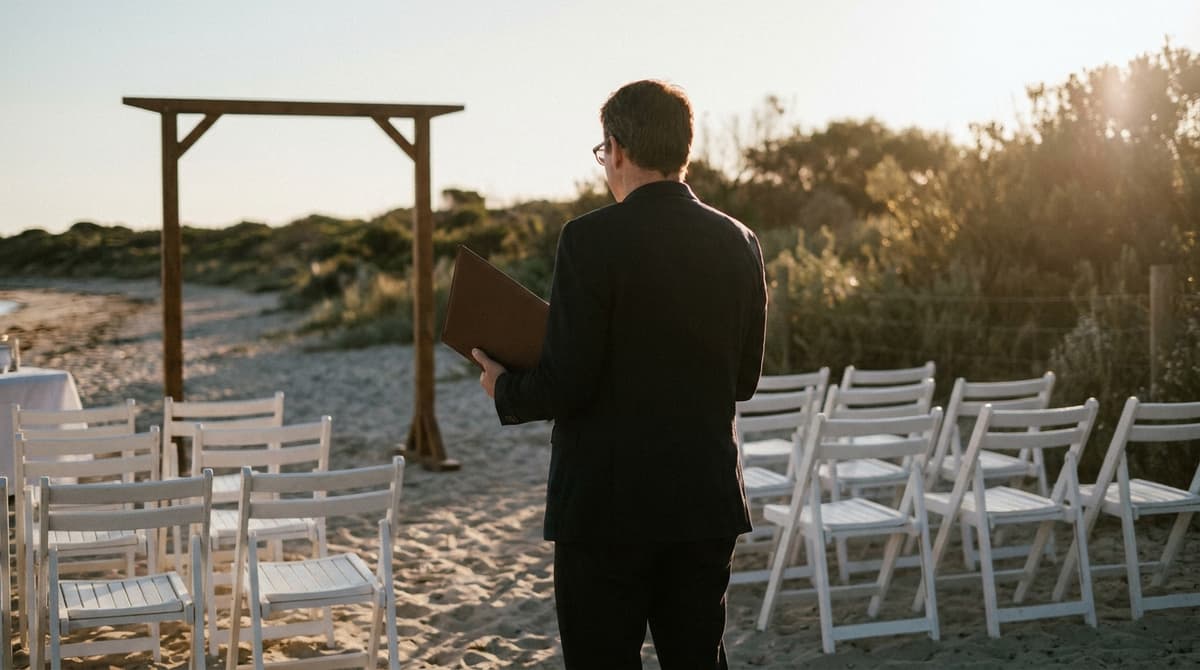
- An authorised celebrant, physically present. "A marriage shall be solemnised by an authorised celebrant who is physically present at the place where the marriage takes place" (s 41). The Victorian registry's getting married in Victoria page is blunt about online weddings: "No. A marriage must be solemnised in the physical presence of a celebrant and two witnesses."
- Any day, time or place. "A marriage may be solemnised on any day, at any time and at any place" (s 43).
- Two adult witnesses. At least 2 people who are, or appear to the celebrant to be, over 18 must be present as witnesses (s 44). The NSW guidance adds that your witnesses need to speak and understand English.
- The celebrant's words. A celebrant who is not a minister of religion of a recognised denomination must say, "or words to that effect", that they are "duly authorised by law to solemnise marriages according to law", remind you "of the solemn and binding nature of the relationship", and state that "Marriage, according to law in Australia, is the union of 2 people to the exclusion of all others, voluntarily entered into for life" (s 46(1)), unless the Minister has exempted them (s 46(2)).
- Your vows. In a civil ceremony each of you says words to the effect of "I call upon the persons here present to witness that I, A.B. (or C.D.), take thee, C.D. (or A.B.), to be my lawful wedded wife (or husband, or spouse)" (s 45(2)).
Your celebrant can be a state or territory officer, a Commonwealth-registered civil marriage celebrant, or a minister of religion. A minister of religion may marry you according to the form and ceremony their religious body recognises (s 45(1)), and may refuse to solemnise a marriage (s 47). The Victorian registry says "Your celebrant or minister will tell you the wording that your ceremony must include", and that a simple ceremony with only the legal requirements is allowed.
If one of you does not speak English well, the celebrant can use an interpreter who is not one of the couple (s 112(1)). The interpreter gives a statutory declaration that they understand and can converse in the languages involved, and afterwards certifies that they interpreted faithfully (s 112(2) and (3)).
What it costs
Private celebrants set their own prices. The Victorian registry says: "There's no set fee for a wedding ceremony in Victoria. Confirm costs with your celebrant or minister before booking your wedding." Registry weddings have published prices; Western Australia's registry, for example, lists "$205 Lodgement of Notice of Intended Marriage (non-refundable) (including GST)" and "$252 Registry Marriage - Ceremony Fee" for the Perth Registry Office, as shown on its marriages page on 26 October 2026.
If you want to settle property arrangements before you marry, see our guide to binding financial agreements in Australia.
After the ceremony: registration and certificates
Straight after the ceremony, you, your celebrant and your two witnesses sign the official certificates (s 50(2)). The NSW guidance explains that you will sign "two official certificates of marriage and one ceremonial certificate. You'll receive the ceremonial certificate on the day."
That certificate you take home is not legal proof of your marriage. The Queensland Government's marriage certificate page says the ceremonial certificate "cannot be used to prove your relationship", and Victoria says the commemorative certificate "generally can't be used for official purposes as proof of your marriage."
Lodging the papers for registration is the celebrant's job. Except for the state and territory office holders listed in Schedule 4 of the Marriage Regulations (mostly registry staff), who prepare only one official certificate (Regulations s 75), the celebrant must, within 14 days of the wedding, send the official certificate, the NOIM and any statutory declarations, consents and dispensations to the registering authority of the state or territory where you married (s 50(4)(a)(i)). The NSW Government confirms that "Marriage celebrants have up to 14 days to register your marriage."
Ordering the official marriage certificate
Once the marriage is registered, you apply to the registry of the state or territory where the wedding took place. Queensland notes that it does "not send an official certificate when a new marriage is registered"; you have to apply and pay. Victoria says it "can't issue certificates for marriages that took place outside of Victoria."
| Registry | Certificate fee | Processing and extras | Source as at 26 October 2026 |
|---|---|---|---|
| New South Wales | $70 standard, $105 priority (both include $11 postage and handling) | Online: standard up to 3 weeks, priority up to 2 weeks; by post or via Service NSW: standard up to 4 weeks, priority up to 3 weeks (postage time extra) | NSW Government (no effective date shown) |
| Victoria | $59.10 | Up to 14 days; express post $10.60 in Australia, $58.60 international | BDM Victoria fees (effective 1 July 2026) |
| Queensland | $58.10 | Standard up to 10 business days; urgent within 2 business days (urgent application $34.45); regular postage free | Queensland Government (page updated 1 October 2026) |
| Western Australia | $60 | Priority service $44 extra; at least three forms of identity evidence | WA Government (page last updated 18 September 2026) |
| South Australia, Tasmania, Northern Territory, ACT | Check with the registry | Fees not verified for this page | See the state guides below |
Registry fees change, often each 1 July (Victoria says its fees "are updated every financial year"), so confirm the current amount before you pay. For how to apply in each jurisdiction, see our state and territory guides to vital records: New South Wales, Victoria, Queensland, Western Australia, South Australia, Tasmania, the ACT and the Northern Territory, or start from our Australian vital records hub.
Changing your name after marriage
Nothing in the Marriage Act requires either of you to change your name. If you want to take your spouse's surname, the NSW Government's surname after marriage page says "it's not necessary to pay the fee for an official change of name. Most government departments accept your official marriage certificate as proof of your name." Victoria similarly says that in most cases you do not need to apply for a change of name to take your spouse's family name.
The certificate has to be the official one. NSW is explicit: "Ceremonial or commemorative certificates are not accepted." So order the official certificate first, then update your records with each agency or organisation.
Marrying overseas: will Australia recognise it?
Part VA of the Marriage Act gives effect to Chapter II of the 1978 Hague Convention on Celebration and Recognition of the Validity of Marriages. The basic rule in s 88D(1) is that a foreign marriage that was valid under the local law where it took place "shall be recognised in Australia as valid."
There are exceptions. Under s 88D(2), the marriage is not recognised if:
- either person was, at the time, already in a marriage recognised in Australia as valid;
- one of the couple was domiciled in Australia and either person was under the Australian marriageable age;
- the couple are within a prohibited relationship under s 23B; or
- either person's consent was not real consent.
Where neither person was domiciled in Australia, the marriage is not recognised while either of them is under 16 (s 88D(3)). Nor is a marriage recognised while it is voidable under the law of the country where it took place (s 88D(4)). Section 10(2)(b) also applies the age rules in ss 11 and 12 to the marriage of a person domiciled in Australia "wherever that marriage takes place." In practice, an Australian-domiciled 17 year old cannot get around the age rules by marrying abroad. Domicile can be a complex question, so get advice if it matters to your situation.
Keep the official certificate issued in the country where you married, with a NAATI-accredited translation if it is not in English. Australian registries issue certificates only for their own registrations; Victoria, for example, says it cannot issue certificates for marriages that took place outside Victoria.
Marrying in Australia when one of you is not a citizen
The Marriage Act governs whether you are validly married; it does not deal with immigration. Marrying an Australian does not by itself give a partner the right to stay, and immigration status remains a separate question for the Department of Home Affairs.

Home Affairs describes the Prospective Marriage visa (subclass 300) as letting you come to Australia to marry your prospective spouse, after which you can apply for a Partner visa. Its partner visa overview sets out the options for married and de facto partners. Check the current requirements, costs and processing times with Home Affairs before you plan the wedding around a visa.
If you are not planning to marry, our guide to de facto relationships in Australia explains how the law treats couples who live together.
Forced marriage is a crime
A forced marriage is not just void under the Marriage Act; it is a Commonwealth offence. Section 270.7A of the Criminal Code says a marriage is a forced marriage if either person entered it "without freely and fully consenting" because of "coercion, threat or deception" or because they could not understand the nature and effect of the ceremony, or if either person was under 16. The definition covers marriages recognised under foreign law and ceremonies that are not legally valid at all, and coercion counts whether it is used against the victim or someone else.
Under s 270.7B it is an offence to cause another person to enter a forced marriage, and an offence to be a party to a forced marriage when you are not the victim, unless you have a reasonable excuse. Each carries up to 7 years' imprisonment, or 9 years for an aggravated offence. The Australian Federal Police say forced marriage "has been illegal in Australia since 2013, with the laws tightened in 2019 to extend protection to children under 16."
Where to get help
- Australian Federal Police: call 131 AFP (131 237) or use the AFP's online human trafficking report. In an emergency, or if anyone is in immediate danger, call Triple Zero (000). The AFP's human trafficking page covers slavery-like practices including forced marriage.
- My Blue Sky: the national forced marriage service run by Anti-Slavery Australia at the University of Technology Sydney offers free and confidential legal advice. Call +61 2 9514 8115 (Monday to Friday, 9am to 5pm Sydney time), SMS +61 481 070 844, or email help@mybluesky.org.au. See My Blue Sky.
- Support: the AFP media release on forced marriage names the Life Without Barriers Forced Marriage Specialist Support Program as a national program supporting people at risk of, or experiencing, forced marriage. My Blue Sky also lists 24-hour counselling lines: 1800 RESPECT for sexual assault and domestic and family violence, 13 11 14 for crisis support and suicide prevention, and 1800 55 1800 for children and young people aged 5 to 25.
As My Blue Sky puts it: "Nobody is allowed to force you to marry. You have rights no matter your age, visa status, gender, sexuality, ethnicity, culture or religion."
For the wider picture on marriage, separation, children and property, see our Australian family law hub.
Frequently Asked Questions
How far in advance do we need to lodge the Notice of Intended Marriage?
Your authorised celebrant must receive the notice at least one month before the wedding and not more than 18 months before it (Marriage Act 1961 s 42(1)(a)). The 18 months count from the day the celebrant receives it. If you are inside the one-month window, ask your celebrant about applying to a prescribed authority to shorten the time.
Who can witness the NOIM if we sign it in Australia?
An authorised celebrant, a Commissioner for Declarations, a justice of the peace, a barrister or solicitor, a medical practitioner, or a member of the Australian Federal Police or a state or territory police force. The witness must also be in Australia. The NSW Government guidance notes that pharmacists, psychologists, nurses, physiotherapists and dentists do not qualify.
Can we sign the Notice of Intended Marriage while living overseas?
Yes. If you sign outside Australia, the witness must also be outside Australia and must be an Australian diplomatic or consular officer, a notary public, or an authorised Commonwealth or Austrade employee under the Consular Fees Act 1955 (Marriage Act s 42(2)(d)). Your celebrant in Australia still has to receive the notice within the one-month to 18-month window.
Can the NOIM be witnessed by video call?
Section 42(2) of the Marriage Act allows the witness to observe the signing in person or by a facility that enables audio and visual communication between people in different places. The witness and the person signing must both be in Australia, or both be outside Australia. Ask your celebrant how they want a remotely witnessed form returned.
Can we get married in less than a month?
Only if a prescribed authority approves it. The grounds are set out in Schedule 3 of the Marriage Regulations 2017: employment-related or other travel commitments, wedding or celebration arrangements (including religious considerations), serious medical reasons, legal proceedings, or an error by a celebrant in giving notice. You will need evidence. For weddings at the Perth Registry Office, the Western Australian registry lists a $51 fee for shortening of time if approved.
Do we need to be Australian citizens or residents to marry in Australia?
No. The NSW Government states that you do not have to be an Australian citizen or permanent resident to get married in Australia. A foreign passport showing your date and place of birth is acceptable evidence, and documents in another language must be translated into English by a NAATI accredited translator. Getting married does not by itself give anyone a visa.
Is the certificate we sign at the wedding our official marriage certificate?
No. The certificate handed to you on the day is a ceremonial or commemorative certificate, and Queensland and Victoria both say it cannot be used to prove your marriage. In most cases your celebrant must send the official certificate and the NOIM to the state or territory registry within 14 days, and you then apply to that registry for the official certificate.
Do I have to change my surname when I marry?
The Marriage Act sets no requirement to change your name. If you choose to take your spouse's surname, the NSW Government says you generally do not need an official change of name; most government departments accept the official marriage certificate as proof. Ceremonial and commemorative certificates are not accepted for this.
Will Australia recognise a marriage we have overseas?
Generally yes, if the marriage was valid where it took place (Marriage Act Part VA, s 88D). It will not be recognised if, for example, either person was already married, the couple are within a prohibited relationship, either person did not really consent, or a party domiciled in Australia was under the Australian marriageable age at the time.
Can a 16 or 17 year old get married in Australia?
Only in rare cases. A judge or magistrate must make an order under s 12 of the Marriage Act after being satisfied the circumstances are so exceptional and unusual as to justify it. The order covers marriage to one named adult only and lapses if the wedding does not happen within 3 months. Written parental consent, or a dispensation or court consent in its place, is also required.
Where can someone get help if they are being forced to marry?
Call 131 AFP (131 237) or use the AFP online human trafficking report, or 000 in an emergency. My Blue Sky, the national forced marriage service run by Anti-Slavery Australia, gives free confidential legal advice on +61 2 9514 8115 (Monday to Friday, 9am to 5pm Sydney time), by SMS on +61 481 070 844, or at help@mybluesky.org.au.
Updates
Independently fact-checked against the cited primary sources
Sources and References
- Marriage Act 1961 (Cth), Compilation No. 34 (28 March 2026): ss 5, 10-13, 23B, 41-50, 88A-88E, 94-95, 112(legislation.gov.au).gov
- Marriage Regulations 2017 (Cth), Compilation No. 3 (14 October 2024): ss 70-72, 75 and Schedules 3 (shortening of time) and 4(legislation.gov.au).gov
- NSW Government: Getting married in NSW (including the Notice of Intended Marriage guide)(nsw.gov.au).gov
- Marriage Amendment (Definition and Religious Freedoms) Act 2017 (Cth), as made: commencement 9 December 2017(legislation.gov.au).gov
- Births, Deaths and Marriages Victoria: Getting married in Victoria(bdm.vic.gov.au).gov
- Government of Western Australia: Marriages (registry fees and certificates)(wa.gov.au).gov
- Queensland Government: Get a marriage certificate(qld.gov.au).gov
- NSW Government: Applying for an official marriage certificate(nsw.gov.au).gov
- Births, Deaths and Marriages Victoria: Fees (effective 1 July 2026)(bdm.vic.gov.au).gov
- Births, Deaths and Marriages Victoria: Get a marriage certificate(bdm.vic.gov.au).gov
- NSW Government: Change your surname after marriage(nsw.gov.au).gov
- Department of Home Affairs: Prospective Marriage visa (subclass 300)(immi.homeaffairs.gov.au).gov
- Department of Home Affairs: About partner visas(immi.homeaffairs.gov.au).gov
- Criminal Code Act 1995 (Cth), Schedule, Division 270: ss 270.7A-270.7B (forced marriage)(legislation.gov.au).gov
- Australian Federal Police: Human trafficking (including forced marriage)(afp.gov.au).gov
- My Blue Sky (Anti-Slavery Australia, UTS): national forced marriage service(mybluesky.org.au)
- Australian Federal Police media release: Schools urged to play frontline role protecting children against forced marriage(afp.gov.au).gov