Pennsylvania Child Support Laws: Guidelines and Calculations

Pennsylvania child support laws are governed by Title 23 of the Pennsylvania Consolidated Statutes, Chapter 43 and the Pennsylvania Rules of Civil Procedure, specifically Rules 1910.16-1 through 1910.16-4. These laws establish how child support obligations are calculated, modified, enforced, and terminated in the Commonwealth.
Effective January 1, 2026, Pennsylvania updated its child support guidelines for the first time in four years. The updates reflect rising costs of living and changes to the Federal Poverty Guidelines. This page covers the current rules as of 2026.
How to Apply for Child Support in Pennsylvania
The Bureau of Child Support Enforcement (BCSE), operating under the Pennsylvania Department of Human Services (DHS), administers the state's child support program through local Domestic Relations Sections (DRS) in each county.
To apply for services:
- Online: Visit the Pennsylvania Child Support Program website and create an account to request support services.
- In Person: Visit the Domestic Relations Section in your county courthouse.
- By Mail: Download application forms from the website and mail them to your local DRS.
What to remember:
- Online requests do not constitute an official filing until the DRS reviews and accepts them. For faster processing, consider applying in person or through an attorney.
- Parents who have never received cash assistance must pay an annual $35 service fee, as required by federal law.
- Child support arrears begin accruing from the date you file the petition or complaint.
- You may request to proceed "In Forma Pauperis" (waived filing fees) if you meet low-income requirements.
Documents needed for application:
- Your name and Social Security number
- Proof of income and employment
- Documentation of expenses (daycare, medical costs, etc.)
- Special needs documentation for the child (if applicable)
- As much identifying information about the other parent as possible
How Is Paternity Established in Pennsylvania?
Pennsylvania law no longer recognizes common law marriage for relationships established after January 1, 2005. For paternity purposes:
- Married Parents: When a child is born to a married couple, the law presumes the husband is the father.
- Unmarried Parents: A child born to an unmarried woman has no legal father until paternity is established through an Acknowledgment of Paternity (AOP) or a court order.
Methods to establish paternity:
- Acknowledgment of Paternity (PA/CS 611): Both parents sign this form at the hospital or later at County Assistance Offices, DRS, or DHS offices. A witness must be present for the signing.
- Genetic Testing: Either parent can request DNA testing through the DRS or the court.
Important notes:
- Either party can rescind an AOP within 60 days of signing or before any court proceedings begin.
- Establishing paternity grants the father visitation and custody rights, gives the child inheritance rights and access to the father's health insurance, and reduces the custodial parent's financial burden.
For paternity questions, contact the Child Support Enforcement Paternity Coordinator at 1-800-932-0211.
How to Determine Child Support in Pennsylvania
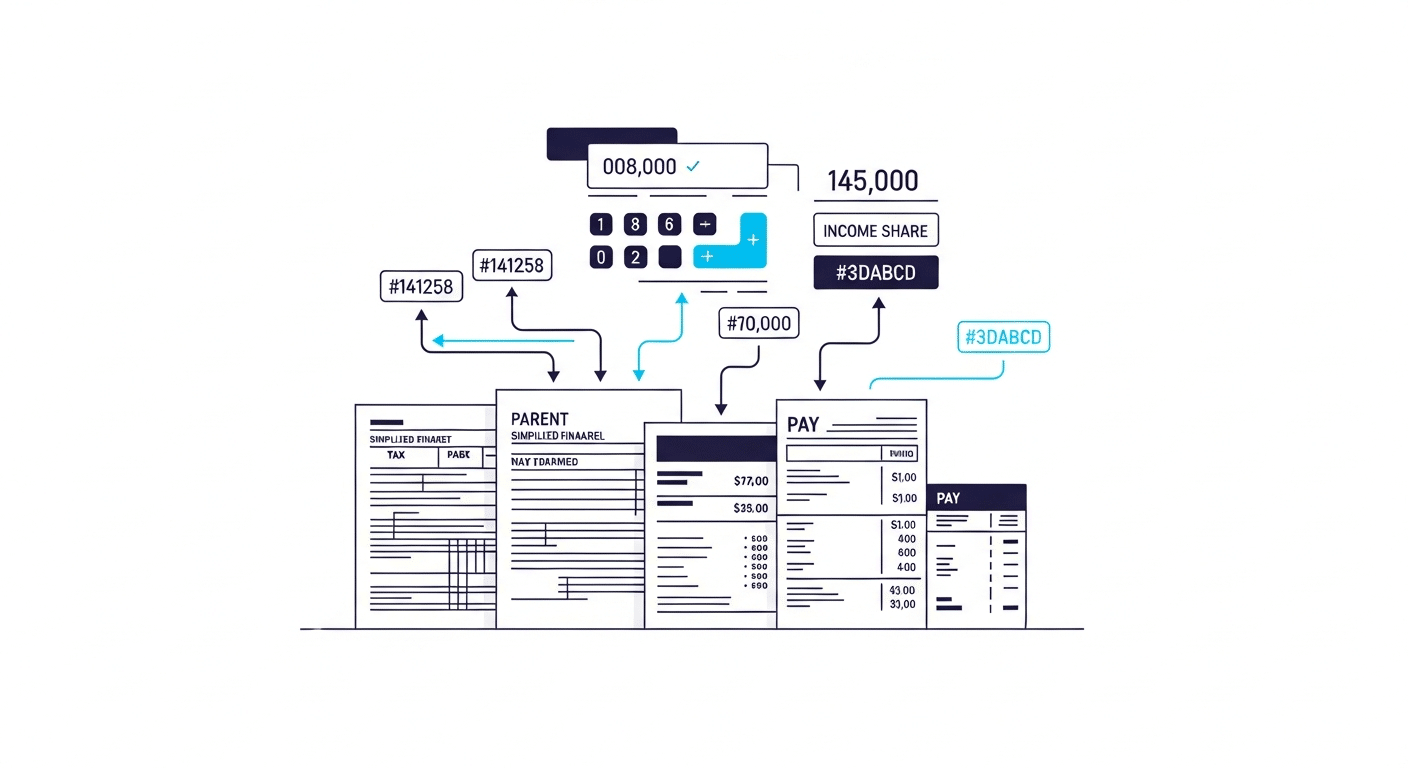
Pennsylvania uses the Income Shares Model to calculate child support obligations. This model is based on the principle that children should receive the same proportion of parental income they would have received if the parents lived together. The guidelines are codified in Pa.R.C.P. 1910.16-1 through 1910.16-4.
Under federal law (42 U.S.C. 667(a)), Pennsylvania must review and update its child support guidelines every four years to ensure they remain appropriate.
2026 Guidelines Update
Effective January 1, 2026, Pennsylvania's Basic Child Support Schedule was revised to reflect current economic conditions. Key changes include:
- Increased basic obligations: Support amounts rose approximately 15% for one child, 16% for two children, and 18% for three or more children.
- Higher self-support reserve: The minimum income a paying parent retains for basic needs increased from approximately $1,063 to $1,255 per month.
- Expanded medical expenses: Unreimbursed psychiatric, psychological, and orthodontic expenses are now included as reasonable medical expenses under the guidelines, where they were previously excluded unless agreed upon.
- High-income adjustments: For families with combined net monthly incomes above $25,000 to $30,000, increases can reach approximately 25%.
Existing orders do not change automatically. Either parent must file a Petition to Modify Support with their local Domestic Relations Section to adopt the new schedule.
Factors Considered in the Calculation
The calculation considers:
- Combined monthly net incomes of both parents
- Number of children covered by the support order
- Physical custody arrangements and parenting time
- Reasonable child-rearing costs (daycare, education)
- Health insurance costs for the children
Allowable deductions from gross income include:
- Federal, state, and local income taxes
- FICA (Social Security and Medicare taxes)
- Mandatory retirement contributions
- Union dues
- Alimony paid to another party
Net income is ordinarily based on at least a six-month average of a parent's earnings, as specified in Pa.R.C.P. 1910.16-2.
Step-by-Step Calculation Process
Here is how Pennsylvania calculates a basic child support obligation:
- Determine each parent's monthly net income by subtracting allowable deductions from gross income.
- Combine both parents' net incomes to get the combined monthly net income.
- Look up the basic obligation on the Basic Child Support Schedule (Pa.R.C.P. 1910.16-3) using the combined net income and number of children.
- Calculate each parent's percentage share of the combined income. For example, if one parent earns 60% of the combined income, that parent is responsible for 60% of the basic obligation.
- Apply the obligor's share to determine the monthly support payment.
- Add adjustments for childcare expenses, health insurance premiums, and other costs as outlined in Pa.R.C.P. 1910.16-4.
Use the Pennsylvania Child Support Estimator to get an approximate calculation. The actual court-ordered amount may differ based on judicial discretion and the best interests of the child.
Shared Custody Adjustments
When the obligor (paying parent) has the child for 40% or more of annual overnights, a rebuttable presumption applies that the obligor is entitled to a reduction in the basic support obligation. This reflects the obligor's increased direct spending on the child during custodial time.
The reduction works on a sliding scale:
- At 40% custodial time, the obligor receives a 10% reduction in the support obligation.
- The reduction increases incrementally up to 20% at 50% custodial time.
Pennsylvania considers 30% of overnights as the routine partial custody arrangement. The adjustment threshold of 40% is the point where expenses shift enough to warrant a reduction in the basic obligation.
High-Income Cases
When the parties' combined net monthly income exceeds $30,000, the court applies the three-step process outlined in Pa.R.C.P. 1910.16-3.1. This process uses the schedule amount at the $30,000 income level as a starting point and then applies additional calculations based on the reasonable needs of the child.
Imputed Income for Voluntary Underemployment
Under 23 Pa.C.S. 4322, if the court finds that a parent is intentionally unemployed or underemployed to avoid paying support, the court may impute income based on that parent's earning capacity.
Earning capacity reflects a realistic ability to pay, not a theoretical one. Courts consider the parent's education, work history, job skills, and local employment opportunities. If a parent voluntarily quits a stable job to take lower-paying work without justification, the court will likely calculate support based on what the parent could reasonably earn.
Imputation does not apply when a parent stopped working because of injury, illness, layoff, or other involuntary circumstances.
How to Modify Child Support in Pennsylvania
Pennsylvania allows parents to request a modification of child support at any time there is a material and substantial change in financial circumstances.
Valid grounds for modification include:
- Involuntary job loss or significant change in income
- Changes in daycare or childcare expenses
- Changes in medical or dental insurance coverage
- Physical or mental disability of a parent or child
- Change in custody arrangements
- Addition of new dependents
- Extraordinary expenses for the child's benefit
- Updated guidelines that would significantly change the support amount (such as the 2026 updates)
How to apply for modification:
- Contact or visit the DRS office handling your case.
- Download the Petition for Modification form from the DHS website.
- Complete and submit the form to the DRS. There is no filing fee.
Important notes:
- Either parent can request a modification.
- The petitioning parent must provide evidence that circumstances have changed.
- A written agreement between both parents may expedite the process.
- Incarcerated parents may request the Child Support Incarceration Packet.
- Modifications take effect from the date the petition is filed, not retroactively.
For modification assistance, call 1-800-932-0211.
What Happens If You Do Not Pay Child Support in Pennsylvania?
Pennsylvania has numerous enforcement tools to collect unpaid child support. The Bureau of Child Support Enforcement and local Domestic Relations Sections use the following methods:
- Automatic Wage Withholding: Income is garnished directly from wages or other income sources.
- State and National New Hire Reporting: Helps locate delinquent parents who start new employment.
- Tax Refund Intercept: Federal, state, and local tax refunds may be seized to cover arrears.
- Financial Institution Data Match: Bank accounts can be located and garnished.
- Credit Bureau Reporting: Past-due support is reported to major credit bureaus, negatively affecting credit scores.
- Passport Denial: Passports may be denied or revoked for arrears exceeding $2,500.
- Lump-Sum Interception: Workers' compensation payments, personal injury settlements, and lottery winnings can be seized.
- License Suspension: Driver's licenses, professional licenses, and recreational licenses may be suspended.
- Public Notice: Information may be published in local newspapers if arrears exceed one month of support.
Criminal Nonsupport in Pennsylvania
23 Pa.C.S. 4354 defines willful failure to pay a court-ordered support obligation as a criminal offense when the person has the financial ability to comply.
Penalties for criminal nonsupport:
| Offense Level | Maximum Imprisonment |
|---|---|
| Third-degree misdemeanor | Up to 1 year |
| Second-degree misdemeanor | Up to 2 years |
| First-degree misdemeanor | Up to 5 years |
Civil contempt penalties may include up to 6 months in jail, a fine of up to $500, or probation for up to 6 months. The court may also order enrollment in parenting programs, community service, or work release programs.
Additionally, the Domestic Relations Section may assess a civil administrative penalty of up to $1,000 per violation against any person or entity that fails to comply with a subpoena or request for information related to child support enforcement.
You can prevent enforcement actions by requesting a modification if your circumstances have changed or by making consistent payments on your arrears.
When Does Child Support End in Pennsylvania?
Child support in Pennsylvania generally terminates on the later of two events: when the child turns 18 or when the child graduates from high school. Support will not extend beyond age 19 under most circumstances.
Termination Process
The Domestic Relations Section in your county will issue an emancipation inquiry and notice to the obligee (receiving parent) within six months before the child turns 18. If the DRS determines the child is no longer entitled to support, it will administratively terminate the order.
Exceptions to Termination
Child support may continue beyond age 18 in these situations:
- High school completion: If the child turns 18 before graduating high school, support continues until graduation.
- Disability: If the child has a physical or mental disability that prevents self-support, the court may order support to continue indefinitely.
- Written agreement: Parents may execute a legal agreement requiring one parent to continue support beyond age 18, such as for college expenses.
Early Termination Through Emancipation
Child support may end before age 18 if the child:
- Joins the military
- Gets married
- Leaves the parental home and becomes self-supporting
Pennsylvania does not have a formal court process or statute for minor emancipation. A minor cannot legally move out at 16 without parental consent.
College and Higher Education
Pennsylvania courts generally cannot order child support beyond age 18 (or high school graduation) solely for college expenses. However, parents can voluntarily agree to extend support through higher education. If you want to ensure college tuition is covered, negotiate this arrangement with the other parent and formalize it in a written, legally binding agreement before the child turns 18.
Recommendations:
- Contact the DRS at least 6 months before the child's 18th birthday to prepare for termination.
- Receiving parents should petition for any necessary extensions before support ends.
- Paying parents should confirm the termination date and ensure they do not overpay beyond it.
More Pennsylvania Laws
Sources and References
- Title 23, Chapter 43 - Support Matters Generally(legis.state.pa.us).gov
- Pa.R.C.P. 1910.16-1 - Support Obligation Guidelines(pacodeandbulletin.gov).gov
- Pa.R.C.P. 1910.16-2 - Calculation of Monthly Net Income(pacodeandbulletin.gov).gov
- Pa.R.C.P. 1910.16-3 - Basic Child Support Schedule(pacodeandbulletin.gov).gov
- Pa.R.C.P. 1910.16-4 - Calculation of Support Obligation Formula(pacodeandbulletin.gov).gov
- Pa.R.C.P. 1910.16-3.1 - High-Income Cases(pacodeandbulletin.gov).gov
- Pennsylvania Child Support Program - DHS(humanservices.state.pa.us).gov
- Pennsylvania Child Support Estimator(humanservices.dhs.pa.gov).gov
- 42 U.S.C. 667 - State Guidelines for Child Support Awards(law.cornell.edu)
- Pennsylvania Department of Human Services(dhs.pa.gov).gov